
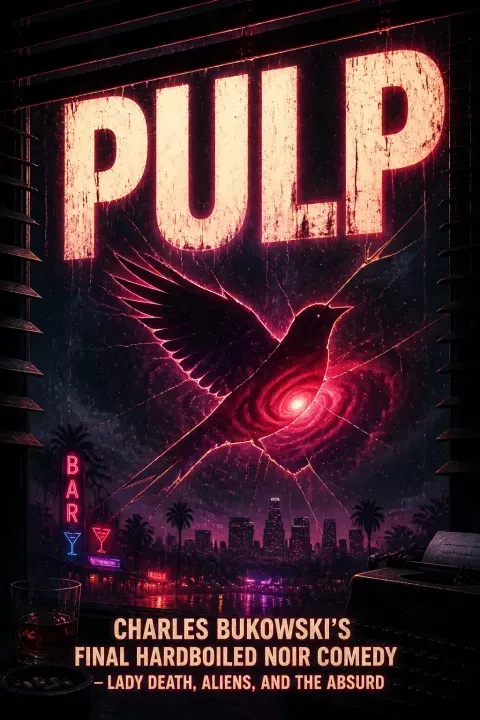


Plot Summary
Lady Death Walks In
Nick Belane1 is rotting in his office, eviction looming, when the phone rings. A woman's voice asks if he reads Celine.3 She wants the French writer,3 dead since 1961, and she believes he is alive in Hollywood, skulking around Red Koldowsky's13 bookstore. She tells Belane1 that John Barton5 recommended him. Minutes later, she walks in: a body that defies physics, calling herself Lady Death.2
She pays $240 up front at six dollars an hour, explains she has some kind of block that prevents her from confirming Celine's3 identity herself, and tasks Belane1 with finding out whether the man at the bookstore is the real Louis-Ferdinand Céline3 or just another wannabe. Then she walks out, leaving Belane1 stunned and aroused.
The novel opens by collapsing genre expectation into metaphysical farce. Lady Death is not a metaphor: she is a client with a checkbook. Bukowski literalizes the noir trope of the femme fatale by making her Death incarnate, yet she operates within the banal machinery of private investigation (hourly rates, advances, referrals). Belane's immediate sexual response to Death establishes the book's governing joke: even the ultimate mystery is processed through the same hungers and inadequacies as everything else. The search for Celine, a writer obsessed with human misery, becomes a search for meaning under the shadow of mortality, except here Death is impatient, paying cash, and crossing her legs.
The Red Sparrow Hunt
The next day, rain leaks through the ceiling while Belane1 drinks sake and contemplates his failures. John Barton5 calls, praising Belane's1 raw talent, and hires him to locate something called the Red Sparrow. Barton5 offers one hundred dollars a month for life but refuses a lump sum because Belane1 would blow it at the track.
He provides no leads, no description, just faith that Belane1 can find it. Almost immediately, the landlord McKelvey12 appears demanding back rent. Belane1 punches him in the gut, knees his face, steals his Gold Visa Card, and heads to Red's13 bookstore. On the walk, he muses about existence: men are born to die, hanging around waiting for the A train or a pair of big breasts in a Vegas hotel room.
Two absurdist quests launch simultaneously: the concrete (find a dead writer) and the abstract (find a thing no one can describe). Barton's faith in Belane is the novel's first suggestion that the Red Sparrow represents something beyond a physical object: it is the unnameable thing every person seeks, the meaning that hovers just beyond articulation. Belane's violence against McKelvey shows his method: brute survivalism masking as professional competence. The rain leaking through the ceiling literalizes his porous boundaries, the way the world seeps into every space he tries to occupy.
Celine Escapes by Cab
At Red's13 bookstore, Belane1 spots a man who looks exactly like the famous author photos. Red13 throws him out for loitering. Belane1 follows him to a newsstand where the man3 flips through The New Yorker and dismisses its writers. Before Belane1 can ask any real questions, an empty cab idles by, a phenomenon unseen in that neighborhood for decades.
The man3 leaps in, leans out the window, and sticks up his middle finger as the cab speeds toward Hollywood Boulevard. Belane1 is left on the sidewalk, the rain stopped but the chill still there, everything smelling of wet farts. He walks toward Musso's, humming Eric Coates, telling himself hell is what you make it.
Celine's escape by improbable cab establishes the novel's dream-logic: coincidences are weapons, not accidents. The empty cab appearing exactly when needed suggests forces arranging events behind the scenes (Lady Death, perhaps, or the absurdist machinery of the universe). Celine's obscene gesture is the first of many refusals Belane will endure: every clue, every lead, every client eventually withdraws, betrays, or dies. The resigned final line 'hell is what you make it' is Belane's philosophy in miniature: suffering is a creative act, not a passive condition.
Not Sex, but Insurance
Jack Bass6 hires Belane,1 convinced his young wife Cindy7 is cheating. Belane1 stakes out the Bass mansion, follows her red Mercedes, gets pulled over, and has her provocative photo confiscated by cops as extortion. Later, he tails the Celine suspect3 from Red's13 bookstore straight to Jack Bass's6 own house.
Certain he has caught Cindy7 in adultery with the Frenchman,3 Belane1 breaks in, camcorder rolling, and kicks open the door. But Celine3 is merely selling Cindy7 life insurance on her husband. Cindy7 screams. Her massive bodyguard Brewster14 attacks. Belane1 smashes his camcorder into Brewster's14 groin, knocking him unconscious, and flees, shouting that he will still nail her ass.
The insurance scene is the novel's comic masterpiece of misreading. Belane projects his sexual obsession onto every situation, so he interprets 'life insurance' as foreplay. The joke cuts deeper: Celine really is dangerous to Jack Bass, just not in the way Belane imagines. The camcorder, symbol of the detective's objective gaze, becomes a blunt weapon. Every tool fails at its intended purpose and succeeds accidentally at another. Bukowski suggests that all our interpretive frameworks are just as compromised as Belane's: we see what we want to see, and our instruments of clarity become clubs.
The Mortician's Alien Woman
A new client arrives: Hal Grovers,8 a mortician, claims a space alien woman named Jeannie Nitro4 is ruining his life. She controls his mind, makes him do whatever she commands, and can float through ceilings. Belane1 is skeptical until Jeannie4 herself walks into the office. She is impossibly beautiful, every movement a provocation.
She orders Grovers8 to crawl across the floor like a dog and lick her shoes. He obeys. Enraged, Belane1 unbuckles his belt to whip her, but she snaps her fingers and freezes him solid. She then walks out with Grovers8 toddling behind her. Belane1 remains paralyzed for twenty minutes, gradually regaining control of his body, starting with his eyebrows and working down to his feet.
Jeannie Nitro introduces science fiction into the noir framework, but her power operates on the same principle as Lady Death's: female figures who control male bodies through supernatural means. The mortician's profession makes him a natural target for alien manipulation: he already lives among the dead, already serves bodies. Belane's belt unbuckling is a displacement of sexual aggression into violence, and Jeannie's freezing of him is a literalization of what every femme fatale does: stops the male protagonist in his tracks. The thawing sequence (eyebrows first) is a miniature rebirth.
Death Meets Celine
Belane1 arranges a meeting at Musso's. Celine3 arrives first, wary. Then Lady Death2 walks in, dressed to kill. Belane,1 unsure who either of them really is, proposes a ridiculous game: each guesses how many numbers are on their driver's license. They pull out their IDs. Belane1 grabs Celine's3 and reads the fine print: LOUIS FERDINAND DESTOUCHES,3 born 1894.
It is really him, France's greatest writer,3 somehow alive and sitting in a Hollywood bar. Lady Death2 glows with triumph. Celine,3 realizing he has been had, storms out. Seconds later, screeching brakes and a sickening thump echo from the street. Belane1 runs outside. Celine3 lies dead on Hollywood Boulevard, struck by an ancient Oldsmobile driven by a fat woman in a red hat.
The driver's license is the novel's most poignant reveal: identity reduced to a laminated card, the great writer's secret hidden among bureaucratic digits. That Celine dies immediately after being identified gives Lady Death's quest a cruel logic: she didn't want to find him, she wanted to confirm him so she could take him. The fat woman in the red hat driving the Oldsmobile is the banality of death made vehicular. Bukowski stages the death of literature itself (Celine as the last great writer) on the tackiest possible street, orchestrated by the most elegant personification of mortality.
Jeannie's True Form
Jeannie Nitro4 appears in Belane's1 office and drops the pretense. She is the advance scout for an invasion force from the planet Zaros. Her people are overpopulated; they need Earth. She shows Belane1 her true body: a snake-like creature covered in coarse hair, with a round moist glob containing a single eye at its center.
Belane1 tries to crush it with his telephone, then his shoe. She shifts back to her seductive human form. She wants to enlist him for the Cause because he is gullible, self-centered, and has no character. When she tries to kiss him, he recoils, terrified she will transform again. He shoots at her; she catches the bullet in her teeth and spits it into his ashtray.
The alien's true form literalizes the disgust that runs beneath all desire in Bukowski's world. The beautiful woman is a hairy snake with one eye: attraction is misperception, intimacy is proximity to horror. That Jeannie selects Belane because he lacks character is the novel's most devastating self-assessment. The bullet caught in teeth is the final proof that violence is useless against the cosmic absurd. Belane's gun, his professional tool, becomes as impotent as his sexuality. The invasion of Earth by Zaros mirrors the invasion of Belane's consciousness by forces he cannot comprehend or resist.
The Motel Room Vaporization
Belane1 follows Cindy Bass7 to the Honeydunes Motel, rents the adjacent room, and presses a glass to the wall. She is with a young man named Billy, who boasts about his anatomy. Belane1 kicks in the door, camcorder running. Billy laughs off the intrusion, then pulls the bullet from his navel after Belane1 shoots him. No blood, no wound.
A purple flash: Jeannie Nitro4 appears, enraged that Billy has been fraternizing with humans against orders. She points her hand, and Billy transforms into the hairy snake creature, then vaporizes entirely. Cindy,7 trembling and half-dressed, can barely process what she has witnessed. Belane1 tells her he now has the footage, and she had better behave.
The motel scene merges infidelity farce with alien invasion thriller into something uniquely Bukowskian. Billy pulling the bullet from his own belly button is a birth-image turned grotesque: he births his own invulnerability. Jeannie's destruction of Billy for 'fraternizing' reveals the aliens as prudes, cosmic moralists who find human sexuality more objectionable than human violence. Belane wins this round not through skill but through luck: the aliens police themselves, leaving him holding the evidence. The camcorder footage, never actually used, becomes the blackmail that never needs to be shown, a threat more potent than its execution.
Aliens Abandon Earth
At a bar, Lady Death2 sits to Belane's1 right. Then Jeannie Nitro4 sits to his left. Between Death and Space, Belane1 orders another round. Lady Death2 departs after a cryptic warning about unfinished business. Alone with Belane,1 Jeannie's4 mood shifts. She is sad. The Zaros have decided to abandon the colonization plan.
Earth is too awful: the smog, the murder, the poisoned water and food, the hatred, the hopelessness. The only beautiful thing is the animals, and they are being killed off. She will miss Belane1 and the animals. Tears form in her eyes. She says goodbye and vanishes in a flash of purple light. The alien threat simply evaporates.
The aliens' departure is the novel's most damning judgment of humanity. Not even an overpopulated race seeking new territory wants this planet. Jeannie's specific indictment (smog, poisoned water, murdered animals) reads like an environmentalist's manifesto delivered by a furry snake. That she cries over leaving Belane suggests genuine attachment formed through their absurd encounters. The invasion plot evaporating without climax mirrors the book's larger structure: nothing resolves in expected ways, threats simply dissolve, dangers recede not through heroic action but through the universe's own capriciousness.
Deja's Dangerous Game
An informant named Amos Redsdale16 sells Belane1 an address for sixty dollars: Deja Fountain,11 apartment nine. Belane1 visits that night. A stunning woman in red greets him, but her bodyguard Bernie immediately pats him down and confiscates his gun.
Deja11 smokes a cigar, tells Belane1 he has a well-lived-in look, and tries to seduce him into forgetting the Red Sparrow. When the kissing intensifies, Bernie reappears with two guns, screaming that he loves Deja11 and will kill everyone. Belane1 kicks him in the groin, disarms him, and shoves a gun into his mouth until Bernie farts in fear.
Deja,11 now terrified of Belane's1 violence, begs him to leave. The next night, the apartment is empty. The manager, Tohil, attacks and nearly strangles him before suffering a fatal heart attack. Lady Death2 appears, having saved Belane1 by inducing the cardiac event.
Deja Fountain represents the Red Sparrow hunt's dark heart: every lead is a trap, every beautiful woman a predator, every clue a dead end. Her name suggests déjà vu, the feeling of having been here before, because Belane (and the reader) has been here before: another stunning woman, another violent confrontation, another disappearance. Lady Death's intervention by heart attack is the novel's most direct statement that Death is not merely Belane's client but his protector, an ambiguous guardian who keeps him alive precisely so she can claim him later, on her own terms and timeline.
Signing with the Executioners
Harry Sanderson,9 a large man in a light pink suit flanked by two apes, arrives at Belane's1 office. He claims he can deliver the Red Sparrow into Belane's1 hand for ten thousand dollars. Belane1 does not have the money. Sanderson9 reveals that he and his associates are also the loan sharks: Belane1 signs a promissory note to the Acme Executioners for four thousand dollars (negotiated down), at fifteen percent monthly interest, with no money actually changing hands.
The collateral is his life. Belane1 signs, and Sanderson9 tells him to meet at the Grand Central Market the next day, by the butcher shop displaying hogs' heads. Belane1 has a sinking feeling he has been thoroughly taken.
The loan transaction is capitalism as cosmic joke: Belane borrows money he never touches to buy an object that may not exist, using his life as collateral. The Acme Executioners' name combines cartoonishness (Acme from Looney Tunes) with genuine menace (Executioners). Sanderson's pink suit and his interchangeable ape-thugs create a world where violence wears pastels and speaks in bureaucratic jargon. The hogs' heads meeting place underscores the transaction: Belane is being led to slaughter, another head on display, and he knows it.
A Canary Painted Red
At the market, Sanderson9 delivers a covered birdcage and a second, decoy cage. Back in his car, Belane1 uncovers the real cage: a canary dyed red, not a sparrow at all. As he drives, the cage door pops open. The bird flies wildly around the car. A driver in the next lane, enraged by the spectacle, fires a gun through both of Belane's1 windows.
The bullet misses. The bird lands on Belane's1 head and defecates. Later, Johnny Temple10 of Acme Executioners visits with a thug named Luke. Temple10 demonstrates his power by nearly ordering Luke to eat the red canary alive. He informs Belane1 the first payment of six hundred dollars is due in twenty-five days, and failure to pay means death.
The dyed canary is the novel's cruelest joke: a fake of a thing that may have been imaginary to begin with. The bird escaping its cage but remaining trapped in the car mirrors Belane's condition: he has some freedom of movement but cannot leave the vehicle of his own doomed existence. The road rage shooting confirms that violence is ambient, not targeted, just part of the atmosphere. Temple's demonstration with Luke establishes the Executioners' methodology: psychological torture through proxy cruelty. The red canary, yellow feathers showing through, is a perfect metaphor for the Red Sparrow quest itself: something ordinary painted to seem extraordinary.
Collected in Griffith Park
Twenty-five days vanish. Belane1 cannot pay. Johnny Temple10 and two new apes arrive at the office, disarm Belane,1 and drive him to Griffith Park. They march him down an abandoned horse path, branches blocking the sun. Belane1 protests that six hundred dollars is not worth a life, that the real debtors owing millions should be the targets.
Temple10 explains the logic: killing a man over a pittance sends a message that terrifies the big debtors into paying. Temple10 fires four shots into Belane's1 gut. Belane1 falls, rolls onto his back, and manages to thank Temple10 sarcastically. The three men walk away, leaving him to bleed out on the dirt path. He loses consciousness, then comes back, knowing he does not have long.
Temple's rationale is the novel's darkest insight into power: the small debtor is killed precisely because he is small, because his death is cheap advertising. This inverts every narrative of justice or proportionality. Belane's sarcastic 'thanks' is the last act of a man whose only remaining power is the refusal to plead. The execution on an abandoned horse path, branches blocking the sun, stages death in a ruined pastoral, nature itself corrupted into a killing floor. Four shots to the gut is a deliberately slow death, a punishment that extends beyond the trigger pull.
The Red Sparrow Appears
As Belane1 lies dying, he hears music unlike any he has ever known. Then it materializes: the Red Sparrow, gigantic, glowing, a red he has never seen before, more magnificent than anything imaginable. Lady Death2 stands beside it, looking more beautiful than ever. She explains: John Barton5 was right, the Sparrow exists. The con artists were just parasites.
The mailman15 left the inflatable doll. She is leaving Belane1 with the Red Sparrow. She says goodbye. The Sparrow opens its beak, revealing a vast yellow vortex more dynamic than the sun. Belane1 thinks this is not how it is supposed to happen. The beak widens, the Sparrow's head moves closer, and the blaze and blare of yellow sweeps over and envelops him completely.
The Red Sparrow appearing only in death is the novel's thesis: meaning, beauty, transcendence are real but inaccessible to the living. The Sparrow is the thing Belane hunted across Los Angeles through sleazy bars, motels, and bookie joints. It existed all along, but on the other side of mortality. Lady Death's farewell is almost tender: she has been his patron, his adversary, his protector, and now his usher. The yellow vortex that consumes Belane recalls the sun he never quite saw clearly through the smog. The final thought ('this isn't the way it is supposed to happen') is everyone's final thought: death never matches the script.
Analysis
The novel functions as a hardboiled detective story that repeatedly sabotages its own genre conventions. The detective solves cases through accident rather than deduction. The femme fatale is Death herself.2 The MacGuffin (the Red Sparrow) is found only by dying. Bukowski uses the noir framework to stage a metaphysical inquiry: what if the thing we are all searching for (meaning, transcendence, beauty) exists, but is accessible only through death? Belane1 is an anti-hero whose defining trait is persistence without hope. He charges six dollars an hour and keeps working because stopping would require a decision he is incapable of making. Every client betrays him, every woman threatens him, every lead dead-ends, yet he keeps showing up. This is Bukowski's vision of heroism: not triumph but endurance, not courage but the inability to quit. The novel's surreal elements (Lady Death2 as a client, space aliens who find Earth too awful, a century-old French writer selling life insurance3) serve to literalize metaphors that other noir fiction keeps figurative. Death is not like a beautiful woman; Death2 IS a beautiful woman with a checkbook. The alien perspective on humanity (we are too polluted, too violent, too hopeless to colonize) is the novel's most savage social criticism, delivered by a furry snake with one eye.4 The Red Sparrow is the perfect anti-MacGuffin: it matters precisely because it cannot be found, and its appearance at the moment of Belane's1 death suggests that the search itself was the point. John Barton's5 faith in Belane1 is the novel's one uncorrupted relationship, a belief that exists without evidence and is ultimately vindicated. Bukowski wrote Pulp knowing it would be his last novel (he died shortly after completing it). The book's obsession with death, its relentless comic nihilism, and its final image of being consumed by a beautiful, impossible light reads as both farewell and triumph. Belane1 dies, but he dies finding what he was looking for.
Review Summary
The reviews for Pulp are mixed. Many praise Bukowski's dark humor, existential themes, and unique writing style. Readers appreciate the book's commentary on life's absurdity and death. Some find the plot disjointed and characters underdeveloped, but others see this as intentional. The novel's unconventional approach to detective fiction is both celebrated and criticized. Readers note that Pulp may not be the best starting point for those new to Bukowski's work. Overall, the book is recognized as a fitting final novel that encapsulates Bukowski's worldview.
Characters
Nick Belane
Hardboiled Hollywood Private EyeA 55-year-old private detective in Hollywood, overweight, alcoholic, perpetually broke, and absurdly confident in his own abilities. He charges six dollars an hour when other detectives charge hundreds. Three ex-wives, no friends, a VW Bug, and an office with a leaking ceiling. Belane navigates the world through a haze of vodka and cigars, solving cases through a mixture of dumb luck, stubbornness, and violence. His signature obsession is to 'nail' his targets, a sexualized threat that reveals how desire and aggression merge in his psyche. Beneath the bluster, he is acutely aware of his failures, his mortality, and the absurdity of existence. He is Bukowski's final protagonist: a man who keeps going not out of hope but because stopping requires more effort than continuing.
Lady Death
Death Personified as Femme FataleDeath incarnate, appearing as a stunning, sharply dressed woman who hires Belane1 to find Celine3. She can cause illness and death with a stare, appears and vanishes at will, and claims to have claimed Hemingway personally. She is simultaneously Belane's1 most reliable client and his ultimate threat, saving his life at crucial moments while reminding him that she will come for him eventually. Her beauty is overwhelming, her manner sardonic. She operates within the bureaucratic forms of the living world (checks, hourly rates) while wielding absolute power over life itself. She represents the novel's central paradox: death is both the most natural thing in the world and the most incomprehensible, a beautiful woman who will one day take you out like a light bulb.
Celine
Undead French Literary GiantLouis-Ferdinand Destouches, the real French writer, author of Journey to the End of the Night, somehow alive in 1993 Los Angeles at approximately 99 years old, though he looks forty to fifty. He haunts Red's13 bookstore, browses Faulkner, criticizes Thomas Mann for treating boredom as art, and dismisses The New Yorker's entire stable of writers. He is evasive, sardonic, and utterly unimpressed by Belane's1 detective work. His identity is confirmed by his driver's license in a moment of absurd bureaucratic revelation. He represents the persistence of literature and artistic vision in a world that has moved past both. He is also a con man of sorts, selling life insurance to Cindy Bass7, suggesting that even the greatest artist must hustle to survive in America.
Jeannie Nitro
Alien Scout from Planet ZarosAn advance scout from the overpopulated planet Zaros, sent to prepare Earth for colonization. She appears as an impossibly beautiful woman but her true form is a hairy snake-like creature with a single moist eye and a thin mouth. She can freeze people with a snap of her fingers, catch bullets in her teeth, create duplicates of herself, and vaporize her enemies. She becomes genuinely attached to Belane1 despite his lack of character, and ultimately weeps when the Zaros abandon Earth because it is too polluted, violent, and hopeless. She represents the gaze of the cosmic outsider on human folly: even aliens find us too degraded to bother conquering.
John Barton
Faithful Client and BelieverA printing company owner who hires Belane1 to find the Red Sparrow. He is the only client who never wavers in his faith, insisting Belane1 will succeed despite all evidence. He offers a lifetime annuity rather than a lump sum, understanding Belane's1 gambling habit. His quiet, persistent belief that the Red Sparrow exists proves correct, making him the novel's unlikely prophet. He recommended Belane1 to Lady Death2, setting the entire plot in motion.
Jack Bass
Jealous Husband and ClientA wealthy, insecure executive who hires Belane1 to catch his young wife Cindy7 in adultery. He oscillates between desperate love and jealous rage, and is himself caught having sex with Cindy7 during one of Belane's1 botched stakeouts. His case exposes the absurdity of marital surveillance: the detective ends up videotaping the client's own sexual performance. He is a man who cannot accept that his wife might desire him, so he pays to have her infidelity manufactured.
Cindy Bass
Unfaithful Trophy WifeA former beauty contest winner married to a wealthy older man. Belane1 pursues her for adultery but finds her with a life insurance salesman (Celine3) and later a space alien (Billy). She transitions from terror to calculation quickly, offering Belane1 sexual favors in exchange for the incriminating camcorder footage. She represents desire as a commodity and survival instinct dressed in a mini-skirt.
Hal Grovers
Mortician Menaced by AliensA mortician who runs the Silver Haven Mortuary and hires Belane1 to free him from Jeannie Nitro's4 mind control. His profession makes him a natural bridge between the living and the dead, preparing bodies for burial. He is meek, easily dominated, and utterly out of his depth. His assistant Billy French has suspiciously red hands. Grovers represents the ordinary person caught in extraordinary circumstances, just trying to run a business while space aliens manipulate his mind.
Harry Sanderson
Con Artist Loan SharkA con artist and loan shark who dresses in pastel suits and travels with two interchangeable thugs. He sells Belane1 a fraudulent Red Sparrow (a canary dyed red) and traps him in a predatory loan with the Acme Executioners. He is a cartoon of corporate predation, all false smiles and legal jargon, extracting profit from Belane's1 desperation. His taste in colors is freaky, his logic is circular, and his word is worthless.
Johnny Temple
Acme Executioners EnforcerThe enforcer for Acme Executioners, dressed entirely in black with only a lime green necktie for color. He is methodical, soft-spoken, and utterly cold. His demonstration with the thug Luke (nearly forcing him to eat a live bird) establishes his methodology: psychological cruelty as business practice. He executes Belane1 personally, explaining the actuarial logic of killing small debtors to frighten large ones. He embodies the banality of evil in a tailored suit.
Deja Fountain
Femme Fatale Con ArtistA beautiful con woman who tries to seduce Belane1 into abandoning the Red Sparrow search. Her bodyguard Bernie is obsessively in love with her. She vanishes overnight, leaving only empty hangers in her closet.
McKelvey
Belane's Vindictive LandlordBelane's1 vindictive landlord, perpetually trying to evict him. Carries photos of children in pornographic poses. Gets punched, humiliated, forced to ride his own thug like an elephant, and later reveals Lady Death2 paid Belane's1 lease.
Red Koldowsky
Bookstore Owner and GatekeeperOwner of a rare bookstore in Hollywood. Aggressively throws out customers who browse without buying, including Celine3. Sells signed Faulkner first editions. A good guy who is just freaky.
Brewster
Cindy's Enormous BodyguardCindy Bass's7 enormous bodyguard who gets hit in the groin with Belane's1 camcorder and becomes a eunuch with a high-pitched voice. Later follows Celine's3 orders but is easily outmaneuvered by Belane's1 .45.
The Mailman
Belane's Grudge-Holding NeighborBelane's1 neighbor from apartment 302. Asks for betting money, gets beaten and has broken glass shoved in his mouth. Later extorts $50 at knifepoint at the racetrack and leaves an inflatable sex doll in Belane's1 apartment as revenge.
Amos Redsdale
Ragged Informant and ToutA ragged informant who sells Belane1 Deja Fountain's11 address for sixty dollars. Claims to have a tip on the daily double. Disappears after providing the lead.
Plot Devices
The Red Sparrow
Elusive MacGuffin and Transcendent TruthThe object of John Barton's5 quest and Belane's1 final case. No one can describe it, yet everyone seems to know someone who knows about it. Con artists exploit the search for profit. It appears only at the moment of Belane's1 death: a gigantic, glowing red bird of impossible beauty that opens its beak to reveal a yellow vortex more dynamic than the sun. The Sparrow represents meaning, beauty, and transcendence, real but inaccessible to the living. Its appearance vindicates Barton's5 faith and gives Belane's1 absurd life a final, luminous resolution.
Space Aliens from Zaros
Cosmic Judgment on HumanityJeannie Nitro4 and five other aliens arrive on Earth via space tube as an advance invasion force from the overpopulated planet Zaros. They can appear as beautiful humans but are actually hairy snake-like creatures with a single moist eye. They possess powers including teleportation, mind control, duplication, and the ability to catch bullets in their teeth. After observing humanity up close, they unanimously decide to abandon the colonization plan because Earth is too polluted, violent, and hopeless. Their departure is the novel's most savage indictment of human civilization: even aliens find us too degraded to conquer.
Lady Death's Supernatural Powers
Death Made Tangible and BureaucraticLady Death2 can cause illness and death with a stare, as demonstrated when she makes Dante and Fante violently sick for threatening Belane1. She appears and vanishes at will, speaks through car radios, and can induce fatal heart attacks from a distance. Despite these powers, she operates through mundane channels: hiring a detective, writing checks, making phone calls. Her powers literalize the noir convention of the deadly woman while also suggesting that death is always nearby, always watching, and always operating through ordinary means. She intervenes to save Belane1 multiple times, claiming him as her own eventual prize.
Celine's Driver's License
Bureaucratic Proof of IdentityThe California driver's license that reveals Celine's3 true identity during the Musso's confrontation. When Belane1 grabs it during their betting game, the fine print reads LOUIS FERDINAND DESTOUCHES3, born 1894, confirming that the man in the bar is indeed the real French literary giant. The license transforms an absurd bar game into the novel's central revelation. Identity, even for one of the twentieth century's greatest writers, is reduced to a laminated state document carried in a wallet. The moment proves that truth, however profound, arrives through banal mechanisms.
The Inflatable Doll
Intimidation Tactic and Loneliness SymbolAn inflatable sex doll left in Belane's1 apartment with a warning note around its throat telling him to drop the Red Sparrow case or end up 'less than this dead rubber fuck.' The mailman15 admits to planting it as payback for Belane1 beating him. The doll symbolizes the artificiality of the threats against Belane1 (most are bluffs or cons) and his profound isolation (a rubber woman is the closest thing to a companion in his apartment). It sits on his couch as both warning and mirror, a deflatable double of his own hollow existence.
About the Author
Download PDF
Download EPUB
.epub digital book format is ideal for reading ebooks on phones, tablets, and e-readers.








































