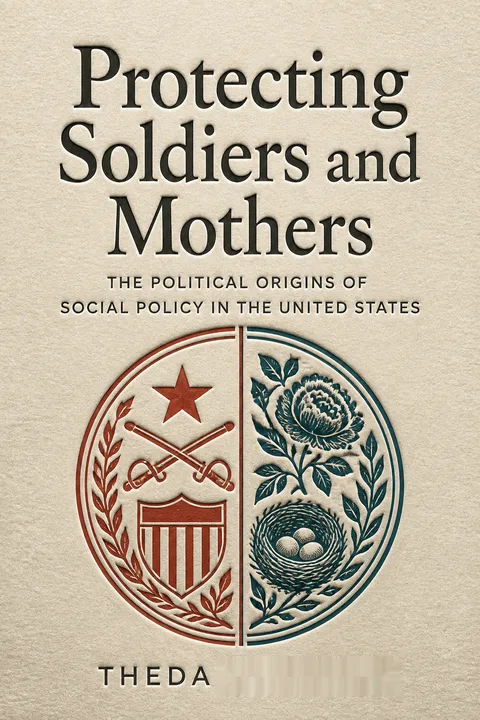

Key Takeaways
1. US Social Policy's Unique Origins
The United States would no longer so exclusively focus its social policies on veteran soldiers or on actual or prospective mothers, as it distinctively did between the 1870S and the 1920S.
Challenging conventional wisdom. Contrary to the common belief that the U.S. was a "welfare laggard" before the New Deal, this book argues that America developed a unique approach to social provision between the 1870s and 1920s. Instead of mirroring European "paternalist welfare states" focused on industrial workers, the U.S. carved out a distinctive path centered on soldiers and mothers. This period was not a void, but a formative era that shaped the future of American social policy.
Distinctive focus. While European nations were building comprehensive social insurance systems for male wage earners, the U.S. federal and state governments channeled resources to specific, morally "worthy" groups. This included:
- Union Civil War veterans and their dependents
- Mothers and children
- Women workers (as potential mothers)
Institutional shaping. These unique policy choices were not accidental. They were deeply intertwined with America's distinctive political institutions, including its patronage-driven democracy, fragmented federal system, powerful courts, and the rise of powerful, gender-specific social movements. These factors created a different set of opportunities and constraints compared to European contexts.
2. Civil War Pensions: America's First Welfare State
In terms of the large share of the federal budget spent, the hefty proportion of citizens covered, and the relative generosity of the disability and old-age benefits offered, the United States had become a precocious social spending state.
Unrecognized scale. From the 1870s through the turn of the century, the U.S. federal government operated a massive and generous pension system for Union Civil War veterans and their dependents. By 1910, over a quarter of all elderly American men, and hundreds of thousands of widows and orphans, received federal benefits. These expenditures often exceeded other major federal spending categories, making the U.S. a "precocious social spending state" for its time.
Generous benefits. The system evolved from compensating war-related disabilities to providing de facto old-age and disability pensions for any Union veteran with minimal service. Benefits were often more generous than early European social insurance programs, with:
- Earlier eligibility (age 62 for "disability" due to old age)
- Higher average payments (30% of average annual earnings in 1910, compared to 17-22% in Germany/Britain)
- Extensive coverage for dependents
Moral worthiness. Unlike European systems based on employment status, U.S. Civil War pensions were justified by moral and political terms: honoring soldiers who saved the nation. This created a system of "honorable public aid" that transcended class and, to some extent, racial lines for its beneficiaries, distinguishing them from the "undeserving" poor.
3. Patronage Democracy's Distributive Logic
The riches that governments bestowed were various indeed.
Governmental intervention. Nineteenth-century American government was far from minimalist. It actively engaged in "distributive policies" – allocating resources and privileges to individuals, communities, or groups. This included:
- Land grants
- Charters for banking and transportation
- Tax exemptions and special privileges
- Public bounties and infrastructure projects
- Protective tariffs
Party-driven distribution. This distributive pattern was deeply embedded in America's "state of courts and parties." Competitive, patronage-oriented political parties, rooted in a mass male electorate, used these benefits to build coalitions and secure votes. Public offices themselves were spoils, motivating party cadres and linking local to national politics.
Positive-sum politics. Distributive policies were favored because they could be disaggregated and often appeared "positive-sum," meaning beneficiaries gained without clear losers. This allowed parties to appeal to diverse interests without exacerbating zero-sum conflicts, fostering a system where many Americans could "get ahead economically" through political connections, without feeling they received "welfare."
4. Progressive Era's Paternalist Failure
The United States thus did not follow other Western nations on the road toward a paternalist welfare state, in which male bureaucrats would administer regulations and social insurance "for the good" of breadwinning industrial workers.
Missed opportunity. Despite the hopes of reformers like Isaac Max Rubinow and Charles Richmond Henderson, the U.S. failed to transition from Civil War pensions to a European-style paternalist welfare state for workers during the Progressive Era (1906-WWI). Proposals for general old-age pensions, health insurance, and unemployment insurance for male workers were largely defeated.
Multiple obstacles. This failure stemmed from a confluence of factors:
- Judicial hostility: Courts frequently struck down labor laws for men, citing "freedom of contract."
- Public distrust: Elite and middle-class opinion, scarred by the perceived "corruption" of Civil War pensions, opposed new large-scale public spending.
- AFL opposition: The national American Federation of Labor (AFL) under Samuel Gompers largely rejected compulsory social insurance, fearing bureaucratic control and preferring union-led collective bargaining.
- Reformers' choices: The American Association for Labor Legislation (AALL) prioritized contributory social insurance over non-contributory old-age pensions, missing a potential alliance with the AFL.
Contrasting paths. While Britain successfully implemented a range of paternalist welfare measures for workers during this period, the U.S. political and institutional landscape, marked by weak bureaucracy and strong anti-patronage sentiment, proved unreceptive to similar reforms. The "army of labor" was not granted the same honorable public provision as the "Army of the Republic."
5. The "Corruption" of Pensions
I hold it to be a hideous wrong inflicted upon the republic that the pension system instituted for the benefit of soldiers and sailors of the United States has been prostituted and degraded...
Elite condemnation. While Civil War pensions were popular among beneficiaries, many elite and middle-class reformers, particularly Mugwumps like Harvard President Charles Eliot, viewed the system as a prime example of "political corruption" and governmental profligacy. They saw it as a patronage tool that degraded both the recipients and republican institutions.
Negative precedent. This widespread perception of corruption had a profound impact on subsequent social policy debates. The specter of Civil War pension abuses was constantly invoked to argue against new forms of public social spending, especially non-contributory old-age pensions. Reformers feared that any new mass benefit program would inevitably fall prey to partisan manipulation and inefficiency.
Hindering progress. This fear created a significant barrier to the development of a broader welfare state. Even reform-minded intellectuals, despite their admiration for European social insurance, hesitated to advocate for policies that might be seen as repeating the "pork barrel" politics of Civil War pensions. This ideological legacy contributed to the U.S. diverging from European paths of social provision.
6. Workmen's Compensation: A Limited Success
No other kind of labor legislation gained such general acceptance in so brief a period in this country.
An exception to the rule. Amidst the general failure of paternalist social policies, workmen's compensation laws were rapidly enacted by 42 states between 1911 and 1920. These laws mandated fixed compensation for industrial accidents, regardless of fault, in exchange for employers' immunity from lawsuits.
Solving an existing problem. This success was not a new expansion of state spending, but a "reworking" of existing governmental regulation. The prior system of common-law employer liability was inefficient and unpredictable, leading to:
- High and unpredictable litigation costs for businesses
- Delayed and inadequate compensation for injured workers
- Public outcry over the human cost of industrial accidents
Broad consensus. A broad, cross-class consensus emerged for reform. Businesses sought predictable costs, labor desired quicker compensation, and reformers aimed for efficiency and fairness. This allowed for a "rationalized" solution that replaced an inefficient court-based system with administrative commissions, making it acceptable to diverse interests.
7. Maternalist Policies: A Distinctive Path
Instead, America came close to forging a maternalist welfare state, with female-dominated public agencies implementing regulations and benefits for the good of women and their children.
A different kind of welfare. While paternalist welfare for male workers faltered, the U.S. saw significant success in establishing "maternalist" social policies during the Progressive Era. These policies focused on women as mothers or potential mothers, and on children.
Key maternalist achievements:
- Protective labor laws: New or improved restrictions on women's working hours and minimum wage laws for women were enacted in many states.
- Mothers' pensions: Laws in over 40 states provided public payments to impoverished mothers to keep children in their homes.
- Federal Children's Bureau: Established in 1912, this agency, led by women, investigated child welfare.
- Sheppard-Towner Act (1921): This federal program provided grants to states for maternal and infant health education.
Gendered justification. These policies were justified by appealing to women's unique biological and social roles. Arguments centered on protecting women's health for the sake of "the race" and supporting mothers in their "God-given work" of child-rearing, rather than on universal worker rights.
8. Women's Organizations as Political Powerhouses
Woman's place is in the Home ... But Home is not contained within the four walls of an individual home. Home is the community. The city full of people is the Family. The public school is the real Nursery. And badly do the Home and the Family and the Nursery need their mother.
Extending the "separate sphere." Nineteenth-century American middle-class women, confined to a "separate sphere" of domesticity, transformed this limitation into a source of civic power. They extended their moral authority from the home into public life, advocating for "municipal housekeeping" and "educated motherhood."
Widespread federations. Organizations like the General Federation of Women's Clubs (GFWC) and the National Congress of Mothers grew into massive, nationwide federations. These networks, with millions of members across all states, became powerful forces for social reform. They:
- Educated public opinion through lectures, publications, and media campaigns.
- Lobbied legislators at state and national levels.
- Cooperated with professional reformers from social settlements.
Political leverage. Operating largely without the vote, women's groups found unique leverage in the fragmented, anti-patronage U.S. polity. Their non-partisan, moralistic appeals resonated with a public wary of traditional party politics, allowing them to set agendas and push through legislation that male-dominated groups often could not.
9. Judicial Acceptance of Maternalism
That woman's physical structure and the performance of maternal functions place her at a disadvantage in the struggle for subsistence is obvious.
A legal distinction. While U.S. courts consistently struck down labor laws for men based on "freedom of contract" (e.g., Lochner v. New York, 1905), they adopted a different stance for women. In Muller v. Oregon (1908), the Supreme Court unanimously upheld women's hour laws.
"Special protection" rationale. Justice Brewer's opinion explicitly stated that women's unique "physical structure and the performance of maternal functions" justified special legislation. This legal reasoning, heavily influenced by "Brandeis briefs" prepared by the National Consumers' League, differentiated women workers as a class deserving state protection, unlike "grown and intelligent men."
Impact on policy. This judicial acceptance was crucial for the success of maternalist policies. It provided a legal foundation for:
- Widespread enactment of women's hour laws.
- The subsequent push for minimum wage laws for women.
- The broader legitimacy of state intervention to protect women and children.
This legal distinction, rooted in prevailing gender norms, allowed maternalist reforms to advance where paternalist ones for men were blocked, highlighting the profound influence of cultural understandings on legal outcomes.
10. The Rise and Fall of Maternalist Statebuilding
The Children's Bureau developed by the early 1920S into something close to the central directorate of this possible maternalist welfare state.
Female-led federal agencies. The Children's Bureau, established in 1912 and led by women like Julia Lathrop and Grace Abbott, became a hub for maternalist statebuilding. It strategically focused on infant and maternal mortality, issues that resonated with women's groups and avoided direct conflict with established interests.
Sheppard-Towner's expansion. The Bureau successfully spearheaded the Sheppard-Towner Act (1921), America's first federal social welfare program. This act provided matching grants to states for maternal and infant health education, expanding the Bureau's reach and influence nationwide. It was a triumph of:
- Strategic alliances between female reformers and widespread women's federations.
- Leveraging the newly enfranchised women's vote.
- A "maternalist vision" of public health, emphasizing prevention and community-based care.
Demise and marginalization. However, this maternalist momentum was short-lived. Sheppard-Towner was terminated in 1929 due to:
- Conservative backlash against federal "meddling" and "socialistic" programs.
- Intense opposition from the American Medical Association, which sought to privatize preventive health care.
- A perceived decline in women's political bloc power post-suffrage.
The Children's Bureau was weakened, and its vision for a comprehensive maternalist welfare state was ultimately sidelined, leaving a fragmented legacy for future social policy.
11. Legacies of Early US Social Policy
The direct legacies of maternalist social policies in the United States thus involve the working out of unfortunate unintended consequences, reinforced by the political marginalization of female administrators, social workers, and surviving maternalist programs in the era of Social Security.
Shaping the New Deal. The early phases of U.S. social provision profoundly influenced the Social Security Act of 1935. The distrust of open-ended spending (from Civil War pensions) pushed Social Security towards contributory insurance. The failure of paternalist welfare for men meant the New Deal did not build a European-style social democracy.
Maternalism's ambivalent fate. Maternalist policies, though initially successful, faced complex legacies:
- Mothers' pensions: Incorporated into Social Security as Aid to Dependent Children (ADC/AFDC), they became a marginalized, underfunded "welfare" program, often stigmatized and administered by male-dominated agencies.
- Protective labor laws: Undermined by judicial rulings against minimum wages for women, they became less effective and were later challenged by equal-rights feminists.
- Children's Bureau: Weakened by the loss of Sheppard-Towner, it lost its preeminent planning role, and female administrators became more marginalized.
Enduring challenges. The early U.S. experience left a fragmented welfare state. While the "woman movement" of the Progressive Era achieved significant breakthroughs by leveraging gendered ideals and unique political opportunities, its decline and the subsequent marginalization of maternalist programs highlight ongoing challenges for achieving comprehensive, equitable social provision for all American families.
Download PDF
Download EPUB
.epub digital book format is ideal for reading ebooks on phones, tablets, and e-readers.








































