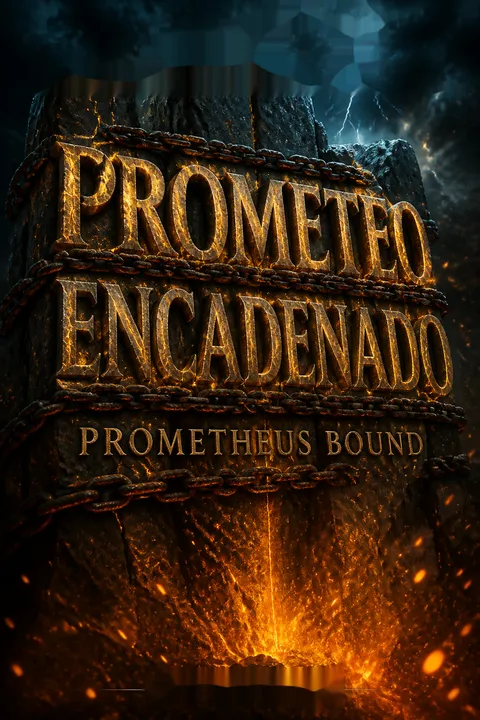

Summary Temporarily Unavailable
This summary is temporarily unavailable and is currently being updated. You can still explore the FAQs and other metadata below.
Plot Summary
Chains on the Cliff
The play opens with the Titan Prometheus being dragged to a remote, desolate cliff at the edge of the world by the gods' enforcers, Power and Force, under Zeus's orders. Hephaistos, the divine blacksmith, reluctantly chains Prometheus to the rock, torn between duty and pity for his kinsman. Prometheus is condemned for stealing fire from the gods and giving it to humanity, an act that defied Zeus's will and upended the cosmic order. The harshness of the punishment is clear: Prometheus is to endure endless torment, exposed to the elements, isolated from gods and mortals alike. The scene is stark, setting the tone for a drama of suffering as resistance and prophecy as leverage, resistance, and the cost of compassion.
The Price of Fire
Alone, Prometheus laments his fate, calling upon the elements—earth, sky, sea, and sun—to witness his agony. He reflects on the inevitability of destiny and the unyielding force of Necessity. His crime was to bestow fire, the foundation of all human arts, upon mortals, thereby elevating them and incurring Zeus's wrath. For this, he is condemned to an eternity of pain, a god punished for loving humanity too much. The arrival of the Chorus of Oceanids, daughters of Okeanos, brings a measure of sympathy, but also underscores his isolation. Their presence is a reminder of the cosmic scale of his rebellion and the loneliness of his stand.
Okeanos' Cautious Counsel
Okeanos, the ancient river god, arrives on a fantastical winged creature, expressing concern for Prometheus and offering to intercede with Zeus. He advises Prometheus to temper his defiance, warning that Zeus's rule is new and harsh, and that further provocation will only worsen his suffering. Okeanos's counsel is pragmatic, urging adaptation and humility in the face of overwhelming power. Prometheus, however, rejects this advice, unwilling to betray his principles or involve others in his fate. The exchange highlights the tension between prudent self-preservation and the uncompromising pursuit of justice.
Prometheus' Gifts Unveiled
In a moment of pride and sorrow, Prometheus details the many arts and skills he gave to mortals: fire, architecture, astronomy, writing, animal husbandry, navigation, medicine, and prophecy. He transformed humanity from a state of ignorance and helplessness into a race capable of reason, creativity, and survival. Yet, for all his beneficence, he is left to suffer alone, his compassion repaid with torment. The Chorus marvels at his achievements but questions the wisdom of helping mortals at such a cost. Prometheus's narrative becomes a meditation on the risks and responsibilities of progress.
Io's Agony and Flight
Io, once a mortal woman and now transformed into a cow, stumbles onto the scene, tormented by a gadfly sent by Hera's jealousy. Her story is one of relentless wandering and divine persecution, echoing Prometheus's own ordeal. She seeks understanding and relief, desperate to know the end of her suffering. Prometheus, moved by her plight, prophesies her future: she will wander through distant lands, cross continents, and eventually find rest in Egypt, where her descendants will play a crucial role in the fate of gods and men. Their shared suffering for defying or being caught in the designs of the gods forges a bond between them.
Prophecy and Suffering
Prometheus's prophecy for Io is both a map of her wanderings and a vision of the interconnectedness of fate. He foretells her journey through strange lands and peoples, her eventual deliverance, and the birth of Epaphos, ancestor to a line that will return to Argos and ultimately produce Herakles—the hero destined to free Prometheus himself. The narrative weaves together suffering, endurance, and the hope of eventual liberation. The Chorus, moved by Io's and Prometheus's pain, laments the inscrutable designs of Zeus and the gods, questioning the justice of such ordeals.
The Tyranny of Zeus
Throughout the play, Zeus is depicted as a new and ruthless ruler, wielding power with suspicion and violence. He punishes not only Prometheus but also the Titans and any who challenge his authority. The Chorus and Okeanos both remark on the dangers of opposing Zeus, whose laws are arbitrary and whose heart is unyielding. Yet, Prometheus insists that Zeus's reign is not eternal; he hints at a secret that threatens Zeus's supremacy. The play explores the dynamics of tyranny, resistance, and the possibility of change within the divine order.
The Secret of Power
Central to the drama is Prometheus's knowledge of a prophecy: Zeus is destined to fall if he pursues a certain marriage, for the union will produce a son mightier than himself. Only Prometheus knows the details, and Zeus cannot maintain his rule without this knowledge. This secret becomes Prometheus's leverage, the one thing that gives him power even in chains. The Chorus presses him for details, but Prometheus refuses, knowing that his suffering is the price for holding onto this dangerous truth. The tension between knowledge and power, silence and speech, is palpable.
Chorus of Lamentation
The Oceanids, witnessing the pain of Prometheus and Io, sing laments that question the justice of the gods and the meaning of suffering. They recall Prometheus's former glory and the bonds of kinship and friendship that have been shattered by Zeus's tyranny. Their songs are filled with empathy, fear, and a longing for a world where power is tempered by compassion. The Chorus becomes the voice of humanity, reflecting on the fragility of happiness and the unpredictability of fate.
The Limits of Defiance
As the play progresses, Prometheus's defiance hardens. He refuses to submit, to beg, or to betray his secret, even as the threats against him escalate. The Chorus warns him of the dangers of stubbornness, and Hermes, Zeus's messenger, arrives to demand compliance. Prometheus's resistance is portrayed as both admirable and self-destructive—a stand for principle that brings only more suffering. The play probes the limits of endurance and the costs of rebellion against absolute power.
Hermes' Ultimatum
Hermes delivers Zeus's ultimatum: reveal the secret that threatens Zeus's rule, or face even greater torment—burial beneath the earth, an eagle sent to devour his liver, and endless agony until another god volunteers to take his place. Prometheus remains unbowed, refusing to yield or plead. The Chorus, loyal to Prometheus, chooses to share his fate rather than abandon him. The confrontation is tense, with threats of cosmic upheaval and the unleashing of elemental forces.
Cataclysm and Endurance
As Prometheus rejects Hermes's demands, the earth shakes, thunder roars, and lightning flashes—a sign of Zeus's wrath and the unleashing of divine punishment. Prometheus, steadfast, calls upon earth and sky to witness his suffering and the injustice of his fate. The play ends with Prometheus and the Chorus engulfed in chaos, but unbroken in spirit. The promise of eventual liberation lingers, tied to the future actions of Herakles and the unfolding of fate.
The Promise of Liberation
Despite the overwhelming power of Zeus and the relentless pain inflicted upon him, Prometheus's knowledge and endurance hold the promise of change. The prophecy of Herakles's future intervention, the eventual reconciliation between Prometheus and Zeus, and the transformation of suffering into wisdom all point toward the possibility of liberation. The play suggests that even the mightiest tyrant cannot escape fate, and that resistance, though costly, can shape the destiny of gods and mortals alike.
Fate, Freedom, and Rebellion
Prometheus Bound is a meditation on the tension between fate and free will, authority and rebellion. Prometheus's suffering is both a consequence of his choices and a challenge to the legitimacy of Zeus's rule. The play interrogates the nature of justice, the limits of power, and the value of defiance. Through Prometheus's ordeal, the audience is invited to consider the costs and rewards of standing against oppression, and the ways in which suffering can lead to transformation and progress.
The Human Condition Transformed
The ultimate impact of Prometheus's rebellion is the elevation of humanity. By giving mortals fire and the arts, he enables them to rise above ignorance and helplessness, to create, reason, and hope. His suffering becomes the foundation of civilization, a testament to the power of knowledge and compassion. The play closes with the sense that, though Prometheus is bound, his spirit endures in every human act of creativity and resistance—a symbol of the unbreakable will to be free.
Analysis
Prometheus Bound remains a timeless exploration of the struggle between authority and conscience, fate and freedom, suffering and progress. At its core, the play interrogates the legitimacy of power and the costs of rebellion. Prometheus's defiance is both a challenge to tyranny and a catalyst for human advancement; his suffering is not merely punitive but becomes the crucible in which hope and wisdom are forged. The play's emotional arc—moving from isolation and agony to solidarity and the promise of liberation—mirrors the journey of humanity itself, from ignorance to enlightenment, from subjugation to self-determination. In a modern context, Prometheus Bound speaks to the dangers of unchecked authority, the necessity of dissent, and the enduring value of compassion and creativity. Its lessons are clear: progress is born of sacrifice, justice demands resistance, and even the mightiest powers are subject to change. The play invites us to reflect on our own relationship to power, the responsibilities of knowledge, and the unbreakable will to be free.
Last updated:
Report IssueReview Summary
Prometheus Bound receives largely positive reviews for its exploration of tyranny, rebellion, and human progress. Readers appreciate its powerful themes of defiance against unjust authority and the sacrifices made for knowledge. Many find the play's portrayal of Zeus as a tyrant intriguing, though some debate its authorship. The poetic language and philosophical depth resonate with readers, who often draw parallels to modern political struggles. Some find the lack of action limiting, but most consider it a timeless classic that raises profound questions about power and human potential.
People Also Read

Characters
Prometheus
Prometheus is the Titan who defies Zeus by stealing fire and giving it to humanity, an act that transforms the human condition and marks him as both savior and transgressor. His relationship to the other gods is complex: once an ally of Zeus in the war against the Titans, he becomes the object of Zeus's wrath for his compassion toward mortals. Psychologically, Prometheus is defined by his unyielding will, intellectual pride, and deep empathy for human suffering. His refusal to submit, even under torture, is both heroic and tragic, revealing a character who values principle above self-preservation. Over the course of the play, Prometheus evolves from a proud, isolated sufferer to a symbol of endurance and hope, his pain intertwined with the fate of humanity.
Zeus
Zeus, though never appearing on stage, dominates the play as the unseen antagonist. His rule is new, harsh, and marked by suspicion and violence. He punishes Prometheus and others who challenge his authority, seeking to maintain control through fear and retribution. Zeus's psychological profile is that of a ruler threatened by the possibility of being overthrown, haunted by the prophecy that his own actions may lead to his downfall. His relationship with Prometheus is adversarial, defined by a struggle for power and knowledge. Over time, Zeus is hinted to be capable of change, but in this play, he embodies the dangers of unchecked authority and the fragility of absolute power.
Hephaistos
Hephaistos, the divine blacksmith, is tasked with chaining Prometheus to the rock. Torn between obedience to Zeus and sympathy for Prometheus, he embodies the conflict between duty and compassion. His actions are marked by reluctance and sorrow, highlighting the moral ambiguities faced by those who serve power. Hephaistos's psychological struggle reflects the broader theme of complicity and the costs of following orders against one's conscience.
Power (Kratos) and Force (Bia)
Power and Force are personifications of Zeus's will, carrying out his commands without hesitation or empathy. Power is especially vocal, mocking Prometheus and urging Hephaistos to suppress any pity. They represent the machinery of oppression, the faceless enforcers who prioritize order over justice. Psychologically, they are unreflective, serving as reminders of the dangers of blind obedience and the dehumanizing effects of absolute rule.
Okeanos
Okeanos, the ancient river god, arrives offering sympathy and advice to Prometheus. He urges prudence and submission, advocating for adaptation in the face of overwhelming power. Okeanos's psychological makeup is marked by caution, a desire to avoid conflict, and a limited willingness to help. His relationship with Prometheus is one of distant kinship and pragmatic concern, highlighting the tension between solidarity and self-interest.
The Chorus of Oceanids
The Chorus, daughters of Okeanos, serve as both observers and participants in the drama. They express deep sympathy for Prometheus and Io, questioning the justice of the gods and the meaning of suffering. Psychologically, they are sensitive, compassionate, and at times fearful, embodying the collective voice of humanity in the face of divine power. Their development over the play moves from passive lamentation to active solidarity, choosing to share Prometheus's fate rather than abandon him.
Io
Io, once a mortal woman, is transformed into a cow and driven to madness by Hera's jealousy. Her endless wandering and agony mirror Prometheus's own ordeal, creating a bond of shared suffering. Io's psychological state is one of confusion, desperation, and longing for relief. Her relationship to Prometheus is that of fellow victim and recipient of prophecy; her descendants are destined to play a crucial role in the liberation of Prometheus and the future of gods and men. Io's journey is both literal and symbolic, representing the trials of innocence caught in the crossfire of divine conflict.
Hermes
Hermes arrives as the mouthpiece of Zeus, demanding that Prometheus reveal the secret that threatens Zeus's rule. He is sharp-tongued, unsympathetic, and relentless, embodying the impersonal force of authority. Psychologically, Hermes is dutiful and detached, more concerned with enforcing Zeus's will than with justice or compassion. His interactions with Prometheus and the Chorus reveal the limits of persuasion and the escalation of conflict when dialogue fails.
Herakles (Hercules)
Though not appearing in the play, Herakles is prophesied as the hero who will eventually free Prometheus from his torment. He represents the possibility of reconciliation, the intervention of a new force that can break the cycle of suffering. Psychologically, Herakles stands as a figure of strength, endurance, and the transformative power of heroic action. His anticipated arrival is a beacon of hope amid despair.
Humanity
Humanity, though never personified on stage, is the ultimate recipient of Prometheus's gifts and the reason for his suffering. The play's psychological portrait of humanity is one of vulnerability, ignorance, and potential. Through Prometheus's intervention, mortals are elevated from helplessness to creativity, from fear to hope. Their development is both a cause for celebration and a source of conflict, as their progress challenges the established order of the gods.
Plot Devices
Central plot device: Suffering as resistance and prophecy as leverage
The narrative structure of Prometheus Bound is built around the tension between Prometheus's endurance of suffering and his possession of secret knowledge. The play employs dramatic irony, as the audience knows that Prometheus's pain is not merely passive but is the very means by which he maintains agency against Zeus. Foreshadowing is used extensively: Prometheus's hints about Zeus's vulnerability, the prophecy of Herakles's future intervention, and the interconnected destinies of gods and mortals all point toward eventual change. The use of personified abstractions (Power, Force, Necessity) and the Chorus as a moral barometer deepens the exploration of justice, tyranny, and rebellion. The play's structure is circular, beginning and ending with Prometheus in chains, but the emotional arc moves from despair to a defiant hope, suggesting that suffering can be transformative and that resistance, though costly, is not futile.
About the Author
Aeschylus was an ancient Greek tragedian born around 525 BC, often called the father of tragedy. He expanded theatrical conventions by introducing multiple characters and conflict between them. Only seven of his estimated 70-90 plays survive, with ongoing debate about the authorship of Prometheus Bound. Aeschylus likely pioneered the trilogy format, with his Oresteia being the only surviving ancient example. He wrote about contemporary events in The Persians, inspired by the Persian invasion of Greece. Aeschylus's epitaph emphasizes his participation in the Battle of Marathon rather than his theatrical achievements, highlighting the cultural significance of the Persian Wars to ancient Greeks.
Download PDF
Download EPUB
.epub digital book format is ideal for reading ebooks on phones, tablets, and e-readers.








































