
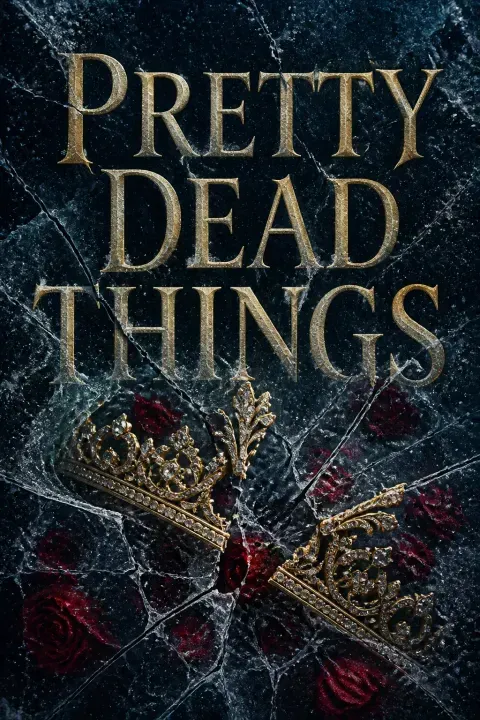


Plot Summary
Prologue
Hail taps the auditorium windows, and snow piles heavy on the roof, trapping pageant contestants inside. In a dressing room, a standing mirror reflects racks of glittering gowns, their rhinestones catching light now smeared with blood. A white feathered headpiece is splattered red, a clump of brain matter clings to an emerald tulle dress.
Blood trails snake down the mirror, pooling around lipstick tubes and blush compacts. From beyond the door come the screams of young girls, one high shriek cutting sharper than the rest as panic spreads. A killer is among them. The storm howls, scraping at the walls, and the night is far from over.
This opening tableau functions as a dark still life, juxtaposing the pageant's superficial beauty with visceral violence. The blood on gowns and the mirror reflecting carnage literalize the book's central theme: that the polished surface of femininity can conceal rot. The storm traps characters inside, creating a locked-room scenario that forces confrontation. The faceless killer and the screaming girls establish immediate dread while withholding identity, priming the reader to scrutinize every character in the pages that follow. It is a promise that the glittering pageant world will crack open to reveal something monstrous.
Cat's Fragile Second Chance
Catherine Dennis, known as Cat,1 lives in a model home at the new Sherman Ranch development, a job her ex-husband Mark12 arranged so she can save money after rehab.
Her daughter Olivia,6 seventeen, arrives for an overnight visit, and Cat1 scrambles to connect: she orders Thai food, offers to watch a movie, even hides the fashion magazines Mark12 bought so she can surprise Olivia6 with them herself. The evening cracks open when Olivia6 shares a photo of a silver pageant dress she wants for the upcoming Miss Lone Star Princess competition.
Cat1 promises to take her shopping. Sheriff Ryan8 stops by with a can of Fix-a-Flat, checking on Cat1 out of habit; he does not like her staying alone at the construction site. When Olivia6 says she wants to enter the pageant, Cat1 sees a path back into her daughter's6 life.
Cat's desperation is palpable. She treats every interaction with Olivia like a high-stakes interview for the role of mother, a position she forfeited years ago. The model home itself mirrors her identity: staged, immaculate, but ultimately uninhabited. Her willingness to seize the pageant as a lifeline reveals the addict's all-or-nothing psychology: either she becomes the mother Olivia needs, or she vanishes again. Sheriff Ryan's protective presence introduces the small-town surveillance that will both shelter and suffocate.
The Queenmaker's War Room
Sarah Lynn Preston4 trains under the gaze of her mother, Kennedy Claire,5 a former Miss Texas who treats her upstairs pageant room like a military command center. A corkboard holds index cards for every contestant, color-coded by threat level.
While Sarah Lynn4 does squats, Kennedy Claire5 evaluates the field with surgical precision. When she learns that Olivia Blake,6 the quiet daughter of Cat Dennis,1 has studied ballet since age three, her demeanor shifts.
She drops the blue dress Olivia6 borrowed with a false promise to dry-clean it, then later tells Sarah Lynn4 that Olivia6 is a red-dot-level problem. Sarah Lynn,4 caught between loyalty to her friends Hannah7 and Olivia6 and her mother's5 relentless ambition, feels the first cracks in her carefully constructed pageant persona.
Kennedy Claire embodies the dark side of competitive femininity: she is a woman who survived by transforming herself into a weapon, and she intends to forge her daughter into the same. Her corkboard reduces human beings to data points, an act of emotional brutality dressed as strategy. Sarah Lynn's internal conflict introduces a generational fracture: she craves her mother's approval but is beginning to recognize the cost of earning it.
Iggy Comes Home
Ingrid Whitmore, called Iggy,3 flies from Colorado to Central Texas because her mother, Barbara,15 needs cancer surgery. Driving into Anhalt, she passes the construction site that was once the Sherman family ranch, where her identical twin sister, Isabelle,14 disappeared twenty-five years ago.
At a red light, she locks eyes with Ben Sherman,10 the boy she once believed killed Izzy.14 Later, after visiting her mother15 in the hospital, she finds an envelope addressed to her at her parents' house.
Inside is an invitation to the fiftieth Miss Lone Star Princess Pageant with a message scrawled on the back: Ben10 did not kill Izzy,14 and the writer knows what really happened. The note sends Iggy3 reeling, reopening a wound she has spent a lifetime trying to close.
Ingrid's return is an exercise in confronting the past she fled. The encounter with Ben, the half-built houses on his family's land, and the anonymous note all force her to question the certainty that has defined her adult life. Her compulsion to control things (planning her mother's care, organizing medication schedules) is a trauma response, an attempt to impose order on a world that once proved brutally unpredictable.
A Skull in the Cave
Despite warnings of a coming cold front, Sarah Lynn4's brother Kayden and his friends throw a party at The Hollow, the forbidden swimming hole on the old Sherman land. Hannah7 and Billy steal away into the cave to make out, but instead of romance they find horror: a human skull, moss creeping up its cheekbones, jaw missing.
Hannah's7 scream brings everyone running. By the time deputies arrive, the scene is chaos. Parents pull up, flashlights sweep the dark, and the yellow tape goes up.
The discovery confirms what the town has suspected for twenty-five years: Izzy Whitmore14 was buried on the Sherman property. But it also forces Cat1 to call the authorities, putting her daughter Olivia6 in the middle of a police investigation and igniting old tensions.
The cave functions as a literal and metaphorical underworld: it hides the truth the town has avoided. The teenagers' reckless party becomes the catalyst that excavates not just bones but decades of secrets. Hannah's scream is the sound of the past violently intruding on the present, and the collective trauma of Anhalt is no longer something that can be politely ignored.
Cat's Hidden Cameras
After seeing Abel Sherman9 drunk and menacing at the model home, and convinced a white Silverado is following her, Cat1 retrieves her ex-husband12's old hunting trail cameras. She straps one near The Hollow and another facing the model home.
When she reviews the footage, she finds damning video of the teenagers drinking, smoking, and skinny-dipping at the forbidden party. At the pageant venue setup, Cat1 corners Kennedy Claire5 and warns her: she has security footage of Sarah Lynn4's illegal behavior, and she will not hesitate to send it to judges and admissions boards if Kennedy Claire5 does not back off Olivia.6
Their confrontation is witnessed by other mothers, and word spreads. The SD card soon goes missing, stolen by Sarah Lynn4 and Hannah7 in a panicked attempt to erase the evidence.
Cat's paranoia is partly justified (she is being watched) and partly a symptom of her damaged psyche, but her decision to weaponize the footage transforms her from victim to aggressor. The threat escalates the conflict from passive-aggressive pageant politics to open warfare. The stolen SD card becomes a MacGuffin that multiple characters will kill to possess, illustrating how secrets in a small town become currency.
The Scaffolding Falls
During pageant setup, a massive scaffolding structure supporting heavy stage lights collapses. Olivia6 is sitting directly beneath it, painting a gold star. She leaps aside in the final second, avoiding the crashing metal and exploding bulbs by inches.
Cat,1 watching in horror, becomes convinced Kennedy Claire5 deliberately sabotaged the scaffolding to eliminate Olivia6 as a competitor. She screams accusations in front of the assembled volunteers, but her wild-eyed panic only makes her look unstable compared to Kennedy Claire's5 cool composure.
Humiliated and terrified, Cat1 takes Olivia6 home. That night, alone in the model home, she reviews her trail cam footage obsessively, searching for proof of what she is sure is a conspiracy against her daughter6 and herself.
The scaffolding collapse is the point of no return for Cat's mental state. Her justified maternal fear curdles into something darker, and her inability to control the narrative brands her as hysterical. The scene crystallizes the book's gender politics: a woman who voices danger is disbelieved if she cannot perform calm. Kennedy Claire's weaponized composure is a more effective mask than Cat's raw emotion.
Snowbound at the Show
On the morning of the pageant, a winter storm slams Central Texas with ice and snow, far worse than forecasted. Roads become impassable; an ambulance trying to reach the development crashes. Sheriff Ryan8 announces that no one is leaving the Amenity Center until conditions improve.
The pageant, absurdly, proceeds. Kennedy Claire5 insists the show must go on. Generators are hauled in, extension cords snake across the floor, and the contestants change into gowns by the glow of construction lamps.
As dusk falls and the temperature drops, the building becomes a pressurized container of ambition, fear, and unresolved history. Outside the windows, the storm erases the landscape, and someone opens a door to the cold, letting in more than just wind.
The blizzard literalizes the narrative's claustrophobia. Cut off from the outside world, the characters become a closed system in which secrets must combust. The absurdity of continuing the pageant amid a survival situation highlights the pathological priorities of pageant culture: appearance above all. The open door suggests that the boundary between safety and danger has been breached by someone inside.
Bald and Unbroken
Backstage, grieving her mother's1 death, Olivia6 picks up a bikini trimmer and razes a stripe down the center of her scalp. Sarah Lynn,4 after a beat of shock, asks for the clippers and shaves her own head. Then Hannah7 joins. The three friends step onto the pageant stage bald, their bare scalps gleaming under the tripod lights.
Hannah,7 who has never sung in public, delivers a hymn so pure the crowd falls silent. Sarah Lynn4 moves through her routine with newfound freedom. Olivia6 dances a ballet solo to The Dying Swan, her thin frame a blade of grief and grace. The audience, trapped in the cold and dark, is given a moment of genuine beauty. Kennedy Claire,5 watching from the wings, looks not proud but furious.
The head-shaving is the novel's most powerful act of rebellion. The girls reject the central currency of pageantry (their hair) and reclaim their bodies as sites of solidarity rather than competition. Olivia's choice to dance for her dead mother transforms the pageant from a contest into a memorial. Kennedy Claire's fury reflects her recognition that her daughter has slipped beyond her control, choosing friendship over ambition.
Abel's Final Confession
In the chaos following the pageant, someone discovers the dressing room door locked. When Kayden kicks it open, the scene is nightmarish: Abel Sherman9 lies in a chair, the top half of his skull blown away by a shotgun blast. In his lap rests a handwritten note confessing to the murder of Isabelle Whitmore14 twenty-five years ago and to the recent killing of Cat Dennis.1
The note apologizes vaguely, mentions that Sheriff Ryan's daughter2 can attest to the kind of man Abel9 was, and asks forgiveness. The room erupts. Ben Sherman,10 who had arrived earlier carrying his infant niece through the storm, is pulled away before he can see his father's9 body. For a moment, the mystery seems solved.
Abel's suicide note is a carefully crafted lie, one that neatly ties up loose ends for the town. The confession offers closure while obscuring the actual killer, functioning as a narrative trap. His mention of the sheriff's daughter (Melanie) is a deliberate breadcrumb, hinting at a deeper connection that only a few will recognize. The note's convenient timing and broad admissions should provoke skepticism, but the community's need for resolution overrides suspicion.
Melanie's Performance of Grief
In the hallway outside the dressing room, surrounded by townspeople, Sheriff Ryan8 asks his daughter Melanie2 what Abel9's note means. Visibly trembling, Melanie2 confesses that twenty-five years ago, after her classmates humiliated her by stealing her clothes at The Hollow, Abel Sherman9 found her naked in the cave and sexually assaulted her.
She says she told only Cat,1 and the two of them kept the secret out of shame. She claims she always suspected Abel9 might have killed Izzy14 but was too terrified to speak up. The crowd accepts her story with sympathy and horror. Ingrid,3 listening, feels her certainty about Ben10's guilt dissolve, replaced by a sickening understanding that the real monster was Abel9 all along.
Melanie's confession is a masterful manipulation, built on a foundation of genuine trauma (the skinny-dipping humiliation) and layered with fabricated detail. By making herself a victim, she deflects suspicion while casting Abel as a predator worthy of murder. The performance works because the town wants to believe it: it is cleaner to blame a dead man and pity a wronged woman than to interrogate more complicated truths.
The Sheriff's Impossible Choice
Days after the storm clears, Sheriff Ryan8 walks the development and finds a second trail camera Cat1 had hidden, this one pointed at the model home's front door. He reviews the footage and sees what it captured the night Cat1 died: his daughter Melanie2 entering the house, and later leaving alone.
The time stamps align with the coroner's estimated window of death. Ryan8 stands in the cold, the evidence in his hands, and makes his decision. He ejects the SD card, pockets it, and walks away. The better man he believed himself to be is left behind in those woods. He will never speak of what he saw.
This is the book's most devastating moral collapse. Sheriff Ryan, the embodiment of small-town integrity, chooses his daughter over justice. The act is not impulsive: it is a conscious sacrifice of his identity, a recognition that the law he served his whole life cannot accommodate the love he feels. The scene inverts the traditional Western trope of the righteous lawman, revealing that even the most upright pillar can crack under sufficient weight.
What Melanie Really Did
In the privacy of her own mind, Melanie2 replays the truth. The night before the storm, Cat1 called her, distraught, saying she could no longer carry the secret of what they had done as teenagers: the prank with almond oil that nearly killed Ingrid Whitmore,3 and their decision to hide the evidence.
Worse, Cat1 was determined to finally confess everything to Sheriff Ryan.8 Melanie2 tried to talk her down, but Cat1 reached for her phone. Melanie2 grabbed the heavy marble fruit bowl from the dining table and brought it down on the back of Cat's1 skull.
Cat1 dropped instantly. Melanie2 then staged the scene, exited through the back door, and later manipulated a dying Abel Sherman9 into taking the blame for both murders in exchange for ending his suffering from ALS on his own terms.
Melanie's confession reframes the entire narrative. The sweet, self-effacing nurse is revealed as a calculating survivor who has spent decades managing her image as carefully as Kennedy Claire manages her pageant girls. Her murder of Cat is not rage but pragmatism: a friendship that has become a liability must be terminated. The revelation that the 'prank' was not fatal (Ingrid survived) but that the guilt consumed Cat regardless, turns the story into a tragedy of perception.
Epilogue
One year later, Ingrid3 has moved back to Anhalt. Her mother15 is in remission, and she is dating Ben Sherman,10 the man she once believed murdered her sister.14 She develops photographs in a darkroom her father built in the old twin bedroom, capturing fleeting moments of happiness. Melanie2 floats the river with Kennedy Claire5 and the girls, who are now college roommates.
She reflects on the cardinal she saw, a sign she believes is Cat1 visiting her from the other side. The woman who once called Melon-ball Melanie2 has become the town's most trusted caregiver, her secrets buried as deeply as the bones in the cave. The river runs clear, and The Hollow is empty, but nothing has been forgotten.
The epilogue offers a surface-level peace that is deeply unsettling once the reader knows the truth. Melanie's serene reflection, her friendship with Kennedy Claire, and her satisfaction with the way things worked out are the thoughts of a woman who has successfully curated her reality. Ingrid's happiness with Ben represents a parallel resolution, a genuine healing made possible only because she never learned who truly caused her sister's pain. The novel ends with the uncomfortable suggestion that closure is sometimes just a prettier version of a lie.
Analysis
Pretty Dead Things is a novel about the violence that beauty culture demands and conceals. The pageant, with its tiaras and talent routines, operates as a miniature of the wider world: girls are trained to perform, to compete, to destroy one another with smiles. Kennedy Claire's5 corkboard of rivals, the diet pills Hannah7 orders in secret, the plastic surgery sponsorship in the prize package, all reveal a system that sells self-hatred as self-improvement. The book is particularly sharp on the way mothers transmit their own survival strategies to daughters, sometimes lovingly, sometimes lethally. Kennedy Claire5 genuinely believes she is protecting Sarah Lynn4 by teaching her to be ruthless; Melanie's2 suffocating care for Cat1 is indistinguishable from control. The mystery plot, with its nested confessions and unreliable narrators, mirrors the larger theme: truth in this town is always mediated by performance. Abel's9 false confession is accepted because it fits the story everyone wants to tell; Melanie's2 sweet demeanor is a mask that no one thinks to question. The novel suggests that the most dangerous people are not the obvious monsters but the ones who have perfected the art of appearing harmless. That the sheriff8 destroys evidence to save his daughter2 is not just a plot twist but a thesis statement: the law, like the pageant stage, is a space where justice is subordinate to image.
Review Summary
Characters
Catherine 'Cat' Dennis
Recovering addict, Olivia's motherA woman in her late thirties fighting to stay sober after years of addiction cost her marriage and custody of her daughter6. She works as a property manager at the Sherman Ranch model home, a job arranged by her forgiving ex-husband Mark12. She is raw and reactive, her emotions always close to the surface. She loves Olivia6 fiercely but struggles to trust her own stability, terrified that one slip will prove everyone right about her. Her friendship with Melanie Campbell2 has been her anchor since high school, built on a shared secret that has bound them together and slowly poisoned them both.
Melanie Campbell
Compassionate nurse, secret killerThe sheriff's8 daughter and a home-care nurse known for her kindness and unshakeable reliability. On the surface, she is the woman who brings muffins to patients, checks on struggling friends, and never says no. Beneath that warm exterior lies a survivor who has been managing her image since a traumatic high school humiliation. She is married to Waylon and mother to Hannah7, and she worries constantly about protecting her daughter7 from the cruelties she endured. Her bond with Cat1 is the most important relationship of her life, but it is also her greatest vulnerability.
Ingrid 'Iggy' Whitmore
Grieving twin, seeking answersA woman in her early forties whose identical twin sister Isabelle14 vanished the night before the pageant twenty-five years ago. She has built a careful, controlled life in Colorado, complete with a practical husband (now separated) and an office job she chose over her dream of photography. Her mother's15 breast cancer diagnosis forces her back to Anhalt, where every street and photograph triggers memories of Izzy14. She is methodical to a fault, making lists and plans to ward off chaos, but the cracks in her composure widen as old suspicions about Ben Sherman10 and new doubts about her best friend Kennedy Claire5 resurface.
Sarah Lynn Preston
Pageant frontrunner, dutiful daughterThe seventeen-year-old daughter of Kennedy Claire Preston5, raised from birth to be a pageant queen. She has the polished smile, the perfect posture, and the strategic mind her mother5 instilled, but she is beginning to chafe against the relentless control. Her friendships with the less polished Hannah7 and the quietly beautiful Olivia6 introduce her to a version of herself that is not performing. She wants the crown desperately, because it is all she has ever been trained to want, but she is learning that winning might cost her the people she actually cares about.
Kennedy Claire Preston
Pageant director, ruthless motherA former Miss Texas who runs the Miss Lone Star Princess pageant with the discipline of a general and the charm of a politician. She is fiercely protective of her own status and her daughter's4 future, viewing every other contestant as a threat to be neutralized. Her friendship with Ingrid Whitmore3 is genuine but complicated by decades of manipulation and secrets. Beneath the impeccable surface, she is a woman who learned early that the world is cruel to girls who cannot control their image, and she has spent her life ensuring she is never that girl again.
Olivia Blake
Cat's daughter, reluctant competitorA quiet seventeen-year-old ballet dancer who enters the pageant at the urging of her friend Sarah Lynn4. She carries the quiet wound of a mother1 who was absent for most of her childhood, and her tentative hope for Cat's1 sobriety makes her vulnerable to disappointment. Her stage presence is startling, a transformation from shy girl to commanding performer that draws attention she does not always know how to handle.
Hannah Campbell
Melanie's daughter, loyal friendMelanie's2 outspoken, plus-size daughter with a secretly beautiful singing voice and a paralyzing fear of performing in public. She joins the pageant to support her friends, bringing a caustic humor that cuts through the pageant's saccharine surface. Her crush on the quirky Billy and her fierce loyalty to Sarah Lynn4 and Olivia6 ground her in what matters beyond crowns.
Sheriff Ryan
Town lawman, conflicted fatherThe aging sheriff of Anhalt, a fixture of the community who has known the Whitmores and Shermans since childhood. He is methodical, protective, and deeply principled, until the evidence forces him to choose between his duty and his daughter2. His nightly checks on Cat1 at the model home reveal both genuine concern and a desire to maintain order in a town where chaos has deep roots.
Abel Sherman
Dispossessed landowner, false confessorThe aging patriarch of the Sherman family, a man broken by the loss of his land and the suspicion that has dogged his son10 for a quarter century. Once a gruff but generous figure who let the town's kids swim in his river, he has become a reclusive alcoholic. Diagnosed with ALS, he is dying slowly, and his final act is shaped by a visitor who offers him a way to control how his story ends.
Ben Sherman
Wrongly accused son, Ingrid's lost loveThe boy who once dated Isabelle Whitmore14 and has lived under the shadow of her disappearance ever since. Now in his forties, he is quiet, steady, and gentle, caring for his infant niece while his sister is away. He still carries the same careful manner he had as a teenager, a man who measures his words because he learned early that the wrong ones could destroy him. His enduring love for Ingrid3 is complicated by the ghost of her twin14.
Travis Magnuson
Charismatic teacher, opportunistic podcasterA young communications teacher at the local high school whose good looks and easy charm make him a favorite with students and mothers alike. He cultivates Ingrid's3 trust to extract details about her sister's14 disappearance for his true crime podcast, revealing a hunger for attention that overrides any genuine empathy.
Mark Blake
Cat's ex-husband, Olivia's steady fatherA contractor who still loves Cat1 despite years of chaos. He arranged her job at the model home and monitors her sobriety with anxious hope. His new wife, Emily13, resents Cat's1 persistent place in their lives, a tension that complicates Olivia's6 loyalties.
Emily Blake
Olivia's stepmother, protective rivalMark's12 second wife, who has raised Olivia6 since she was eight. She loves her stepdaughter fiercely and views Cat's1 return as a threat to the stability she has built. Her decision to hire a private investigator to monitor Cat's1 sobriety adds fuel to Cat's1 paranoia.
Isabelle 'Izzy' Whitmore
The missing twin, the ghost at the centerThe free-spirited twin who was supposed to break up with Ben Sherman10 the night she vanished. Beautiful, bold, and dreaming of traveling the world, she was the one who dared first while her sister3 planned. Her disappearance twenty-five years ago is the wound around which every character's life has constricted.
Barbara Whitmore
The first Miss Lone Star, Ingrid's motherA regal woman now fighting breast cancer, she won the inaugural Miss Lone Star Princess crown fifty years ago. She maintains her dignity and her makeup even in a hospital bed, a survivor of the worst loss a mother can endure who has learned to carry grief like a second skin.
Plot Devices
Trail Cameras
Silent witness that captures hidden crimesOld hunting cameras Cat1 borrowed from her ex-husband12 to monitor activity around the model home and The Hollow. She sets up two: one pointed at the cave where the teens party, another at her front door. The first captures the teenagers' illegal party and becomes the leverage Cat1 uses to threaten Kennedy Claire5. The second, discovered later by Sheriff Ryan8, records Melanie2 entering the model home at the time of Cat's1 murder, becoming the evidence that would convict her if her father8 did not choose to destroy it.
The Anonymous Invitation
Mysterious message that reopens the pastAn invitation to the Miss Lone Star Princess Pageant, hand-delivered to Ingrid's3 parents' house with a note scrawled on the back: 'Ben10 DIDN'T KILL IZZY14. I KNOW WHAT REALLY HAPPENED TO YOUR SISTER14.' The note was written by Cat Dennis1, who carried guilt about the teenage prank and wanted to clear Ben's10 name before she died. It sets Ingrid3 on a path of investigation, pulling her toward the truth about her sister's14 disappearance and the secrets the town has buried.
The SD Card
Stolen evidence that triggers murderThe memory card containing the trail cam footage of the teenagers' party at The Hollow. Sarah Lynn4 and Hannah7 steal it from Cat's1 camera to protect themselves from exposure. The theft draws Cat1 into a confrontation with Kennedy Claire5 and, indirectly, sets in motion the events that lead Cat1 to decide to confess everything to Sheriff Ryan8, a decision that prompts Melanie2 to kill her.
The Broken High Heel
Physical proof of past sabotageA shoe Ingrid3 wore in the 2000 pageant, which Kennedy Claire5 secretly cut and glued back together so it would snap during Ingrid's3 performance. Ingrid3 finds it in her parents' attic twenty-five years later, the clean cut still visible beneath old glue. The heel becomes the catalyst for Ingrid's3 confrontation with Kennedy Claire5, forcing both women to reckon with the lengths Kennedy Claire5 went to win the crown and the way that single act echoes into the present.
The Blizzard
Natural prison that forces confrontationA severe winter storm that hits Central Texas on the day of the pageant, far worse than forecasts predicted. Ice and snow close every road, knock out power, and trap all the characters inside the Amenity Center. The storm transforms the pageant venue into a locked-room mystery, preventing outside help from arriving and forcing the killer to act within a confined space while tensions boil over. It also provides the cover of chaos that allows Abel Sherman9 to enter the building undetected.
Download PDF
Download EPUB
.epub digital book format is ideal for reading ebooks on phones, tablets, and e-readers.








































