


Key Takeaways
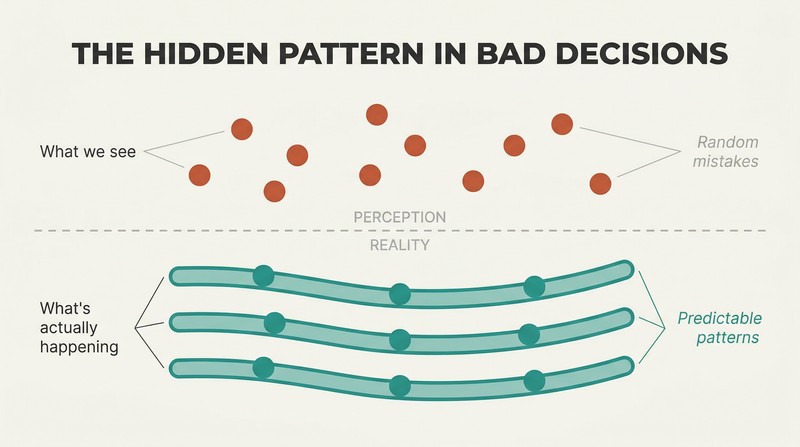
Your bad decisions aren't random — they're predictable enough to exploit
Ariely's insight began with pain. After a magnesium flare explosion left 70 percent of his body with third-degree burns, he spent years in a hospital watching nurses rip off bandages quickly, believing short, intense pain was kinder. His later research proved the opposite — slower removal hurt less. These nurses weren't cruel. They were systematically wrong, and experience hadn't corrected them.
This is the foundation of behavioral economics: our irrationality isn't chaotic — it follows rules. Standard economics assumes we compute every option rationally. Ariely's experiments across MIT, Harvard, Princeton, and Yale show we consistently overpay, procrastinate, overvalue what we own, and misjudge our emotions. But because the errors are predictable, we can learn to anticipate and architect around them.
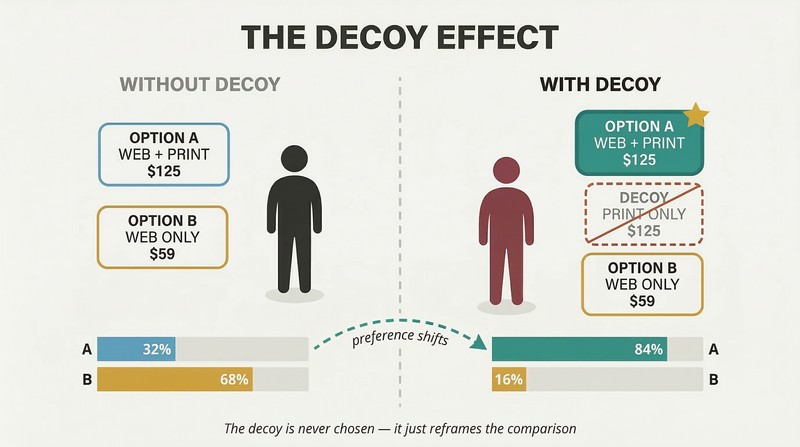
Add an inferior option to make your preferred choice irresistible
The Economist offered three subscriptions: web-only ($59), print-only ($125), and print-plus-web ($125). Nobody picked print-only — but when Ariely removed it, preference for the combo dropped from 84% to 32%. That "useless" option was a decoy — an inferior choice that made the combo look like a steal by comparison.
Decoys work because we judge relatively, not absolutely. Williams-Sonoma couldn't sell a $275 bread maker until they introduced a larger model at 50% more — then the original flew off shelves. In dating experiments, people shown a slightly distorted photo of one person alongside the original chose that person over an equally attractive alternative 75% of the time. The decoy never needs to be chosen; it just needs to exist.
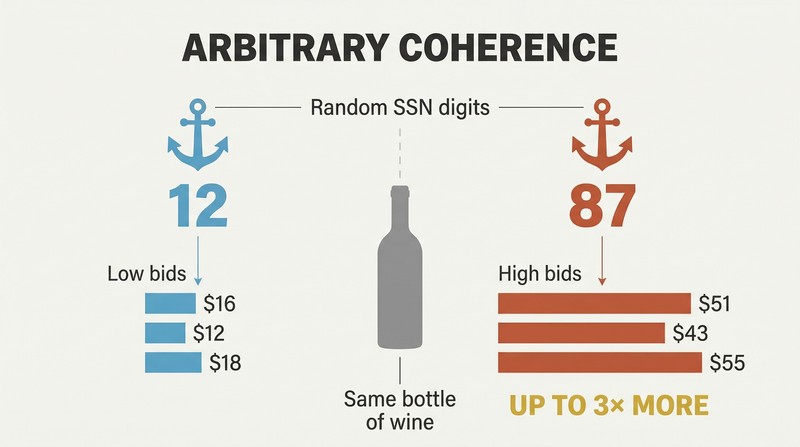
The first price you accept anchors every price that follows
Random numbers shape real spending. Ariely asked MBA students to write down the last two digits of their Social Security numbers, then bid on wine and electronics. Students with high-ending digits (80 – 99) bid 216 to 346 percent more than those with low digits (1 – 20). The arbitrary number became a price anchor influencing all subsequent valuations — a phenomenon Ariely calls arbitrary coherence.
Anchors explain how markets are made. Salvador Assael turned worthless Tahitian black pearls into luxury items by placing them in Harry Winston's Fifth Avenue window beside diamonds and rubies. Starbucks escaped Dunkin' Donuts pricing by creating an entirely different experience — different names, sizes, and ambience — so customers formed a new anchor rather than comparing on an old one.
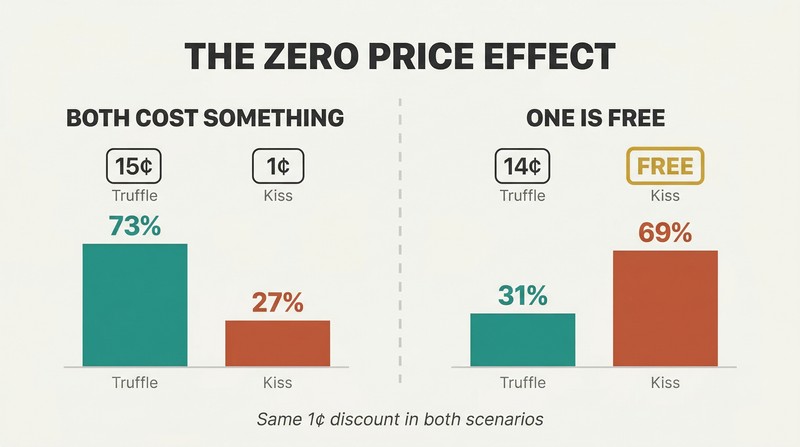
"Free" isn't a discount — it hijacks rational calculation entirely
One penny makes all the difference. When a Lindt truffle cost 15¢ and a Hershey's Kiss cost 1¢, 73% chose the truffle. Drop both by one penny — truffle at 14¢, Kiss at free — and 69% grabbed the Kiss. The relative gap was identical, but free flipped the majority toward the inferior chocolate.
The zero price effect appears everywhere. Amazon offered free shipping above a threshold and saw sales spike globally — except in France, where shipping cost one franc (about 20¢). Switching France to truly free triggered the same surge. We overvalue free because it eliminates loss: a free item carries zero risk of regret. Ariely suggests policymakers use this power deliberately — making colonoscopies and mammograms free, not just cheap.
Never introduce money into a social favor — the damage is permanent
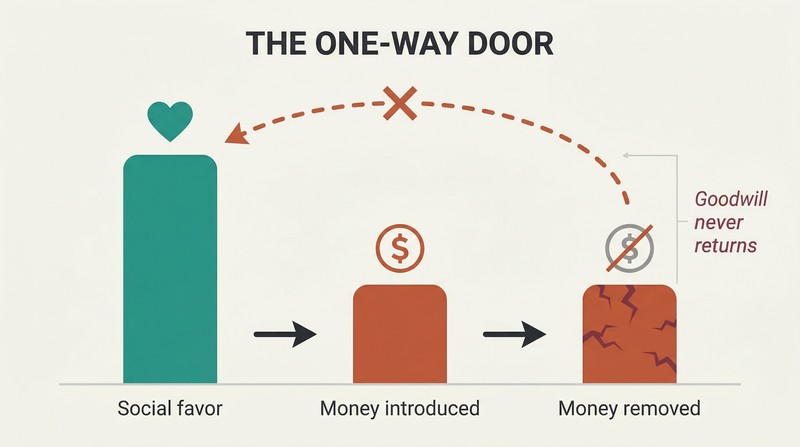
We live in two exchange worlds. Ariely asked participants to drag circles across a screen. Those paid $5 dragged 159; those paid 50¢ dragged 101. Those asked as a social favor, with no payment, dragged 168 — outperforming both paid groups. When AARP asked lawyers to help retirees at $30/hour, they refused. Asked to volunteer free, they agreed.
Once market norms invade, social norms vanish. An Israeli daycare introduced fines for late pickups. Parents arrived later — converting guilt into a fee. When the fine was removed, lateness didn't decrease. Both the social contract and the penalty were gone. Companies that brand themselves as family but impose punitive fees face the same trap: one market-norm violation can destroy years of social goodwill.
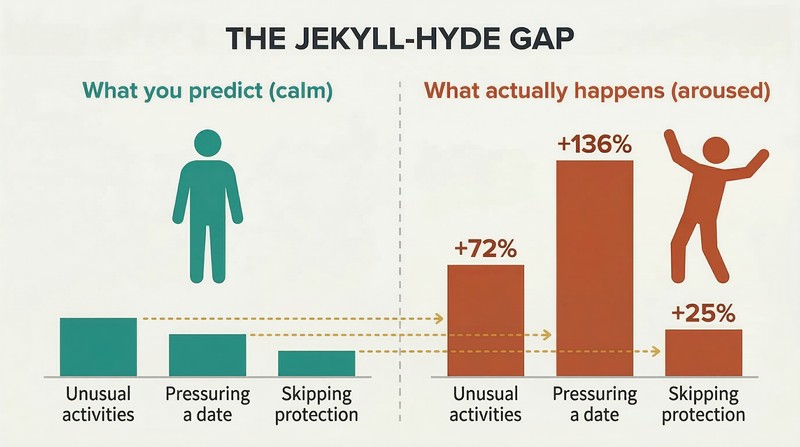
You cannot predict your aroused self from your calm one
Ariely measured the Jekyll-Hyde gap. Berkeley undergraduates answered questions about sexual preferences, moral boundaries, and condom use twice: once calm and once while sexually aroused. In the aroused state, desire for unusual activities jumped 72%, predicted willingness to pressure a date rose 136%, and likelihood of skipping a condom increased 25%.
The gap was consistent and enormous. Even students with extensive experience of arousal couldn't predict their transformation. This has direct implications: "Just say no" campaigns assume we can override passion at will. Ariely argues we must either avoid triggering situations entirely or prepare practical safeguards — like always carrying condoms — while calm, because our emotional self simply won't cooperate.
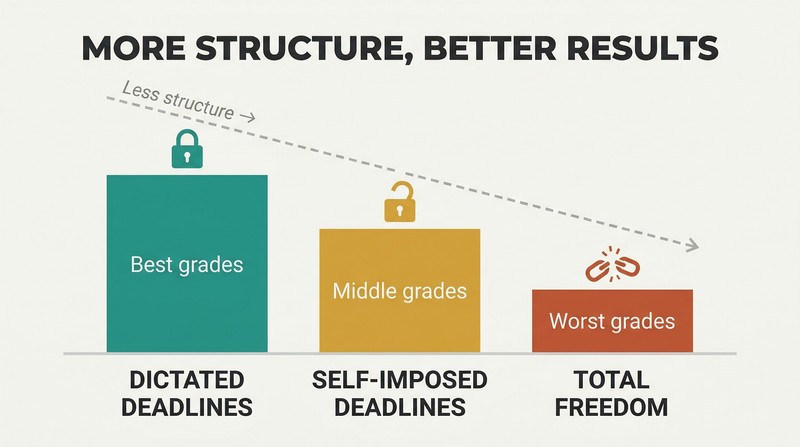
Impose structure on yourself before temptation arrives, not during
Dictated deadlines beat freedom. Ariely gave three classes the same assignments with different rules. One got dictated deadlines (weeks 4, 8, 12). Another set their own deadlines with penalties. The third had only an end-of-semester deadline. Dictated deadlines produced the best grades; total freedom produced the worst; self-imposed deadlines fell in the middle.
Precommitment works beyond school. Ford struggled with vehicle maintenance until copying Honda's approach: bundling 18,000 potential service items into three simple intervals. Service bays went from 40% empty to full in three years. Thaler and Benartzi's "save more tomorrow" program let employees commit future raises to retirement savings — boosting rates from 3.5% to 13.5% without anyone feeling the pinch.
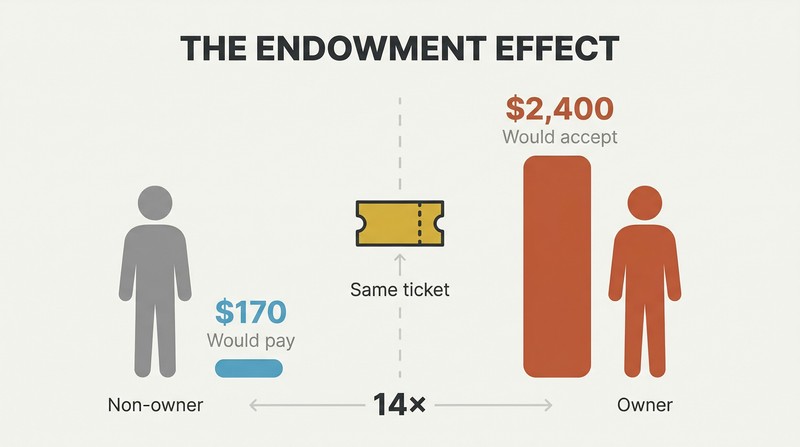
The moment you own something, you'd demand 14x what you'd pay
Duke basketball tickets tell the story. After a campout lottery, Ariely called winners and losers. Non-owners offered about $170 for a ticket. Owners demanded about $2,400. Not a single trade occurred — a 14-fold emotional chasm created by random chance.
Three quirks drive the endowment effect:
1. We fall in love with what we already have
2. We fixate on what we'll lose, not what we'll gain
3. We assume buyers see the same value we do
Virtual ownership makes it worse: the longer you lead an eBay auction, the more "yours" the item feels. Trial promotions and 30-day guarantees exploit this — once something enters your home, the pain of returning it exceeds the logic. Ariely and Mike Norton call the related labor-to-love phenomenon the Ikea effect.
Expectations and price physically alter your experience
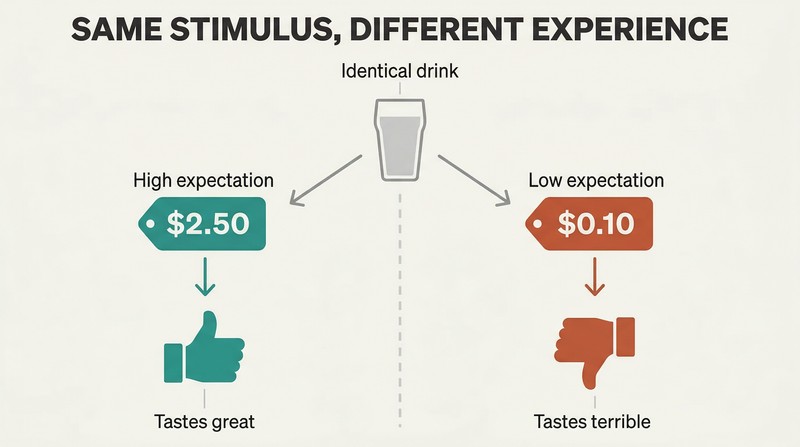
Ariely served vinegar beer to unsuspecting bar patrons. "MIT Brew" — Budweiser spiked with balsamic vinegar — was preferred by most tasters when they didn't know about the vinegar. Told beforehand, they hated it. Told afterward, they liked it as much as blind tasters. Knowledge before the experience didn't just change opinion; it changed the taste itself.
Price reshapes physiology. Participants given vitamin C capsules branded as "Veladone-Rx" at $2.50 per pill nearly all reported pain relief from electrical shocks. At 10 cents, only half did. Students who paid full price for SoBe energy drinks solved 28% more word puzzles than discount buyers. fMRI scans confirmed Coke's advantage over Pepsi lives in brand associations, not chemistry.
A moral reminder at the moment of temptation kills dishonesty
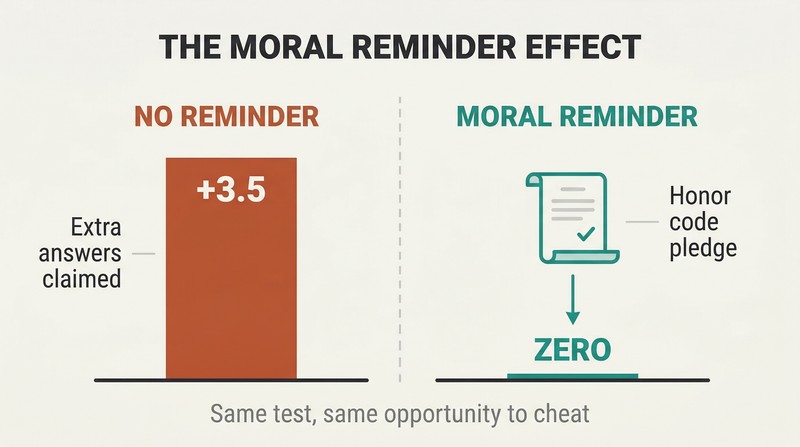
Given a chance to cheat, most people do — but barely. Across experiments at Harvard, MIT, Princeton, and Yale, participants who could inflate test scores claimed about 3.5 extra correct answers. Even when they could shred all evidence, they didn't cheat more. The risk of getting caught barely influenced behavior — something inside held them back.
But a moral nudge eliminated cheating entirely. Participants asked to recall the Ten Commandments before the test — even those who remembered only one or two — didn't cheat at all. Signing a statement about an honor code had the same effect, even at MIT, which has no honor code. It wasn't the content that mattered but contemplating any moral benchmark at the point of temptation.
Move a transaction one step from cash and dishonesty doubles
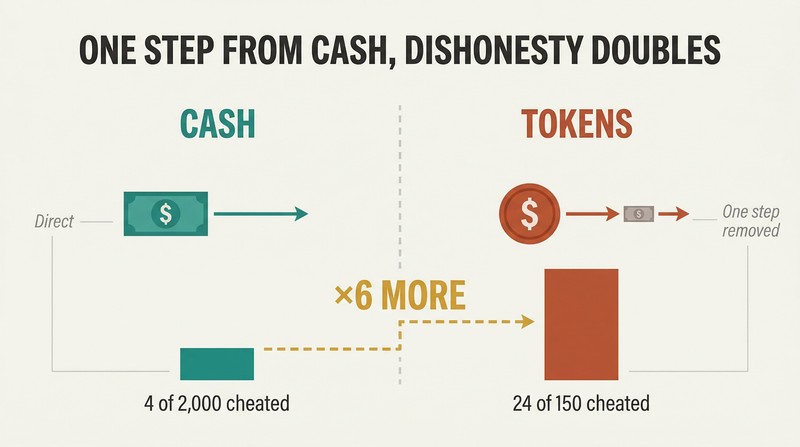
Ariely left six-packs of Coke in MIT dorm fridges — gone in 72 hours. Plates of dollar bills left in the same fridges? Untouched. When he replaced cash rewards in cheating experiments with tokens exchangeable for money seconds later, cheating more than doubled. Of 150 token-condition participants, 24 cheated "all the way" versus just 4 of 2,000 in cash experiments.
Distance from cash lubricates rationalization. Insurance claimants inflate losses by about 10%. Wardrobing — wearing clothes then returning them — costs retailers $16 billion annually. Expense reports get looser when submitted through assistants. As society shifts from physical money to electronic transactions, Ariely warns this moral buffer will only grow thinner and opportunities for small-scale dishonesty will multiply.
Analysis
Ariely's Predictably Irrational occupies a distinctive position in the behavioral economics canon. Published in 2008 alongside Thaler and Sunstein's Nudge and three years before Kahneman's Thinking, Fast and Slow, it helped democratize a field confined largely to academic journals. Where Kahneman provides theoretical architecture (System 1 vs. System 2), Ariely provides laboratory theater — chocolate tastings, Halloween candy swaps, and poetry auctions that make abstract biases viscerally concrete.
The book's most radical intellectual contribution is arbitrary coherence, which strikes deeper than standard anchoring. Ariely doesn't merely claim first prices influence later judgments; he argues preferences themselves are constructed from random starting points and then become internally logical. This challenges the neoclassical assumption that consumers possess stable, pre-existing utility functions, aligning Ariely with constructivist approaches to preference formation that remain contentious in mainstream economics.
His social-versus-market-norms framework anticipated a decade of research on motivation crowding — the finding that extrinsic incentives can destroy intrinsic motivation. The Israeli daycare experiment he discusses became a landmark case in policy design, illustrating how seemingly rational interventions backfire when they transform social contracts into market transactions.
A limitation is the gap between laboratory elegance and policy prescription. Ariely leaps from small-sample experiments with university students to sweeping claims about healthcare reform and credit regulation, often without addressing external validity. The self-control credit card he pitches to bank executives — charming as narrative — glosses over massive incentive misalignments in the credit industry.
The book's most enduring practical insight may be the simplest: awareness of predictable patterns is the first step toward designing environments that account for them. Ariely's free lunches aren't about making people rational. They're about making irrationality less costly — a design philosophy now central to behavioral nudging in corporate and public policy worldwide.
Review Summary
Predictably Irrational explores how humans make irrational decisions in predictable ways. Ariely uses experiments to demonstrate concepts like relativity, anchoring, and the power of free. The book covers topics such as procrastination, social norms, and the influence of price on perception. While some readers found the examples repetitive or the extrapolations too broad, many praised the book's engaging style and thought-provoking ideas. It offers insights into human behavior that can be applied to personal decision-making, marketing, and policy-making.
People Also Read






Glossary
Predictably irrational
Systematic, repeating human irrationalityAriely's central thesis that human irrationality is not random but systematic and consistent. People make the same types of mistakes over and over in predictable patterns across decisions about money, health, relationships, and honesty. Because these errors follow rules, they can be anticipated, studied, and potentially corrected through better choice architecture.
Arbitrary coherence
Random anchors, consistent follow-throughThe phenomenon where initial prices or valuations are 'arbitrary'—influenced by random or irrelevant factors like Social Security numbers—but once established in our minds, they become internally 'coherent,' shaping not only what we pay for that item but also for related products. Coined by Ariely, Loewenstein, and Prelec to explain how market prices can be manipulated yet still produce internally logical demand curves.
Decoy effect
Inferior option steers choicesThe phenomenon where adding a clearly inferior option (the 'decoy') to a choice set makes a similar but superior option look more attractive—not just compared to the decoy, but overall. The decoy need never be chosen; its mere presence shifts preferences. Demonstrated with Economist subscriptions, bread makers, and dating experiments using digitally distorted photographs.
Self-herding
Following your own past choicesA form of decision-making where people base current choices on their own previous behavior rather than recalculating preferences from scratch. After buying Starbucks coffee once, you 'line up behind yourself' in future visits, treating the initial decision as evidence of your preference. Distinguished from regular herding, where people follow others' behavior.
Zero price effect
Free triggers disproportionate demandThe phenomenon where reducing a price to zero produces a response far larger than any other equivalent price reduction. Free items trigger an emotional charge that makes us perceive them as immensely more valuable than their actual worth, because choosing something free eliminates any possibility of loss. Demonstrated by Shampanier, Mazar, and Ariely using Lindt truffles and Hershey's Kisses.
Endowment effect
Owning inflates perceived valueThe tendency to value things more highly simply because we own them, driven by loss aversion, emotional attachment, and the assumption that others share our perspective. Demonstrated in Ariely and Carmon's Duke basketball ticket study where owners demanded roughly 14 times what non-owners would pay. Term originally coined by economist Richard Thaler.
Ikea effect
Labor increases ownership attachmentA term coined by Ariely and Mike Norton describing how the more effort someone invests in creating or assembling something, the more they value it—regardless of the result's objective quality. Named after the Swedish furniture retailer whose products require customer assembly, which inadvertently boosts customers' attachment to the finished product.
Social norms vs. market norms
Two parallel exchange systemsAriely's framework distinguishing two types of exchanges governing human behavior. Social norms involve friendly, community-based interactions without immediate reciprocity (helping a neighbor move). Market norms involve transactional exchanges with clear prices and payments. Critically, introducing market norms into social exchanges—such as offering cash for a home-cooked dinner—destroys the social relationship and is extremely difficult to reverse.
FAQ
What's Predictably Irrational about?
- Behavioral Economics Focus: The book explores how human behavior often deviates from rational decision-making, influenced by various psychological factors.
- Systematic Mistakes: It highlights that our irrational behaviors are not random but systematic and predictable, leading to consistent errors in judgment.
- Real-Life Applications: Ariely uses experiments and anecdotes to illustrate how these irrationalities affect everyday decisions, from purchasing to personal relationships.
Why should I read Predictably Irrational?
- Insightful Experiments: The book presents a series of engaging experiments that reveal surprising truths about human behavior and decision-making.
- Practical Implications: Readers can apply the insights to improve their own decision-making processes in personal finance, health, and relationships.
- Challenging Assumptions: It encourages readers to rethink their assumptions about rationality and understand the hidden forces that shape their choices.
What are the key takeaways of Predictably Irrational?
- Influence of Context: Our decisions are heavily influenced by context and relative comparisons, as shown in the "decoy effect."
- Power of Free: The allure of "free" can lead us to make irrational choices, often opting for less valuable options simply because they are free.
- Arousal's Impact: Emotional states, particularly sexual arousal, can drastically alter our decision-making capabilities.
What are the best quotes from Predictably Irrational and what do they mean?
- "We are not only irrational, but predictably irrational.": This emphasizes that while humans often make irrational choices, these choices follow recognizable patterns.
- "Zero is not just another price.": Highlights the unique psychological impact of free offers, which can lead to irrational decision-making.
- "The most expensive sex is free sex.": Suggests that mixing social and market norms can undermine relationships and lead to poor decisions.
How does Predictably Irrational explain the "decoy effect"?
- Relative Comparison: The decoy effect occurs when a third option (the decoy) is introduced, making one of the other options appear more attractive.
- Example from The Economist: Ariely illustrates this with a subscription model where a print-only option makes a combined print and online option seem like a better deal.
- Predictable Choices: This effect shows that our choices are influenced by the options presented to us, leading to predictable irrationality.
What is the "zero price effect" discussed in Predictably Irrational?
- Emotional Hot Button: "Free" items trigger a strong emotional response, often leading us to make irrational choices.
- Experiment with Chocolates: Ariely's experiment with Hershey's Kisses and Lindt truffles demonstrates how people overwhelmingly choose the free option.
- Implications for Marketing: Understanding this effect can help marketers design promotions that leverage the allure of free offerings.
How does Predictably Irrational address procrastination and self-control?
- Behavioral Insights: People often fail to act in their long-term interests due to immediate temptations, leading to procrastination.
- Student Experiment: Ariely's experiment shows that those with imposed deadlines performed better than those who set their own.
- Precommitment Strategies: Creating systems for precommitment can help individuals overcome procrastination and make better choices.
What role does emotional arousal play in decision-making according to Predictably Irrational?
- Altered Decision-Making: Emotional states, particularly sexual arousal, can significantly distort our decision-making processes.
- Experiment Findings: Participants showed vastly different preferences when aroused compared to when they were in a calm state.
- Implications for Understanding Behavior: Highlights the importance of recognizing how emotions can lead to decisions that contradict our rational beliefs.
How does Predictably Irrational suggest we can improve our decision-making?
- Awareness of Biases: Understanding the systematic biases that affect our choices can help navigate decision-making processes.
- Precommitment Techniques: Setting up precommitment strategies, such as deadlines or financial penalties, can help maintain self-control.
- Rethinking Choices: Encourages readers to rethink their choices and the context in which they make decisions.
What is the significance of social norms versus market norms in Predictably Irrational?
- Different Motivations: Social norms encourage cooperation and altruism, while market norms focus on transactions and self-interest.
- Impact on Relationships: Mixing these norms can lead to misunderstandings and damage relationships.
- Practical Applications: Understanding the distinction can help foster better relationships and improve interactions.
How does Predictably Irrational relate to consumer behavior?
- Understanding Irrationality: Provides insights into why consumers often make irrational choices, influenced by factors like pricing and context.
- Marketing Strategies: Offers valuable lessons for marketers on how to frame offers and promotions.
- Consumer Empowerment: Recognizing these patterns can help consumers make more informed decisions.
How does Predictably Irrational explain the concept of anchoring?
- Initial Impressions Matter: First experiences or information serve as anchors, shaping future decisions.
- Examples in Pricing: Consumers often base judgments on initial price points, affecting their perception of value.
- Long-Term Effects: Once an anchor is set, it can influence choices over time, even if the context changes.
About the Author
Other books by Dan Ariely







Download PDF
Download EPUB
.epub digital book format is ideal for reading ebooks on phones, tablets, and e-readers.








































