
Key Takeaways
1. The Papacy is the Distinctive Truth of Christianity
Quite simply, if the Catholic Church’s claims about the papacy are true, then everyone should be a Catholic.
The core question. The papacy, while not the most important doctrine (like God's existence or Christ's divinity), is the most distinctive aspect of Catholicism. It serves as the linchpin: if the Catholic Church's claims about the papacy are true, then its authority is divinely ordained, and all should embrace it. Conversely, if these claims are false, then the entire Catholic structure lacks divine foundation.
Beyond personal interpretation. Many Christians approach theology by individually investigating doctrines and then seeking a denomination that aligns with their conclusions. This method, however, often overlooks the Church's role as an authoritative teacher. The crucial question isn't "Do I agree with this doctrine?" but "What is the Church?"—is it truly what it claims to be, a divinely established authority?
Faith seeking understanding. True faith, as St. Anselm noted, is "faith seeking understanding," not faith contingent upon understanding. Just as C.S. Lewis argued that one cannot accept Jesus merely as a "great moral teacher" without addressing His claim to be God, so too must one address the Catholic Church's claim to be directly founded and sustained by Jesus Christ. If this claim is true, then its teachings are trustworthy, even if not immediately understood.
2. Jesus Built a Visible, Unified Church, Not an Invisible Assembly
When Jesus says to Peter, “You are Peter, and on this rock I will build my church,” we can become so fixated on understanding who or what he means by “this rock” that we can overlook his promise, “I will build my church.”
God's design for the Church. Just as marriage is a divine institution to be discovered, not invented, so too is the Church. Jesus' promise to "build my church" implies a specific, divinely designed structure, not a collection of man-made denominations. This challenges the common Protestant idea of an "invisible church" composed solely of the saved, or a visible church that is merely a flawed approximation.
The Judas problem. The idea of an invisible church of only the saved is contradicted by the inclusion of Judas Iscariot among the apostles. Jesus explicitly chose Judas, knowing he was a "devil," demonstrating that the visible Church, the "body of Christ," can contain both faithful and unfaithful members. This refutes the notion that bad behavior by Christians means they were never truly part of the Church.
An unassembled body. The Greek word for church, ekklesia, means a "political gathering of citizens" or "a group of people that gathers together." An "invisible church" cannot gather, making the term a contradiction. Furthermore, reducing the Church to an atomistic collection of believers, rather than a unified "body of Christ," strips it of its essence as a visible continuation of Christ's Incarnation.
3. The Church is a "City on a Hill" and the Fulfillment of Israel
The Church that Jesus founded is both a light and a city.
Perpetual visibility. Jesus declared, "You are the light of the world. A city set on a hill cannot be hid" (Matthew 5:14). For the first 1,300 years of Christianity, this was understood as a promise of perpetual visibility for the Church. This poses a challenge for Protestantism, which effectively disappeared for over a millennium before the Reformation, making it difficult to claim historical continuity with Christ's original Church.
A visible, structured society. St. Robert Bellarmine defined the Church as "the assembly of men bound together by the profession of the same Christian faith and the communion of the same sacraments, under the rule of the legitimate pastors, and especially that of the Roman pontiff." This visible society, like the parable of the net containing both good and bad fish, includes both faithful and unfaithful members, and even those connected to it in ways known only to God.
Israel's continuation. The Church is not a "plan B" after Israel's rejection of Christ, but the fulfillment and reorganization of God's covenant with Israel. Just as ancient Israel was a visible, structured people with a priesthood, so too is the Church. Paul's analogy of the olive tree (Romans 11) shows Gentiles being grafted into Israel, not replacing it, ensuring a continuous, visible "Israel of God" with a sacerdotal priesthood.
4. Jesus Commissioned Peter to Unique Servant Leadership
Simon, Simon, behold, Satan demanded to have you, that he might sift you like wheat, but I have prayed for you that your faith may not fail; and when you have turned again, strengthen your brethren.
Leadership in service. At the Last Supper, as the apostles debated who was greatest, Jesus promised them royal authority ("sit on thrones judging the twelve tribes of Israel") but redefined leadership as humble service. He then singled out Peter, stating that Satan desired to sift all of them, but He prayed specifically for Peter, commissioning him to "strengthen your brethren."
A unique commission. This passage (Luke 22:31-32) reveals a distinct commission for Peter. While all apostles would face trials and fall away, Jesus' specific prayer for Peter and his subsequent instruction to "strengthen your brethren" highlights a unique role of leadership and support for the others. This is not a generic call to all believers, but a personal charge to Peter.
Humility in office. Peter's self-description as a "fellow elder" (1 Peter 5:1) is often misinterpreted by Protestants as a denial of his primacy. However, this aligns with Christ's teaching on servant leadership, where authority is exercised with humility. Early Christians, like the bishops at the Council of Carthage referring to Pope Boniface as "fellow-priest," understood this as a mark of Peter's office, not a repudiation of it.
5. Peter's Calling as Shepherd and Fisher of Men is Unique
What was afterward disclosed to him in words was now indicated to him by an action.
Vocation, not occupation. Biblical leadership, from Abraham to the apostles, is consistently presented as a divine calling, a vocation, not merely a self-chosen occupation. Jesus explicitly warns against those who "climb in by another way" (John 10:1), calling them "thieves and robbers." This contrasts sharply with the Protestant Reformation's origins, where figures like Martin Luther acknowledged acting without ordinary commission.
The three miraculous catches. Jesus' three miraculous catches of fish, all intimately involving Peter, serve as "living parables" of his unique calling:
- First Catch (Luke 5:1-11): Jesus tells Peter, "henceforth you will be catching men," a personal call to evangelization.
- Second Catch (Matthew 17:24-27): Peter catches a fish with a coin to pay the temple tax for "me and for yourself," linking him uniquely to Christ's priestly exemption.
- Third Catch (John 21:1-14): Post-Resurrection, Peter leads the disciples in a miraculous catch where the net, full of 153 fish, does not tear, and Peter alone hauls it in.
Shepherd of the flock. The untorn net in John 21 symbolizes the Church's unity, protected from schism, with Peter playing a unique role in guiding it to the eternal shore. This miracle is immediately followed by Jesus' threefold commission to Peter, "Feed my lambs," "Tend my sheep," "Feed my sheep" (John 21:15-17), a clear and unique call to shepherd the entire flock of Christ, as understood by early Church Fathers.
6. Jesus Tethers Peter to Himself as His Vicar and Priest
So it’s shocking that Jesus should break from his own apparently deliberate pattern in such a dramatic way in this one instance, explaining to Peter that the miracle is done “lest we offend.”
The temple tax miracle. In Matthew 17:24-27, tax collectors approach Peter about Jesus' temple tax. Jesus then tells Peter to miraculously catch a fish with a coin to pay for "me and for yourself." This seemingly small detail is profound: Jesus, who consistently distinguishes Himself from others, uses an "inclusive we" only for Himself and Peter ("lest we offend"), uniquely tethering Peter to His own divine status.
Priestly exemption. Jesus' claim of exemption for "the sons" from the temple tax refers to the priestly exemption in Jewish law. By including Peter in this exemption, Jesus implies Peter's participation in His own priesthood, making him a vicar (a deputy authorized to act on another's behalf) in a priestly capacity. This is a direct challenge to interpretations that deny Peter any special role.
Rock and stumbling stone. The passage also contains a powerful wordplay: Jesus calls Peter the "rock" (petra) but then calls him a "stumbling stone" (skandalon) when Peter rebukes Him. This foreshadows the complex reality of the papacy: popes, like Peter, can be both the divinely appointed foundation and, through their human failings, a source of scandal, yet their office remains valid.
7. Peter's Primacy is Evident in Apostolic Lists and Inner Circles
In other words, it’s not only that the lists begin and end with the same two people each time. It’s that the same explanations are given for why they’re listed where they are: Simon is first, because he’s Peter, the rock; and Judas is last, because he’s the traitor who betrayed Christ.
Consistent first place. All four biblical lists of the apostles (Matthew 10, Mark 3, Luke 6, Acts 1) consistently place Peter first and Judas last. This consistent ordering, along with the explicit reasons given for their positions, strongly indicates Peter's unique leadership role among the Twelve, rather than a random arrangement.
The inner circle. Jesus repeatedly singles out Peter, James, and John as an inner circle, taking them apart from the other apostles for significant events like the Transfiguration and Gethsemane. Even within this inner circle, Peter is often addressed individually and held to a higher standard, as seen when Jesus rebukes him alone in Gethsemane. This refutes the idea that all apostles held identical authority.
"Peter and the apostles." The New Testament frequently uses phrases like "Peter and the eleven" or "Peter and the apostles," distinguishing him from the others even while including him among them. This linguistic pattern, along with the people's desire for Peter's shadow to fall on them for healing (Acts 5:15), highlights his recognized primacy and unique authority in the early Church.
8. "Upon This Rock" Personally Establishes Peter's Foundational Role
And I tell you, you are Peter, and on this rock I will build my church.
The pivotal passage. At Caesarea Philippi, after the crowds offer contradictory opinions about Jesus' identity, Peter alone, inspired by God, confesses, "You are the Christ, the Son of the living God." In response, Jesus blesses Peter personally, changes his name from Simon to Peter (meaning "Rock"), and declares, "And on this rock I will build my church."
Name change as covenant. The renaming of Simon to Peter is a profound covenantal act, akin to God renaming Abram to Abraham. Just as Abraham's new name signified his destiny as "father of a multitude of nations," Peter's new name, "Rock," defines his foundational role in the new covenant. This personal blessing cannot be dismissed as merely symbolic or applicable to all believers.
Aramaic clarity. The argument that Petros (small stone) differs from petra (large rock) in Greek is largely a Protestant invention, based on poetic distinctions not present in first-century common Greek. Crucially, Jesus spoke Aramaic, where the word Kefa means "rock" and would have been used for both Peter's name and the foundation. Thus, Jesus literally said, "You are Rock, and on this rock I will build my my church."
9. The Keys and Binding/Loosing Grant Infallible Authority
And I will give you the keys of the kingdom of heaven, and whatever you bind on earth shall be bound in heaven, and whatever you loose on earth shall be loosed in heaven.
Keys of the kingdom. Jesus' promise to give Peter "the keys of the kingdom of heaven" is not a trivial gift. In Jewish tradition (Isaiah 22:19-23), the "key of the house of David" signified the authority of a royal steward or vicar, who governed the king's household and acted in his stead. This implies Peter is made the chief administrator and priest of Christ's kingdom on earth.
Binding and loosing. The terms "binding" and "loosing" in a first-century Jewish context referred to the authority to:
- Interpret and apply divine law (forbid or permit actions).
- Discipline members (condemn or acquit).
These decisions, made by rabbinical authorities like the Sanhedrin, were understood to be ratified in heaven. Jesus explicitly acknowledges this authority in the Pharisees who "sit on Moses' seat" (Matthew 23:2-4).
Heavenly ratification. The promise that "whatever you bind on earth shall be bound in heaven" signifies a divine guarantee for Peter's authoritative decisions on faith and morals. This is a form of infallibility, where the Holy Spirit protects Peter's official teaching from error, ensuring that the Church's earthly pronouncements align with God's will.
10. Infallibility Ensures Unity in Truth, Solving Protestant Dilemmas
If the church is infallible, appeals to history, tradition, and Scripture are superfluous.
Christ's dual demands. Jesus demands both unity ("that they may all be one," John 17:20-23) and orthodoxy ("hold firm to the sure word," Titus 1:9) from His Church. Protestantism, with its emphasis on individual interpretation of "Scripture alone," inevitably creates a "catch-22": believers are forced to choose between unity (staying in a denomination they believe is wrong) or truth (leaving to form a new one), leading to endless division and theological chaos.
The canon problem. The Protestant argument against infallibility often claims that inspired Scripture is sufficient. However, nowhere does Scripture provide a divinely inspired table of contents. Historically, the Bible's canon was assembled and affirmed by the Catholic Church. Without an infallible Church, the canon itself becomes a "fallible collection of infallible books," undermining the very authority of Scripture.
Infallibility's solution. Infallibility, properly understood, is not about papal impeccability or divine inspiration for every utterance. It is a divine protection of the Church's official teaching on faith and morals from error. This gift ensures that believers will never have to choose between fidelity to the visible Catholic Church and fidelity to the Gospel, thereby making unity in truth possible and fulfilling Christ's prayer.
11. Christ's Church Cannot Fail, Guaranteed by Divine Promise
Christ’s promise is that the gates of Hades will not prevail, not that they will prevail for only 1,500 years.
The apostasy problem. The Protestant Reformation's premise often implies that the Church founded by Christ fell into apostasy for centuries, only to be "restored" by figures like Luther or Calvin. This directly contradicts Jesus' promise to Peter that "the gates of Hades shall not prevail against it" (Matthew 16:18). If the Church fell into widespread error, sin and death would have prevailed, nullifying Christ's victory.
Nebuchadnezzar's dream. The prophet Daniel interpreted King Nebuchadnezzar's dream of a statue representing four successive earthly kingdoms (Babylon, Persia-Media, Greece, Rome). The dream culminates with a stone, "cut out by no human hand," destroying the statue and becoming "a great mountain and filled the whole earth." This stone represents God's kingdom, which "shall never be destroyed" and "shall stand for ever."
Historical continuity. This prophecy guarantees the perpetual existence and indefectibility of God's kingdom on earth. The Catholic Church, as the world's oldest continuously functioning institution, uniquely fulfills this prophecy. Any theory of a widespread apostasy or an invisible "remnant" church contradicts this divine guarantee and the historical visibility of Christ's Church.
12. The Church's Growth and Continuity Fulfill Prophecy
The kingdom of heaven is like a grain of mustard seed which a man took and sowed in his field; it is the smallest of all seeds, but when it has grown it is the greatest of shrubs and becomes a tree, so that the birds of the air come and make nests in its branches.
The mustard seed analogy. Jesus Himself taught that the Kingdom of Heaven would start small, like a mustard seed, but grow into a large tree. This means the Church should look different over time, developing infrastructure, bureaucracy, and a global presence. Criticizing the modern Catholic Church for its size or complexity, compared to the early Church, is like expecting a 27-year-old man to still look like a 7-year-old boy.
Growth, not corruption. The Church's growth and development are signs of its flourishing, not its corruption or apostasy. Just as a successful company expands beyond a garage, the Church's mission to "make disciples of all nations" necessitates growth and adaptation. To demand it remain in a first-century state is to misunderstand Christ's own parables of its organic development.
Unbroken lineage. Unlike other religious systems that can be traced to specific human founders centuries after Christ, the Catholic Church's lineage traces directly back to Peter and the apostles. The inability of critics to name a specific human founder for the Catholic Church, other than Christ Himself, underscores its unique claim to historical and apostolic continuity, fulfilling the prophecies of an enduring, visible kingdom.
Review Summary
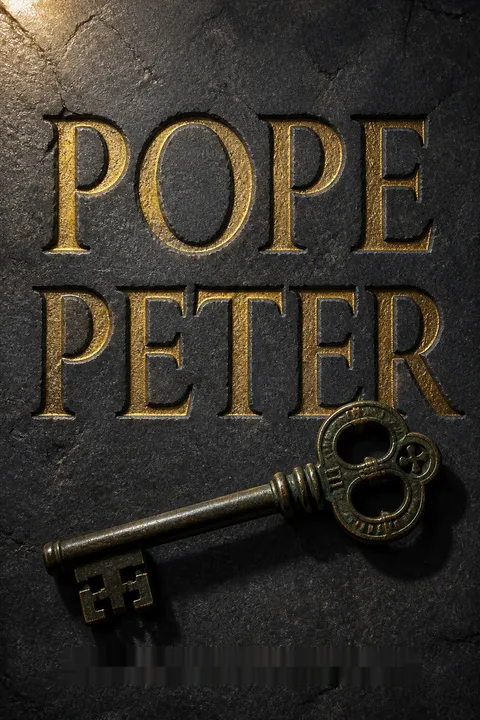
Pope Peter by Joe Heschmeyer receives mostly positive reviews (4.44/5), praised for its clear biblical defense of papal authority and Peter's special role among apostles. Readers appreciate the accessible writing style, thorough scriptural exegesis, and fair engagement with Protestant objections. Some critics note the book focuses heavily on Peter's primacy but lacks depth on apostolic succession and early Church history. Several reviewers found certain arguments stretched or wished for more historical evidence. Many describe it as an excellent introduction for lay readers, though some wanted more academic rigor regarding papal succession.
People Also Read



Download PDF
Download EPUB
.epub digital book format is ideal for reading ebooks on phones, tablets, and e-readers.








































