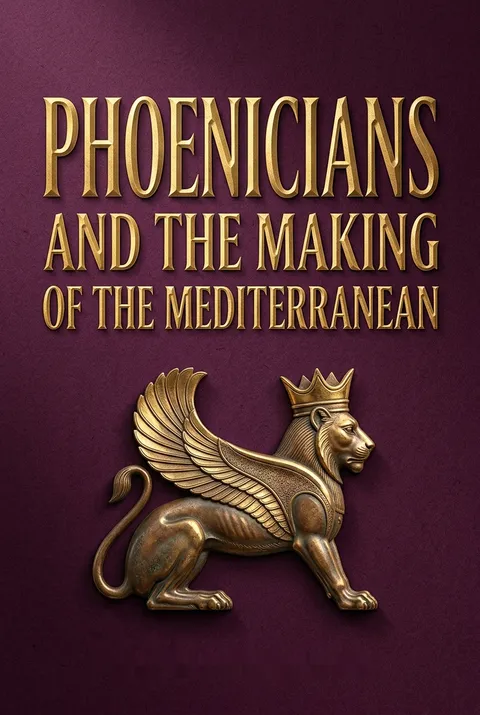

Key Takeaways
1. Phoenicians: The Unsung Architects of Mediterranean Connectivity
This book will argue that it was these Phoenicians who set in motion the new connectivity networks and to a great degree created a first, truly interconnected Mediterranean.
A Global Transformation. Around 700 BC, the Mediterranean experienced an unprecedented era of interconnectedness, largely spearheaded by the Phoenicians. Following the collapse of Late Bronze Age palatial economies, Phoenician mariners, settlers, and traders revitalized communication lines, linking distant communities from Tyre to the Straits of Gibraltar. This dynamism fostered a pan-Mediterranean "class" of urban, literate elites, whose shared cultural and economic modes bore a clear Near Eastern imprint.
Driving Forces. Phoenician expansion was not random but a strategic pursuit of vital resources and trade routes. Their city-states, especially Tyre, sought areas rich in metals like copper, silver, and iron, as well as timber, murex (for purple dye), and salt. Crucially, they also established settlements in locations with good harbors and farmland to sustain their extensive, long-distance networks, paving the way for other peoples, including the Greeks, to join this burgeoning global system.
Bridging Eras. The Phoenicians uniquely bridged the "Dark Ages" and the Archaic period, connecting Aegean "prehistory" with Near Eastern history. Their agency explains the rapid spread of new technologies and artistic styles that defined the "orientalizing" culture. By facilitating these networks, they enabled diverse proto-urban cultures across the Mediterranean to step onto the stage of history, even if their own voices are often lost to us.
2. The "Orientalizing Kit": A Phoenician-Marketed Cultural Revolution
The Phoenicians profited from the export of a modifiable package of orientalizing goods and cultural capital, which I have called an “orientalizing kit.”
A Customizable Package. The "orientalizing" phenomenon, characterized by the adoption of Near Eastern models, was largely driven by the Phoenicians' successful marketing of a customizable cultural package. This "orientalizing kit" included a range of innovations that appealed to emerging elites across the Mediterranean, allowing them to signal status and participate in an international koine.
Key Components: This toolkit encompassed both tangible and intangible elements:
- Symbolic Motifs: Lotus flowers, rosettes, tree of life, sphinxes/griffins, lionesses, Mistress/Master of Animals.
- Technologies: Pottery (shapes, decoration), ivory carving, metalwork (jewelry, engraving, filigree, granulation), monumental stone sculpture, masonry, architectural innovations (quadrangular buildings, urban grids).
- Practices: Burial forms and rituals (cremation, votive deposits), industrial developments (metallurgy, fishing, salting), farming innovations (olive, vine), wine culture (banqueting).
- Intangible Assets: Alphabetic writing, mythological themes, religious ideas.
Strategic Marketing. The Phoenicians, as surviving Canaanite polities, assimilated traits from major Near Eastern civilizations (Assyrian, Egyptian) and repackaged them into a coherent, prestigious "Phoenician" style. They understood and exploited the local desire for international sophistication, tailoring their offerings to the specific needs and tastes of recipient cultures, thereby energizing local expressions of status and identity.
3. Challenging Hellenocentrism and "Phoenicoskepticism"
The Phoenician agency is instead diffused in vague discussions of “Near Eastern” or “Levantine” models adopted by the Hellenic genius.
Overcoming Bias. The study of Phoenicians has long been fragmented and marginalized, caught between classical and Near Eastern studies. Hellenocentric narratives often downplay Phoenician contributions, attributing innovations to a "Greek miracle" or vague "Near Eastern" influences, while "Phoenicoskepticism" questions their very existence as a coherent group. This bias stems from modern geopolitical circumstances and the traditional focus on Greco-Roman heritage.
Reclaiming Agency. The book argues against the notion that Phoenicians were mere "vectors" or that their culture was too eclectic to be distinct. Ample archaeological and epigraphic evidence, alongside ancient Greek and Roman testimonies, confirms their unique identity, shared material culture, language, religion, and organized expansion. Dismissing their agency perpetuates a "clash of civilizations" narrative and overlooks their pivotal role in early Mediterranean history.
Integrated View. To gain an integrated view of the early Mediterranean, it's essential to decenter the narrative from an imagined Greek core. By placing Phoenicians at the crossroads of ancient encounters, we can better appreciate the unique character of each region and the profound effects of their interactions with Levantine cultures. This approach moves beyond teleological views that prioritize later "classical" developments.
4. Phoenician Settlements: Beyond Mere "Trading Posts"
The dichotomy between Greek apoikia / Phoenician emporion presupposes that Greek presence responded to a sort of “civilizing mission” linked to logic and order, “while the Phoenicians offered nothing at best, irregular chaos at worst,” as Garnand denounced.
Challenging Stereotypes. Traditional scholarship often labels Phoenician settlements as limited "trading posts" (emporia), contrasting them with supposedly more organized Greek "colonies" (apoikia). This distinction, rooted in Hellenocentric bias, unfairly diminishes the sophistication and permanence of Phoenician enterprises, implying a lack of "civilizing mission" or territorial ambition.
Organized Urbanism. Archaeological evidence reveals that many Phoenician foundations were conceived as well-organized towns from their inception. Sites like Gadir (Cadiz) and Carthage demonstrate urban planning with:
- Dense quadrangular constructions.
- Narrow angular streets.
- Levantine building techniques (e.g., "pier and rubble" masonry, Egyptian cubit measurements).
- Strategic locations on defensible islands or headlands with access to agricultural land (chora) and resources.
- Communal spaces articulated by intramural and peri-urban sanctuaries.
Comparable Networks. Both Greek and Phoenician settlements functioned within complex networks, adapting to local conditions. The idea of Phoenician activity being limited to small coastal "bubbles" is no longer tenable. Their settlements were interconnected city-states, comparable in organization and impact to their Greek counterparts, and often predating them in the far west.
5. The Phoenician Alphabet: A Foundational Legacy for the West
If there is an item of undoubted, direct Phoenician origin in Greek culture it is the alphabet.
Direct Transmission. The Greek alphabet, the foundation of Western writing systems, is a direct borrowing from the Phoenician script. This is acknowledged by the Greeks themselves, who called their letters "Phoenician letters" (phoinikeia grammata) or "Kadmean letters" (kadmeia grammata), linking them to the legendary Phoenician prince Kadmos.
Key Features of Adaptation: The transmission involved specific, consistent choices:
- Letter Shapes: Greek letters mirrored Phoenician forms.
- Phonetic Value: Corresponding phonetic values were maintained, with adaptations for Greek sounds.
- Order: The sequence of letters followed the Phoenician abecedary.
- Direction: Initially, both right-to-left and boustrophedon (alternating directions) were used, reflecting Phoenician practice, before standardizing to left-to-right.
- Names: Greek letter names (alpha, beta, gamma) are phonetic adaptations of Semitic names ('aleph, bet, gimmel), which had acrophonic meanings in Phoenician (e.g., 'aleph = "ox").
Beyond a Tool. The alphabet was more than a mere technological transfer; it was a cultural phenomenon. Its adoption by Greeks, Etruscans, and Tartessians was part of the broader "orientalizing" trend, enabling the development of new literary traditions (like Homeric epics) and administrative systems. The Phoenician script, standardized by Tyre, became the "Mutterschrift" for Old Hebrew, Aramaic, and ultimately, all Western alphabets, profoundly shaping literate civilizations across the Mediterranean.
6. Artistic Synthesis: The Distinctive Phoenician Egyptianizing Style
The misuse or more properly ‘reuse’ of foreign motifs (especially Egyptian) has been traditionally identified as a hallmark of Phoenician art.
Eclecticism as Identity. Phoenician art, often described as eclectic due to its blend of Egyptian, Assyrian, and Canaanite motifs, possessed a distinct and coherent personality. This "Egyptianizing" style, characterized by the creative adaptation and synthesis of foreign elements, was not a sign of lack of originality but a deliberate manifestation of Phoenician cultural identity and a claim to the prestigious Canaanite continuum.
Key Artistic Mediums: This unique synthesis is evident across various Phoenician crafts:
- Ivories: Often found in Assyrian caches, these carvings display a blend of Egyptianizing (e.g., Horus figures, lotus flowers) and North Syrian/Assyrian features.
- Metal Bowls: Engraved bronze and silver paterae, praised by Homer, feature concentric bands of figures combining Egyptian and Assyrian narrative styles.
- Terracottas: Female figurines and plaques, often of the "Astarte-type," reflect popular religious expression with Egyptianizing elements.
- Architecture: Elements like the "Proto-Aeolic" or volute capitals, though debated in origin, became a hallmark of Phoenician monumental art.
Cultural Capital. The Phoenicians' mastery of this synthetic style made their art highly valued and influential. It conveyed an aura of royalty, prestige, and sophistication, making it a desirable cultural capital for elites in emerging Iron Age societies. This artistic output, far from being merely derivative, was a powerful expression of Phoenician identity and a key component of the "orientalizing kit" disseminated across the Mediterranean.
7. The Sphinx: A Potent Symbol of Phoenician Cultural Transfer
Both the saga into which the Greek sphinx was inserted and the name itself bear connections with the Phoenician world, or could have been understood in Phoenician terms in the archaic period.
A Levantine Hybrid. While the colossal sphinx of Giza is iconic, the winged, human-headed lion that became ubiquitous in Mediterranean "orientalizing" art derived its form and symbolism from the Levant, not directly from Egypt. The Egyptian sphinx was typically wingless and masculine, whereas the Levantine and subsequently Greek sphinx was winged and predominantly feminine.
Phoenician Mediation. The winged sphinx was a staple of Canaanite and later Phoenician art, appearing on luxury items like ivories and metalwork, as well as in stone. It carried rich symbolic connotations:
- Royalty and Divinity: Often depicted guarding thrones or associated with deities like Ashtart and Baal-Hammon.
- Life and Regeneration: Frequently combined with motifs like palmettes, lotuses, and the tree of life.
- Protection: Its aggressive aspect, as seen in the "strangler" demon (honeqet) on Aramaic-Phoenician amulets, also served an apotropaic function.
Greek Adaptation. The Greek sphinx, famously encountered by Oedipus at Thebes, aligns with the Levantine model in its winged, feminine form and its role as a guardian of the empty throne. The Greek name "sphinx" itself may derive from a Semitic term for "strangler." This mythological integration, alongside its widespread depiction in Greek art, demonstrates a deep cultural transfer mediated by Phoenician networks, far beyond mere aesthetic borrowing.
8. Beyond Seafaring: Phoenicians as Farmers and Master Builders
In the end, like Odysseus, the Phoenicians held both an oar and a plow when they needed to.
Challenging the "Seafaring Semites" Stereotype. The popular image of Phoenicians as exclusively merchants and sailors, detached from land-based activities, is a misleading stereotype. This dichotomy, often exploited by Romans to characterize Carthaginians as unstable and greedy, obscures their significant contributions to agriculture and monumental construction.
Agricultural Innovations. Phoenicians were deeply invested in farming, transforming landscapes in their homeland and colonies:
- Homeland: The narrow but fertile coastal strip of Phoenicia supported a dense population through small farming and export of inland products like wood.
- Colonies: In Iberia, Sardinia, and North Africa, they introduced Levantine modes of viticulture and olive farming, essential elements of the "Mediterranean diet."
- Marine Resources: They also specialized in exploiting marine resources, such as salt and fishing, producing famous products like Punic garum.
Master Builders. Phoenicians were renowned as skilled masons, architects, and woodworkers, a prowess acknowledged in ancient texts like the Hebrew Bible (e.g., Hiram of Tyre's assistance to Solomon). Their expertise included:
- Urban Planning: Organized layouts in cities like Gadir and Carthage.
- Masonry Techniques: "Pier and rubble" walls, use of the "Egyptian cubit."
- Naval Technology: Innovations like biremes, rudders, sharp rams, and the mortise-and-tenon system (coagmenta punicana).
- Monumental Architecture: Temples and palaces, often incorporating distinctive "Proto-Aeolic" capitals, influenced building practices across the Levant and Mediterranean.
9. Local Adaptations: The "Orientalizing Kit" on Indigenous Terms
To orientalize or not to orientalize” was a matter of choice, as was how to do it.
Active Reception. The "orientalizing" phenomenon was not a passive absorption of foreign culture but an active process of local choice, consumption, and transformation. Indigenous communities across the Mediterranean selectively embraced Phoenician innovations to serve their internal socioeconomic and political dynamics, often creating unique hybrid expressions.
Diverse Responses: The degree and nature of "orientalization" varied significantly by region:
- Iberia (Tartessos): Local elites eagerly adopted the full "orientalizing kit," integrating Phoenician pottery techniques, metalwork (filigree, granulation), ivory carving (incision style), monumental burials (tumuli), oxhide altars, and even a Phoenician-derived script into their distinct Tartessic culture.
- Sardinia: Nuragic communities selectively appropriated Phoenician ceramic types (Sant'Imbenia amphorae), monumental statuary (Giants of Mont'e Prama), and religious practices, but maintained strong indigenous traditions and did not adopt the Phoenician alphabet.
- North Africa: Despite extensive Phoenician settlement, local populations showed less interest in adopting the "orientalizing kit" in the early period, leading to less cultural hybridization compared to Iberia or Etruria. Later, Punic culture exerted a deeper, more direct grip.
Beyond Diffusion. This variability underscores that cultural influence is not inevitable or unidirectional. The success of Phoenician cultural capital depended on local receptivity and the ability of indigenous elites to adapt these foreign elements to their own needs, thereby articulating their status and identity within a broader, interconnected Mediterranean world.
10. Cyprus: A Microcosm of Greco-Phoenician Entanglement
On Cyprus there is no “orientalizing period” (as in Etruscan or Greek art); materials with evident Levantine traits are subsumed under the Cypro-Geometric and Cypro-Archaic labels.
"Ground Zero" of Interaction. Cyprus, geographically positioned between the Aegean and the Levant, was a crucial hub for cultural exchange, making the term "orientalization" almost redundant. Here, Canaanite and Phoenician influences were deeply interwoven with local and later Greek cultures, creating a complex, hybrid society from the Late Bronze Age into the Iron Age.
Intertwined Legacies:
- Phoenician Presence: Evident from the 11th century BC, with permanent settlement at Kition by the mid-9th century. Phoenicians introduced masonry, specific pottery types (Bichrome, Red-Slip), metalwork (lamp stands, decorated bowls), and Egyptianizing iconography.
- Greek Influence: Mycenaean migrations brought Greek speakers, but a generalized Hellenic culture only became manifest later. Greek and Phoenician elements were often too intertwined for neat ethnic classification.
- Autochthonous Resilience: Cypriot culture maintained a strong local character, assimilating newcomers and adapting foreign elements on its own terms, as seen in unique pottery styles (Proto-White Painted), monumental statuary (Giants of Mont'e Prama), and the persistence of the Cypro-Syllabic script.
Egyptianizing Statues as a Linchpin. The Egyptianizing male limestone statues from Cyprus, often misattributed to direct Egyptian influence, are a prime example of Phoenician mediation. These kilt-wearing figures, dating from the 7th century BC, draw on Phoenician Egyptianizing models in wood and ivory, rather than direct Egyptian prototypes. This Cypriot innovation, in turn, influenced Phoenician statuary and offers a crucial context for understanding the origins of the Greek kouroi.
11. The Levant: Phoenicia as the Cultural Beacon of the Iron Age
The Phoenicians’ uninterrupted palatial and temple traditions as well as their institutions, preserved since the Bronze Age, served as models for the formation of new city- states, such as in Israel, Judah, and the Aramaean and Neo- Hittite states.
Canaanite Continuum. After the Late Bronze Age collapse, Phoenician city-states (Tyre, Sidon, Byblos, Arwad) emerged as torchbearers of urban, literate civilization in the Levant. Unscathed by the widespread destruction, they built upon their Canaanite heritage, maintaining continuous palatial and temple traditions that became models for new states like Israel, Judah, and the Aramaean kingdoms.
Tyre's Preeminence. Tyre, in particular, rose as the foremost naval and commercial power, driving Phoenician expansion and setting cultural standards. The biblical accounts of King Hiram I's collaboration with Solomon highlight Tyre's role in providing timber, architects, and masons, and its involvement in long-distance trade. This economic and cultural capital was the matrix for the "orientalizing kit" disseminated abroad.
Phoenicianization of the Levant. Phoenician influence was transformative across the surrounding Levant:
- Writing: The Phoenician alphabet, formalized by Tyre, became the "Mutterschrift" for Old Hebrew, Aramaic, Moabite, and other regional scripts, serving as a prestigious international medium.
- Art & Architecture: Phoenician Egyptianizing art, ivories, and monumental architectural elements like the "Proto-Aeolic" capitals were coveted and imitated by neighboring elites, shaping their own expressions of royal culture.
- Trade: Phoenician transport jars and luxury goods penetrated markets across the Levant, reinforcing their economic and cultural hegemony.
People Also Read

Download PDF
Download EPUB
.epub digital book format is ideal for reading ebooks on phones, tablets, and e-readers.








































