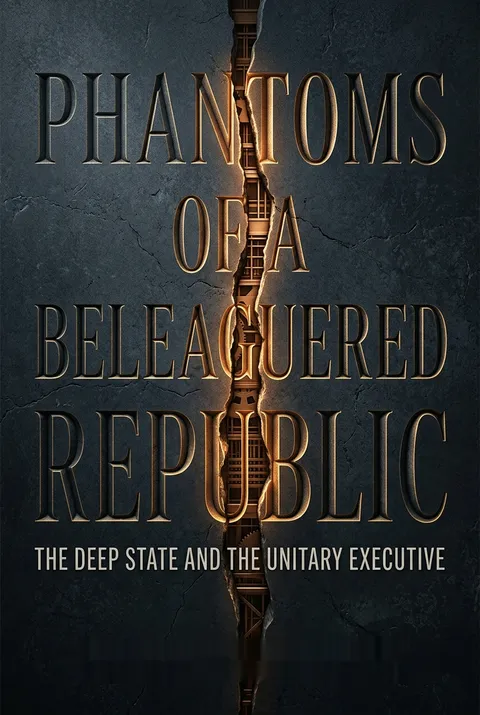

Key Takeaways
1. The American State's "Depth" is a Reality, Not Just a "Deep State" Conspiracy
Put simply, the American state is “deep.”
Beyond conspiracy. The term "Deep State" gained notoriety under the Trump presidency, often used to suggest a clandestine shadow government thwarting the president's will. However, the book argues that this is a politically charged caricature. The reality is that the American state possesses inherent "depth," a natural byproduct of its evolution and complexity, rather than a conspiratorial cabal. This depth refers to the extensive reach and intricate structure of the federal bureaucracy.
Multifaceted depth. This "depth" manifests in several ways, reflecting the vast resources and intricate organization of the public sector. It includes:
- Public sector penetration: The enormous resources committed to social regulation and national security.
- Densely articulated instruments: Operating units from the White House to local offices, governed by roles, duties, rules, and procedures.
- Insulation and independence: Mechanisms that protect authority at all levels from arbitrary decisions, fostering stability and continuity.
- Human resources: A vast reservoir of professional expertise, managerial skill, and institutional memory.
- External connections: Extensive bonds to universities, professional societies, think tanks, and media, anchoring decisions and amplifying administrative voices.
Challenging the "weak state" myth. Historically, the American state has been characterized as "weak" due to its fragmented authority and pervasive influence of civil society. However, the book contends that this perspective overlooks the formidable nature of these connections. The "Deep State" epithet, while exaggerated, forces a direct confrontation with the state's undeniable depth, moving beyond simplistic notions of strength or weakness to acknowledge its complex, entrenched reality.
2. The Unitary Executive Theory Demands Absolute Presidential Control
The assertion is that Article II does not vest “some of the executive power” in the president, or even the preponderance of the executive power in the president. It vests “all of the executive power” in the president.
Constitutional claim. The unitary executive theory, rooted in Article II of the Constitution ("The executive Power shall be vested in a President of the United States of America"), posits that the president holds absolute, hierarchical, and exclusive control over the entire executive branch. This interpretation contrasts with a more modest view that Article II merely establishes a single head of state, not an all-encompassing grant of power. Proponents argue this ensures accountability by centralizing responsibility in the elected president.
Politicized interpretation. This theory gained significant traction in the 1970s and 80s, coinciding with the growth of the national government and a conservative insurgency. It offered a principle for reasserting control over an expanding administrative state, sidelining arguments for central direction based on knowledge and expertise in favor of a more detached, personal, and subjective presidential authority. For presidents, it transforms the transfer of power into a mandate for wholesale remaking of the executive branch in their image.
Trump's embrace. Donald Trump, lacking prior government experience, found the unitary theory irresistible, famously declaring, "I have an Article II, where I have the right to do whatever I want as president." He surrounded himself with ardent unitarians, including Supreme Court appointees and legal advisors, who provided constitutional justification for his actions. This theory became a touchstone for his administration, explicitly linking presidential authority to hostility towards administrative depth and any perceived resistance.
3. "Phantom Twins" Unleash Destructive Conflict in Governance
The alleged problem and the inferred solution hang together in a mutually constitutive package.
A self-fulfilling prophecy. The "Deep State" (the alleged problem) and the "unitary executive" (the inferred solution) are presented as "phantom twins" that feed off each other, creating a destructive cycle of conflict. The president's assertion of unitary control, often fueled by accusations of a "Deep State" conspiracy, provokes resistance from administrators. This resistance, in turn, is then cited as further proof of the "Deep State," justifying even more aggressive presidential clampdowns.
Eroding trust and norms. This dynamic blurs critical distinctions between legitimate administrative protocol and rogue action, or between presidential direction and arbitrary imposition. When administrators, acting on established norms and rules, push back against what they perceive as capricious directives, they are immediately branded as "Deep State" operatives. This stigmatization undermines the very foundations of public service and professional integrity, making it harder for the government to function effectively.
A constitutional nightmare. The interaction of these phantom twins exposes fundamental ambiguities in the American constitutional design, particularly concerning the balance between separated powers and checks and balances. The relentless push for absolute presidential control, coupled with the demonization of administrative independence, risks transforming the presidency into an authoritarian force. This creates a "constitutional nightmare" where the government is pulled apart by wildly different conceptions of good governance, leaving the republic beleaguered and at the mercy of political contingencies.
4. Historical "Republican Remedies" Finessed Constitutional Ambiguities
Throughout American history, politicians found ways to finesse the maddening ambiguities in that structure— ambiguities about how administrative management is to be organized, about how the public interest is to be divined, and about how political accountability is to be secured.
Pragmatic solutions. For nearly two centuries, the American state avoided direct confrontation over its constitutional ambiguities by developing "republican remedies"— informal institutional and organizational devices that fostered collaboration rather than strict separation. These adaptations allowed for a more powerful presidency while simultaneously reaffirming commitments to shared responsibility and collective decision-making. Presidents often embraced these remedies because they ultimately bolstered their leadership position within a cooperative framework.
Party government's role. In the 19th century, party government served as a primary mechanism for reconciling competing models of state organization.
- Jeffersonian era: Jefferson, while asserting presidential authority, also promoted inter-branch cooperation, bringing Congress into his orbit and consolidating the power of the congressional party caucus in presidential nominations.
- Jacksonian era: Andrew Jackson's strong assertions of presidential power led to the development of more elaborate party systems, where national networks of local party machines fostered collective control, integrating the presidency into broader national interests while keeping executive branch power dispersed.
- Spoils system: This system, though politicizing administration, elevated collective party unity over individual presidential unity, ensuring that the executive branch served a wide array of interests.
Progressive administrative reforms. The early 20th century saw Progressive reformers seeking to expand national administrative capacities while insulating them from partisan politics.
- Neutral competence: Reforms emphasized political neutrality, administrative competence, and inter-branch coordination around professional expertise.
- Institutionalized presidency: Franklin Roosevelt's creation of the Executive Office of the President (EOP) aimed to integrate presidential direction into government operations through "neutral" competence and advice, fostering collaboration with Congress and the courts.
These historical approaches, though imperfect, prioritized cooperation and shared responsibility, allowing the state to function effectively despite its inherent structural tensions.
5. President Trump's Assault on Administrative Depth Was Systemic and Intentional
Trump’s assault on the Deep State was an attempt to disrupt the current arrangement of those activities.
A new calculus of governing. Developments since the 1970s, including the vast expansion of national administrative capacities and the rise of presidential parties, shifted the calculus for presidents. Governing through direct administrative control became more attractive than through legislative collaboration. This made the existing "depth" of administration—its semi-permanent bureaucrats and quasi-autonomous agencies—a prime obstacle to presidential ambition.
Nixon's foreshadowing. Richard Nixon's presidency prefigured Trump's approach. Facing a hostile Congress and a bureaucracy he perceived as an impediment, Nixon sought to:
- Purge "ballast": Expressing disdain for the civil service, he aimed to clamp down on career administrators.
- Centralize control: He reorganized the Bureau of the Budget into the Office of Management and Budget (OMB) and expanded the White House Office to strengthen the hold of personal loyalists.
- Bypass established channels: He pushed political operatives deeper into the administrative structure, creating a "counter-bureaucracy" and asserting unilateral authority, such as impounding funds.
Trump's radicalization. Trump took Nixon's administrative presidency to its logical extreme, making the "deconstruction of the administrative state" a central political project. His administration systematically targeted various forms of administrative depth, not merely to redirect policy, but to strip away the very integrity and independence of the bureaucracy. This was a deliberate, multi-front campaign to subordinate all executive functions to the president's personal will and political agenda, often by weaponizing the "Deep State" narrative.
6. White House Staffers Became Unlikely Agents of Resistance
But staff of any kind adds depth, and curiously enough, some of the most brazen acts of internal resistance to President Trump’s assertion of unitary command and control came from these high-level helpers.
Staff as intermediaries. The White House staff, initially conceived to "help" the president by establishing regular order and facilitating responsible decision-making, inherently adds a layer of depth. Their role is to act as honest brokers of information and expertise, integrating presidential authority into the broader executive branch. However, this position places them at the delicate interface between presidential command and administrative prudence, often leading to tension when a president prioritizes personal will over established processes.
Trade policy clashes. During the Trump administration, this tension erupted dramatically over trade policy.
- Process as a shield: Staffers like Gary Cohn and Rob Porter, aligned with the Republican establishment's free-trade consensus, used established procedures to slow down or block Trump's protectionist impulses.
- Sabotage: When process failed, they resorted to outright insubordination, physically removing draft withdrawal letters from the president's desk to prevent unilateral action on trade agreements like NAFTA and KORUS.
- Enlisting allies: They sought to "educate" the president by bringing in cabinet officers and experts to explain the broader implications of his trade policies, often in settings designed to impress upon him the gravity of their concerns.
The limits of prudence. These acts of resistance, while preventing immediate unilateral actions, ultimately proved unsustainable. The president perceived such management as an impingement on his authority, confirming his suspicions of deeply ingrained administrative biases. Staffers like Cohn eventually resigned, and those who remained, like Peter Navarro, were rewarded for aligning with Trump's "intuition." This episode highlighted the vulnerability of even the closest presidential aides when their commitment to institutional norms clashed with a president's demand for absolute personal loyalty.
7. Norms of Investigatory Independence Collapsed Under Pressure
When push comes to shove, then, DOJ resistance to political imposition has little to fall back upon other than a shared respect for legal ethics and professional integrity.
Fragile foundations. The Department of Justice (DOJ) and Federal Bureau of Investigation (FBI) rely heavily on norms of investigatory independence and political neutrality to maintain public trust. While the DOJ is part of the executive branch and subject to presidential direction, a long-standing understanding dictates that presidents should limit their involvement to allow for professional judgment. This delicate balance, however, is precariously dependent on collective buy-in and shared respect for legal ethics.
Comey's precarious position. FBI Director James Comey, a holdover from the Obama administration, personified this tension. His public statements during the 2016 election, though intended to protect the bureau's neutrality, violated DOJ norms and politicized the investigation into Hillary Clinton's emails. This set the stage for a clash with President Trump, who viewed any deviation from executive branch unity as a direct threat to his political legitimacy.
"Witch Hunt" and its consequences. Trump's demand for Comey's loyalty and his subsequent firing of the FBI director ignited a fierce battle.
- FBI's response: The FBI, fearing the investigation into Russian interference would be quashed, opened an investigation into Trump himself for obstruction of justice.
- Special Counsel: Deputy Attorney General Rod Rosenstein appointed Robert Mueller as Special Counsel, further insulating the probe.
- Deep State narrative: Trump aggressively countered, branding the investigation a "Witch Hunt" and accusing administrators of a "Deep State" conspiracy.
- Erosion of credibility: Revelations of anti-Trump texts between FBI officials and Comey's own admission of leaking memos severely damaged the bureau's reputation for neutrality, providing fodder for Trump's narrative.
Barr's intervention. Attorney General William Barr, a committed unitarian, further dismantled the norms of independence. He preempted the release of the Mueller report with a favorable summary, publicly disagreed with the DOJ Inspector General's findings, and launched new inquiries to investigate the origins of the Russia probe, effectively turning the DOJ into an instrument of presidential defense. This demonstrated how a determined president, backed by a unitary executive theory, could shatter the distinction between public service and political loyalty, leaving the foundations of investigatory independence in tatters.
8. Knowledge-Based Authority Was Systematically Undermined
The so-called war on science ramped up again in the Trump administration, and questions about whether and to what extent rules protect government research and expertise from the unitary executive have been pushed front and center.
Science as common ground. The modern American state was built on the premise that scientific knowledge and expertise serve as public goods, facilitating inter-branch cooperation and informing policy. Statutes and rules, like the Administrative Procedure Act, were designed to protect the integrity of agency decision-making by ensuring it was "supported by substantial evidence" and "unwarranted by the facts." However, this reliance on knowledge-based authority became a battleground under the Trump administration.
Targeting scientific integrity. The administration's approach to undermining knowledge-based authority was multifaceted:
- Hurricane Dorian: Trump publicly contradicted the National Weather Service's hurricane forecast, then pressured the Commerce Department to issue an unsigned statement criticizing the NWS, implying political motivations for their accurate forecast. This was a direct assault on the credibility of government science.
- EPA's "secret science": The EPA, under Scott Pruitt and Andrew Wheeler, proposed rules requiring public access to all data, including medical data, used in regulatory decisions. While framed as promoting "transparency," this move was designed to stifle public health research that often relies on confidential patient data, thereby limiting the scientific basis for environmental regulations.
- USDA's relocation: The Department of Agriculture physically relocated the National Institute of Food and Agriculture (NIFA) and the Economic Research Service (ERS) from Washington D.C. to Kansas City. This move, ostensibly for efficiency, decimated the agencies' workforces and broke up policy networks, effectively marginalizing experts whose findings often clashed with administration policies.
Pandemic's stark lesson. The COVID-19 pandemic starkly exposed the dangers of sidelining experts. Trump's initial downplaying of the threat, his disbanding of the NSC's pandemic response team, and his subsequent public clashes with health officials like Dr. Anthony Fauci, demonstrated a profound disregard for scientific consensus. This approach led to a muddled public message, politicized expert advice, and ultimately, a disastrous national response, confirming that depth in knowledge is an indispensable resource that the state can ill-afford to squander.
9. Loyalty Became the Ultimate Qualification in Presidential Appointments
When the president’s interest in responsiveness becomes absolute, it drives down the value of all other qualifications; when unity is the priority, loyalty becomes the ultimate credential.
Eroding qualifications. The power of appointment is central to the tension between unity and depth. While Senate confirmation is meant to ensure fitness for office, the Trump administration prioritized absolute loyalty over traditional qualifications. This approach, driven by the unitary executive's demand for unmediated presidential direction, effectively devalued competence and experience across the executive branch.
National Security Council's transformation. The NSC, designed to provide holistic, expert advice, saw its leadership transformed:
- Flynn and McMaster: Initial appointments of experienced generals like Michael Flynn and H.R. McMaster quickly faltered as Trump grew impatient with their expertise and "teaching" him.
- Bolton's clash: John Bolton, a hawkish ideologue, clashed with Trump on numerous foreign policy issues, demonstrating that even a strong personality with a clear agenda could not align with Trump's personal instincts.
- O'Brien's subservience: Robert O'Brien, a largely unknown loyalist, completed the NSC's transformation into an unmediated extension of the president's ego, reducing staff and ensuring that the NSC's role was to implement Trump's thinking, not to develop policy.
"Acting" appointments as a tool. Trump extensively used "acting" officials to bypass Senate confirmation and ensure pliability.
- DNI: After experienced DNIs like Dan Coats clashed with Trump over Russian interference, he appointed loyalists like Richard Grenell and John Ratcliffe, often in acting capacities, to ensure the intelligence community's assessments aligned with his narrative.
- DHS: At the Department of Homeland Security, officials like L. Francis Cissna were replaced by acting appointees like Ken Cuccinelli, who, despite legal challenges to his appointment, aggressively pursued Trump's immigration agenda, prioritizing speed and political messaging over practical or legal concerns.
- CFPB's dismantling: At the Consumer Financial Protection Bureau, Mick Mulvaney was appointed acting director with the explicit goal of dismantling the agency. He used his interim role to halt rulemaking, strip enforcement powers, and pack the agency with political appointees, effectively gutting its mission.
Breaching the merit line. Trump also targeted the merit-based civil service, issuing executive orders to weaken union protections and give political appointees more control over disciplinary actions. The Supreme Court's ruling in Lucia v. SEC (2018), classifying administrative law judges (ALJs) as "inferior officers," allowed Trump to issue an executive order removing ALJs from competitive service, further politicizing appointments and eroding the independence of these "hidden judiciary" members.
10. Congressional Oversight Mechanisms Were Tested and Weakened
If a President can obstruct his own investigation, if he can effectively nullify a power the Constitution gives solely to the Congress— indeed the ultimate power the Constitution gives— to prevent Presidential misconduct, then the President places himself beyond accountability and above the law.
Watchdog role. Congress, as the "first branch," has a vital interest in overseeing the executive branch, especially as programmatic government expands. To counter the presidency's strategic advantages, Congress developed "fire alarm" mechanisms, enlisting administrators as "surrogate overseers" through whistleblower protections and the creation of Inspectors General (IGs). These statutory provisions were designed to deepen administrative authority and provide legislators with crucial information, directly challenging presidential claims to unitary control.
The Ukraine scandal and impeachment. The Trump impeachment proceedings, triggered by a whistleblower report, became a stark test of these oversight mechanisms.
- Whistleblower and ICIG: A CIA officer's report on Trump's "shadow foreign policy" in Ukraine, aimed at soliciting foreign interference in the 2020 election, was deemed credible and urgent by the Intelligence Community Inspector General (ICIG), Michael Atkinson.
- Presidential obstruction: Trump's administration, citing the Office of Legal Counsel (OLC), attempted to withhold the report from Congress, arguing that presidential conduct was outside the scope of the whistleblower statute.
- Administrative defiance: Despite gag orders, executive branch subordinates, including Lieutenant Colonel Alexander Vindman and Ambassador Marie Yovanovitch, defied the White House and testified, detailing Trump's linkage of Ukraine aid to his political interests and its violation of established norms.
Acquittal and retaliation. While these administrators provided compelling evidence, the impeachment ultimately failed along partisan lines in the Senate. Trump interpreted his acquittal as vindication for his "war against the Deep State" and swiftly retaliated against those he perceived as disloyal.
- Firings: Vindman, Ambassador Gordon Sondland, and ICIG Michael Atkinson were all fired or forced to retire.
- IGs under attack: Trump publicly questioned the integrity of IGs, removed several, and issued a signing statement challenging congressional oversight of coronavirus relief funds, declaring, "I'll be the oversight."
This episode demonstrated that while statutory protections for depth exist, their effectiveness is severely compromised when a president is determined to disregard them and a partisan Congress is unwilling to enforce them, leaving the "constitutional rights of the place" vulnerable.
11. The Crisis Reveals a Beleaguered Republic at a Crossroads
The ineluctable question posed by the phantom twins is whether we are finally resigned to let go of old republican values and accept a strong, hierarchically controlled presidential democracy.
A profound reckoning. The confrontation between the "Deep State" and the "unitary executive" under Trump has exposed a critical, unresolved tension in American governance. This spectacle forces a long-overdue "reckoning with depth," compelling a choice between valuing the inherent complexity and independence of administration or accepting a strong, hierarchically controlled presidential democracy. The book argues that the president's assault on depth, while highlighting its downsides, also revealed the invaluable assets it offers, making the choice between these two visions stark.
The fragility of norms. The survey of conflicts across various executive branch domains reveals that administrative depth ultimately relies on shared understandings and respect for norms. When a president, like Trump, flagrantly disregards these norms—whether for investigatory independence, scientific integrity, or merit-based appointments—statutory protections alone prove insufficient. The "opt-out clause" of the unitary executive theory allows presidents to vent their instinctive hostility to depth, turning electoral decisions into an "iron cage" that traps the rest of the government.
Beyond formal solutions. The historical record shows that the American state has long finessed its constitutional ambiguities through informal, extra-constitutional arrangements that fostered collaboration. The current fixation on constitutional formalities and strict separation, however, pushes the branches further apart, drawing the courts into political conflicts they are ill-equipped to resolve. The path forward requires a political reorientation, a reimagining of the system that breaks the "obsession with the presidency" and rebuilds a consensus on the value of depth. This entails rethinking party organization to foster collaboration and re-establishing the organizational integrity of administration, rather than succumbing to the "volatile union" of a presidential party and a unitary executive.
Review Summary
Phantoms of a Beleaguered Republic receives a 4.04 out of 5 rating from 25 Goodreads reviews. One reader appreciated the book's valuable lessons applicable beyond American politics, particularly for India, though found principles sometimes buried in lengthy White House narratives. As a non-American reader, they preferred clearer separation between principles and incidents. Another reviewer gave five stars, praising the book as super relevant, interesting, and easy to understand while delivering valuable information, calling it their favorite course reading.
People Also Read





About the Author
Other books by Stephen Skowronek
Download PDF
Download EPUB
.epub digital book format is ideal for reading ebooks on phones, tablets, and e-readers.








































