
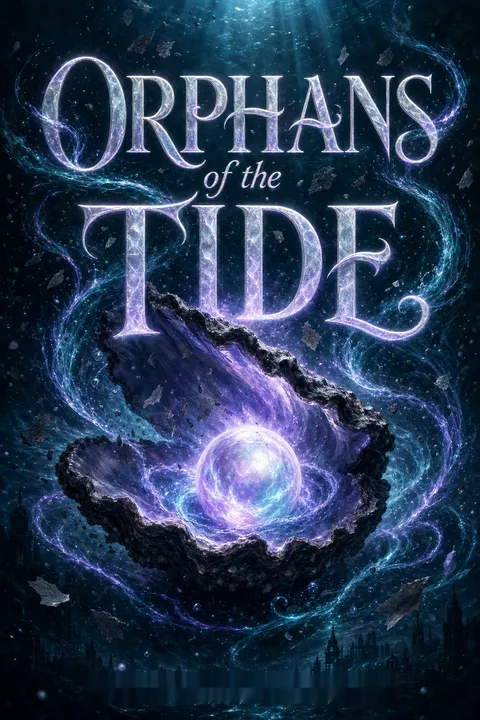


Plot Summary
A Hand Inside the Whale
On a gray morning in the City — a mountain jutting from a drowned world — twelve-year-old inventor Ellie Lancaster1 climbs down to a dying whale beached on a chapel roof. After the creature dies, she cuts into its belly to vent the gas building inside.
A hand shoots from the wound and seizes her ankle. She pulls out a blood-soaked boy who cannot breathe, cannot remember his name, and keeps asking about brothers and sisters. Ellie1 forces air into his lungs until he can draw breath on his own.
Anna,3 her ginger-haired best friend, names the boy Seth.2 Before Ellie1 learns more, Inquisitor Hargrath5 arrives — a towering, one-armed enforcer who declares Seth2 the Vessel, host to the last surviving god. He sedates Seth2 with a dart and drops Ellie1 into the sea.
Condemned Before Sundown
Pulled from the water by a guardsman, Ellie1 races uphill to the Inquisitorial Keep. Along the way, a boy named Finn4 in a green velvet waistcoat trails her, needling about her motives and insisting she cannot save anyone. At the Keep, Lord Castion6 — a whale lord with a mechanical leg built by Ellie's late mother8 — intercepts her and orders her to stay out of it.
The Inquisitors, he warns, execute anyone who helps the Vessel. That evening, the bell tolls: the High Inquisitor has confirmed Seth.2 The execution is happening now, in St. Ephram's Square. Ellie1 runs toward the bonfire where Seth2 sits caged and bruised, crossbows trained on him, the drumbeat hammering across ten thousand cheering spectators.
The Cage Found Empty
Perched on Anna's3 shoulders, Ellie1 watches Seth2 being wheeled atop the bonfire in his cage. She spots Finn4 hanging from a statue at the edge of the square, grinning at her. Every instinct warns against it, but she nods — and Finn4 leaps into the crowd. A torch touches the kindling. Then fireworks detonate from inside the logs, thundering columns of blinding light that drive the crowd backward in a stampede.
When the smoke clears, the cage door hangs open. Seth2 is gone. Ten thousand revelers become ten thousand terrified strangers. A preacher screams that the Enemy walks among them. Ellie1 and Anna3 flee through the chaos, and Ellie1 denies involvement — though Anna3 suspects the fireworks bore Ellie's1 unmistakable signature.
The Sea Obeys a Boy
Seth2 appears unconscious in Ellie's1 workshop that same night — how he got there, she cannot explain. He wants to leave the City and find the real Vessel. When he slips away, Ellie1 tracks him using a luminescent tincture she left by the basement door, following glowing violet footprints to the flooded Cathedral of St. Celestina.
There, perched atop a ruined church organ rising from the water, Seth2 raises his hand and the sea responds — a column of water lifting silently toward his palm.
Then his anger flares and the ocean crashes down, pulling him under. Ellie1 dives in and hauls him out, noticing blue swirling marks moving beneath his skin. Back at the workshop, she experiments with a tub of seawater, discovering that Seth's2 emotions and the ocean move as one.
The Oystery Burns
Finn4 has been following Ellie1 for days — a golden-haired boy only she can see. He warns her that Seth2 endangers her safety, and when she refuses to give Seth2 up, Finn4 shifts his threat to Anna.3 Ellie1 races to the Oystery, a network of wooden platforms above the sea where Anna3 has gone after a fight between them. The platforms are already ablaze, the fire spreading with impossible speed.
Trapped far from shore, Ellie1 and Anna3 cling to each other as rope bridges crumble to ash around them. On the waterfront, Seth2 raises his arms and hurls a wall of seawater over the burning structures. The fire dies — but the crowd sees his blue-swirling skin, and the City now knows the Vessel is alive and nearby.
Three Days or Ruin
After escaping the Oystery through sewers and a desperate leap from the Tower of the Serpent — saved by a hole in the street that Ellie1 claims she made but that was actually created by a force she won't name — Ellie1 returns to the workshop to find Hargrath5 waiting. He has recovered one of her distraction devices at the scene of Seth's2 earlier escape, linking her to the fugitive.
He gives her three days to deliver Seth2 or lead Hargrath5 to him; otherwise he will have her arrested, her workshop torn apart, and her mother's8 legacy ground to nothing. He crushes her mother's8 microscope beneath his boot to prove he means it. Seth2 overhears from the library above and, once Hargrath5 leaves, presses Ellie1 with a question she can no longer dodge.
The True Vessel
Seth2 has noticed that Finn's4 impossible feats — rescuing Seth2 from the bonfire, creating the escape hole in the street — mirror the wish-granting power described in the diary of Claude Hestermeyer, the last known Vessel who died twenty-three years ago. He asks Ellie1 directly: is Finn4 the Vessel? Ellie1 takes his hand and tells him the truth.
Finn4 is not the Vessel — Finn4 is the Enemy, the last god, appearing to her in the form of her dead brother. She is the Vessel, and has been for three years. Every wish she asks of the Enemy weakens her and strengthens it. Seth2 does not flinch. He tells her she is the only person in the City not trying to kill him, and he is not leaving. They agree to find a way to defeat the Enemy together.
The Boy From the Shark
Ellie1 tells Anna3 the truth, and Anna3 grips her hand and holds on. They discover eight pages torn from Hestermeyer's diary — removed from every copy by the Enemy4 as payment for a past wish. Hoping the original is intact, they break into a waterfront stronghold, Seth2 holding the ocean back to expose a submerged entrance.
Inside they find shelves holding possessions of all forty-five past Vessels, a map showing unknown southern islands, and Hestermeyer's original diary — with the same pages gone.
But Anna3 finds something else: a manuscript describing a boy who emerged from a dead shark centuries ago with sea-blue eyes, the power to move water, and the same words on his lips. Seth2 is not the Vessel. He is a surviving god who has been drifting from one sea creature to the next for centuries, searching for his drowned siblings.
The Wish She Didn't Mean
Near the waterfront, Hargrath5 ambushes them. Seth2 hurls him into the sea with a wave, and they flee to Celestina's Hope, an offshore castle accessible only at low tide. Hargrath5 returns drenched and raging, throwing Seth2 into a flooded amphitheater alongside a blood-maddened shark.
Seth2 saves Ellie1 and Anna,3 but the Enemy4 acts independently — collapsing the stone beneath Hargrath5 and another Inquisitor, sweeping both out to sea. Ellie1 screams at the Enemy4 to save them. It refuses to save both — but she realizes later that her wording only asked it to save Hargrath.5 The Enemy4 granted that half of the wish, pocketing the power of another fulfilled request while the other Inquisitor drowns.
Forgiveness as Poison
Ellie1 is weakening — hair thinning and silvering, bruises blooming at the lightest touch. In the workshop at midnight, the Enemy4 comes wearing her brother's face: bloody, crying, begging for an apology. It asks Ellie1 to admit her brother's death was her fault, promising forgiveness.
Exhausted and aching for relief, Ellie1 cradles the golden-haired boy and whispers that she is sorry, that she should have stayed by his side. A rush of warmth floods her chest — then the Enemy4 dissolves in her arms, flaking away like ash. The warmth turns to ice.
She understands now: the Enemy4 feeds on love misdirected toward it rather than toward the real Finn.4 Anna3 grasps what is needed and volunteers to search the orphanage storage for one of the real Finn's4 drawings — the last surviving image of who he actually was.
Hargrath Surfaces
Castion6 wakes Ellie1 before dawn with alarming news: her broken underwater boat has washed up near shore, and the Inquisition wants answers. At the waterfront, the hatch opens and Hargrath5 hauls himself out — trembling, half-drowned, but alive. The Enemy's4 scheme clicks into place.
It fixed the boat, rescued Hargrath5 alone from the storm, and timed his return to expose Ellie1 at the worst possible moment. Hargrath5 points at her and screams that she has been harboring the Vessel. Castion,6 devastated but duty-bound, orders the Inquisitors to march on Ellie's1 workshop. In her mind, the Enemy4 gloats. It granted her wish and used the counter-move to shatter everything she had left.
I Am the Vessel
In the workshop, surrounded by Inquisitors and Castion's6 grief-stricken gaze, Ellie1 makes her choice. She tells them Seth2 is not the Vessel — she is. She has carried the Enemy4 inside her for three years.
Castion6 does not believe her until something shifts behind her face, something inhuman that makes every man in the room step backward. He draws a sword and speaks the sentence of death. Anna3 snatches Hargrath's5 dart-gun from his unbuttoned pocket.
Ellie1 throws the oyster pearl she has been carrying at a metal trigger plate in the ceiling, activating hidden smoke-pipes and springing trapdoors that drop the Inquisitors into a tangle of wire below the floorboards. In the blinding chaos, she and Anna3 burst through the front door, the bell of the Inquisition clanging above.
The Drawing on the Dart
Seth2 reaches Ellie1 at the chapel where they first met. She ties herself to a cracked whale-gargoyle and drops into the water — Seth2 will push the current east toward the underwater boat Anna3 has sent. In the sea, the Enemy4 begins forcing its way out of her, a second heartbeat hammering against hers.
Then a dart thuds into the wood she clings to. Attached — fired from the stolen dart-gun by Anna3 on shore — is a drawing by the real Finn: three children in a boat, the boy with green eyes and a crooked nose, nothing like the Enemy's4 golden impostor.
Ellie1 enters a vision of her real brother — warm, scruffy, freckled like her. She holds the memory like a shield. The Enemy's4 disguise collapses into something gray and inhuman, and she pushes it into the deep. She cuts the rope. Seth's2 current carries her toward the boat.
Epilogue
Seth2 and Anna3 wait in Ellie's1 hidden second workshop, terrified she has drowned. The underwater boat surfaces and Ellie1 hauls herself out, gasping but alive. The Enemy4 still lives inside her — weakened, unable to wear Finn's4 face — but she is herself again, her real brother's memory intact. Anna3 will stay behind to care for the orphans she refuses to abandon.
Ellie1 and Seth2 will take the boat south, toward the mysterious islands on the map no one in the City knows about, toward something entirely new. Before Anna3 leaves, she hugs Ellie1 so fiercely that neither wants to let go. Above the rooftops, fireworks bloom in celebration — Ellie's1 own design — marking an ending the City believes, and a beginning only three people know about.
Analysis
Orphans of the Tide operates on an elegant inversion: in a world where everyone hunts the Vessel, the protagonist IS the Vessel, and the boy everyone wants dead is actually a god. But the novel's real sophistication lies in its treatment of grief as a vector for parasitic exploitation.
The Enemy4 doesn't simply inhabit its hosts — it wears the faces of their beloved dead, converting mourning into dependency. Ellie's1 vulnerability is not weakness of character but the specific architecture of unresolved guilt: a child who believed she should have been able to cure her brother's illness, who left his bedside to search for answers and returned too late. The Enemy4 exploits the gap between who her brother was and who she wishes she could have saved — filling it with an idealized impostor that offers the one thing grief forbids: forgiveness from the dead.
The cure is equally precise. Ellie1 defeats the Enemy4 not through combat or cleverness but through accurate remembering. A colored-pencil drawing — green eyes, not blue; crooked nose, not straight — pierces the impostor's disguise by restoring the actual Finn.4 The novel argues that healthy grief requires holding onto the real person, imperfections included, rather than the perfected ghost that guilt constructs.
This framework extends to every relationship. Hargrath's5 trauma transforms justice into revenge. Castion's6 guilt over Hestermeyer7 makes him overprotect Ellie,1 then condemn her. Anna's3 history in the coal cellar gives her the emotional vocabulary to recognize isolation when she sees it. Seth's2 amnesia — his inability to remember his own lost siblings — makes him the one character who understands Ellie's1 pain without projecting onto it.
Murray structures the story as a mystery that dissolves into an emotional argument: the people we have lost are not honored by guilt or nostalgia. They are honored by being remembered as they were. The pearl inside the oyster is not beautiful because it erased the parasite — it is beautiful because it transformed the relationship between the host and the thing that invaded it.
Characters
Ellie Lancaster
Inventor carrying a secretTwelve-year-old inventor and daughter of the brilliant Hannah Lancaster8, Ellie maintains her late mother's machines for the City but fears she will never match her genius. Beneath her resourcefulness and sharp tongue lies devastating guilt: her younger brother died of illness while she was away searching for a cure, and she has never forgiven herself for leaving him alone. This self-blame makes her compulsively protective of everyone around her—Anna3, Seth2, the orphans—as if each rescue might compensate for the one that matters most. Her workshop mirrors her mind: cluttered with half-finished projects, full of hidden depths, built atop a foundation she refuses to examine. She carries more secrets than any twelve-year-old should, and the weight is beginning to show.
Seth
The boy from the whaleA boy of roughly twelve with sea-blue eyes, no memory, and an instinctive connection to the ocean that terrifies him as much as it fascinates Ellie1. Pulled from inside a whale, Seth is immediately marked for execution by a city that sees in him its ancient enemy. His defining trait is fierce independence tempered by bewildering vulnerability—he blusters about tearing off heads but cannot remember his own name. His longing for lost brothers and sisters he cannot picture mirrors Ellie's1 grief for her brother, making them natural allies. Emotionally direct where Ellie1 is guarded, Seth challenges her defenses simply by asking straightforward questions. Learning to control the water through emotional regulation parallels Ellie's1 need to separate love from guilt, making their struggles mirror images of the same lesson.
Anna Stonewall
Ellie's fiercely loyal friendEllie's1 ginger-haired best friend and the de facto leader of the orphanage children. Practical where Ellie1 is cerebral, Anna expresses affection through action: stealing keys, picking locks, biting anyone who threatens those she loves. She masks deep loyalty behind sarcasm and an obsession with sailors and weapons. Having spent her early orphanage years locked in a coal cellar for misbehavior, Anna understands isolation intimately—and carries tender memories of the small kindnesses that first made her feel less alone. She is hurt most not by danger but by exclusion, and her greatest frustration is Ellie's1 refusal to let others share her burdens.
Finn
The golden boy no one seesA golden-haired boy in a green velvet waistcoat who appears throughout Ellie's1 life, trailing her through markets and alleyways with an unsettling blend of adoration and menace. He is connected to Ellie1 through bonds deeper and more complicated than friendship. Finn alternates between childish vulnerability, wounded sincerity, and flashes of terrifying cruelty—capable of orchestrating miracles and disasters with equal ease. He claims to want only what is best for Ellie1, yet his protection consistently endangers those she cares about. His relationship with Ellie1 holds the story's central mystery: what he truly is, what he truly wants, and why Ellie1 cannot simply walk away from him.
Hargrath
One-armed Inquisitor, hauntedInquisitor Killian Hargrath, the fearsome one-armed enforcer credited with destroying the Enemy twenty-three years ago. His brutality toward anyone suspected of being the Vessel stems from deep trauma: he watched the Enemy4 emerge from his friend Claude Hestermeyer7 and barely survived. His obsessive pursuit of Seth2—and later Ellie1—is driven less by duty than by a desperate need to prove the worst day of his life meant something.
Castion
Whale lord and protectorLord Castion, a whale lord who walks on a mechanical leg built by Ellie's mother8. Warm, diplomatic, and fiercely protective, he serves as Ellie's1 patron and surrogate guardian while hiding a painful history connected to the Enemy4. His love for Ellie1 echoes his inability to save a dear friend long ago, and he carries a burden of knowledge about the past that shapes everything he does. His greatest fear is watching history repeat itself.
Claude Hestermeyer
The previous Vessel's voiceA university professor whose diary entries, interspersed throughout the narrative, chronicle a parallel descent. Grieving the death of his best friend Peter Lambeth, Hestermeyer discovered too late that his vulnerability had made him a host for forces beyond his understanding. His written account serves as both cautionary tale and coded message to whoever might follow in his footsteps, and his final words express faith that a future soul will succeed where he failed.
Hannah Lancaster
Ellie's brilliant late motherEllie's1 late mother, a genius inventor whose machines sustain the City. Dead five years, she casts a long shadow over Ellie's1 self-worth, embodying a standard of brilliance Ellie1 fears she can never reach.
Fry
Bold young orphan scoutA mischievous young orphan who aids Ellie's1 missions with fierce enthusiasm and questionable judgment, treating every errand as a grand adventure.
Ibnet
Fry's partner in mischiefFry's9 fellow troublemaker among the orphans, prone to eating paint and collecting treasure, who eagerly assists in tasks far above his understanding.
Plot Devices
Hestermeyer's Diary
Parallel cautionary narrativeThe diary of Claude Hestermeyer7, the previous Vessel, runs throughout the book as interspersed first-person entries. It chronicles how the Enemy4 appeared to Hestermeyer7 as his dead friend Peter Lambeth, how each wish made him weaker and the Enemy4 stronger, and how each granted wish allowed the Enemy4 a destructive counter-move. Eight pages are missing from every known copy—removed by the Enemy4 as its counter-wish when Ellie1 once asked it to retrieve her brother's drawings. These pages contained whatever Hestermeyer7 discovered about the Enemy's4 true vulnerability. The diary functions as both foreshadowing and instruction manual, its final entry expressing faith that a future Vessel will succeed where he failed.
The Wish System
Powers and corrupts equallyThe mechanism by which the Enemy4 grants the Vessel's requests. Each time Ellie1 asks for help, the Enemy4 fulfills her wish but extracts a cost: she grows physically weaker—paler, thinner, bruised, her hair thinning—while the Enemy4 grows stronger. Additionally, the Enemy4 earns a counter-move of its own, a harmful action that mirrors or subverts the original request. The Enemy4 exploits wording loopholes ruthlessly: asked to save two men, it saves only one and returns him at the worst possible moment. The system creates an agonizing dilemma where every act of desperation feeds the parasite within, and the true price is not fatigue but the misdirection of love itself.
The Underwater Boat
Failed invention becomes escapeEllie's1 perpetually broken submarine, originally conceived to show her brother the sea. Throughout the story it sits defunct in her hidden second workshop—a symbol of unfulfilled promises. The Enemy4 secretly repairs it as part of a counter-wish, using it to return a dangerous adversary5 to the City at the worst moment. In the climax, the same boat becomes Ellie's1 actual means of escape and survival, carrying her to safety after she fakes her own drowning. Its transformation from broken failure to functional lifeline mirrors Ellie's1 own arc from guilt-ridden isolation to hard-won agency.
Finn's Drawing
Memory weaponized against a godA colored-pencil drawing by the real Finn Lancaster4, preserved in the orphanage storage room, showing three children in a boat—Ellie1, Anna3, and a green-eyed boy with a crooked nose. It is the last surviving image of the real Finn4, and it looks nothing like the golden-haired, blue-eyed impostor the Enemy4 wears. Fired to Ellie1 on a dart during the climax, the drawing restores her memory of her actual brother, allowing her to separate genuine love from the Enemy's4 parasitic imitation. The device crystallizes the novel's argument that accurate memory—not idealized grief—is the only defense against emotional manipulation.
Seth's Sea Powers
Divine heritage as raw emotionSeth's2 ability to control the ocean, which responds directly to his emotional state. When calm, he can raise water with precise delicacy; when angry, the sea becomes violent and uncontrollable, threatening to drown him and everyone nearby. The power initially appears supernatural and frightening, suggesting he might truly be the Enemy's4 Vessel. It ultimately reveals his identity as something far older and stranger—a being who has been drifting through sea creatures for centuries, searching for lost family. His learning to govern the water through emotional regulation parallels Ellie's1 need to separate love from guilt, making their struggles mirror images of the same lesson.
Orphans of the Tide Series
Download PDF
Download EPUB
.epub digital book format is ideal for reading ebooks on phones, tablets, and e-readers.








































