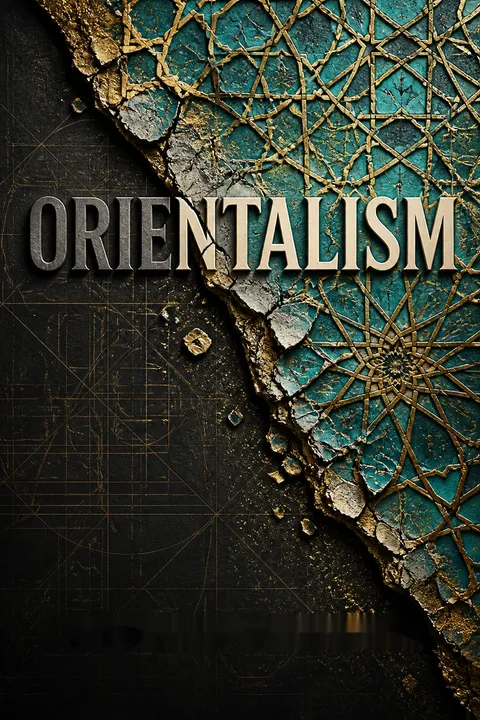

Key Takeaways
1. Orientalism: A System of Power and Knowledge
Orientalism expresses and represents that part culturally and even ideologically as a mode of discourse with supporting institutions, vocabulary, scholarship, imagery, doctrines, even colonial bureaucracies and colonial styles.
Beyond academia. Orientalism is more than just an academic field of study; it is a pervasive Western framework for understanding, managing, and asserting authority over the "Orient." This framework encompasses cultural representations, political ideologies, and a vast network of institutions that collectively shape how the East is perceived and interacted with. It's a discourse that defines the Orient not as it is, but as it is constructed by the West.
Defining the West. This mode of thought has been crucial in defining Europe (or the West) itself, serving as a contrasting image, an "Other" against which European identity, ideas, and experiences are solidified. The Orient became integral to European material civilization and culture, providing a constant point of reference for self-definition and perceived superiority. This dynamic is deeply embedded in Western consciousness.
Interdependent meanings. The concept of Orientalism operates on multiple, interdependent levels:
- Academic: The study, teaching, and research of the Orient by scholars.
- Stylistic: A pervasive style of thought based on an ontological and epistemological distinction between "the Orient" and "the Occident."
- Institutional: A corporate institution for dealing with the Orient through statements, views, descriptions, teaching, settlement, and rule.
This multifaceted nature highlights its systematic and deeply ingrained presence in Western thought.
2. The Orient as a Western Invention
The Orient is not an inert fact of nature. It is not merely there, just as the Occident itself is not just there either.
Man-made entities. Just as human beings construct their own history, they also construct their geography. "Orient" and "Occident" are not natural, pre-existing facts but rather human-made geographical and cultural entities, shaped by a history of thought, imagery, and vocabulary. These constructs gain reality and presence for the West, supporting and reflecting each other in a complex interplay of ideas.
Imaginative geography. This process involves "imaginative geography," where a familiar space ("ours") is distinguished from an unfamiliar one ("theirs"). This distinction is often arbitrary, yet it allows societies to derive a sense of identity negatively, defining themselves by what they are not. For the West, the Orient became a repository for all sorts of suppositions, associations, and fictions, crowding the unfamiliar space beyond its own borders.
Poetic construction. Like Gaston Bachelard's "poetics of space," where a house acquires emotional meaning beyond its objective dimensions, the Orient gains emotional and rational sense through a poetic process. Distant, anonymous reaches are converted into meaning for the West, often through a blend of empirical knowledge and imaginative projection. This imaginative construction is powerful, shaping perceptions and often overriding empirical reality.
3. Power Defines the East-West Relationship
The relationship between Occident and Orient is a relationship of power, of domination, of varying degrees of a complex hegemony, and is quite accurately indicated in the title of K. M. Panikkar's classic Asia and Western Dominance.
Domination, not dialogue. The interaction between the West and the Orient is fundamentally asymmetrical, characterized by Western power and domination. The Orient was "Orientalized" not merely because it was discovered to be "Oriental," but because it could be made Oriental, submitting to Western frameworks. This dynamic is evident in how Western figures spoke for the Orient, rather than allowing Orientals to represent themselves.
Hegemony at work. Orientalism's durability stems from cultural hegemony, where certain cultural forms and ideas predominate through consent rather than overt coercion. This hegemony establishes European identity as superior, reiterating European dominance over Oriental backwardness. This positional superiority allows the Westerner to engage with the Orient from a consistently advantageous stance.
Knowledge as control. Western knowledge of the Orient is generated from a position of strength, and in turn, creates the Orient as a subject of scrutiny, study, and discipline. The Oriental is depicted as something to be judged, managed, and illustrated within dominating frameworks. This knowledge is not neutral; it is instrumental, designed to maintain authority and control over the "Other."
4. The Self-Reinforcing Nature of Orientalist Discourse
One ought never to assume that the structure of Orientalism is nothing more than a structure of lies or of myths which, were the truth about them to be told, would simply blow away.
More than mere falsehoods. Orientalism is not simply a collection of inaccuracies or fabrications that can be easily dispelled by truth. Instead, it is a deeply "knitted-together strength" of discourse, closely tied to enabling socio-economic and political institutions, giving it formidable durability. This system of ideas has remained largely unchanged as teachable wisdom for generations, from academies to colonial bureaucracies.
Material investment. There has been a considerable material investment in Orientalism as a body of theory and practice. This continuous investment transformed Orientalism into an accepted "grid" for filtering the Orient into Western consciousness, multiplying statements about the Orient into the general culture. This makes it a powerful, self-sustaining system.
A closed system. Orientalism functions as a self-containing, self-reinforcing closed system, akin to magic or mythology. Objects are what they are because they are what they are, for all time, based on ontological reasons that empirical evidence cannot dislodge. This "radical realism" designates, names, and fixes what is deemed Oriental, making it appear as reality itself.
5. From Religious Dogma to Scientific Classification
In other words, modern Orientalism derives from secularizing elements in eighteenth-century European culture.
Secular shift. The eighteenth century marked a significant shift, moving the study of the Orient away from narrow religious scrutiny towards secular frameworks. The expansion of the "Orient" geographically and temporally, coupled with a more radical conception of history, loosened the Biblical framework. This allowed for a more detached, comparative study of non-European cultures.
New disciplines. This secularization gave rise to new comparative disciplines like philology, comparative anatomy, and anthropology. Figures like Silvestre de Sacy and Ernest Renan were instrumental in establishing Orientalism on a "scientific and rational basis." They created systematic bodies of texts, pedagogical practices, and scholarly traditions, linking Oriental scholarship directly to public policy.
Reconstituted religious impulse. Despite its secular veneer, modern Orientalism retained a "reconstructed religious impulse," a "naturalized supernaturalism." This impulse resided in the Orientalist's self-conception, their view of the Orient, and their discipline. They saw themselves as secular creators, rescuing and reconstructing the Orient's lost languages and mentalities, much like a divine act of creation.
6. The Textual Lens: Books Over Reality
A text purporting to contain knowledge about something actual, and arising out of circumstances similar to the ones I have just described, is not easily dismissed.
Authority of the written word. A common human failing is to prefer the schematic authority of a text over the disorientations of direct encounters with human reality. This "textual attitude" is particularly prevalent when confronting something unknown or threatening, leading people to rely on what they have read rather than what they experience. Travel books and guidebooks exemplify this tendency.
Self-fulfilling prophecy. If a text claims something is true and experience seems to corroborate it, the text gains immense authority. This creates a complex dialectic where readers' experiences are shaped by what they read, which in turn influences writers to produce more texts confirming these predefined subjects. The text, therefore, can create the very reality it purports to describe.
Napoleon's textual Egypt. Napoleon's invasion of Egypt in 1798 is a prime example. His preparations were "fanatically schematic and—if I may use the word—textual," relying on classical texts and Orientalist experts rather than empirical reality. The resulting Description de l'Égypte became a "master type" for future efforts, demonstrating how Western knowledge and power could engulf and re-create the Orient through textual appropriation.
7. The Orientalist as the Orient's Creator
Knowledge of the Orient, because generated out of strength, in a sense creates the Orient, the Oriental, and his world.
Rescuing from obscurity. The modern Orientalist saw himself as a hero, rescuing the Orient from the obscurity, alienation, and strangeness that he himself had defined. Through meticulous research in lexicography, grammar, and cultural decoding, he reconstructed the Orient's lost languages, customs, and mentalities, presenting them as a "re-vision" of what had disappeared.
Imposing order. The Orientalist's role was to impose a disciplinary order on the vast, amorphous Oriental material. This involved deciphering, interpreting, annotating, codifying, and arranging fragments to create a coherent, knowable "Orient" for Western consumption. The Orient, in this process, became less important than what the Orientalist made of it, reluctant to emerge into reality beyond the pedagogical tableau.
Secular creation. By transporting the Orient into modernity through scientific methods, the Orientalist celebrated his method and position as that of a secular creator, making new worlds as God had once made the old. This act of creation, however, was a sign of imperial power over recalcitrant phenomena, confirming the dominating culture and its "naturalization" of the Orient.
8. Essentialist Stereotypes and Their Enduring Grip
An Oriental man was first an Oriental and only second a man.
Human flatness. Orientalists like Renan and Sacy sought to reduce the Orient to a "human flatness," exposing its characteristics easily to scrutiny and removing its complicating humanity. This involved reducing languages to their roots and then connecting these linguistic roots to race, mind, character, and temperament, creating a one-dimensional portrait.
Reductive categories. Broad, semi-popular designations like "Oriental," "Asiatic," "Semite," "Muslim," or "Arab" became rigid, essentialist categories. These categories denied individuality, historical change, and complexity, forcing attention towards immutable origins rather than plural human realities. Any individual Oriental was primarily defined by these overarching, unchanging types.
Racial and cultural determinism. This radical typing was reinforced by sciences like linguistics, anthropology, and biology, which sought to define a "primary human potential" from which all specific behaviors uniformly derived. The "good" Orient was often a classical, long-gone India, while the "bad" Orient lingered in present-day Asia and Islam, seen as degraded remnants of former greatness.
9. Orientalism as an Instrument of Empire
To colonize meant at first the identification—indeed, the creation—of interests; these could be commercial, communicational, religious, military, cultural.
From contemplation to administration. The nineteenth century saw a fundamental shift in Orientalism from a textual and contemplative approach to an administrative, economic, and military one. The centuries-old designation of the East as "Oriental" transformed from a partly political, doctrinal, and imaginative concept into a colonial space to be penetrated, worked over, and taken hold of.
Knowledge for control. Orientalist knowledge became directly instrumental in justifying and facilitating colonial rule. Figures like Lord Cromer, Britain's representative in Egypt, applied theories about the "Oriental mind" (acquired from the traditional Orientalist archive) to govern millions of Orientals. This knowledge was seen as essential for maintaining paternal British control and revenue.
The expert as agent. The Orientalist evolved into a "special agent of Western power," advising governments on the modern Orient. Scholars like D.G. Hogarth, Gertrude Bell, and T.E. Lawrence, with their intimate knowledge of the Orient, became formulators of policy, blurring the lines between academic study and imperial administration. Their expertise made academic Orientalism effective in the service of empire.
10. The Persistence of Orientalist Dogmas Today
The extraordinary thing is that these notions persist without significant challenge in the academic and governmental study of the modern Near Orient.
Contemporary caricatures. In American popular culture, the Arab Muslim is often reduced to negative stereotypes:
- Incompetent and easily defeated: From camel-riding nomad to a figure of abject failure.
- Menacing and "Semitic": Post-1973, associated with oil crises, hooked noses, and a transfer of anti-Semitic animus.
- Lascivious and dishonest: Portrayed as oversexed degenerates, slave traders, or colorful scoundrels in media.
These images are rarely challenged, allowing for widespread, often virulent, anti-Islamic prejudice.
Academic reinforcement. Even in academic and policy circles, these caricatures are often supported rather than contradicted. Scholars like Morroe Berger and Bernard Lewis, despite their professional standing, perpetuate canonical Orientalist opinions:
- The Middle East lacks great cultural achievement.
- The "Arab mind" is incapable of true thought or objective analysis.
- Islam is a monolithic, unchanging, and inherently hostile ideology.
This "learned perspective" ensures the Orientalist's centrality as the sole interpreter of a region deemed incapable of self-representation.
Social science veneer. Modern American Orientalism has transformed from a philological discipline into a social science specialty, often avoiding literature and focusing on "facts" and "trends." Language study becomes a tool for strategic objectives and propaganda, aiming for "control by divination." This new form, while appearing sophisticated, retains the core cultural hostility and dehumanizing dogmas of traditional Orientalism.
11. A Call for Critical Humanism
Perhaps if we remember that the study of human experience usually has an ethical, to say nothing of a political, consequence in either the best or worst sense, we will not be indifferent to what we do as scholars.
Beyond political scholarship. Orientalism calls into question the very possibility of non-political scholarship and the advisability of too close a relationship between the scholar and the state. It highlights how scholarship, when uncritical, can become an instrument of power, perpetuating stereotypes and intensifying divisions between cultures.
Skeptical critical consciousness. There is a need for scholarship that is not corrupt or blind to human reality, produced by scholars whose allegiance is to intellectually defined disciplines rather than canonically, imperially, or geographically defined "fields." This requires a "skeptical critical consciousness" that constantly scrutinizes methodology and resists doctrinal preconceptions.
Promoting human community. The goal is to avoid "Orientalizing the Orient again and again," which dehumanizes cultures and reduces the scholar's conceit. By recognizing that racial, ethnic, and national distinctions are less important than the common enterprise of promoting human community, scholarship can contribute to human freedom and knowledge, shaping study to fit and illuminate concrete human history and experience.
Review Summary
Orientalism is a seminal 1978 work examining how the West has stereotyped and misrepresented the East, particularly the Middle East and Islam. Said argues that Orientalism is a political discourse supporting colonialism by portraying the Orient as exotic, backward, and inferior. The book analyzes historical texts, literature, and scholarship to show how Western knowledge production justified imperialism. Reviewers praise its groundbreaking critique and lasting relevance, though some find the prose dense or overly academic. Critics note Said's methodology and selectivity, but most acknowledge the work's profound influence on postcolonial studies and cultural criticism.
People Also Read





FAQ
What is "Orientalism" by Edward W. Said about?
- Critical analysis of Western views: "Orientalism" examines how the West, especially Europe and later America, has historically perceived, represented, and dominated the "Orient," primarily the Middle East and Islamic world.
- Orientalism as discourse: Said argues that Orientalism is not just an academic field but a system of thought and a corporate institution that constructs the Orient as fundamentally different and inferior to the West.
- Power and representation: The book explores how these representations have justified colonial and imperial control over Eastern societies, shaping both knowledge and policy.
Why should I read "Orientalism" by Edward W. Said?
- Reveals power-knowledge dynamics: The book exposes how Western knowledge about the Orient is intertwined with imperial power, influencing political and cultural attitudes.
- Challenges stereotypes: It critiques essentialist and stereotypical views of Eastern societies, encouraging readers to question received ideas.
- Influential across disciplines: "Orientalism" has had a major impact on literary criticism, postcolonial studies, anthropology, and political science, making it essential reading for understanding cultural representation.
What are the key takeaways from "Orientalism" by Edward W. Said?
- Orientalism is a discourse: The West’s representations of the East are not neutral but serve to reinforce Western dominance.
- Knowledge and power are linked: Academic and cultural portrayals of the Orient have justified and facilitated imperialism.
- Stereotypes persist: Even as methods change, many Orientalist assumptions about the East’s irrationality and backwardness remain embedded in Western culture and policy.
How does Edward W. Said define "Orientalism" in his book?
- Three interrelated definitions: Orientalism is an academic field, a style of thought based on East/West distinctions, and a corporate institution of power.
- Discourse of power: Said borrows from Foucault to describe Orientalism as a system of knowledge and power that shapes what can be said and done about the Orient.
- Constructed representation: Orientalism is not objective knowledge but a constructed representation that serves Western interests.
What is the relationship between Orientalism and imperialism according to Edward W. Said?
- Mutually reinforcing systems: Orientalism provides the ideological justification and knowledge framework that supports imperial domination.
- Cultural imperialism: It shapes Western attitudes to see the Orient as a place to be controlled, civilized, or exploited.
- Institutional collaboration: Academic Orientalism often works hand-in-hand with colonial administrations and later with government policy and business interests.
Who was Edward W. Said and what influenced his writing of "Orientalism"?
- Personal background: Said was a Palestinian-born scholar and professor at Columbia University, with a deep personal connection to the Middle East.
- Academic and political influences: His upbringing in Palestine, Egypt, and Lebanon, combined with his Western academic training, gave him a unique perspective on East-West dynamics.
- Political engagement: Said’s involvement in Middle Eastern politics, especially after the 1967 Arab-Israeli war, and his humanistic commitment shaped his critical approach to Orientalism.
What are the key historical phases and figures in Orientalism discussed by Edward W. Said?
- Early encounters: European scholars and travelers began constructing knowledge about the Orient during the Renaissance and Enlightenment.
- 19th-century institutionalization: Figures like Silvestre de Sacy and Edward Lane formalized Orientalism in academia and colonial administration.
- 20th-century transformations: Orientalism shifted into area studies and social sciences, especially in the U.S., but retained many of its ideological assumptions.
How did philology and language studies shape Orientalism in Edward W. Said's analysis?
- Foundation of modern Orientalism: Philology, especially the study of Semitic and Indo-European languages, provided a scientific basis for classifying and understanding the Orient.
- Key figures: Scholars like Silvestre de Sacy and Ernest Renan established Orientalism as a rigorous academic discipline.
- Reinforcement of hierarchies: Language studies often linked linguistic families to notions of superiority and inferiority, shaping Western perceptions of the Orient.
What is the "textual attitude" toward the Orient in "Orientalism" by Edward W. Said?
- Reliance on texts: The West tends to understand the Orient through authoritative texts and representations rather than direct experience.
- Self-reinforcing system: This attitude creates a cycle where the Orient is defined as static, exotic, and inferior through repeated textual representations.
- Limits genuine understanding: Said argues that this approach perpetuates stereotypes and prevents a true understanding of the living realities of Eastern societies.
How does Edward W. Said critique the representation of Arabs and Islam in Western culture?
- Negative stereotyping: Arabs are often portrayed as irrational, violent, and incapable of modernity, while Islam is depicted as monolithic and static.
- Popular culture influence: Films, textbooks, and media frequently reduce Arabs and Muslims to simplistic and demeaning images.
- Academic complicity: Even scholarly works sometimes reinforce these stereotypes, failing to account for the diversity and complexity of Arab and Islamic societies.
What is the difference between latent and manifest Orientalism in Edward W. Said's framework?
- Latent Orientalism: Refers to the underlying, stable set of ideas, stereotypes, and assumptions about the Orient that persist over time.
- Manifest Orientalism: Consists of explicit, stated views and scholarly works that change with time but are grounded in latent assumptions.
- Continuity and change: While manifest Orientalism evolves, latent Orientalism remains constant, shaping how the Orient is always perceived and represented.
What solutions or alternatives does Edward W. Said propose to overcome Orientalism?
- Critical scholarship: Encourages interdisciplinary and self-critical approaches that avoid essentializing and stereotypical representations.
- Recognition of hybridity: Emphasizes the interconnectedness and fluidity of cultures rather than fixed oppositions.
- Humanistic engagement: Advocates for scholarship that respects the humanity and agency of Eastern peoples, promoting coexistence and mutual respect beyond Orientalist binaries.
About the Author
Other books by Edward W. Said
Download PDF
Download EPUB
.epub digital book format is ideal for reading ebooks on phones, tablets, and e-readers.








































