

Key Takeaways
Your mind juggles only three complex tasks at once; stop overloading it
Channel capacity is your real bottleneck. In 1956, psychologist George Miller found the mind holds roughly seven simple items (like a phone number) at once. For multidimensional tasks, that number collapses to about three. Selk and Bartow argue that no app, calendar system, or paperless office can hack this limit. The problem is not disorganization, it is overload.
Modern life makes it worse. You are reachable roughly five more hours a day than a decade ago, which builds artificial expectations that you must act on information around the clock. Trying to change everything at once, like the New Year's resolver who overhauls diet and gym simultaneously, guarantees collapse. The authors insist you pick ONE concept from their eight and master it before adding another.
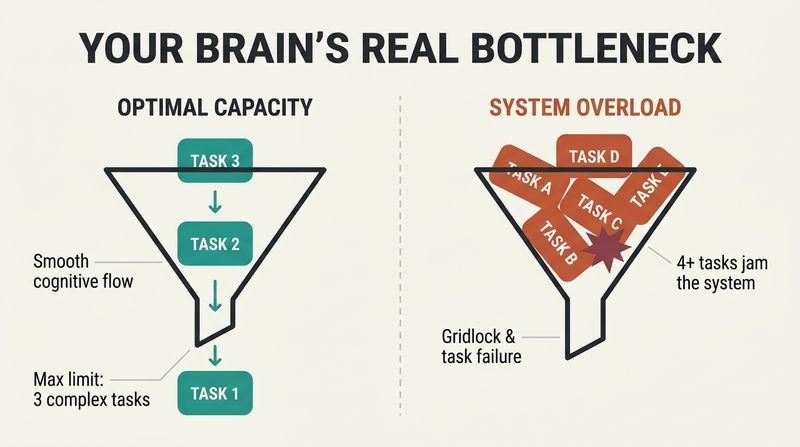
The channel-capacity framing gives self-help an unusually honest floor: it treats willpower failure as a hardware constraint, not a moral one. This dovetails with Roy Baumeister's ego-depletion research and Barry Schwartz's paradox of choice, where more options degrade decisions. One caveat: Miller's magical number has been contested, and later work by Nelson Cowan revised working memory closer to four items. But the practical thrust holds. What's striking is how it inverts productivity culture: the authors reject the premise that busier equals better, aligning with Cal Newport's deep-work argument that fragmented attention carries a steep cognitive switching cost.
Each night, name tomorrow's three priorities and the single one that matters most
Organize Tomorrow Today is the title tool. Spend about five minutes, ideally between lunch and 3 p.m. rather than end of day, writing your 3 Most Important tasks plus the 1 Must, the single non-negotiable priority. Write it by hand: the physical act engages the reticular activating system, flagging the info as important. Alabama coach Nick Saban wins by redefining success as consistent daily preparation, not the scoreboard, calling it the process.
Writing it primes your sleeping brain. This exploits the Zeigarnik Effect, named for a 1920s researcher who noticed waiters recalled unpaid orders vividly but forgot them once settled. Unfinished tasks create mental tension your subconscious works to resolve overnight. One top-ten financial advisor felt his business running him until Tom reminded him he had simply stopped writing his next-day client list. The fix restored control.
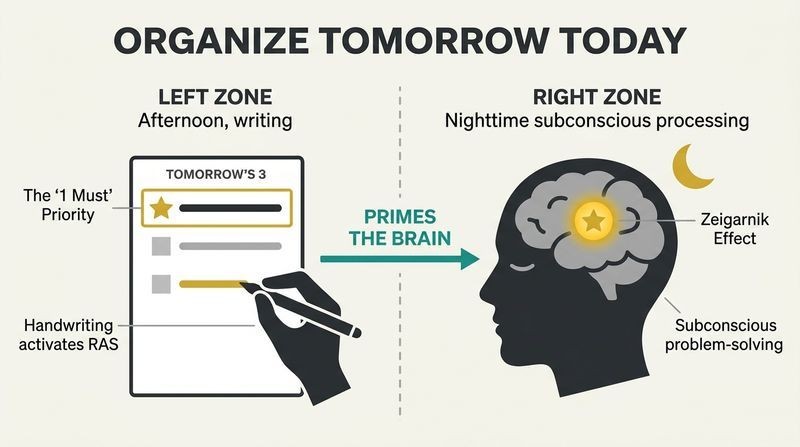
The Zeigarnik claim is real but nuanced: replication studies show the effect strengthens when people feel committed to completing a task, which is precisely what writing a prioritized list manufactures. This also connects to David Allen's Getting Things Done, where the mind is a terrible office and open loops drain attention. What distinguishes this tool is the ruthless cap at three plus one, versus GTD's exhaustive capture. The longhand detail earns its place: Mueller and Oppenheimer's 2014 study found handwritten notes beat typed ones for conceptual retention, likely because writing forces summarization rather than transcription.
Do less, more often: master one change before adding a second
The power of one beats multitasking. Every time you dart to an email and back, your brain pays a switching tax, burning energy and missing detail. Navy SEAL candidate Bobby Gassoff survived Hell Week (only 24 of 240 finished) by narrowing his focus to the next single step rather than the marathon ahead. Wrestling coach Dan Gable, who went 117-1 and won Olympic gold without surrendering a point, called this choosing wisely: never overcommit, move one critical factor.
Nailing it has a precise definition. You have mastered a change only when you complete it 90% of days for three straight months. Peyton Manning, not the strongest-armed 1998 draft prospect, won by burying himself in one thing: the playbook. Edward Jones found every training dollar spent teaching advisors to pick one focus returned $17 in year one.
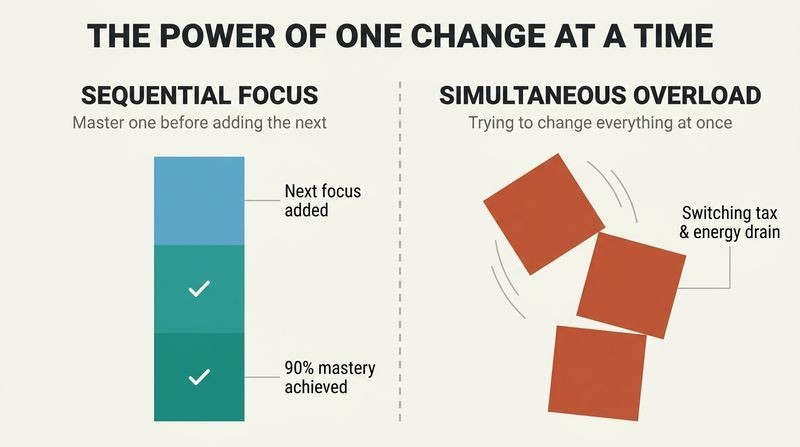
The counterintuitive core here is subtraction as strategy, echoing Greg McKeown's Essentialism and the Pareto principle. The 90%-for-three-months bar is smart behavioral design: it converts a fuzzy aspiration into a measurable, falsifiable commitment, which is exactly what implementation-intention research (Peter Gollwitzer) shows drives follow-through. One tension worth flagging: real jobs demand parallel obligations, and the advice is about where deliberate improvement energy goes, not pretending other duties vanish. The $17 return figure is a single-firm anecdote, not peer-reviewed, so treat it as illustrative. Still, the saying-no discipline, framed as every yes being a hidden no, is genuinely load-bearing.
The more successful you get, the smaller the time unit you must think in
Time maximization beats time management. Management arranges the pieces you have; maximization creates more time. The trick is attacking open space: decide your Open Space Number (say, two minutes), and whenever an unplanned gap that size or larger appears between meetings, knock out one important task instead of checking scores or scrolling. Randy Boll reclaimed three three-minute gaps daily, roughly nine minutes a day, which compounds to about forty extra hours, a full workweek, per year, and vaulted him to number one in his firm.
Prioritize priorities and trim the fat. Fill gaps with your most important task, not the easiest. Set a game clock on meetings. At American Funds, Tom capped calls at seventeen minutes. Beat procrastination with ask and chop: identify the most important task, then chop off just its first step.
The compounding math is the quiet star: small reclaimed intervals accumulate like interest, which behavioral economists would recognize as the same mechanism behind marginal-gains coaching (Dave Brailsford's British Cycling). The distinction between management and maximization is partly rhetorical, since both allocate finite hours, but the reframe usefully shifts attention from scheduling to opportunity cost. The seventeen-minute meeting rule anticipates Parkinson's Law: work expands to fill the time allotted, so shrinking the container forces focus. One risk: hyper-optimizing every gap can crowd out the mind-wandering that fuels creativity, which the authors themselves permit below their threshold, a sensible guardrail.
Habits are never finished; you win or lose small internal battles daily
The 21-day habit myth is a misreading. Maxwell Maltz's 1960 figure described how long plastic-surgery patients took to adjust to new faces, not habit formation. A University College London study found real habits took anywhere from about 18 days to 254 days (2.5 weeks to over 8 months) to reach automaticity. Habits are in constant formation, strengthening or weakening daily.
Three phases, and the fight-thru is decisive. First comes the honeymoon (easy, motivated), then the fight-thru (this is harder than I thought), then second nature. To win a fight-thru: ritualize it at a set time, recognize you are in one, ask how you will feel if you win versus lose, and run a five-year life projection. A minor-league ballplayer who capped pre-game drinking at three beers triggered a cascade, more sleep, better prep, that made him a full-time major leaguer.
Naming the fight-thru is the book's best move, because it externalizes the moment of temptation into a recognizable event you can prepare for, echoing Charles Duhigg's cue-routine-reward loop and Marshall Goldsmith's daily active questions. The two-emotion contrast (win versus lose) leverages loss aversion, a Kahneman staple, since imagined regret often motivates more than imagined reward. The 254-day ceiling is a useful corrective to the tidy 21-day meme that still saturates coaching. What the framework underplays is environment design: sometimes the durable fix is removing the cue entirely (Wendy Wood's work) rather than repeatedly winning a willpower duel.
Judge yourself on effort you control, not results you cannot
Perfectionism poisons evaluation. As you climb, external pats on the back thin out, and if your worth rides on winning, confidence erodes into a downward spiral. The escape is a performance mentality: grade daily effort and process, not outcomes. A young coach Tom took over a team with 21 straight losing seasons; after adding a nightly ritual where each player named one thing done well, they went 20-5 the next year, their first winner in 23 seasons.
The Success Log builds the habit. Daily, in under three minutes: name what you did well, one thing to improve, one action to make it happen, and rate your 3 Most Important effort 1 to 10. This counters problem-centric thinking, our default obsession with faults, because whatever you focus on expands. John Wooden famously watched whether players cut in straight lines, not the score, over sixteen seasons and ten titles.
This is process-versus-outcome orientation, well supported in sport psychology (mastery goals reliably beat ego goals for long-term performance and resilience). The Success Log's insistence on logging strengths first counters negativity bias, the evolutionary tilt to weight threats over gains, which Barbara Fredrickson's broaden-and-build research links to narrowed cognition under negative affect. The neurotransmitter claims (acetylcholine, norepinephrine) borrowed from Norman Doidge are gestural rather than precise, so lean on the behavioral evidence instead. The sharpest practical nuance: results are lagging indicators you cannot directly command, whereas effort is a leading indicator you can, so evaluating the controllable is simply better feedback engineering.
Program your self-image with a daily 100-second Mental Workout
Self-talk shapes self-image, which caps performance. Maltz argued people cannot consistently outperform or underperform their self-image, and since self-image is built from what you repeatedly tell yourself, directing self-talk directs the ceiling. Marathoner Katie Sutton, a breast-cancer survivor, beat the mile-24 mental monsters with an identity statement (Today I am strong, healthy, a beast) and visualization.
The Mental Workout has five steps, about 100 seconds:
1. Centering breath (in six, hold two, out seven)
2. Identity statement (present-tense, aspirational self-talk)
3. Personal highlight reel (visualize three past wins, three upcoming tasks)
4. Identity statement again
5. Centering breath again
Visualize in first person, feel the target emotion, and run it at real speed. Like a muscle, the mind deteriorates without use, so never let two days pass without a rep.
The identity-statement instruction (the further from current truth, the more impactful) is the most debatable claim, and it collides with research on affirmations: Joanne Wood's 2009 studies found grandiose self-statements can backfire for low-self-esteem individuals by highlighting the gap. Process-based visualization (rehearsing the doing) generally outperforms outcome visualization (imagining the trophy), which the highlight-reel design partly respects. The centering breath is on firm ground: extended exhalation activates the parasympathetic nervous system and measurably lowers heart rate, a technique shared with clinical anxiety treatment and elite performance under pressure. Framing the mind as a trainable muscle is motivating shorthand, if biologically loose.
Say less to be believed more; slow down and pause deliberately
Overtalking destroys credibility. The authors' counterintuitive rule: the more you say, the less believable you become, because listeners remember what you say last, and padding forces you onto trivial points. Steve Jobs's seemingly effortless product launches were heavily scripted and rehearsed. Their three-step method: Write it (script it, then attack with the delete key; one main point, max three subpoints, one story each), Slow it (pauses are the biggest confidence signal; take three to seven second pauses), and Triangle it.
The success triangle prepares you. For three days before a talk, rehearse mentally in three separate three-minute sessions per day, timed to meals. The authors claim this is roughly seven times more effective than rote practice, because it recreates real pressure. In conversation, remember communication is about 65% listening, 20% speaking; interrupting proves you are not listening.
The say-less principle aligns with signaling theory: confident communicators tolerate silence because they are not anxiously filling space, and pauses read as authority across cultures. Jobs as exemplar is well-chosen precisely because his spontaneity was manufactured through obsessive rehearsal, puncturing the myth of the natural. The 7x claim for mental rehearsal is stated without citation and should be read as emphatic rather than exact, though motor-imagery research does show visualization meaningfully supplements physical practice. The 65/20 listening split is a memorable heuristic more than a hard measurement. The strongest takeaway is the delete-key discipline, which fights the expert's curse of overexplaining.
Kill the viable excuse: reasonable-sounding reasons quietly lower your standards
Being abnormal means immunizing against three viruses. Normal is average; greatness requires the abnormal. The first virus is the Trap of the Viable Excuse, dangerous precisely because it contains real truth (traffic, fatigue, a difficult market), so you accept the failure without noticing. A veteran hitter whose average dropped 50 points kept explaining he was never a good breaking-ball hitter, until his coach warned they would both be fired; dropping the excuse, he doubled his success against breaking pitches.
Excuses act as a pacifier. They shift attention to the reason rather than the broken commitment, and they rob you of the negative emotion (disappointment, disgust) that actually fuels change. A no-excuse mentality, even when it means apologizing more, converts you from externally motivated to internally motivated, the mark of people you can count on under pressure.
The insight that excuses are effective because they are true is genuinely sharp and underappreciated. It resembles the psychological concept of self-handicapping, where people preemptively supply reasons for failure to protect self-esteem, which research links to worse long-term performance. The authors' reframe of negative emotion as fuel rather than something to suppress aligns with functional accounts of emotion in Susan David's work on emotional agility. A fair critique: the no-excuse ethos can curdle into self-blame or ignore genuine structural constraints, and the authors sensibly carve out defer to intelligence for real emergencies. The line between accountability and toxic hustle culture is thin and worth guarding.
Convert any problem into one improving step within sixty seconds
Relentless Solution Focus (RSF) is the antidote to problem obsession. When trouble hits, the default is problem-centric thought, replaying the problem until it swells and triggers neurotransmitters that dull creativity and drag you toward quitting. RSF flips this: within sixty seconds, identify one step, the +1 solution, that improves the situation even slightly. Not the perfect fix, just any forward increment.
Focus on the controllable. In the 2009 market crash, Tom had panicked advisors list what they could control (effort, tone of voice, communication frequency) versus what they could not (markets, news, elections); 95 of 100 admitted living in the second list. His fix: get on the phone and control just your tone of voice. In the 2011 World Series Game Six, the Cardinals, one strike from elimination, refused to think about losing and focused on a good at-bat, winning and taking the title.
RSF is essentially a rapid cognitive-reframing protocol, kin to solution-focused brief therapy (Steve de Shazer, Insoo Kim Berg), which asks what small sign of progress would look like rather than excavating the problem's history. The sixty-second window is clever behavioral engineering, interrupting rumination before it entrenches, consistent with Susan Nolen-Hoeksema's research showing rumination predicts depression and impaired problem-solving. The claim that merely talking about problems does not produce solutions is a fair pushback against some therapeutic folk wisdom, though it overstates: processing and reframing are not opposites. The controllable-versus-uncontrollable ledger is pure Stoicism, Epictetus's dichotomy of control, repackaged for a trading floor, and none the worse for it.
Analysis
Organize Tomorrow Today is a framework-based business self-help book whose distinctive move is grafting elite sports psychology onto corporate performance. Its authors, a mental-training coach for the two-time champion St. Louis Cardinals and a former basketball coach turned financial-advisor trainer, share a single unifying constraint: channel capacity. Nearly every one of the eight tools is a downstream consequence of the claim that the mind cannot juggle more than about three complex things at once. That gives the book a rare internal coherence; it is less a grab-bag than a system radiating from one premise.
The book's intellectual lineage is worth naming. It leans heavily on John Wooden (process over scoreboard, fundamentals, controlling the controllable) and Charlie Munger (inversion, the Lollapalooza effect of compounding forces). Its psychology borrows selectively: Zeigarnik on open loops, Maltz on self-image, Miller on working memory. Some citations are load-bearing and sound (Mueller and Oppenheimer on handwriting, UCL on habit timelines); others are gestural, especially the neurotransmitter mechanisms and the unsourced multipliers like seven-times-more-effective rehearsal. A discerning reader should treat the behavioral prescriptions as robust and the neuroscience garnish as motivational.
What elevates the book above genre filler is its disciplined minimalism. Where most productivity guides pile on tactics, this one insists you pick exactly one, define mastery precisely (90% for three months), and resist the ambitious reader's urge to do three at once. That restraint is both the thesis and the reading instruction. Its best original coinages, the fight-thru, the viable excuse, Relentless Solution Focus, name moments most people experience but never label, and naming is the first step to controlling.
The limitation is scope: the examples skew toward salespeople, athletes, and high earners, and the no-excuse ethos risks blurring accountability into self-blame while sidestepping structural constraints. Still, as an operating manual for converting knowledge into daily doing, its animating refrain, knowing something changes nothing, doing something does, is honest and durable.
Review Summary
Organize Tomorrow Today receives mostly positive reviews for its practical strategies on productivity and performance improvement. Readers appreciate its straightforward advice, actionable tips, and focus on mental preparation. The book's emphasis on prioritizing tasks, visualizing success, and maintaining a positive mindset resonates with many. Some find the sports analogies and corporate focus less appealing. While some concepts are familiar, many readers find value in the book's structured approach to personal development and its potential for real-life application.
People Also Read





FAQ
What's "Organize Tomorrow Today" about?
- Focus on Improvement: "Organize Tomorrow Today" by Jason Selk and Tom Bartow is about retraining your mind to optimize performance in both work and life.
- Eight Strategies: The book outlines eight strategies to help you prioritize tasks, manage time, and improve mental toughness.
- Mental Training: It combines principles from sports psychology and business to help individuals achieve consistent high performance.
- Practical Techniques: The authors provide practical techniques that can be implemented immediately to enhance productivity and reduce stress.
Why should I read "Organize Tomorrow Today"?
- Proven Methods: The book offers methods used by world-class athletes and successful businesspeople, making it applicable to various fields.
- Actionable Advice: It provides actionable advice that can be easily integrated into daily routines to improve efficiency and effectiveness.
- Mental Toughness: The book emphasizes building mental toughness, which is crucial for overcoming challenges and achieving long-term success.
- Personal Growth: It encourages personal growth by focusing on process-oriented goals rather than just results, fostering a healthier mindset.
What are the key takeaways of "Organize Tomorrow Today"?
- Prioritize Tasks: Focus on the most important tasks each day to maximize productivity.
- Mental Workouts: Use mental workouts to build mental toughness and improve focus.
- Process Over Results: Emphasize process-oriented goals to achieve consistent success.
- Fight-Thrus: Learn to recognize and overcome internal resistance to form lasting habits.
How does the "Organize Tomorrow Today" method work?
- Daily Planning: Spend a few minutes each day identifying the three most important tasks for the next day.
- 1 Must: Choose one task that is non-negotiable and must be completed.
- Channel Capacity: Focus on a limited number of tasks to avoid overwhelm and increase effectiveness.
- Momentum: Completing prioritized tasks early in the day builds momentum and confidence.
What is the "Mental Workout" in "Organize Tomorrow Today"?
- Five Steps: The Mental Workout consists of centering breath, identity statement, personal highlight reel, repeated identity statement, and another centering breath.
- Centering Breath: Helps control stress and focus the mind by regulating breathing.
- Identity Statement: Positive self-talk to reinforce desired qualities and goals.
- Visualization: Visualize past successes and future tasks to prepare mentally for challenges.
How does "Organize Tomorrow Today" address procrastination?
- Ask and Chop: Break down daunting tasks into smaller, manageable steps to overcome procrastination.
- Prioritize Early: Complete the most important tasks early in the day to avoid delays.
- Momentum Building: Use small wins to build momentum and reduce the tendency to procrastinate.
- Accountability: Regular self-evaluation helps maintain focus and accountability.
What is the "Trap of the Viable Excuse" in "Organize Tomorrow Today"?
- Reasonable Excuses: Viable excuses are reasonable-sounding justifications for not achieving goals.
- Lowering Standards: Accepting these excuses lowers personal standards and hinders progress.
- Accountability: The book emphasizes taking full accountability for actions and results.
- Motivation: Use negative emotions from unmet goals as motivation to improve and avoid excuses.
How does "Organize Tomorrow Today" suggest improving communication?
- Write It: Script your presentations to ensure clarity and focus on key points.
- Slow It: Deliver your message at a controlled pace to enhance understanding and retention.
- Triangle It: Use the success triangle method to mentally rehearse presentations for better delivery.
- Confidence Building: Preparation and practice build confidence, making communication more effective.
What are some of the best quotes from "Organize Tomorrow Today" and what do they mean?
- "The noise of the urgent creates the illusion of importance." This quote emphasizes the need to prioritize tasks that truly matter rather than getting caught up in urgent but unimportant activities.
- "Success is not about being brilliant. It is about being consistent." It highlights the importance of consistent effort and process over sporadic brilliance.
- "Knowing something doesn’t change your life. Doing something does." This underscores the book's focus on actionable steps and implementation rather than just acquiring knowledge.
- "If you lose the spirit of repetition, your practice will become difficult." This quote from Zen master Suzuki, included in the book, stresses the importance of repetition in mastering skills.
How does "Organize Tomorrow Today" help with self-evaluation?
- Success Log: Use a Success Log to record daily achievements and areas for improvement.
- Positive Reinforcement: Focus on what you did well to build confidence and motivation.
- Effort Evaluation: Evaluate your effort on a scale to ensure focus on process rather than just results.
- Balanced Scorecard: Maintain a balanced view of strengths and areas for growth to foster continuous improvement.
What is the "Relentless Solution Focus" (RSF) in "Organize Tomorrow Today"?
- Solution Path: Focus on finding a solution path rather than dwelling on problems.
- +1 Solution: Identify one small step that can improve the situation, even if incrementally.
- 60-Second Rule: Shift focus from problem to solution within 60 seconds to prevent negative emotions from taking hold.
- Optimism: Cultivate optimism by consistently seeking solutions and improvements.
How does "Organize Tomorrow Today" suggest handling adversity?
- Embrace Adversity: Accept that adversity is a part of life and use it as an opportunity for growth.
- Mental Toughness: Build mental toughness through consistent practice and mental workouts.
- No Excuses: Develop a no-excuse mentality to maintain accountability and drive improvement.
- Focus on Control: Concentrate on factors you can control to reduce stress and increase effectiveness.
About the Author

Download PDF
Download EPUB
.epub digital book format is ideal for reading ebooks on phones, tablets, and e-readers.








































