


Key Takeaways
Sell options instead of buying them to flip the odds in your favor
The seller has a structural edge. Lawrence cites the trader's rule of thumb that 80 to 85% of all options expire worthless. Most option buyers place a directional bet (a call if they think a stock rises, a put if they think it falls) and need three things to go right: correct direction, sufficient size of move, and correct timing before expiration. Miss any one and the option decays to zero.
Buyer versus seller math. By his framing, an option buyer has roughly a one-in-three chance of profit, while the seller who collects the premium has a two-in-three chance. The seller wins whether the stock rises, stays flat, or even drops slightly, because time decay quietly erodes the contract's value in the seller's favor. This asymmetry is the philosophical foundation of the entire book.
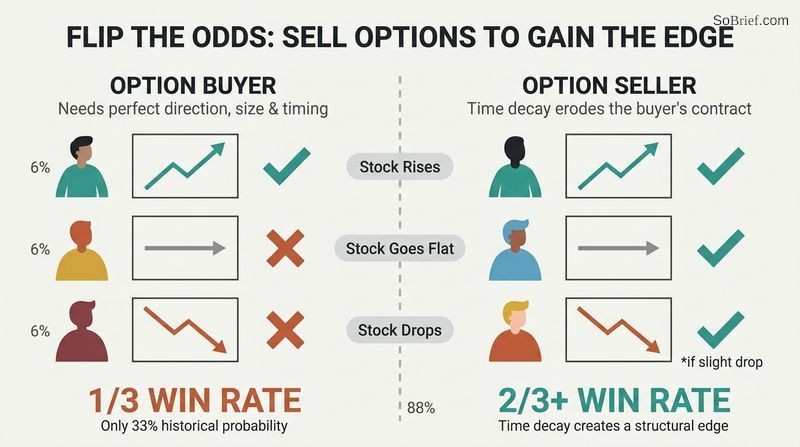
The 80 to 85% figure is widely repeated in retail options circles but is often misunderstood. Data from the OCC suggests only about 20 to 30% of options are actually exercised, while roughly 10% expire worthless and the majority are closed out before expiration. So 'expire worthless' is not the same as 'seller profits,' since a seller can still be forced to buy back a losing position for far more than the premium collected. Lawrence's edge is real but conditional: sellers trade many small, high-probability gains against occasional large losses, the classic 'picking up pennies' profile that demands the hedging discipline he insists on.
Buy one long-dated put as insurance, then sell weekly puts against it
The KaChing Formula in four steps. This is the book's centerpiece. (1) Pick a stock you understand. (2) Buy a long-dated protective put expiring in roughly 120 days, past the next earnings report. (3) Sell a put expiring the following Friday and pocket the premium instantly. (4) Manage, rinse, and repeat weekly.
The ice cream tub analogy. The long put is like a five-gallon tub of ice cream costing $50 that yields 100 scoops sold at $3 each, or $300 total. Each weekly put you sell is one scoop. In his Charles Schwab example, a $70 put expiring in 120 days costs $4.20, while each week he sells the at-the-money put for around $1.28. Over the tub's life those weekly 'scoops' vastly outearn the cost of the insurance.
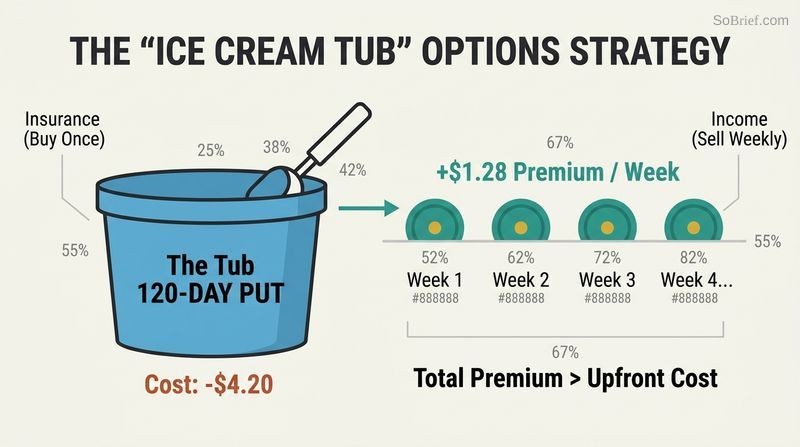
Structurally this is a diagonal put spread: a long-term long put paired with rolling short-term short puts. What Lawrence adds is a psychological reframe (income generation rather than speculation) plus strict rules about earnings and rolling. The genius is decoupling the two time horizons: the short put decays fast (good for the seller) while the long put decays slowly (preserving the hedge). One caution absent from the ice cream metaphor: the long put is a real, recurring cost that eats into returns during flat or rising markets, and if the stock grinds sideways for months, the insurance premium can quietly outpace the scoops collected.
Time decay is the option seller's silent, dependable paycheck
Theta works while you sleep. Theta measures how fast an option loses value as expiration approaches, and it accelerates in the final days. For a buyer this is a tax; for a seller it is income. Lawrence deliberately pairs two opposite decay rates: the weekly put he sells melts fast over seven days (he keeps that premium), while the 120-day insurance put he owns barely decays at all.
Why weeklies amplify this. Because weekly options have only days of life left, their time value evaporates quickly, which is exactly what a seller wants. He closes long protective puts about 30 days before expiration precisely because that is when their decay starts to speed up and turn against him. The whole formula is an engineered mismatch: harvest fast decay, avoid slow decay's acceleration.
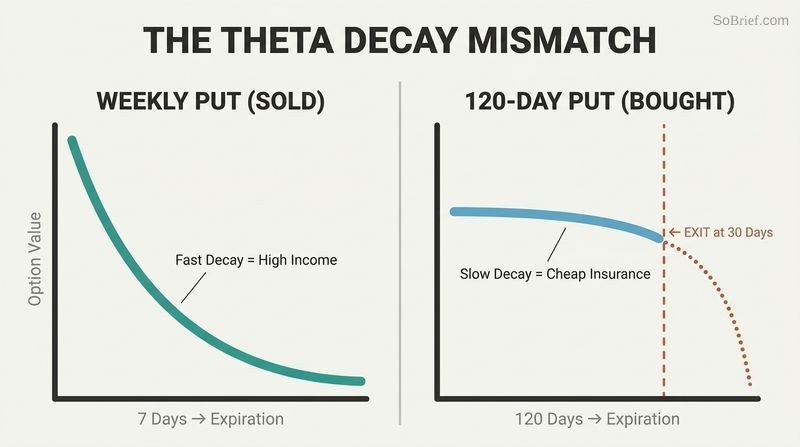
Theta is the closest thing options trading has to compound interest for a seller, but it never comes free. It is compensation for taking on gamma risk (the danger that a sudden large move blows past the position faster than decay can offset). Near expiration, short options carry the highest theta and the highest gamma simultaneously. That is why the strategy generates steady small wins punctuated by occasional sharp reversals, which is precisely the scenario Lawrence's long-put hedge and rolling mechanics are built to survive. The metaphor of decay as a 'friend' is apt, but that friend keeps company with a volatile one.
Weekly options pay you fifty-two Fridays a year, not twelve
Four paydays a month, not one. Weekly options (introduced on individual equities in June 2010, starting with names like Apple, Bank of America, and Citigroup) expire every Friday rather than monthly. That means 52 selling opportunities a year instead of 12, and 52 chances to reassess risk on a short seven-day leash.
Smaller premiums, bigger totals. Each weekly premium is lower than a monthly one, but selling four times compounds. In his Charles Schwab example, selling the weekly put at $1.20 four times yields $480 per contract, versus $262 for the equivalent monthly put, roughly 83% more income for the same month. Hundreds of high-volume stocks now offer weeklies, and the short window makes trading the news and cutting losses far faster than the sluggish monthly cycle allows.
The frequency advantage is real, yet it carries hidden friction that the raw premium comparison omits: transaction costs, bid-ask slippage, and the time cost of managing 52 cycles versus 12. Weeklies also concentrate gamma risk into tight windows, meaning an earnings surprise or macro shock can inflict outsized damage on a position with days to live. The 83% edge assumes the seller reliably captures four clean weeks, which real markets rarely deliver. Still, the core insight (that frequency plus fast decay favors the disciplined seller) mirrors why insurance companies prefer writing many short policies over few long ones: more shots at the law of large numbers.
Never sell a put naked; the long put is why you sleep
Protection turns terror into a shrug. The entire 'sleep at night' promise rests on always owning the long-dated put beneath the weekly put you sell. If the stock craters, the short put you sold loses money, but the protective put you own rockets in value to offset it. Lawrence says he slept fine during the March 2020 COVID crash because his long-term protection kicked in.
Chewy in the real world. He walks through a Chewy trade where the stock plunged from $49.64 to $38.21 in a week, forcing him to buy back short puts at a $6,838 loss. But his $45 protective puts surged, gaining $10,036, more than covering it. Across seven volatile weeks he netted $8,027, about $1,146 per week. The lesson: define your maximum loss before you enter, and let the hedge absorb the disaster.
This is the discipline that separates Lawrence's approach from the naked-put selling that periodically wipes out overconfident retail traders and even funds (the 2018 'Volmageddon' erased short-volatility products overnight). Defining maximum loss in advance is the single most important risk practice in any derivatives strategy, echoing Nassim Taleb's warning about strategies that eat like chickens and defecate like elephants. The trade-off is honest: the hedge caps catastrophic loss but also drags on returns every calm week. Buying insurance you rarely 'use' feels wasteful until the one week it saves your account, exactly the cognitive trap that makes most people underinsure.
A losing week is a roll, not a loss, if the stock keeps its edge
Rename and roll. Lawrence refuses to call a bad week a loss, preferring 'a temporary investment into someone else's account.' The mechanic behind the wordplay: when a short put moves against you, you buy it back at a loss and immediately sell next week's put, often collecting enough fresh premium (especially when volatility is high) to offset the buyback.
Yeti proves the point. In one Yeti sequence, week three produced a $1,676 loss when the stock dropped. But he rolled forward and week four's sale, as Yeti bounced back near $93, netted $2,253. Over nine weeks he averaged $585 a week despite two red weeks. The rule that gates all of this: only roll if the stock still has an 'edge.' If it makes a fresh low on heavy selling volume, the edge is gone and you exit, taking the loss for real.
Rolling is a legitimate and powerful tool, but the linguistic reframe deserves scrutiny. Calling losses 'temporary investments' can shade into the sunk-cost fallacy and loss aversion that Lawrence himself warns against elsewhere. Rolling a losing put down and out can convert a small defined loss into a larger, deferred one if the stock keeps falling, a pattern that has blown up traders who 'rolled forever' into a crash. The saving discipline is his edge condition: exit on new lows with volume. That objective trip-wire is what keeps rolling from becoming denial dressed up as strategy.
Cap each trade at 3 to 5% and deploy only a fraction of your capital
Position sizing is the real safety net. Lawrence targets no more than 3 to 5% of his portfolio at risk on any single trade, with most around 3%. On a $50,000 account he might allocate $1,500 maximum risk per position and deploy only about $10,000 of capital in a given week, keeping the rest in reserve so no single trade can 'blow up' the account.
Diversify across sectors, not just stocks. Because risk per trade is small, he can run six or seven positions simultaneously, spread across different sectors like banking, cloud computing, energy, and ecommerce. He deliberately avoids loading up on multiple names in one sector, since a sector-wide selloff would drag them all down together. His stated goal is modest and mechanical: 0.5 to 1% per week, which compounds to 26 to 52% annualized.
The sizing rule is the least glamorous and most important content in the book. Ruin in trading almost never comes from being wrong; it comes from being wrong while oversized. Lawrence's 3 to 5% cap aligns with the spirit of the Kelly criterion and professional risk desks, which fractionalize bets precisely because sequence-of-returns risk can destroy an account before its edge plays out. The 26 to 52% annual target, however, should raise eyebrows: it dwarfs the S&P's historical ~10%, and sustainable double-digit-per-month income claims are the reddest of flags in retail finance. The strategy's real, more modest value is generating steadier cash than buy-and-hold, not beating the market severalfold.
Your childhood money story silently runs your trading account
Beliefs formed by age seven still trade for you. Before any strategy, Lawrence insists you audit your relationship with money, because scarcity or abundance wiring drives every decision under pressure. His own $1.4 million margin call during the dot-com collapse (Cisco cratered, his account was liquidated) traced back to a divided upbringing: a mother who preached invention and abundance, a father who snapped that money was never discussed, and an illness that installed a 'don't do too much' brake. The result was a lifelong pattern of attracting wealth and then handing it back.
Rewire deliberately. He recommends journaling early memories, reframing negative self-talk into curiosity ('I wonder how to do this'), keeping a gratitude log, and even a 'Money Everywhere' habit of collecting found coins to reinforce a felt sense of abundance.
Embedding money psychology in an options manual is unusual and, on the evidence of behavioral finance, justified. The 'confused brains with a bull market' insight is a folk version of the fundamental attribution error and hindsight bias: attributing to skill what was really market beta. Where the book drifts into contestable territory is the law-of-attraction flavor (money 'flowing like a river,' the subconscious not distinguishing vision boards from reality). These claims lack empirical support and can breed magical thinking dangerous in a leveraged arena. The durable kernel, well supported by research on financial anxiety and decision-making, is that emotional regulation and a written plan beat willpower when real money is on the line.
The big funds farm retail emotion; trade the chart, not the talking heads
Meet the Analyst Cartel. Lawrence argues large institutions engineer sentiment. His Priceline story: after a blowout earnings report sent shares up $65 after hours, Goldman Sachs issued a pre-open downgrade citing 'softness in Europe,' the stock sank over $100, and sixty days later Goldman upgraded on that same European softness as it 'looked better.' The pattern rewards those who watch what institutions do, not what they say.
Read gaps and money flow. He distinguishes 'Amateur Gaps' (retail piling in at the top on FOMO after a talking head's tip, dubbed 'dumb money') from 'Professional Gaps' (sudden institutional moves on volume). His favorite tell is the accumulation/distribution rating in Investor's Business Daily, which reveals whether big money is quietly buying or selling. The governing mantra: the trend is your friend, so swim with the wave, never against it.
The 'Cartel' framing overstates coordination (analyst timing is more incentive-misalignment and herding than conspiracy), but the underlying caution is sound: sell-side research and financial media are not neutral, and retail order flow is genuinely a source of institutional profit, as payment-for-order-flow arrangements make explicit. The Priceline anecdote is a vivid, if unfalsifiable, illustration of narrative arbitrage, where the same fact justifies opposite calls depending on positioning. Lawrence's practical remedy (follow price, volume, and accumulation signals rather than commentary) aligns with a large literature on the unreliability of forecasts and the value of trend-following. The risk is trading price action alone can whipsaw you in choppy, trendless regimes.
Pick boring uptrenders between $20 and $400, and skip Apple
The ideal KaChing stock is calm and liquid. Lawrence wants steady climbers or sideways 'coilers,' not bottle rockets that blow past his risk threshold. His selection filters:
1. Priced above $20 (cheaper names get little institutional love and thin premiums).
2. Below about $400 (pricey stocks lurch too violently for his taste).
3. Highly liquid, ideally with $1 strike increments for tighter spreads and less risk.
4. Showing an up or sideways consolidation over a three-month window.
5. Avoid Apple and Chinese stocks.
Why avoid Apple? Because it is so widely held that when it runs, large funds must sell to stay under ownership limits, making it, in Jim Cramer's phrase, great to own but lousy to trade. He never trades through earnings, exiting a few days before and re-entering after the dust settles.
The stock-selection rules quietly encode a volatility preference: KaChing profits most from low-to-moderate implied volatility with a mild upward drift, and suffers in violent or crashing tapes. Avoiding earnings is textbook risk management, since implied volatility crush and gap risk around reports can overwhelm a seven-day position. The Apple avoidance is idiosyncratic and debatable (many income traders love its deep, liquid options chain), but it reflects a coherent philosophy: match the instrument to the strategy. The insistence on $1 strike increments is an underrated, professional-grade detail, tighter spreads mean smaller max loss and better risk-reward, which matters enormously when your weekly edge is measured in cents.
Write the plan before the trade so the market can't hijack your emotions
A trading plan is pre-decided courage. Lawrence defines it as a written, unemotional blueprint covering capital allocation, risk per trade, profit-taking rules, and stock criteria. When a market shock hits, you do not deliberate; you execute what you already decided. If you have ever woken in a sweat over a position, he says, you are overexposed and planless.
His concrete rules. Take profits once 80% of a premium is banked (40 to 50% in wild markets), asking whether you would re-enter the trade for the crumbs still left. Never trade through earnings. Favor fewer contracts to reduce risk. Keep a journal of every trade in green ink for wins and red for temporary losses, because most traders have no idea whether they are actually making money. The plan is what converts a two-in-three statistical edge into realized cash.
This is the operational heart of the book and its most transferable lesson beyond options. Pre-commitment devices (deciding rules in a cool state to bind your future hot state) are among the most robust findings in behavioral economics, from Ulysses lashed to the mast to modern automatic-savings defaults. The journaling mandate doubles as a feedback loop that most amateurs skip, and without it, learning is impossible because outcomes blur with luck. The 80% profit-taking rule is a smart formalization of diminishing returns on held premium. The plan's real function is not prediction but emotional outsourcing: replacing in-the-moment fear and greed with rules written by a calmer version of yourself.
Analysis
This is a strategy-plus-mindset trading manual built around a single mechanical idea the author brands the KaChing Method: sell weekly put options for income while holding a long-dated put as insurance. Its structure is unusual for the genre, bookending concrete tactics with two soft chapters on money psychology and market behavior, and closing with bonus material on spreads, the option Greeks, and small accounts. The pedagogy is anecdote-driven (a career-ending margin call, Priceline manipulation, Chewy and Yeti trade logs), which makes abstract mechanics tangible.
The book's genuine strengths are three. First, it centers risk management rather than profit fantasy: position sizing at 3 to 5%, mandatory hedging, and never trading through earnings are professional habits rarely emphasized in retail material. Second, the diagonal-spread structure it teaches is legitimate and internally coherent, exploiting the real asymmetry between fast short-dated theta and slow long-dated theta. Third, the insistence on a written plan and trade journal addresses the actual reason most retail traders fail, which is emotional, not analytical.
The weaknesses are equally clear. The headline claims (80 to 85% of options expire worthless, one-in-three versus two-in-three odds, 26 to 52% annual returns) are simplified to the point of being misleading; 'expire worthless' conflates with 'seller profits,' and sustainable multiples of market returns are the signature of survivorship bias. The law-of-attraction and vision-board content sits awkwardly beside the rigorous risk talk. And the strategy has a hidden regime dependence: it prints money in calm, drifting-up markets and grinds or bleeds in violent or trendless ones, a fragility the sanguine tone underplays.
Read critically, the book delivers a sound, hedged income framework and, more valuably, a discipline system. Read uncritically, its return promises could lure the very overconfidence its author's own margin-call story warns against. The best reader takes the mechanics and the risk rules, and leaves the manifestation.
Review Summary
Options Trading by T.R. Lawrence is highly regarded by readers for its beginner-friendly approach to options trading. Reviewers praise the book's focus on trading psychology, clear explanations of strategies, and practical examples. Many found the weekly options strategy particularly useful. Readers appreciate the author's emphasis on developing a trading plan and managing risk. Some noted the book's value as a reference for both novice and experienced traders. While a few reviewers felt certain sections could use more explanation, the overall consensus is that the book provides valuable insights into options trading.
Glossary
KaChing Method (KaChing Formula)
Hedged weekly put-selling income strategyThe author's core strategy: choose a liquid stock, buy a long-dated protective put (about 120 days out, past next earnings) as insurance, then repeatedly sell weekly puts against it to collect premium income. The long put caps maximum loss while the fast-decaying weekly puts generate cash. Structurally it is a diagonal put spread run on a rolling weekly cycle.
Theta
Rate of option time decayA measure of how much an option's value erodes each day as expiration nears, accelerating in the final days. For option sellers this decay is income, making theta 'the seller's best friend.' The KaChing Method deliberately pairs a fast-decaying weekly short put with a slow-decaying long-dated protective put to profit from the mismatch.
Delta
Option price sensitivity and probability proxyMeasures how much an option's price moves for a $1 move in the underlying stock, ranging 0 to 1 for calls and 0 to -1 for puts. It also approximates the probability of expiring in-the-money. The author buys protective puts around 25% delta (roughly 75% chance of expiring worthless) and raises it to 35 to 40% in aggressive conditions.
Analyst Cartel
Institutions manipulating retail sentimentThe author's term for large banks, funds, and analysts whose upgrades, downgrades, and heavy trades engineer market sentiment to shake retail traders out of positions, then reload at better prices. His Priceline example: a post-earnings downgrade tanked the stock, followed by an upgrade sixty days later that sent it back up.
Amateur Gap vs. Professional Gap
Retail versus institutional price jumpsAn Amateur Gap is a price jump on heavy volume driven by retail FOMO buying at tops after a media tip, called 'dumb money.' A Professional Gap is a sudden institutional move, often against the crowd, identified by volume. Recognizing which is which helps a trader follow smart money and avoid buying at the top.
Temporary investment into someone else's account
Reframe for a trading lossThe author's deliberate euphemism for a losing trade, based on his belief that changing your language changes your mindset. The word 'temporary' signals that a loss can often be rolled forward into the next week's premium sale, recovering the money as long as the underlying stock still has a valid 'edge.'
Money Everywhere
Abundance-mindset coin-collecting habitA mindset exercise the author adopted from a friend who taught his son to pick up found coins and bills on walks, reinforcing the belief that money is abundant and left lying around. The author keeps a kitchen 'money everywhere nook' of found cash to condition an abundance mindset before trading.
FAQ
1. What’s "Options Trading: How to Turn Every Friday into Payday Using Weekly Options!" by T.R. Lawrence about?
- Weekly Options Income Focus: The book teaches readers how to generate consistent weekly income by selling weekly options, aiming to turn every Friday into a payday.
- Sleep-Worry-Free Trading: T.R. Lawrence emphasizes risk management and strategies that allow traders to sleep well at night, avoiding margin calls and catastrophic losses.
- Mindset and Psychology: The book covers the importance of understanding your relationship with money and developing a positive trading mindset as foundational to success.
- Step-by-Step KaChing Method: Lawrence introduces the "KaChing Formula," a systematic approach to selling weekly options with built-in protection and trade adjustments.
- Comprehensive Guide: The book is suitable for both beginners and experienced traders, covering everything from basic options concepts to advanced strategies and trading plans.
2. Why should I read "Options Trading: How to Turn Every Friday into Payday Using Weekly Options!" by T.R. Lawrence?
- Consistent Weekly Income: The book provides a practical, repeatable method for generating weekly cash flow from the stock market, regardless of market direction.
- Risk Management Emphasis: Lawrence’s approach prioritizes capital preservation and stress-free trading, making it ideal for those wary of high-risk strategies.
- Mindset Transformation: Readers learn how to identify and overcome limiting beliefs about money, which can directly impact trading success.
- Actionable Strategies: The book offers clear, actionable steps, including trade selection, risk parameters, and adjustment techniques, making it easy to implement.
- Suitable for All Account Sizes: Whether you have a small or large account, the book provides tailored advice and strategies to fit your situation.
3. What are the key takeaways from "Options Trading: How to Turn Every Friday into Payday Using Weekly Options!" by T.R. Lawrence?
- Weekly Options Selling Works: Selling weekly options can provide more frequent income opportunities and higher annualized returns compared to monthly options.
- Protection is Essential: Always use long-dated puts as insurance to cap downside risk and avoid sleepless nights.
- Mindset Drives Results: Your beliefs and emotions about money and risk play a critical role in trading outcomes; cultivating a growth mindset is essential.
- Trading Plan is Non-Negotiable: A written, unemotional trading plan is vital for consistent execution and emotional control.
- Adjust and Diversify: Regularly adjust trades as needed and diversify across sectors to manage risk and maximize opportunities.
4. How does the "KaChing Formula" for weekly options work according to T.R. Lawrence?
- Step 1: Stock Selection: Choose a stock with weekly options, good liquidity, and a favorable trend or consolidation pattern.
- Step 2: Buy Long-Dated Put: Purchase a protective put option with 90–120 days to expiration as insurance against large losses.
- Step 3: Sell Weekly Put: Sell a short-term (weekly) put option to collect premium income, repeating this process each week.
- Step 4: Manage and Adjust: Monitor positions, roll trades as needed, and adjust strikes or exit if the stock loses its edge.
- Risk Control Built-In: The difference between the short and long put defines your maximum risk, allowing for precise position sizing.
5. What is the importance of mindset and psychology in options trading, as discussed in T.R. Lawrence’s book?
- Money Mindset Shapes Behavior: Your beliefs about money, formed in childhood and through life experiences, directly influence your trading decisions and risk tolerance.
- Emotional Control is Key: Recognizing and managing emotions like fear, greed, and regret is crucial to avoid impulsive or self-sabotaging trades.
- Growth Mindset Encouraged: The book advocates for a growth mindset, viewing setbacks as learning opportunities and focusing on continuous improvement.
- Journaling and Reflection: Keeping a trading journal helps identify patterns, reinforce positive behaviors, and maintain discipline.
- Supportive Environment Matters: Surrounding yourself with positive, like-minded individuals can reinforce good habits and help overcome negativity.
6. What are the main advantages of trading weekly options versus monthly options, according to T.R. Lawrence?
- More Frequent Income: Weekly options allow for up to four times as many trades as monthly options, increasing income opportunities.
- Faster Time Decay: Weekly options experience rapid time decay, benefiting option sellers as premiums erode quickly.
- Lower Premiums, Lower Barriers: Weekly options typically have lower premiums, making them accessible for smaller accounts.
- Better Risk Management: Shorter time frames allow for quicker adjustments and more precise risk control.
- Increased Liquidity: Many popular stocks now offer weekly options with high trading volumes, ensuring efficient trade execution.
7. How does T.R. Lawrence recommend managing risk and ensuring "sleep-worry-free" trading with weekly options?
- Always Use Protection: Buy a long-dated put as insurance for every trade to cap potential losses.
- Limit Position Size: Never risk more than 3–5% of your portfolio on any single trade, spreading risk across multiple positions.
- Diversify Across Sectors: Avoid concentration in one sector to reduce the impact of sector-specific downturns.
- Adjust and Roll Trades: If a trade moves against you, roll the position to the next week or adjust strikes to manage losses.
- Follow a Written Plan: Stick to a predefined trading plan to remove emotion and ensure consistent, rational decision-making.
8. What are the essential components of a successful trading plan in "Options Trading" by T.R. Lawrence?
- Capital Allocation: Define how much of your portfolio is dedicated to weekly options and set maximum risk per trade.
- Clear Profit Goals: Set realistic weekly and annual cash return targets (e.g., 0.5–1% per week).
- Position Sizing Rules: Determine the number of contracts and spread width based on risk tolerance and account size.
- Entry and Exit Criteria: Specify when to enter, take profits, roll, or exit trades, including rules for avoiding earnings announcements.
- Record-Keeping: Maintain a detailed trade journal to track performance, adjustments, and lessons learned.
9. How does T.R. Lawrence suggest selecting the best stocks for the Weekly KaChing Formula?
- Price Range Criteria: Focus on stocks trading above $20 and generally below $400 for manageable risk and good premiums.
- Avoid Certain Stocks: Steer clear of Apple (due to unpredictable trading behavior), most Chinese stocks (due to transparency issues), and illiquid ETFs.
- Look for Trends or Consolidation: Favor stocks in steady uptrends or sideways consolidation patterns over highly volatile or "bottle rocket" stocks.
- Check Liquidity and Premiums: Ensure the stock has weekly options with tight bid-ask spreads and sufficient trading volume.
- Use Sector Rotation: Diversify across sectors and use tools like Investor’s Business Daily to identify sector leaders and hot industries.
10. What are the key trade adjustment techniques in the KaChing Method for weekly options?
- Rolling Trades Forward: If a short put is threatened, buy it back and sell the next week’s put, often at a similar or lower strike, to offset losses.
- Double Dipping: In strong trends, close profitable short puts early and sell another put in the same week for extra premium.
- Adjusting Protection: If the stock moves significantly, adjust the long put to maintain appropriate risk coverage.
- Exit When Edge is Lost: If the stock breaks key support or loses its favorable pattern, exit the trade and move to a better candidate.
- Keep Detailed Records: Track all adjustments in a journal to evaluate effectiveness and refine your approach.
11. How can traders with small accounts use the KaChing Method from T.R. Lawrence’s book?
- Focus on Liquidity: Trade only highly liquid stocks with tight bid-ask spreads to minimize transaction costs.
- Start Small: Begin with 1–2 contracts and scale up as experience and account size grow.
- Tight Spreads for Lower Risk: Choose stocks with $1 strike increments to keep spread width and risk manageable.
- Mind Pattern Day Trader Rules: For accounts under $25,000, limit trades to avoid regulatory restrictions.
- Diversify and Stick to Plan: Even with a small account, diversify across sectors and strictly follow your risk and position sizing rules.
12. What are the most important options concepts and "Greeks" explained in "Options Trading" by T.R. Lawrence?
- Delta: Measures how much an option’s price moves relative to the underlying stock; used to select both long puts (for protection) and short puts (for premium).
- Theta: Represents time decay; weekly options sellers benefit as options lose value rapidly approaching expiration.
- Vega: Indicates sensitivity to changes in volatility; higher volatility increases option premiums, impacting both risk and reward.
- Gamma: Shows how much Delta changes with price movement; important for understanding risk in fast-moving markets.
- Rho: Measures sensitivity to interest rates; less relevant for most weekly options traders but included for completeness.
Bonus: What are the best quotes from "Options Trading: How to Turn Every Friday into Payday Using Weekly Options!" and what do they mean?
- "The goal of a successful trader is to make the best trades. Money is secondary." – Alexander Elder: Focus on process and discipline, not just profits.
- "Luck is a preparation meeting opportunity." – Oprah Winfrey: Success in trading comes from preparation and readiness, not chance.
- **"Don't ever make the mistake of believing that market success has to come to you fast. Trade small, stay in the game, persist, and
Download PDF
Download EPUB
.epub digital book format is ideal for reading ebooks on phones, tablets, and e-readers.








































