
Plot Summary
Born for Spare Parts
Hiraya Sia, called Hiraya, is born as a "savior sibling" for her brother Jace, who suffers from a life-threatening blood disorder. Her very name, chosen by her linguist father, means "imagination" but also carries the weight of her family's desperate hope. Hiraya's childhood is shaped by her brother's illness, her parents' expectations, and the lullaby of a nurse that becomes her soul's refrain: "Live. Breathe. Be." She grows up with a sense of purpose not her own, her identity entwined with Jace's survival. When a tragic accident takes Jace's life, Hiraya—now Raya—loses her reason for being, left adrift in grief and guilt, feeling like a wasted wish and a pile of useless spare parts.
Portraits and Blindness
Quentin "Q" Chen Philips Jr. is a celebrated portraitist whose life is marked by his father's suicide and his own degenerative blindness. Q's gray eyes, inherited from his father, become both a shield and a curse, hiding his pain but also isolating him. He paints the truth others hide, especially the wounds behind smiles, but is tormented by the unfinished portrait of a woman who visits his dreams—a woman he cannot fully see. As his vision narrows to a pinhole, Q prepares for his final art show, "Unfinished," and faces the end of his career and the world as he knows it, clinging to anger as a way to keep breathing.
The Subway Switch
Ten years after Jace's death, Raya is a medical student, exhausted and hollow, carrying her brother's dream in an upcycled bag. Q, nearly blind, is on his way to deliver his last painting, haunted by the faceless woman of his dreams. Both board the subway, lost in their own thoughts and pain. A series of small accidents—a broken cane, a tripped bag—set them on a collision course. As the subway car fills with daydreamers, both Raya and Q are swept away, their realities dissolving as they are transported onto a mysterious, otherworldly train.
The Elsewhere Express
Raya awakens on the Elsewhere Express, a vintage train built from the daydreams and thoughts of its passengers. She is greeted by Lily, the conductor, who wears the face of a stranger's memory. The train is a sanctuary for those who have drifted from their lives, too light with purposelessness to remain grounded. Passengers board not by choice, but at the end of their dreams and sighs. Raya is told she is not dead, but has floated away from her life, and is now on a journey with no set destination, only the promise of eternity and the challenge of finding her true place.
The Conductor's Many Faces
Lily, the conductor, changes her face for each new passenger, choosing from the daydreams of those left behind. She explains the rules of the train: tickets are nonrefundable, doors are hidden and ever-shifting, and the only way to find one's compartment is to let go of excess baggage—memories, guilt, and grief. The Elsewhere Express is run by its passengers, each finding a role that gives them purpose. Raya, skeptical and resistant, clings to her past, while Q, who soon joins her as a stowaway, is convinced he is dreaming, unable to accept the miracle of restored sight.
Daydreams Become Reality
The train's landscape is shaped by the collective daydreams of its passengers: meadows, animal sanctuaries, and mathematical trees. Doors appear as wildflowers, bottles, or frames, and the train's route loops through waking and dreaming, past and present. Raya and Q are swept through a series of surreal train cars—a lotus-shaped bar, a ship with sails made from vacation itineraries, and a painting studio where the sky and sea are painted anew each day. They learn that every thought has weight, and that letting go is essential to avoid becoming an Echo—one of the lost souls who fall from the train.
Baggage and Echoes
The Elsewhere Express enforces a strict baggage policy: passengers must relinquish memories and attachments that weigh them down. Those who refuse become Echoes, haunting the train's periphery, unable to return. The train's pharmacist, Mr. Goh, offers a blue serum to erase excess baggage, but Raya refuses, unwilling to forget her brother. Q, too, resists, clinging to his anger and unfinished dreams. The threat of becoming an Echo looms, as the knot on their palms—their ticket and bond to the train—begins to unravel under the weight of their unresolved pasts.
The Train of Thoughts
Raya and Q are tasked with finding their compartments, a journey that requires seeing through illusions and embracing their true selves. The train is made of thoughts—memories, plans, poems, and songs—and its structure is ever-changing. They are given a map by the Archivist, Rasmus, which tethers their hearts and allows them to navigate the train's labyrinthine cars. Along the way, they encounter other passengers—painters, maintenance workers, perfumers—each with their own stories of loss and reinvention. The train's rules are both liberating and confining, offering second chances at the cost of forgetting who they once were.
Songs That Heal
Songs are the lifeblood of the Elsewhere Express, used to repair and maintain the train. Raya, once a songwriter, discovers her ability to hear and release songs that can heal wounds and fix broken parts of the train. Q, inspired by her music, paints stars and doors, finding new purpose in creation. Together, they learn that songs and art are not just expressions of self, but tools for survival and connection. Yet, the power of music also brings danger, as dark thoughts and unresolved grief can manifest as destructive forces within the train.
The Gallery of Secrets
The train's gallery car is a place where secrets are put on display. Raya is confronted with a reflection pool that reveals her deepest guilt: her belief that she caused Jace's death by pursuing her own dreams. Q, tethered to her, witnesses her pain and shares his own secret—the desire for death that once brought him to the edge of a train platform. The gallery becomes a crucible, forcing both to confront the truths they have hidden from themselves and each other. Their bond deepens, but so does the threat of unraveling as the train's rot spreads.
The Stowaway's Rot
A stowaway—an entity of rot and moths—invades the train, spreading decay and threatening its existence. The stowaway is a manifestation of unresolved sorrow and guilt, able to take the form of lost loved ones. Raya sees Jace; Lily sees a friend from her past. The train's leaders, Lily and Rasmus, reveal that this is not the first time the stowaway has appeared, and that forgetting is their only defense. Raya and Q, now deeply entangled in the train's fate, must help trap and expel the stowaway, even as it manipulates their deepest wounds.
The Missed and Misplaced
Raya and Q are cast into the Missed and Misplaced Department, a train car filled with all the things and thoughts people have lost or left behind. Here, they meet Olly, a passenger who became lost in his own thoughts and memories, and learn the true nature of the Echoes and the cost of forgetting. The valley of lost objects becomes a metaphor for the parts of themselves they have abandoned. Raya must reclaim her old guitar and her music, while Q must confront the anger and grief that have defined him. Together, they piece together the map to escape, but not without sacrifice.
Tethered Hearts
The bond between Raya and Q is tested as they face impossible choices: who will stay, who will leave, and who will bear the weight of memory. Their tether, once a tool for navigation, becomes a symbol of their intertwined fates. As the train's crisis reaches its peak, they must decide whether to save themselves or each other. Q, realizing that his darkness has fed the stowaway, chooses to sacrifice himself, leaping from the train to save Raya and the Elsewhere Express. Raya, left behind, must decide whether to erase her memories or carry the pain of loss.
The Trap and the Truth
The final confrontation with the stowaway reveals that it is not Q's darkness, but Lily's guilt, that has haunted the train for generations. The cycle of forgetting and sacrifice is exposed, and the true cost of the train's rules becomes clear. Raya, now the new conductor, must break the cycle by facing the truth and refusing to erase the past. She learns that purpose is not found in assigned roles or erased memories, but in the courage to live, breathe, and be—fully present, fully human, and fully herself.
Locked Doors, Open Wounds
The Elsewhere Express is revealed as a place of both healing and harm, where locked doors hide not just secrets, but wounds that fester when left unacknowledged. The train's leaders have cut and stitched the records of the past, trying to protect themselves and the passengers from pain. But Raya discovers that true safety comes not from forgetting, but from embracing the whole of one's story—the grief, the guilt, the love, and the loss. She chooses to remember, to mourn, and to honor those who have been lost, including Q.
The Conductor's Guilt
Lily's tenure as conductor is marked by sacrifice and sorrow, her guilt manifesting as the stowaway that threatens the train. Raya, inheriting the conductor's cap, must learn from Lily's mistakes and forge a new path. She realizes that leadership is not about erasing the past, but about holding space for it, allowing others to find their own way. The train continues its journey, now under Raya's guidance, offering second chances not by erasing pain, but by transforming it into purpose.
The Impossible Choice
Raya is faced with the ultimate choice: to erase her memories and live in comfort, or to carry the weight of loss and love. She chooses to remember, honoring Q's sacrifice and the lessons of the Elsewhere Express. The train's cycle of forgetting is broken, and a new era begins—one where passengers are encouraged to face their pain, find their own purpose, and help each other heal. The story ends not with a destination, but with the ongoing journey of living, breathing, and being.
Here, Now, and Elsewhere
The Elsewhere Express continues, its passengers forever in transit between past and future, loss and hope. Raya, now conductor, welcomes new arrivals—including other versions of herself—offering them the chance to find meaning in the journey, not the destination. Q, having leapt from the train, finds his own way, leaving behind a legacy of art and love. The story closes with the reminder that to be everywhere is to be nowhere, and that the only way to truly live is to be here, now, and elsewhere—open to the possibility of change, connection, and purpose.
Analysis
A meditation on grief, memory, and the search for meaningThe Elsewhere Express is a luminous, intricately layered exploration of what it means to be lost, to carry the weight of the past, and to seek purpose in a world that offers both endless possibility and profound pain. Through the metaphor of a magical train built from thoughts and dreams, Samantha Sotto Yambao examines the human tendency to run from sorrow, to erase what hurts, and the cost of such forgetting. The novel suggests that true healing comes not from erasure, but from integration—embracing the whole of one's story, including the wounds and regrets. The characters' journeys—especially Raya's evolution from spare part to conductor, and Q's transformation from blind rage to selfless love—offer a blueprint for finding meaning in the midst of loss. The book's recursive structure, surreal imagery, and inventive plot devices invite readers to question the nature of reality, the value of memory, and the possibility of change. Ultimately, The Elsewhere Express is a celebration of resilience, connection, and the courage to live, breathe, and be—here, now, and elsewhere.
Review Summary
The Elsewhere Express receives mostly positive reviews (3.79/5), praised for its Ghibli-esque, dreamlike atmosphere and beautiful, lyrical prose. Readers appreciate the emotional depth exploring grief, loss, and finding purpose through protagonists Raya and Q aboard a magical train. The imaginative worldbuilding and philosophical themes resonate strongly with many. However, some find the complex train rules confusing, the pacing uneven, and the abundance of whimsy overwhelming. Several note it's a "mood read" requiring the right headspace. The disability and mental health representation earn acclaim, though character development feels inconsistent to some reviewers.
Characters
Hiraya "Raya" Sia
Raya is the protagonist, born as a "savior sibling" for her brother Jace, her identity shaped by the expectation to save another. After Jace's death, she is left hollow, carrying guilt and a sense of purposelessness. Her journey on the Elsewhere Express is one of self-discovery, as she confronts her grief, her role as a spare part, and her longing for meaning. Raya is deeply empathetic, stubborn, and haunted by the past, but ultimately finds strength in vulnerability and the courage to choose memory over oblivion. Her evolution from lost passenger to conductor symbolizes the possibility of transformation through acceptance and connection.
Quentin "Q" Chen Philips Jr.
Q is a renowned portraitist whose life is marked by loss—his father's suicide and his own impending blindness. He is analytical, sensitive, and fiercely honest, using art to reveal the wounds others hide. Q's journey is one of rage, denial, and eventual acceptance, as he learns to let go of anger and embrace the possibility of love and connection. His bond with Raya is both healing and redemptive, allowing him to see beyond the limits of sight. Q's ultimate sacrifice—leaping from the train to save Raya—underscores his growth from self-absorption to selflessness.
Lily (The Conductor)
Lily is the enigmatic conductor of the Elsewhere Express, a shapeshifter who dons the faces of others to welcome new passengers. Her true identity is revealed to be another version of Raya, burdened by the guilt of past sacrifices and the responsibility of keeping the train safe. Lily is both compassionate and ruthless, willing to erase memories and make hard choices for the greater good. Her struggle with guilt manifests as the stowaway, a monster born of unresolved sorrow. Lily's arc is one of reckoning, as she ultimately relinquishes her role and allows Raya to break the cycle of forgetting.
Rasmus
Rasmus is the train's archivist and former conductor, a bear of a man with a mechanical heart and a deep sense of duty. He is pragmatic, inventive, and loyal, but also complicit in the train's cycle of erasure and denial. Rasmus's relationship with Lily is complex, marked by shared secrets and mutual respect. He serves as a guide and mentor to Raya and Q, but is ultimately limited by his own adherence to the train's rules. Rasmus's willingness to change and support Raya's new vision is a testament to his capacity for growth.
Jace Sia
Jace is Raya's older brother, the reason for her existence and the source of her guilt. Though he dies early in the narrative, his presence haunts Raya throughout her journey. Jace represents the weight of expectation, the pain of loss, and the longing for redemption. His memory is both a burden and a guide, pushing Raya to confront her past and find her own purpose beyond saving others.
Olly
Olly is a maintenance worker who becomes lost in the Missed and Misplaced Department, his thoughts and memories splintering into separate entities. He embodies the dangers of clinging to the past and the consequences of forgetting. Olly's story is a cautionary tale about the cost of erasure and the importance of integration. His presence in multiple forms highlights the train's themes of identity, memory, and the fragmentation of self.
Mr. Goh
Mr. Goh is the train's pharmacist, creator of the blue serum that erases excess baggage. He is meticulous, practical, and somewhat detached, focused on maintaining the train's equilibrium. Mr. Goh represents the allure and danger of forgetting, offering comfort at the cost of memory. His role is both healer and enabler, facilitating the train's cycle of erasure.
Dev
Dev is a member of the maintenance crew, a photographer who documents the train's life and repairs it with songs. He is warm, humorous, and grounded, serving as a bridge between the past and present. Dev's compartment, filled with photographs, is a testament to the importance of remembering and bearing witness. He encourages Raya to join the maintenance crew, supporting her journey toward healing.
Manon
Manon is the creator of illicit perfumes that allow passengers to revisit lost memories. She is sensual, wise, and deeply attuned to the nuances of scent and emotion. Manon's refusal to erase her past sets her apart from other passengers, offering an alternative to the train's culture of forgetting. Her perfumery is a sanctuary for those who wish to remember, and her guidance helps Raya understand the value of memory.
Abbie
Abbie is a mechanical spider created by Rasmus, serving as the train's archivist and a symbol of the strength and danger of grudges. Abbie is loyal, diligent, and ultimately sacrificed in the battle against the stowaway. Her presence underscores the train's reliance on both memory and forgetting, and her loss marks a turning point in the narrative.
Plot Devices
The Elsewhere Express (The Train)
The Elsewhere Express is both setting and metaphor—a train that collects those who have drifted from their lives, built from the daydreams, memories, and plans of its passengers. Its ever-shifting landscape, hidden doors, and surreal train cars reflect the inner worlds of its inhabitants. The train's rules—strict baggage limits, the need to find one's compartment, the threat of becoming an Echo—create a structure that both confines and liberates. The train's cyclical route, looping through time and memory, reinforces the themes of recurrence, forgetting, and the search for purpose.
The Knot and the Ticket
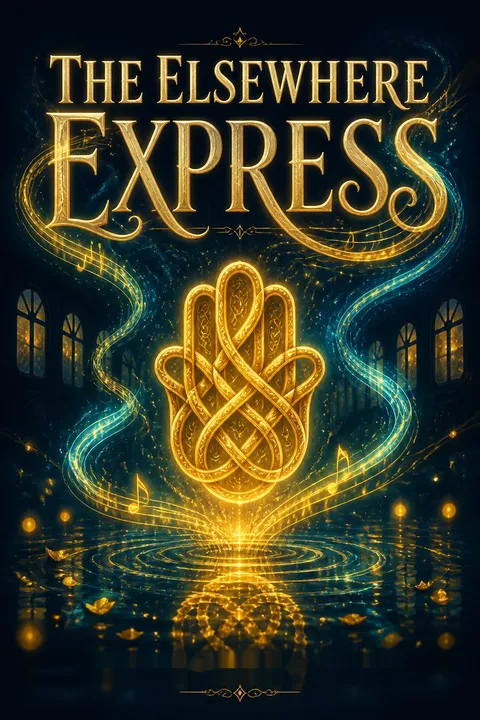
The golden knot on each passenger's palm serves as both ticket and bond to the train. It unravels under the weight of excess baggage, threatening to cast passengers off as Echoes. The knot is a visual and tactile reminder of the tension between holding on and letting go, and its unraveling drives the urgency of the narrative. It also serves as a metaphor for the ties that bind us to our past, our pain, and each other.
Tethering and the Map
The map of the train, accessible only through a magical tether that links two hearts, is both a navigational tool and a symbol of intimacy. The tether forces Raya and Q to share their emotions, breaking down barriers and fostering connection. It also raises the stakes, as the loss of one threatens to crush the other. The map's ephemeral nature—constantly changing, only visible when needed—mirrors the unpredictability of healing and self-discovery.
The Stowaway
The stowaway is a recurring antagonist, a monster born from the guilt and grief of the train's leaders. It takes the form of lost loved ones, preying on the vulnerabilities of its victims. The stowaway's rot threatens to destroy the train, forcing characters to confront the dangers of denial and the necessity of facing pain. Its cyclical return highlights the futility of erasure and the need for integration.
The Gallery and Reflection Pool
The gallery car, with its reflection pool and portraits, serves as a crucible for self-examination. It forces characters to confront their deepest secrets and wounds, breaking through denial and catalyzing transformation. The gallery's ability to display not just images but emotions and memories makes it a powerful device for character development and thematic exploration.
The Blue Serum and Perfume
The blue serum, offered by Mr. Goh, and the illicit perfumes of Manon represent the allure and danger of forgetting. They offer comfort and relief, but at the cost of identity and connection. The tension between erasure and remembrance is central to the narrative, with characters forced to choose between the pain of memory and the emptiness of oblivion.
Narrative Structure and Recursion
The novel employs a recursive structure, with characters reliving variations of the same journey, making different choices but often arriving at the same outcome. This looping narrative reinforces the themes of recurrence, the difficulty of change, and the possibility of breaking cycles through conscious choice. The use of records, embroidery, and passenger manifests as narrative devices blurs the line between story and memory, fiction and reality.
Download PDF
Download EPUB
.epub digital book format is ideal for reading ebooks on phones, tablets, and e-readers.








































