
Key Takeaways
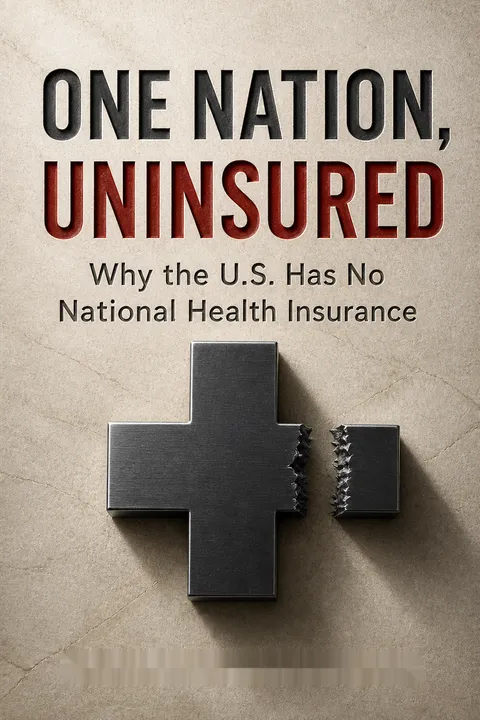
1. The US is unique among industrialized nations in lacking universal health insurance.
With the exception of the United States, all Western industrialized countries, regardless of how they raise funds, organize care, and determine eligibility, guarantee every citizen comprehensive coverage for essential health care services.
A stark contrast. The United States stands alone among developed nations in failing to guarantee its citizens comprehensive health coverage. This unique situation leaves millions vulnerable, with 45 million Americans uninsured in 2003, and nearly 82 million experiencing a period without coverage over two years. Unlike other countries where care is rationed by clinical need, in the U.S., access is often determined by income, race, and health status.
The uninsured burden. Being uninsured severely limits access to medical care, leading to delayed diagnoses, poorer health outcomes, and higher mortality rates. This burden extends beyond individuals, as the costs of care for the uninsured are shifted to taxpayers and privately insured patients, driving up premiums and perpetuating a cycle of increasing uninsurance. The complexity and high cost of the U.S. health insurance market, coupled with practices like "medical underwriting" (segmenting people by health risk), exacerbate these issues.
A social right vs. consumer product. The fundamental difference lies in how healthcare is perceived: as a social right in other nations versus a consumer product in the U.S. This distinction has shaped a century of contentious struggles between social reformers, physicians, employers, insurance companies, and trade unions, all vying over the proper relationship between government and the private sector in healthcare financing.
2. Early attempts at national health insurance were thwarted by powerful medical and business lobbies.
The Red scare’s lasting legacy was a suspicion of socialist sympathies attached to any group looking to alleviate social problems through government action.
The "Red Menace" tactic. From the Progressive Era through the mid-20th century, proposals for government-financed health insurance were consistently branded as "socialist" or "communist" plots. This tactic, fueled by events like the Russian Revolution and McCarthyism, effectively demonized reform efforts and instilled public fear of government overreach. The American Medical Association (AMA) was a primary driver of this narrative, portraying any third-party payer, especially the government, as an intrusion into the sacred doctor-patient relationship.
Powerful alliances. The AMA's success wasn't solely due to its professional authority but also its strategic alliances with other influential groups.
- Employers: Feared government intervention and preferred private, employer-sponsored plans.
- Insurance companies: Worried about government competition undermining their nascent markets for life and disability insurance.
- Conservative politicians: Like Senator Robert Taft and southern Democrats, who opposed New Deal expansion and feared federal intervention in local racial practices.
This coalition effectively defeated early compulsory health insurance bills in the 1910s and President Truman's national health insurance plan in the 1940s.
Shaping the private market. In the absence of public alternatives, these defeats inadvertently spurred the growth of private health insurance. The AMA reluctantly endorsed Blue Cross/Blue Shield plans (created by hospitals and doctors) as a bulwark against government programs. Commercial insurers also began offering health policies, recognizing a new market opportunity. This early entrenchment of private, market-based solutions set a difficult precedent for future reform efforts.
3. Organized labor's strategic shift secured key public health programs like Medicare.
The AFL-CIO won Medicare by mobilizing its extensive union network of state federations and local chapters, organizing a grassroots senior citizens’ movement, and supporting Democratic Party members who served on key congressional committees.
From private to public advocacy. Initially, organized labor, particularly the American Federation of Labor (AFL), opposed government health insurance, preferring to secure benefits through collective bargaining. However, the limitations of private benefits, especially for disabled and retired workers, eventually led to a strategic shift. The unification of the AFL and CIO in 1955 created a powerful, unified labor movement ready to pursue federal social programs.
Targeting specific needs. The AFL-CIO prioritized two critical gaps in the welfare state: disability insurance and health insurance for retirees. These programs offered a way to offload the high costs of these vulnerable groups from union-negotiated contracts, freeing up resources for wage increases for active workers. Their success with disability insurance in 1956, achieved by making concessions like local administration and limiting benefits to older workers, demonstrated that the AMA could be defeated with strategic alliances.
The Medicare triumph. For health insurance for the aged (Medicare), labor leaders like Nelson Cruikshank and Katherine Ellickson meticulously planned their strategy. They cultivated political allies, educated the public, and created the National Council of Senior Citizens to mobilize grassroots support. Despite fierce AMA opposition, which continued to brand Medicare as "socialized medicine," the combined force of organized labor, senior citizens, and a Democratic sweep in the 1964 elections led to Medicare's enactment in 1965. This victory marked a turning point, demonstrating that powerful, organized opposition could be overcome.
4. Civil Rights legislation leveraged Medicare to dismantle racial segregation in healthcare.
Thus the dismantling of racial segregation also allowed federal officials to monitor internal hospital affairs, penetrating the barrier between providers and the federal government and undermining provider sovereignty in the pursuit of racial justice.
Segregation in healthcare. For decades, southern politicians used their control over key congressional committees to block federal intervention in healthcare, fearing it would challenge local racial practices. The Hill-Burton Hospital Survey and Construction Act of 1946, while providing much-needed hospital funding, included a "separate but equal" clause that allowed for racially segregated facilities. This perpetuated systemic discrimination, with black patients often relegated to inferior wards and black physicians denied hospital privileges.
The Civil Rights Act's impact. The Supreme Court's 1954 Brown v. Board of Education decision, declaring "separate but equal" unconstitutional, laid the groundwork for challenging Hill-Burton's provisions. Civil rights advocates, through lawsuits like Simkins v. Moses H. Cone Memorial Hospital, eventually established that federally funded hospitals were not private entities and were subject to the Fourteenth Amendment. This culminated in Title VI of the Civil Rights Act of 1964, prohibiting discrimination in any program receiving federal assistance.
Medicare as an enforcement tool. The implementation of Medicare in 1965 provided the crucial leverage to enforce Title VI in healthcare. To receive Medicare funds, hospitals had to prove non-discrimination. Federal officials, particularly from the Social Security Administration (SSA), conducted rapid compliance inspections, forcing hospitals to integrate facilities, patient assignments, and staff privileges. This process, though met with resistance and some subterfuge, fundamentally reshaped the southern healthcare system and, in doing so, challenged the long-held principle of "provider sovereignty" by allowing federal oversight into internal hospital operations.
5. Medicare's design fueled rampant cost inflation, leading to ineffective early containment efforts.
With hospitals reimbursed for whatever they charged plus 2 percent, physicians paid their “customary” fees, suppliers totally unregulated, extended care facilities guaranteed 7.5 percent profits, a stepped-up demand for services, and insurance companies simply accommodating, there was neither the will nor the mechanism to contain costs.
A blank check for providers. Medicare's design, intended to appease providers and ensure their cooperation, inadvertently created a system ripe for inflation. Hospitals were reimbursed on a "cost-plus-2-percent" basis, physicians received "usual and customary" fees with no upper limit, and private insurers acted as passive intermediaries. This lack of cost controls, coupled with increased demand for services from a newly insured elderly population, led to an immediate and dramatic surge in healthcare expenditures.
Ineffective containment attempts. As costs skyrocketed, the federal government made several attempts to rein in spending, but these efforts were largely ineffectual.
- Utilization Review Boards: Mandated for hospitals, these boards were meant to ensure medical necessity but often lacked formal criteria and enforcement power.
- Professional Standards Review Organizations (PSROs): Introduced in 1972, these physician-led groups were intended to review care and deny payments for unnecessary services but rarely applied sanctions due to professional reluctance to challenge colleagues.
- National Health Planning and Resource Development Act (1974): Created consumer-dominated health systems agencies to plan and coordinate resources, but these agencies lacked decision-making power.
These measures failed to curb inflation, as providers found ways to circumvent regulations and continued to prioritize revenue generation.
Nixon and Carter's struggles. Even presidential efforts to control costs met strong resistance. President Nixon's mandatory wage-price freeze in 1971 temporarily slowed healthcare inflation, but the controls were difficult to maintain and eventually lifted. President Carter's proposals for across-the-board caps on hospital charges in the late 1970s were fiercely opposed by the hospital lobby and business groups, ultimately failing to pass Congress. The inability of the federal government to control costs through these early mechanisms set the stage for a new era of corporate intervention.
6. Corporate purchasers revolted against rising costs, driving the rise of managed care and shifting burdens.
In the 1980s, as Marie Gottschalk noted, “business . . . set off on a long march to downsize the private welfare state.”
Employers as major payers. By the late 1970s, employers, particularly large corporations, became the primary payers of healthcare costs for their employees, often surpassing their spending on steel or rubber. This direct financial burden, exacerbated by hospitals shifting costs from Medicare patients to private payers, spurred a "corporate revolt." Companies like Chrysler, under Lee Iacocca, began scrutinizing healthcare expenditures and demanding accountability from providers.
The rise of self-insurance and managed care. To gain control over costs and avoid state insurance mandates and taxes, many large firms shifted to self-insurance under ERISA. This allowed them to design their own plans and directly negotiate with providers. When initial tactics like cost-sharing with employees proved insufficient, corporations aggressively embraced "managed care" in the late 1980s. Managed care firms aimed to control costs by:
- Reviewing tests and procedures
- Evaluating charges
- Holding physicians financially accountable for medical decisions
This fundamentally challenged physicians' traditional autonomy and control over resource allocation.
Retiree benefits and the Catastrophic Act. The escalating cost of retiree health benefits became a significant liability for manufacturers, leading them to support the Medicare Catastrophic Coverage Act of 1988. This act, which expanded Medicare coverage for acute hospital stays and capped out-of-pocket costs, was seen by corporations as a way to shift retiree healthcare burdens to the federal government or retirees themselves. However, the act's financing mechanism (a surtax on higher-income seniors) led to a furious backlash from a vocal segment of the elderly, resulting in its unprecedented repeal and a subsequent erosion of employer-provided retiree benefits.
7. The insurance industry, once threatened, emerged as a dominant force, defeating comprehensive reform.
At the century’s end, the private insurance industry had vanquished any public sector alternative.
From crisis to dominance. The 1980s saw the insurance industry facing significant underwriting losses and an erosion of its economic base as large employers moved to self-insurance. However, by the 1990s, through strategic adaptation and aggressive lobbying, the industry, particularly large managed care firms, emerged as the unchallenged master of the U.S. healthcare financing system. They successfully fended off federal regulation and crushed proposals for government-backed alternatives.
Defeating Clinton's Health Security plan. President Clinton's 1993 Health Security plan, an ambitious proposal for universal coverage based on "managed competition" through government-organized "health alliances," posed a direct threat to the industry's market. The Health Insurance Association of America (HIAA), along with small businesses and other allies, launched a sophisticated, multi-million dollar public relations campaign. The iconic "Harry and Louise" ads effectively framed the plan as a "costly, bureaucratic nightmare" and undermined public confidence, leading to its ultimate defeat.
Shaping the post-reform landscape. After the Clinton plan's demise, health policy shifted towards shoring up the private insurance system.
- HIPAA (1996): Aimed to improve insurance portability and limit exclusions for pre-existing conditions, though it contained loopholes and did not guarantee affordability.
- SCHIP (1997): Expanded coverage for low-income children, but left many eligible children uninsured due to state variations and enrollment challenges.
- Medicare Modernization Act (2003): Introduced a prescription drug benefit but included a "doughnut hole" in coverage and prohibited the federal government from negotiating drug prices, concessions to the pharmaceutical and managed care industries.
These measures reinforced the private market, leaving millions uninsured and demonstrating the insurance industry's enduring political power.
8. Stakeholder mobilization, not just ideology or institutions, is the consistent barrier to universal coverage.
The evidence presented in the preceding chapters shows only one historical constant across every case, namely, that each attempt to guarantee universal coverage has been resisted by powerful special interests who have used every weapon on hand to keep the financing of health services a private endeavor.
The enduring obstacle. The author argues that the consistent failure to achieve universal health insurance in the U.S. is primarily due to the persistent mobilization of powerful special interests. These stakeholders, initially led by physicians and later by insurers and corporate purchasers, have consistently deployed their resources to protect their financial interests and maintain a private, market-based healthcare system. Their tactics include lobbying, campaign contributions, and grassroots opposition campaigns.
Shifting coalitions, consistent opposition. While the composition of the anti-reform coalition has changed over time, its effectiveness has remained a constant.
- Early 20th Century: AMA, employers, and commercial insurers, often leveraging anti-socialist rhetoric.
- Mid-20th Century: AMA, conservative politicians, and some business groups, until labor and senior citizens broke their power on Medicare.
- Late 20th Century: Health Insurance Association of America, small businesses, and managed care firms, effectively defeating Clinton's plan.
These groups have successfully framed government intervention as a threat to liberty and efficiency, even as they benefit from the existing system's inefficiencies.
Beyond traditional explanations. While factors like antistatist values, a weak labor movement, racial politics, and fragmented state structures play a role, they are insufficient to explain the consistent pattern of reform failure. The author contends that these are often rhetorical tools or contextual factors that enable stakeholder power, rather than the root cause. The ability of organized interests to convert their preferences into political outcomes, often by forming strategic alliances and influencing key decision-makers, is the most consistent thread throughout U.S. healthcare history.
9. Future reform requires strategic Medicaid expansion and innovative federal-private partnerships.
The challenge is not in identifying feasible choices but in mustering the political will.
Lessons from history. The history of U.S. healthcare reform reveals that while comprehensive, single-payer systems face insurmountable opposition from entrenched private interests, incremental expansions and federal-private partnerships have a greater chance of success. The key is to identify gaps in the existing system that private markets are unwilling or unable to fill, and then design solutions that minimize direct threats to powerful stakeholders.
Pathways to expanded coverage:
- Medicaid Modernization: Expand eligibility to include all low-income adults and childless couples, decoupling it from welfare status and standardizing income cutoffs across states (e.g., up to 200% of the poverty level). This would cover a significant portion of the uninsured.
- Federal Vouchers/Buy-in: Allow uninsured individuals and families, particularly early retirees and those deemed "uninsurable," to purchase into the Federal Employees Health Benefits Program using federal vouchers. This leverages an existing, risk-spreading public program without creating a new bureaucracy.
- Federal Stop-Loss/Reinsurance: Implement a federal program that reimburses health plans (including self-insured employers) for a high percentage of "catastrophic" cases (e.g., costs exceeding $50,000). This would reduce insurers' incentives for aggressive underwriting and allow for more affordable "bare bones" policies, especially for small businesses.
Building political will. The ultimate barrier to reform is not a lack of feasible options but the absence of sustained political will. To overcome this, reformers must build a broad, three-tiered coalition:
- National Leadership: To map out a grand plan, disseminate ideas, and cultivate political insiders.
- Intermediate Institutions: Such as state labor federations and senior citizens' clubs, to coordinate activities and tap into local networks.
- Local Chapters: To mobilize grassroots activists and funnel resources.
This coalition must unify diverse groups—privately insured families seeking security, seniors needing long-term care, and the uninsured—around the shared risk of inadequate coverage. The public is willing; the time for action is now.
People Also Read

Download PDF
Download EPUB
.epub digital book format is ideal for reading ebooks on phones, tablets, and e-readers.








































