
Key Takeaways
1. The Ideology of Settler Colonialism: A New Lens for Old Conflicts
I argue that settler colonialism is best understood not as a historical concept but as an ideology, whose growing popularity among educated young Americans is already having significant political effects.
A post-October 7 phenomenon. The Hamas attack on Israel on October 7, 2023, brought the academic concept of "settler colonialism" into mainstream public discourse, particularly among young Americans. This ideology posits that countries like the United States, Canada, Australia, and Israel are inherently illegitimate because they were founded on land taken from indigenous peoples. This belief system has profound implications, suggesting that the original injustice is not a past event but an ongoing "structure" that justifies resistance, including violence, against all non-indigenous inhabitants.
Justifying violence. The core tenet, famously articulated by Patrick Wolfe, is that "invasion is a structure, not an event," implying that the act of dispossession is perpetually renewed. This perspective categorizes all non-indigenous people, regardless of their ancestry or arrival date, as "settlers" who benefit from and perpetuate an illegitimate system. Consequently, the ideology can lead adherents to believe that violence against these "settlers" is a justified act of decolonization, as evidenced by some responses to the October 7 attacks.
A morally disastrous path. The author argues that settler colonialism, while rooted in a praiseworthy indignation against injustice, is a radical ideology prone to historical errors. It attributes diverse injustices—from economic inequality to environmental degradation—to a single, abstract cause, promising that its elimination will solve all problems. This oversimplification cultivates hatred for perceived obstacles to "redemption" and distorts history to create clear divisions between the guilty and the innocent, leading idealistic individuals down a path with historically disastrous outcomes.
2. From Exploitation to Elimination: Redefining Colonialism
Settler colonies were (are) premised on the elimination of native societies.
Evolving definitions. The concept of "settler colonialism" has undergone a significant transformation since its initial use in the mid-20th century. Kenneth Good, in the 1970s, applied it to countries like Rhodesia and Algeria, where a small European settler class exploited a much larger native population, and decolonization meant transferring power to the indigenous majority. However, this definition did not fit countries like the United States or Australia, where European settlers largely replaced the indigenous populations.
Wolfe's radical shift. Patrick Wolfe redefined settler colonialism in the late 1990s, focusing on the "elimination of the native" as its defining characteristic. This "elimination" is not solely physical extermination but also includes the destruction of culture, absorption into the new society, denial of rights, and even assimilation. This expanded definition allows for the concept of "structural genocide," where no one needs to be killed for genocide to occur, as argued by Damien Short and Lorenzo Veracini, who lists 26 forms of "transfer" that constitute genocidal acts.
An impossible future. This redefinition creates a profound dilemma for decolonization. In countries where "settlers" constitute the vast majority and have no "mother country" to return to, the idea of "relinquishing settler futurity" becomes abstract and unachievable. Mainstream Native American advocacy groups, for instance, focus on concrete legal rights rather than the wholesale dismantling of the state. The author suggests that this ideology functions less as a practical political program and more as a "political theology" for "settlers" grappling with their own identity and historical guilt.
3. America's Countermyth: Rejecting Progress for Perpetual Guilt
One of the goals of the ideology of settler colonialism is to discredit this hopeful narrative.
Challenging the American narrative. Traditionally, American history was presented as a providential journey towards liberty, a narrative that Martin Luther King Jr. sought to perfect by framing civil rights as the fulfillment of America's "promissory note." However, the ideology of settler colonialism actively seeks to dismantle this hopeful interpretation, viewing it as a complacent and dishonest account. From this perspective, extending citizenship rights to Native Americans is not progress but "transfer by assimilation," further entrenching the original crime.
"Brown settlers" and false equivalencies. The ideology rejects analogies between Native Americans and other oppressed minorities, arguing that Black Americans, by seeking equality within the existing system, become "brown settlers" who implicitly endorse the settler-colonial project. Roxanne Dunbar-Ortiz, for example, dismisses the idea of America as a "nation of immigrants" as a Cold War myth, asserting that all non-indigenous newcomers are complicit "settlers." This stance, ironically, converges with some nativist arguments in its rejection of multiculturalism, albeit from an opposite ideological direction.
A history of damnation. The new countermyth portrays American history as an "unmitigated disaster," something that "should not have happened." This narrative often idealizes pre-Columbian Native American life as a "disease-free paradise" of egalitarian societies, while selectively presenting historical violence, omitting Native-on-Native conflict or the complexities of early colonial wars. The adoption of terms like "Turtle Island" to rename North America, while seemingly indigenous, is argued to be a modern "settler" construct that erases the actual diversity of Native cultures and imposes a generic identity, serving to reinforce the narrative of American illegitimacy.
4. "Settler Ways of Being": Blaming All Evils on One Source
Settler colonialism includes interlocking forms of oppression, including racism, white supremacy, heteropatriarchy, and capitalism.
The hydra-headed monster. The ideology of settler colonialism posits that all forms of social injustice—from racism and sexism to capitalism and environmental degradation—flow from a single, insatiable source: the rapacity of European settlers. This "hydra-headed monster" framework suggests that once settler colonialism is "slain," all these interconnected evils will simultaneously disappear, offering the seductive promise of a final solution common to many radical ideologies.
Insatiability as original sin. The core "evil disposition" of the settler is identified as insatiability—an unending demand for more land, power, resources, and even knowledge. This quality, once celebrated as "manifest destiny" or "progress," is reinterpreted as rapacity, linking Columbus's brutality to modern capitalism's expansion. The doctrine of terra nullius, originally a legal concept, is metaphorically extended to describe a pervasive settler entitlement that disregards the rights of others.
Critique of progress and science. This totalizing critique extends to scientific progress itself. While acknowledging historical abuses by scientists against indigenous peoples, the ideology often critiques the scientific method as another "settler way of being," an expression of Western insatiability for knowledge. Concepts like "Western scientific 'objectivity'" and even fundamental categories like "space, time, and matter" are re-framed as artifacts of settler colonialism, imposed on indigenous peoples as a demonstration of power, thereby undermining the very tools that might address global challenges like climate change.
5. The Palestine Paradigm: An Axiom for Global Injustice
To a degree that outsiders may well find surprising, for the ideology of settler colonialism, Palestine is the reference point for every type of social wrong.
Palestine as the central axiom. Despite originating in the context of Australia, Canada, and the United States, the concept of settler colonialism is now most frequently invoked in relation to Israel. For this ideology, Palestine serves as an "axiom"—a foundational truth from which all other injustices are understood. This allows activists to "collapse" diverse concerns, from stopping an oil pipeline at Standing Rock to LGBTQ+ rights, into a single global struggle against settler colonialism, with Israel as its "exemplary" manifestation.
Ignoring historical discrepancies. The application of the settler-colonial framework to Israel is puzzling, as its history lacks the hallmarks of classic settler colonialism.
- No terra nullius: Jewish settlement began in a province of the Ottoman Empire, then under British Mandate.
- No continental expansion: Israel is the size of New Jersey.
- No elimination/replacement: The Arab population of historic Palestine has quintupled since 1948, not been destroyed.
- No exploitation of labor: Early Zionists aimed for self-sufficient agricultural communities, not exploitation.
- No "mother country": Israel was built by refugees fleeing persecution, with no imperial power to return to.
These discrepancies are often overlooked to fit the ideological narrative.
The paradox of "queer internationalism." The ideological commitment to Palestine as the ultimate symbol of oppression leads to significant cognitive dissonance, particularly in the context of LGBTQ+ rights. Many Western LGBTQ+ organizations express solidarity with Palestinians and even Hamas, despite Israel being the only country in the Middle East with robust gay rights and Hamas being an Islamic fundamentalist organization that persecutes homosexuals. This demonstrates how the ideology prioritizes a unified "enemy" over factual consistency or the actual well-being of marginalized groups.
6. The Uniqueness of Israel: Why Decolonization Doesn't Fit
Israel, however, has no mother country obligated to defend it, or to accept millions of refugees if it falls.
A unique historical trajectory. Unlike traditional colonial powers, Israel was not established by an empire to exploit resources or labor. Modern Jewish settlement, beginning in the 1880s, involved small, self-funded groups seeking to create self-sufficient agricultural communities, often in harsh conditions. The primary driver for large-scale Jewish immigration has been political persecution and the need for refuge, culminating in the post-Holocaust recognition of Israel as a homeland for a displaced people.
The "Iron Wall" of necessity. While early Zionists hoped for peaceful coexistence, Arab opposition to a Jewish state became undeniable. Vladimir Jabotinsky's "Iron Wall" doctrine acknowledged that Arabs would not voluntarily accept a Jewish state and that its existence would require armed force. This "Zionist realism" reflects the existential reality that Israel's 7 million Jews have no other home to go to, a crucial distinction from European settlers who could return to their imperial metropoles. This means Israelis will fight for their country with the same ferocity as a native people defending their homeland.
A complex, intractable conflict. The Israeli-Palestinian conflict is not a simple case of one people eliminating another. Today, roughly 7 million Jews and 7 million Arabs live between the Mediterranean Sea and the Jordan River. This demographic parity, coupled with the historical events of 1948 (the Nakba and refugee displacement) and 1967 (the occupation of West Bank and Gaza), creates an intractable situation. Calls to "decolonize" Israel by rolling back history to before 1948 or 1880 fail to address the reality of millions of people who now call the land home, leading to "unthinkable" scenarios of mass expulsion or extermination.
7. Anti-Zionism's Echoes: Old Hatreds in New Language
The word exemplary is well chosen: when the ideology of settler colonialism thinks about political evil, Israel is the example that comes instinctively to hand, just as Jews were for anti-Semitism and Judaism was for Christianity.
Denying Jewish indigeneity. The ideology of settler colonialism, in its determination to cast Palestinians as the sole indigenous people of the land, actively rejects the historical and spiritual connection of Jews to Israel. Despite the fact that the Jewish people originated in the land of Israel and maintained a continuous presence and aspiration for return for millennia, this connection is dismissed as an "epic myth." This denial is necessary to maintain the ideological framework, even when the criteria for indigeneity (residence for thousands of years, constitutive connection to the land) perfectly describe the Jewish relationship with Israel.
Genocide redefined and inverted. To fit Israel into the settler-colonial narrative, the definition of genocide is stretched to include any action deemed "inimical to 'the native' as a distinctive way of life," such as cultural assimilation or even "romantic stereotyping." This allows for the accusation of "structural genocide" against Israel, transforming the Jewish people—the paradigmatic victims of actual genocide—into its perpetrators. This inversion, exemplified by claims that Israel is the "completion of the Nazi project," is a profound distortion of history.
The new anti-Semitism. The author argues that this ideological framework allows for the expression of traditional anti-Semitic tropes in a new, "respectable" language. Accusations of Israeli "stratagems," "sadistic pleasure," and responsibility for global poverty and suffering echo historical anti-Jewish narratives of greed, conspiratorial power, and soulless materialism. By making Israel the "exemplary" symbol of political evil, the ideology of settler colonialism provides a virtuous justification for hatred and dehumanization, leading young people to celebrate violence against Israelis and harass Jewish peers, much as earlier generations persecuted Jews under different ideological banners.
8. Justice and Despair: The Peril of Undoing History
The ideology of settler colonialism shares this longing for redemptive destruction. Its eyes fixed on what it takes to be the worst parts of history, it insists that they deserve to be undone.
History as catastrophe. Drawing on Walter Benjamin's concept of history as "one single catastrophe," the ideology of settler colonialism views the past as inherently evil and deserving of repeal. This perspective, while understandable in its indignation against historical injustices, leads to a desire for "redemptive destruction"—a cancellation of history that promises to rectify past wrongs. However, this longing for a clean slate is fundamentally flawed, as history cannot be undone.
The errors of radicalism. The ideology falls into common radical errors:
- Misplaced wrath: It targets specific "settler" nations (US, Canada, Australia, Israel) as uniquely evil, ignoring that "invasion is a structure" universally true across all human history and cultures.
- Impossible solutions: Calls for decolonization in North America or the elimination of Israel are abstract and cannot be achieved without immense destruction and suffering, which adherents often refuse to acknowledge.
- Dehumanization: By falsifying history and demonizing "settlers," it justifies violence and hatred, as seen in the responses to the October 7 attacks.
The right kind of despair. The author proposes a "right kind of despair"—not despair of the future, which leads to a destructive longing to remake the past, but despair of the past. This means recognizing that historical wounds cannot be undone or perfectly rectified, but they can perhaps be healed, even if scars remain. This concept is akin to the Talmudic idea of "despair" in legal ownership, where relinquishing a claim to a lost item prevents greater injustice in the present.
Hope for a better future. Instead of perpetuating grievances and blood feuds, despairing of the past allows for hope in the future. This means accepting that the European settlement of America and the creation of Israel, while curses to some, have also been blessings to many. The path forward involves empowering Native peoples to define their way of life and securing a homeland for Palestinians, rather than seeking the destruction of existing nations. Ideologues who preach "vengeance and murder from an ivory tower" must be rebuked for their inhumanity, as their idealism ultimately leads to more suffering.
Review Summary
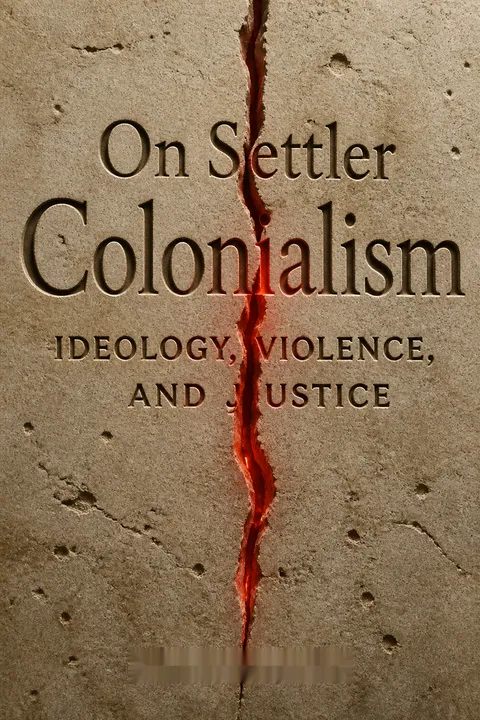
On Settler Colonialism by Adam Kirsch examines the concept of settler colonialism and its application to Israel-Palestine. Reviews are sharply polarized. Critics argue the book uses strawman arguments, ignores Palestinian perspectives, and defends Israeli policies while dismissing legitimate critiques. Supporters praise it as essential reading that exposes logical inconsistencies in settler colonial ideology, explains how the framework distorts history, and warns against weaponizing academic concepts to delegitimize Israel. Several reviewers note the book's brevity and accessibility, though some question its depth and selective use of sources.
People Also Read




Download PDF
Download EPUB
.epub digital book format is ideal for reading ebooks on phones, tablets, and e-readers.








































