
Key Takeaways
1. Psychoanalysis: A Tool for Redescription, Not Just Cure
Psychoanalysis is a story-and a way of telling stories-that makes some people feel better.
Beyond mere cure. Freud initially conceived psychoanalysis as a medical treatment to "cure" hysterical symptoms, comparing it to surgery that removes pathology. However, Phillips argues for a more expansive, transformative view. Psychoanalysis should not just fix what's "wrong," but make our lives more interesting, funnier, or sadder, helping us discover new virtues and values within ourselves.
A curiosity profession. Rather than a "helping profession" aimed at getting people "back on track," psychoanalysis can function as a "curiosity profession." It engages individuals in conversations that illuminate what prevents them from having the kinds of conversations they truly desire. This shifts the focus from prescriptive outcomes to an exploration of self-knowledge and personal narratives.
Embracing the unexamined. The relentless pursuit of omniscience, both in psychoanalysis and in life, can be detrimental. Phillips suggests that psychic health often depends on establishing a realm of life that successfully resists examination. This perspective challenges the notion that only the "examined life is worth living," valuing the spontaneous, ambiguous, and endlessly redescribable aspects of human experience.
2. The Unexamined Life Holds Profound Value
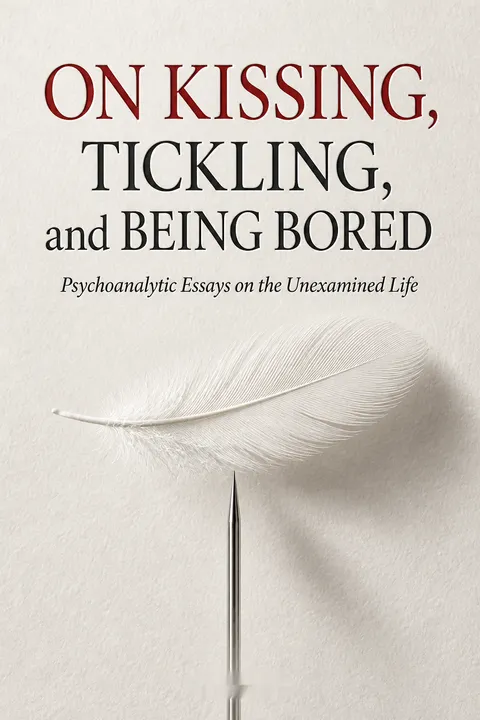
On Kissing, Tickling, and Being Bored is a set of meditations on underinvestigated themes in psychoanalysis that shows how much one's psychic health depends on establishing a realm of life that successfully resists examination.
Resisting constant scrutiny. The book explores ordinary, often overlooked experiences like kissing, tickling, and boredom, which psychoanalysis has largely neglected. Phillips contends that these "underinvestigated themes" are vital precisely because they highlight aspects of life that thrive outside constant scrutiny. Psychic health isn't about achieving total self-knowledge, but about preserving a space where life can unfold without relentless analysis.
Limits of knowing. The ambition for complete understanding, or "omniscience," can be counterproductive for both psychoanalysis and individual well-being. This pursuit often leads to rigid theories and a loss of the improvisational spirit that marked psychoanalysis's inception. Phillips champions a psychoanalysis that acknowledges the limits of knowing, embracing ambiguity and inconsistency as essential to human experience.
Discovering new virtues. By delving into these seemingly mundane yet profound experiences, Phillips invites readers to find new ways of valuing themselves and their lives. It's about discovering "new virtues" that emerge when we allow parts of ourselves to remain unexamined, fostering a sense of wonder and openness to what is not yet fully understood or articulated, enriching self-perception beyond conventional therapeutic goals.
3. Tickling: The Perilous Line Between Pleasure and Pain
Where is that ticklish line between pleasure and pain? Why do we risk its being crossed? Does psychoanalysis possess the language to talk about such an extraordinary ordinary thing?
The ticklish boundary. Tickling, a common and seemingly innocent interaction, reveals a profound boundary between pleasure and pain. It's a unique form of sensuous excitement, often initiated by adults, that children cannot reproduce themselves, highlighting their dependence on another. The experience is fraught with the risk of crossing the line where laughter turns to tears, exposing a primitive helplessness and vulnerability.
A perverse paradigm. Phillips suggests that the tickling scene, with its intense, often frenetic contact that quickly reinstates distance, can be seen as a "paradigm of the perverse contract." It reenacts the irresistible attraction and inevitable repulsion of the object, where the ultimate satisfaction is frustration. This dynamic underscores the impossibility of lasting satisfaction and reunion, making the act a complex interplay of desire and its thwarting.
Unspoken meanings. Despite its rich psychoanalytic implications—condensing themes of intrusion, seduction, and the precariousness of the erotic—tickling is rarely discussed in psychoanalytic literature. Phillips points out that its meaning might be "deferred" in the cumulative trauma of development. The word "tickle" itself, with its antithetical meanings ranging from "unstable equilibrium" to "nicely poised," speaks to the inherent precariousness and erotic charge of the experience.
4. Phobias as Protective Theories Against Curiosity
A phobia, like a psychoanalytic theory, is a story about where the wild things are.
Irrationality as protection. Phobias, often appearing as irrational fears, are in fact sophisticated forms of self-protection. They act as a "theory" or a "form of protection against curiosity," preventing individuals from confronting what they unconsciously fear. William James saw phobias as a return to instinctual, evolutionary fears, while Freud linked them to the ego's fear of sexual temptation and castration, rooted in incestuous fantasies.
Fixing distinctions. A phobia serves to fix distinctions, creating a clear boundary between the acceptably safe and the dangerously forbidden. It allows a person to pretend to a private language, exempting them from shared meanings and baffling inquiry. This "somatic conviction" empowers and disempowers simultaneously, making ordinary things intensely charged and serving as an "unconscious estrangement technique."
Retrieval of self. From a Freudian perspective, the ego depends on its phobia to expel intolerable parts of the self into an "outside world," maintaining a "pure pleasure ego." Treatment, then, becomes a "method of retrieval" for these "misplaced persons" within oneself. The goal is not to "cure" by eliminating the phobia, but to offer "interesting redescriptions" that the patient can "bear to be interested in," showing them that "there is nothing wrong with them."
5. Worrying: A Self-Consuming, Muted Dream
Worrying, then, is devouring, a peculiarly intense, ravenous form of eating.
The work of worrying. Worrying, often dismissed pejoratively, is a complex mental process that can serve multiple functions. For a child, it might be a "form of storage," like "farts that don't work," or a "gift" for a parent to resolve, making them feel empowered. It can also be an attempt to arrest time, an "emotional constipation" that prevents productive mental processing, or a way to engage an object without direct action.
History of self-persecution. Historically, "worrying" (from Old English "wyrgan" meaning to kill by strangulation) referred to what dogs did to their prey. It signified a brutal, successful pursuit of a desired object. By the 19th century, it evolved into a psychological term, describing something people did to themselves—a "self-consuming passion." This shift reflects a new kind of internal persecution, where individuals "prey on themselves" with relentless, intractable concerns.
Muted dreams and censorship. Phillips suggests that worrying can be a "stifled, indeed an overprotected dream," a "muted dream" that acts as a defense against more imaginative or violent responses to predicaments. Unlike dreams, which are ingenious transformations of the forbidden, worries are "addicted to reality," appearing drab and routine. They are conscious convictions that project catastrophe into the future, serving as "punishments for wishes" or "wishes cast in persecutory form," ultimately domesticating self-doubt and sealing time by encapsulating a sequence.
6. Solitude and Risk: Entrusting the Self to the Uncontrollable
His capacity for a beneficent solitude will depend on his being able to entrust himself to his body as a sufficiently holding environment.
Developmental solitude. Solitude, initially a source of phobic terror in childhood, evolves into a crucial developmental achievement. It's not merely an escape from persecution but a path to replenishing privacy. For adolescents, taking risks—like learning to swim by trusting the water—becomes a way to differentiate themselves and discover a self-reliance that isn't just a triumph over needing others.
The body as container. In adolescence, the body itself becomes a "most familiar stranger," a "subjective object" onto which doubts about early maternal care are transferred. Through taking and making bodily risks, the adolescent tests whether their body can serve as a "sufficiently holding environment," recreating the security of infancy internally. This process constitutes a "benign solitude," where one is reliably alone in the presence of their body and its thoughts.
Ruthlessness and real contact. Winnicott's concept of "primitive ruthlessness" in infancy, distinct from sadism, suggests that genuine concern for an object develops only after a period of "benign disregard." This implies that true contact with a "real object" (one beyond one's omnipotent control) is made possible by suspending over-concern and wholeheartedly "hating" it, allowing it to survive one's destructiveness. This "ruthless act" establishes two separate solitudes, making the object real and fostering a capacity for beneficent solitude.
7. Composure: A Strategic Self-Holding Against Disarray
Composure becomes a preemptive strike-a kind of machine inside the ghost-against this fundamental disarray.
Defense against disarray. Composure is a vigilant form of self-control, a "preemptive strike" against the body's inherent disarray and the "attack of the drives on the ego." It begins as a child's response to the mother's implicit demand to alter self-presentation, transforming clamorousness into a calculated social poise. This creates a spectacle of an excited body, safely staged by the ego through fantasies like masturbation.
The precarious mind. Winnicott suggests that "mental functioning" can become a "thing in itself," a "precocious mind" that compensates for failures in mothering. This mind fosters a kind of "psychosomatic dissociation," creating distance from one's own desire and from others. It's often engendered by a grudge, enabling a simulated independence and insulating the individual from perceived misrecognition or appropriation.
Seeking negation. Composure, in this light, is a deferral, a self-holding that paradoxically seeks its own negation. It aims to create or find an environment where it is no longer needed, where the "affective core of the self" can be recognized without dread of being undermined. However, excessive composure, driven by a militant fantasy of self-sufficiency, can insulate the individual from ever allowing the very recognition they seek, leading to a "strange course in life" that looks like a circle.
8. Dreams: The Unknowable Experience of the Self
A person in his dreaming experience, can actualise aspects of the self that perhaps never become overtly available to his introspection or his dreams.
Beyond interpretation. Masud Khan, building on Winnicott, shifts the focus from the dream as a text to be interpreted to the "dreaming experience" as a formative, unknowable entity. For Khan, the dream signifies the "impenetrable privacy of the Self," an "incommunicado element" that is sacred and beyond direct knowledge. The analyst's role is not to decipher content, but to facilitate the "dream-space" where experience can unfold, acknowledging that "dreaming itself is beyond interpretation."
Analyst as facilitator. Khan views the analytic setting as comparable to the preconditions for dreaming, where the analyst acts as a "witness" or "auxiliary ego," providing a reliable environment without preemptive intrusion. This "one-body relationship" allows the patient to "actualise aspects of the self" that might otherwise remain inaccessible. The aim is to "return the dream to the dreamer," ensuring its "eloquence" through minimal translation, rather than colonizing it with the analyst's theoretical preoccupations.
Self's irreducible privacy. The "dreaming experience" becomes a "virtual synecdoche for the True Self of the patient, who is not an object to be deciphered." It represents that which is beyond description in the patient's total lived experience. Pathology, in this view, is whatever has sabotaged this potential for dreaming experience. Khan's work, with its "generous skepticism," acknowledges that we have only described ourselves, not invented ourselves, and that the self possesses an irreducible privacy that resists complete knowing.
9. Obstacles Are the Unconscious Clues to Desire
The desire does not reveal the obstacle; the obstacle reveals the desire.
Paradox of obstacles. Obstacles are not merely hindrances but fundamental components that reveal and even constitute our desires. A child's school phobia, for instance, might be a way to bring a sense of neglect into her omnipotent control, or a mother's clinging child might serve as an obstacle to her own unconscious projects. We often construct obstacles to conceal or "pack up" unconscious desires, using them as "necessary blind spots" to avoid confronting alternative possibilities.
A first relationship. Phillips provocatively suggests that "the first relationship is not with objects but with obstacles." We come to know what something or someone is by discovering what comes between us. For Rousseau, obstacles transformed ordinary desires into something criminal and exciting, making his desire seem inordinately powerful. This "passion for obstacles" implies that we fall in love with people partly because they are perceived as necessary impediments, intensifying our longing.
Unpacking the forbidden. When obstacles are "unpacked" in analysis, they are found to be "full of the unusual and the forbidden." The object of unconscious desire can be represented only by the obstacles to the conscious object of desire. This means that a man consciously desiring "unavailable women" might unconsciously desire the "obstacle"—the man who makes them unavailable. Obstacles, like jokes, are ingenious ways of circumventing repression, linking us to lost pleasures and making the forbidden accessible, albeit indirectly.
10. Kissing: A Narcissistic Quest for Self-Satisfaction
'It's a pity I can't kiss myself,' he seems to be saying.
Oral erotic prototype. Kissing, a seemingly anomalous element in the repertoire of oral eroticism, is central to Freud's theory of sexual development. It links us to our earliest oral relationship with the world, where "sucking at his mother's breast has become the prototype of every relation of love." While it involves the pleasures of eating without nourishment, its most ludicrous and unsatisfying form is kissing oneself, highlighting a fundamental narcissistic dilemma.
A softened hint. Freud describes kissing as a "normal perversion," an ordinary sexual activity that can substitute for genital intercourse. It's a "softened hint at the sexual act," publicly acceptable yet revealing the powerful connection between mouths and genitals. In adolescence, the craving for other mouths resumes the "oral education" with new intensity, where the erotics of greed contend with the reassurances of concern, blurring distinctions between giving and taking.
Disappointment of self-sufficiency. Freud's "extraordinary sequence" from sucking to kissing culminates in the impossibility of kissing one's own mouth, symbolizing a "double disappointment." This reflects the individual's first and recurring loss: the fantasy of self-sufficiency. Desire, in Freud's view, is always in excess of the object's capacity to satisfy, and the kiss, by definition, disappoints. This disappointment, however, makes it resonant and allows for its return, embodying the "dangerous allure and confusion of mistaken identity."
11. Playing Mothers: The Pitfalls of Prescriptive Psychoanalysis
If the analysis is done properly it will arrive on time.
The analyst as mother. In British object-relations theory, mothers became prescriptive models for psychoanalysts, leading to the problematic notion that the analyst, regardless of sex, "is playing mother" at the deepest levels of the patient's pre-oedipal conflicts. This approach, exemplified by concepts like Winnicott's "holding" and Bion's "reverie," risks preempting the transference by assuming the analyst's fundamental role, making it "expected" rather than an unanticipated invitation.
Pedagogy vs. transference. Freud's minimalism regarding technique allowed for the analyst to be a "moving target," an "unknowable set of 'new editions and facsimiles.'" However, the British School's focus on mothering as a model for analytic function led to a pedagogical approach, where psychoanalysis became "the transmission of scientific information about human nature." This shift risked resolving transference into pedagogy, burdening mothers with the "disappointments of wisdom" and making the analyst a "sphinx without a riddle."
Coercion of normality. The identification of the analyst with the pre-oedipal mother, who "knows what's best for us," can lead to the "coercion or simulation of normality." What cannot be taught (like how a mother holds a baby) is paradoxically used as a definition for the analytic process. This creates an impasse where the analyst, poised between omniscience and absolute skepticism, risks becoming a "caricature" or a "willing victim of an open transference," ultimately foreclosing the true, unpredictable nature of the analytic encounter.
12. Idolatry: The Deep Roots of Belief in Childhood Longings
From a psychoanalytic point of view, to talk about religion and to talk about sexuality are to talk about childhood.
Freud's idols. Freud's consulting room, filled with ancient figurines, presented a vivid paradox: a secular Jew, critiquing religious belief, surrounded by "idols." This collection, representing "the splendid diversity of human life," underscored that culture is plural and history is preserved. It also hinted at Freud's unconscious identifications and his "world-historical romance," challenging monotheistic notions of "True Belief" and suggesting that belief itself is a complex, personal construction.
Belief as symptom. For Freud, belief shifted from being about the object's qualities to the believer's history. Religious ideas, like symptoms, are imposed, not found, and serve to console us for "original and pervasive helplessness." They are "wishful illusions," akin to a "narcotic" or "sleeping draught," protecting us from the catastrophe of relinquishing them. This perspective suggests that all belief, including in science, is a form of "idolatry," an elaborate acknowledgment of human "perplexity and helplessness."
Cure by idolatry. Freud's ambivalence towards monotheism—criticizing its intolerance while praising its "triumph of intellectuality over sensuality"—reflects his own internal struggle. He saw children, like "primitive races," as prone to idolatry, remaining "under the spell of sensuality." Ultimately, Freud's discovery of transference evolved into a "cure by idolatry," where the analyst becomes a "false belief" object. The paradox remains: psychoanalysis, while potentially curing idolatry through idolatry, cannot cure belief in itself, highlighting the enduring, wishful nature of conviction.
Review Summary
On Kissing, Tickling, and Being Bored receives mixed reviews (3.75/5 stars). Readers appreciate Phillips' exploration of overlooked psychological states like worry and boredom, finding "tasty nuggets of insight" amid dense psychoanalytic theory. Many praise his eloquent, thought-provoking style and unique perspectives drawing on Freud and Winnicott. However, critics find the essays overly academic, lacking coherence, and heavily reliant on citations rather than original thinking. Several note the book requires substantial psychoanalytic background knowledge. Some Turkish reviewers criticize both the translation and the fundamental psychoanalytic approach itself.
People Also Read





About the Author
Other books by Phillips
Download PDF
Download EPUB
.epub digital book format is ideal for reading ebooks on phones, tablets, and e-readers.








































