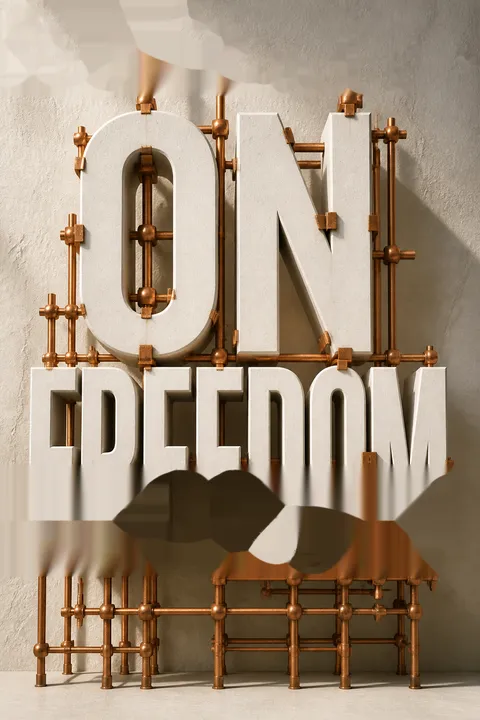

Key Takeaways
1. Freedom is a positive presence, not a negative absence
Freedom is not just an absence of evil but a presence of good.
Redefining liberty. Most Americans mistakenly view freedom as purely negative—the simple absence of government interference or external barriers. However, true freedom is positive; it is the active capacity to choose our commitments and realize our values in the physical world.
The negative trap. When we define freedom only as "freedom from," we fall into a dangerous political trap. We assume that clearing away barriers automatically makes us free, which blinds us to the structures we must actively build to enable human potential.
Affirmation over denial. To be truly free, we must affirm virtues rather than merely deny oppression. This requires a moral and political framework that adds good things to our lives rather than just removing bad ones.
- Negative freedom: us against the world, focusing solely on barriers.
- Positive freedom: the presence of resources, education, and health.
- De-occupation: the removal of harm, which is only a prerequisite for liberty.
2. Sovereignty begins with the body and requires the care of others
There can be a Körper without me, but no Leib without me.
The living body. We are not merely physical objects (Körper) subject to mechanical laws; we are living, feeling bodies (Leib) with subjective zero points. Sovereignty is the learned capacity to make choices, which begins with recognizing other bodies as subjects like ourselves.
Empathy as knowledge. We cannot understand ourselves or the world in isolation. It is only through empathy—acknowledging the physical and emotional reality of others—that we gain objective knowledge and escape the prison of our own limited perceptions.
Generational care. No one is born free; we are born entirely dependent on others. Developing the cognitive and emotional capacities for sovereignty requires years of structured care, education, and attention during childhood.
- Leib: the living, feeling human body that acts on values.
- Körper: the physical body treated as an object or commodity.
- Natality: the supreme human capacity to begin, starting at birth.
3. True freedom is unpredictable and resists algorithmic control
Free people are predictable to themselves but unpredictable to authorities and machines.
Resisting predictability. Modern tyrannies and digital platforms do not require our devotion; they require our predictability. When we are reduced to reacting to stimuli, we are forced into our "most probable states," making us easy to manipulate and rule.
The digital threat. Social media algorithms are designed to hack our brains by isolating us and using intermittent reinforcement. They herd us into conformist silos, replacing our unique, unpredictable value choices with automated, binary reactions.
Living in truth. To resist this digital colonization, we must cultivate "unpredictability" by acting on authentic, personally experienced values. This means stepping out of the screen and engaging in the "significant roughness" of the physical world.
- Normalization: the conformist habit of accepting a system where nothing matters.
- Brain hacks: experimental isolation, intermittent reinforcement, and confirmation bias.
- Living in truth: acting according to virtues rather than conforming to stimuli.
4. Mobility must be social and developmental, not imperial or punitive
An American way to make people unfree is to wax on about choice but deny children the capacities they will need to make choices...
The right of way. True mobility is the capacity to move through space, time, and values over the course of a unique life. It requires physical infrastructure, public transport, and social safety nets that allow individuals to change their life trajectories.
The imperial illusion. Historically, Americans have associated mobility with imperial expansion—the conquest of new frontiers at the expense of others. When physical frontiers closed, we failed to transition fully to social mobility, leaving many trapped in stagnation.
The punitive turn. Instead of investing in social mobility, the United States turned to mass incarceration, caging millions of disproportionately Black citizens. This punitive system immobilizes both the incarcerated and the minds of the non-incarcerated who condone it.
- Imperial mobility: seeking freedom through the domination and displacement of others.
- Social mobility: the ability of individuals to improve their life circumstances through public goods.
- Mass incarceration: a system of racialized immobility that undermines democracy.
5. Factuality and truth are the indispensable shields of a free society
Truthfulness is not an archaism or an eccentricity but a necessity for life and a source of freedom.
The necessity of truth. Factuality is the fourth form of freedom, providing the objective ground upon which we can make sovereign choices. Without a shared commitment to facts, we cannot build democratic institutions, hold the powerful accountable, or solve existential crises.
The threat of big lies. Tyrants and oligarchs thrive by replacing facts with "big lies" that are too massive to easily dismantle. These lies exploit our psychological vulnerabilities, creating alternative realities that demand total conformity and justify violence.
The local news crisis. The collapse of local journalism has created vast "news deserts" across America, leaving citizens vulnerable to nationalized propaganda. To defend freedom of speech, we must actively fund and protect the human reporters who uncover the little truths.
- Factuality: the grip on the world that allows us to change it.
- Big lies: massive, systemic untruths designed to consolidate power.
- News deserts: communities deprived of local, human-reported facts.
6. Solidarity is the recognition that no individual can be free alone
Morally, logically, and politically, there is no freedom without solidarity.
Interdependent liberty. Solidarity is the fifth form of freedom, the practical recognition that our individual liberty depends on the freedom of others. We cannot become sovereign, unpredictable, or mobile without a cooperative social framework that supports everyone.
The limits of selfishness. Negative freedom encourages us to view others as barriers or competitors, leading to isolation and weakness. True solidarity requires us to see others as subjects (Leib) and to actively work to secure their rights alongside our own.
Civil society. Horizontal relationships built on shared values and mutual trust are the bedrock of resistance to tyranny. When we act in solidarity, we create a "virtuous cycle" that strengthens both individual character and democratic institutions.
- No freedom without solidarity: the core lesson of Polish labor movements.
- Civil society: horizontal relationships built on authentic human interests.
7. The "free market" is a dangerous myth that enables oligarchy
Markets cannot be free. Only people can be free.
The market myth. The myth of the "free market" is a form of negative freedom that prioritizes the rights of things over the rights of people. It assumes that if the government does nothing, a mystical "invisible hand" will automatically produce the best outcome. This is a dangerous self-deception.
Enabling oligarchy. In reality, unregulated markets lead to extreme wealth concentration and monopoly, which are the enemies of freedom. Oligarchs use their wealth to buy political influence, suppress competition, and avoid taxes, leaving the majority of citizens stuck in stagnation and anxiety.
Reclaiming the market. We must reclaim the market as a human tool, subject to rules and values that we choose together. A free society requires antitrust laws to break up monopolies, fair taxation to fund public goods, and the protection of workers' rights to organize.
- Free market: a dangerous abstraction that treats human beings as barriers to the movement of capital.
- Monopolies: economic concentrations that destroy competition and individual initiative.
- Antitrust laws: essential legal tools to protect the public interest from corporate power.
8. We must escape the time warps of inevitability, eternity, and catastrophe
The future has vanished: social mobility is lost, we are disoriented by crises.
The politics of inevitability. After the fall of communism, Americans fell into the trap of believing that capitalism would automatically bring democracy. This deterministic view made us passive, leading us to ignore growing inequality and the erosion of our institutions.
The politics of eternity. When the promise of inevitability failed, we slid into the politics of eternity, where the future is replaced by a mythical past of national innocence. This narrative blames external enemies for our problems, feeding resentment and preventing self-correction.
The politics of catastrophe. Today, we face the politics of catastrophe, where the threat of ecological collapse is used to justify panic and authoritarian control. To reclaim our freedom, we must think historically, taking responsibility for our past to open up multiple possible futures.
- Inevitability: the false belief that history has only one, automatically good destination.
- Eternity: the nostalgic loop that replaces policy with myths of innocence and guilt.
- Catastrophe: the exploitation of fear to make survival seem incompatible with liberty.
9. The true purpose of government is to construct the conditions for positive freedom
We enable freedom not by rejecting government, but by affirming freedom as the guide to good government.
Legitimizing the state. Government is not a necessary evil to be minimized, but the essential instrument for creating the structures of positive freedom. A government is legitimate only insofar as it enables its citizens, especially its children, to become sovereign and mobile.
The five forms as policy. A good government would design its policies around the five forms of freedom. This means investing in early childhood care, regulating social media to protect our minds, building public infrastructure, funding local journalism, and ensuring universal health care.
A democratic republic. By aligning government action with the values of positive freedom, we can move beyond the false choice between entrepreneurship and social justice. We can build a democratic republic where the common good is protected, and every citizen has a meaningful voice.
- Positive government: active creation of the conditions for human flourishing.
- Public goods: health care, education, and infrastructure as foundations of liberty.
- The common good: a republic where representation is connected to public interests.
Review Summary
On Freedom by Timothy Snyder explores the concept of freedom, distinguishing between negative ("freedom from") and positive ("freedom to") freedom. Snyder argues for a broader understanding of freedom that includes sovereignty, unpredictability, mobility, factuality, and solidarity. The book draws on historical examples, personal experiences, and philosophical concepts to critique modern threats to freedom, including social media manipulation and oligarchic power. While some readers found the book challenging and occasionally meandering, many praised its thought-provoking ideas and relevance to current political issues, particularly in the United States and Eastern Europe.
About the Author

Download PDF
Download EPUB
.epub digital book format is ideal for reading ebooks on phones, tablets, and e-readers.








































