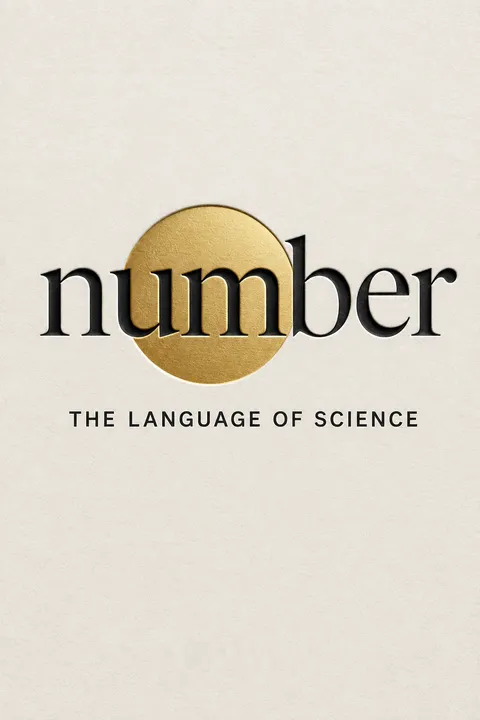

Key Takeaways
1. The Rudimentary Origins of Number Sense and Counting
Man, even in the lower stages of development, possesses a faculty which, for want of a better name, I shall call Number Sense.
Innate number sense. Humans and some animals possess a basic "number sense," allowing them to recognize changes in small collections without explicit counting. This rudimentary faculty, observed in birds distinguishing eggs or wasps provisioning caterpillars, is distinct from the complex mental process of counting. However, this direct perception is severely limited, rarely extending beyond four objects for humans.
Counting as an artifice. True counting is a uniquely human invention, an "artifice" that dramatically extended our perception of number. Early methods involved one-to-one correspondence, like tallying notches or pebbles, which helped compare collections. This led to the creation of "model collections" (e.g., bird wings for two, fingers for five) that eventually evolved into abstract number words.
Fingerprints of history. Finger counting served as a crucial bridge between cardinal (matching) and ordinal (ordering) number concepts. Our base-10 number system is a "physiological accident" stemming from our ten fingers, a fact reflected in many languages. While modern society has largely abandoned finger counting, its historical role in developing our number language and extending our numerical capabilities was immense, shaping the very foundation of exact sciences.
2. The Revolutionary Power of Zero and Positional Notation
Not only did this principle constitute a radical departure in method, but we know now that without it no progress in arithmetic was possible.
Ancient struggles. Early written numeration, from Sumerian cuneiform to Egyptian hieroglyphics, was primarily cardinal, using distinct symbols for units, tens, hundreds, etc. These systems, like the Roman numerals, were cumbersome and ill-suited for arithmetic operations, making calculation a specialist's art. The abacus served as a mechanical aid, but true computational progress remained elusive for millennia.
The Hindu breakthrough. The discovery of the principle of position by an unknown Hindu in the first centuries CE was a "world-event." This principle assigns value to a numeral based on its position within a group (e.g., the '2' in 342, 725, 269 means two, twenty, or two hundred respectively). This mirrored the abacus, but a crucial missing element prevented its written adoption.
The empty column. The key to positional notation was the invention of a symbol for an "empty column"—our modern zero. The concrete minds of ancient Greeks couldn't conceive of "nothing" as a number. The Indian "sunya" (empty/blank) became the Arabic "sifr," then Latin "zephirum," eventually evolving into "zero." This symbol, initially a mere placeholder, transformed arithmetic, making complex calculations accessible and paving the way for modern mathematics.
3. From Mysticism to Modern Number Theory
The theory of integers is one of the oldest branches of mathematics, while modern arithmetic is scarcely four hundred years old.
Ancient numerology. The individual attributes of integers captivated early civilizations, leading to "number-lore" or numerology. Hebrews favored 6, 7, 40; Babylonians, 60. Gematria, assigning numerical values to letters, was used for biblical interpretation and even to prove Achilles' superiority. This mystical fascination, though seemingly absurd, was the genesis of early scientific inquiry.
Pythagorean philosophy. Number worship found its peak in Pythagoreanism, where numbers were imbued with human and divine attributes (odd as masculine, even as feminine). They explored "figurative numbers" (triangular, square) and "perfect numbers" (sum of divisors equals the number itself, like 6 and 28), seeing in them the universe's inherent order. This early reliance on geometric intuition marked the beginning of number theory.
The birth of a science. While arithmetic is a relatively recent development, the theory of numbers is ancient, born from these mystical roots. Problems like amicable numbers (pairs where each is the sum of the other's divisors) and prime numbers (Eratosthenes' Sieve, Euclid's proof of infinite primes) challenged thinkers for millennia. Though initially experimental, this field, exemplified by Fermat's Last Theorem and Goldbach's Conjecture, evolved into a rigorous science, often driven by intuition and later validated by proof.
4. Confronting Infinity: The Foundation of Arithmetic
But if there be no last number, what do we mean by all numbers, and particularly, what do we mean by the property of all numbers?
The dilemma of "all." The absolute generality of arithmetic, where rules apply to "all numbers," hinges on the concept of infinity. For finite collections, "all" is clear, but for numbers, which have no "last member," the meaning becomes problematic. How can we prove properties for an inexhaustible collection? This "dilemma of infinity" guards the entrance to mathematics.
Infinity as assumption. The inexhaustibility of the counting process is not derived from experience, which teaches finitude, nor can it be mathematically proven, as it is a fundamental mathematical assumption. Ancient religions often viewed a "last number" as belonging to the gods, beyond human reach. Archimedes, in his "Sand Reckoner," calculated incredibly large finite numbers, but still within bounds.
Reasoning by recurrence. To prove properties for "all numbers" without exhausting them, mathematics employs "reasoning by recurrence" (mathematical induction). This two-step process proves a property for the first term and then shows that if it's true for any term, it's true for its successor. Poincaré argued this principle is not reducible to logic or experience, but an "affirmation of the power of the mind" to conceive indefinite repetition. This concept of infinity, though not logical or experiential, is a mathematical necessity.
5. Symbolism: The Engine of Algebraic Generalization
The symbol has a meaning which transcends the object symbolized: that is why it is not a mere formality.
Evolution of algebra. Algebra progressed through rhetorical (verbal), syncopated (abbreviated words), and symbolic stages. Early Egyptian algebra was syncopated, while Greek algebra remained largely rhetorical due to its concrete nature and the dual use of letters as numerals. The Hindus, unburdened by Greek rigor, developed a syncopated algebra with symbols for operations and negative numbers.
Vieta's revolution. The turning point came with Vieta's "Logistica Speciosa" in the late 16th century, systematically using letters for unknown and given magnitudes. This literal notation was more than shorthand; it liberated algebra from the "slavery of the word," allowing for abstract operations and the representation of collective forms (e.g., ax + b).
Generalized number concept. Symbolism enabled the "generalized number concept." When equations like x + b = a or x^n = a yielded "impossible" solutions (negative, fractional, irrational), the very act of writing these symbolic solutions gave them meaning. The "principle of permanence" guided this expansion: new number fields (like rationals) were created by preserving the fundamental properties (commutative, associative, distributive) of natural numbers.
6. The "Unutterable" Irrationals and the Expansion of Number
The advent of irrationals marks the decline of Pythagoreanism as a system of natural philosophy.
Pythagorean crisis. The Pythagorean belief that "number rules the universe" (meaning natural numbers) was shattered by the discovery of incommensurables, specifically the irrationality of the diagonal of a square (√2). This "unutterable" truth, initially kept secret, exposed a fundamental flaw in their number philosophy and the first crisis in mathematics.
Gaps in the rational domain. Euclid's proof demonstrated that √2 cannot be expressed as a rational number. This revealed that the rational number line, though "everywhere dense," was "full of gaps." Simple geometric problems, like finding the diagonal of a unit square, had no rational solution, necessitating an extension of the number concept beyond rationals.
Beyond elementary irrationals. The introduction of elementary irrationals (radicals like √a) solved some problems, but this field wasn't "closed" under addition (e.g., √2 + √3 is not a simple radical). More profoundly, Abel and Galois proved that general algebraic equations of degree higher than four cannot be solved by radicals alone. Liouville's discovery of transcendentals (numbers like π and e that are not roots of any algebraic equation) further expanded the number universe, showing that algebra, like rational arithmetic, had its limits.
7. The Calculus: Taming the "Flowing World" with Infinite Processes
The Arguments show that space and time and motion as perceived by our senses (or for this matter by their modern extensions, the scientific instruments) are not co-extensive with the mathematical concepts which bear the same name.
Zeno's paradoxes. The problem of the infinite, particularly concerning continuity, space, time, and motion, was first articulated by Zeno of Elea. His paradoxes (Dichotomy, Achilles, Arrow) highlighted the chasm between our intuitive perception of continuous motion and any attempt to represent it as discrete, infinitely divisible points or instants.
Horror infiniti. Zeno's arguments instilled a "horror infiniti" in Greek geometers, hindering the development of infinite processes despite Archimedes possessing the core ideas of infinitesimal analysis (method of exhaustion). For over a thousand years, this fear suppressed the exploration of limits and infinite series.
The calculus emerges. The European Renaissance saw a revival of infinitesimals, albeit with less rigor. Newton's "fluxions" and Leibnitz's "differences" (now derivatives and differentials) provided tools to analyze continuous change. Despite Bishop Berkeley's witty critiques of these "ghosts of departed quantities," the calculus flourished, becoming indispensable for physics and engineering. It allowed mathematicians to define concepts like velocity and the length of a curve by treating continuous phenomena as the "ultra-ultimate step in an infinite sequence" of discrete approximations.
8. Defining the Continuum: Real Numbers as Limits and Partitions
The aggregate of real numbers contains all its own limiting values and for this reason is perfect.
Filling the gaps. The inadequacy of rational numbers to represent all points on a line led to the need for a new number domain. Georg Cantor's theory defined irrational numbers as the limits of "self-asymptotic" rational sequences (sequences where terms get arbitrarily close to each other). This allowed non-periodic decimal series, like those representing transcendentals, to be recognized as numbers.
Zeno's riddles resolved. Cantor's concept of convergence and limits provided a framework to resolve Zeno's paradoxes. For example, the infinite sum of the dichotomy sequence (1/2 + 1/4 + 1/8 + ...) converges to the finite number 1, demonstrating that an infinite number of terms can have a finite sum. Similarly, Achilles does overtake the tortoise in a finite time, as the sum of the infinite series of diminishing distances is finite.
Dedekind's cuts. Richard Dedekind offered an alternative, more static, definition of real numbers using "partitions" or "cuts." A real number is defined by how it divides all rational numbers into two mutually exclusive classes. This elegant approach, though seemingly avoiding explicit infinity, implicitly relies on it. Both Cantor's dynamic (sequences) and Dedekind's static (partitions) theories were proven equivalent, establishing the "arithmetic continuum" as a "perfect" aggregate, closed to all infinite processes.
9. Complex Numbers: Giving Substance to the "Impossible"
The Divine Spirit found a sublime outlet in that wonder of analysis, that portent of the ideal world, that amphibian between being and not-being, which we call the imaginary root of negative unity.
The "impossible" takes form. Just as real numbers were needed for some algebraic equations, even they proved insufficient for others, like x² + 1 = 0. Bhaskara in the 12th century stated that negative numbers have no square roots. However, Renaissance mathematicians like Cardan and Bombelli dared to symbolize these "meaningless" quantities (e.g., √-1), initially calling them "imaginary."
Cubic equations as catalyst. The impetus for accepting these "mystic beings" came from cubic equations. Cardan's formula for solving cubics sometimes yielded solutions involving imaginary numbers, even when the actual roots were real. Bombelli's insight that these imaginary expressions could combine to produce real results led him to develop rules for operating with them, effectively creating the complex number system (a + ib).
From phantom to indispensable tool. The complex number domain, encompassing real numbers, was shown to satisfy the principle of permanence. Gauss, Wessel, and Argand provided a concrete geometric interpretation, mapping complex numbers to points on a plane. This "objective existence" transformed them from "phantoms" into indispensable tools for algebra, analysis (Cauchy, Weierstrass, Riemann), geometry, and physics, proving that "fiction is a form in search of an interpretation."
10. The Anatomy of the Infinite: Measuring Different Sizes of Infinity
The essence of mathematics is its freedom.
Comparing infinities. Intuition suggests that some infinite collections are "larger" than others (e.g., rational numbers seem denser than natural numbers). Georg Cantor's theory of aggregates provided a rigorous way to "measure" the plurality of infinite collections using "transfinite cardinal numbers." This involved extending the concept of one-to-one correspondence to infinite sets.
Denumerable sets. Galileo's paradox showed that a part can be equal to the whole in infinite sets (e.g., the set of perfect squares has the same "power" as the set of natural numbers). Cantor proved that the set of natural numbers, rational numbers, and even algebraic numbers are all "denumerable," meaning they can be put into a one-to-one correspondence with the natural numbers. This was a counter-intuitive result, as it showed that "filling-in" doesn't increase the "size" of these infinities.
Beyond denumerable. Cantor's groundbreaking "diagonal procedure" proved that the set of real numbers (the arithmetic continuum) is not denumerable; it has a "greater power" than the natural numbers. Even more surprisingly, he showed that the set of points in a line segment, an infinitely extended line, a plane, or even infinite-dimensional space, all have the same power as the linear continuum. This led to the concept of a hierarchy of infinities, with no "last transfinite number," a notion that sparked intense debate and paradoxes among mathematicians.
11. Mathematics: A Human Reality, Guided by Intuition and Necessity
The reality of today was but an illusion yesterday. The illusion survived because it helped to organize and systematize and guide our experience and therefore was useful to the life of the race.
Platonic reality. Mathematicians often view their work as dealing with "acts of the mind," a platonic reality where concepts are judged by internal consistency, generality, and kinship, rather than direct physical applicability. Yet, these mathematical "fictions" often find "delightful surprises" by fitting physical reality (e.g., conic sections for planetary orbits, complex numbers for alternating currents).
The nature of reality. The question of "reality" in mathematics is complex. Physical science, as Hilbert noted, increasingly finds limits to divisibility and a finite universe, seemingly refuting the mathematical infinite. However, our "objective reality"—what is common to many thinking beings—itself presupposes number. Counting requires language and social organization, and scientific instruments are built on mathematical principles, creating a "vicious circle" where number's reality cannot be judged by a world that already assumes it.
Mathematical necessity. Ultimately, mathematical concepts are not validated by immediate evidence or pure logic alone. They are driven by a "mathematical necessity," an intangible intuition that organizes human experience and pushes the mind to conceive of concepts like infinity. This "convenient and necessary fiction" allows for generality, bridges the gap between continuous perception and discrete counting, and enriches our intellectual heritage. Mathematics, in this sense, is the "supreme judge," its concepts earning their "right to reality" by preserving and furthering the intellectual life of the race.
Review Summary
Number: The Language of Science receives praise for its elegant prose and comprehensive exploration of mathematical history, earning a 4.09 rating. Readers appreciate Dantzig's philosophical approach and cultural insights, though opinions diverge on his Enlightenment-era biases and Christian criticism. Many find early chapters on counting systems accessible and fascinating, while later technical sections prove challenging for non-mathematicians. Einstein endorsed it as exceptionally interesting. Despite being published in 1930, most consider it remarkably relevant, though some criticize editorial errors in recent editions and overly technical appendices that lack context.
People Also Read


Download PDF
Download EPUB
.epub digital book format is ideal for reading ebooks on phones, tablets, and e-readers.








































