

Key Takeaways
Friendships slide into affairs through tiny boundary shifts, not big decisions
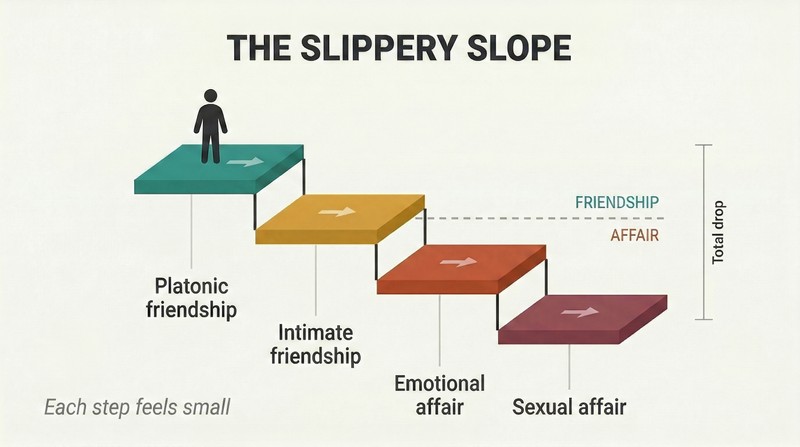
The book's central thesis is that today's affairs aren't premeditated seductions — they grow gradually from workplace friendships and social connections. Like the frog in slowly heating water, people don't notice they've crossed the line until it's too late. Ralph, a devoted husband in the book's recurring case study, drifted into an affair with his colleague Lara over months of shared lunches and deepening conversations — all before a single kiss.
The slippery slope progresses through four steps: platonic friendship, intimate friendship, emotional affair, sexual affair. Each felt minor at the time. Among Glass's 350 clinical couples, 62% of unfaithful men and 46% of unfaithful women met their affair partners through work. The danger isn't attraction — it's acting on it through incremental boundary erosion.
Map where your walls and windows are to spot hidden danger
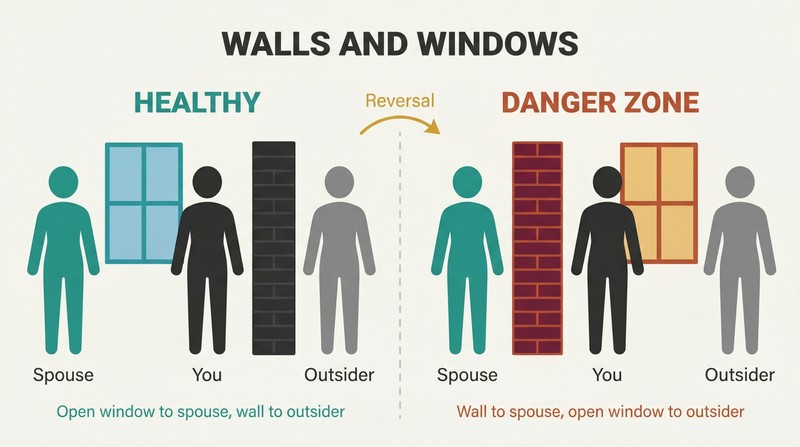
"Walls and windows" is the book's signature framework for diagnosing relationship boundaries. In a healthy marriage, partners share an open window of honesty between them and maintain a protective wall against outside threats. During an affair, this architecture flips: a wall of secrecy rises between spouses while a window of intimacy opens to the affair partner.
To assess any friendship, ask yourself: Am I sharing things with this person I'm not sharing with my partner? Am I keeping details of this friendship secret? If you're building walls inside your marriage and opening windows outside it, you've entered the danger zone — even without a single romantic gesture. Recovery requires physically reversing this architecture: total transparency with your spouse and a firm, opaque wall with the affair partner.
A great marriage alone won't affair-proof your relationship
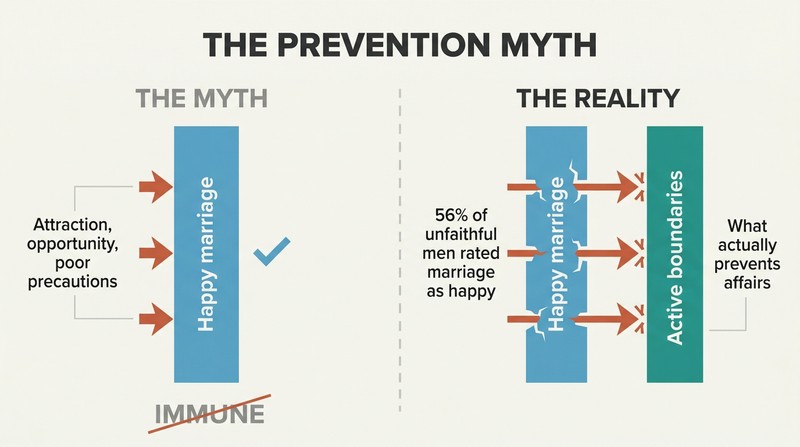
Glass calls this the Prevention Myth — the widely held belief that being a loving, attentive partner immunizes your marriage from infidelity. No research supports this. In Glass's airport study, 56% of unfaithful men and 34% of unfaithful women rated their marriage as happy. Unfaithful husbands in primarily sexual affairs were just as satisfied with their marriages as faithful husbands.
This myth causes real harm. Betrayed partners blame themselves, asking "What did I do wrong?" when the affair may have had nothing to do with them. Women are especially prone to self-blame — thinking if only they had been more desirable or attentive. Prevention requires both partners to actively maintain boundaries with friends and colleagues, not just love each other well enough.
Three markers distinguish emotional affairs from friendships
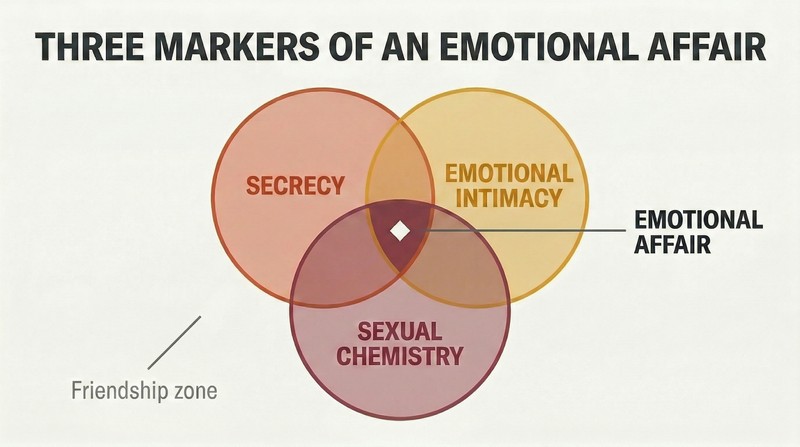
Glass identifies three overlapping elements that transform a platonic friendship into an emotional affair:
1. Secrecy — you're hiding the depth of the relationship from your partner
2. Emotional intimacy — you're sharing personal feelings and marital frustrations that belong inside the marriage
3. Sexual chemistry — there's an undercurrent of attraction, even if you've agreed never to act on it
These three ingredients create what Glass calls the most devastating involvements because they engage heart, mind, and body. Internet affairs are a prime example: they meet all three criteria without physical contact. In her clinical sample, 83% of women and 58% of men who had extramarital sex reported strong emotional attachment to the affair partner. The emotional bond — not just the sex — is what threatens marriages most.
Treat discovery of an affair as trauma, not merely a bad fight
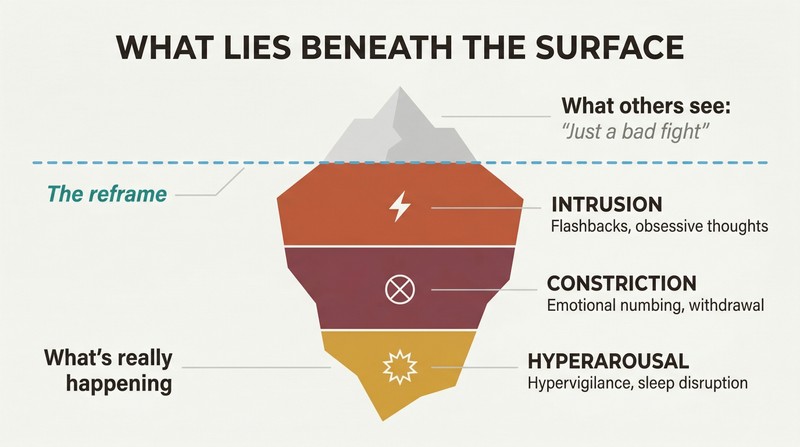
Glass's clinical innovation reframes infidelity through a trauma lens rather than simply as a marital problem. Betrayed partners exhibit the same three symptom clusters seen in PTSD: intrusion (obsessive thoughts, flashbacks), constriction (emotional numbing, withdrawal), and hyperarousal (hypervigilance, sleep disruption, startle responses). In her clinical sample, 24% of betrayed partners were severely anxious and 30% were clinically depressed.
This reframe transforms treatment. Just as disaster survivors need safety before rebuilding, betrayed partners need to feel safe before processing what happened. A therapist who dismisses flashbacks as overreacting or pushes premature forgiveness is essentially telling a hurricane victim to move on. The shattered assumptions — about the partner, the relationship, and one's own judgment — must be reconstructed gradually.
The person who broke trust must become the one who rebuilds it
This is the book's most counterintuitive principle: the unfaithful partner must actively move toward their partner's pain, answer questions, and offer comfort — even when every instinct screams to hide. Glass prescribes a concrete protocol called Stop and Share:
1. Stop all personal contact with the affair partner
2. Share all unavoidable encounters voluntarily — before being asked
3. Be accountable for your whereabouts at all times
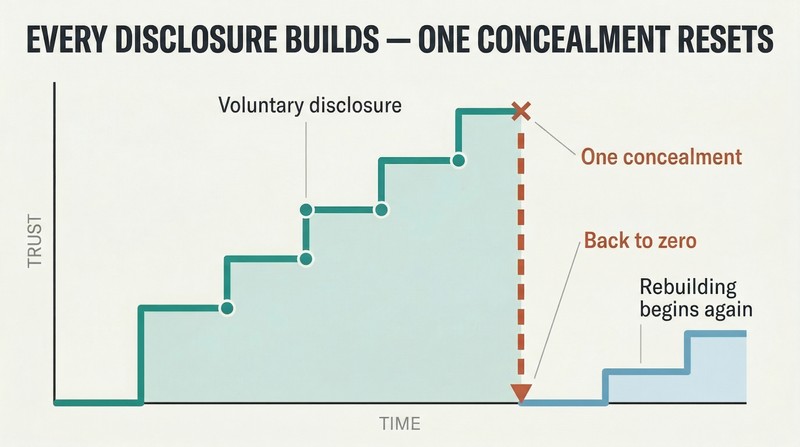
The key word is "voluntarily." When one wife told her husband about an unexpected encounter with her ex-lover before he had to ask, he felt she had given him a gift. Every honest disclosure is a trust deposit. Every concealment — no matter how small — resets recovery to zero. As Glass tells patients: you can't earn trust with oaths of allegiance, only with transparent behavior over time.
Couples who fully discuss the affair are far more likely to survive it
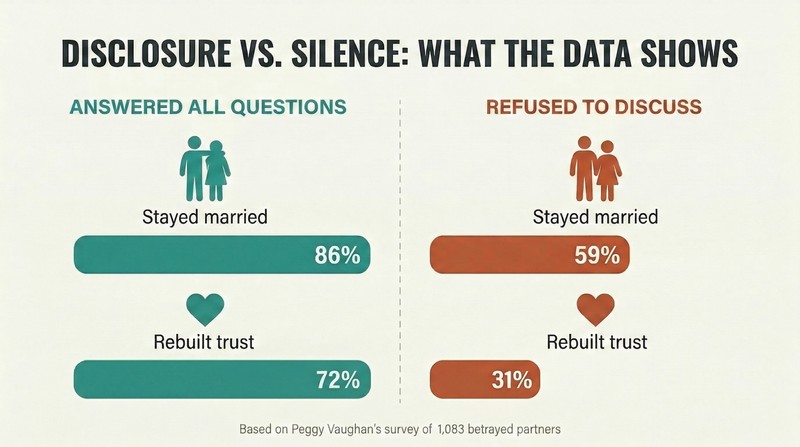
Many therapists advise silence. Glass's data proves them wrong. In Peggy Vaughan's survey of 1,083 betrayed partners, when the unfaithful spouse answered all questions, 86% of couples stayed married and 72% rebuilt trust. When the unfaithful spouse refused, only 59% stayed married and just 31% rebuilt trust.
Disclosure unfolds through three stages of disclosure: adversarial truth-seeking (interrogation mode), neutral information-seeking (reporter mode), and empathic mutual understanding (compassion mode). Glass developed the fishbowl technique — the betrayed partner writes questions on separate slips, places them in a glass bowl, and the unfaithful partner pulls them out at their own pace. Keeping the affair in a secret bubble preserves its romantic power; discussing it in daylight dissolves the spell.
Stop comparing affair fireworks with decades of real partnership
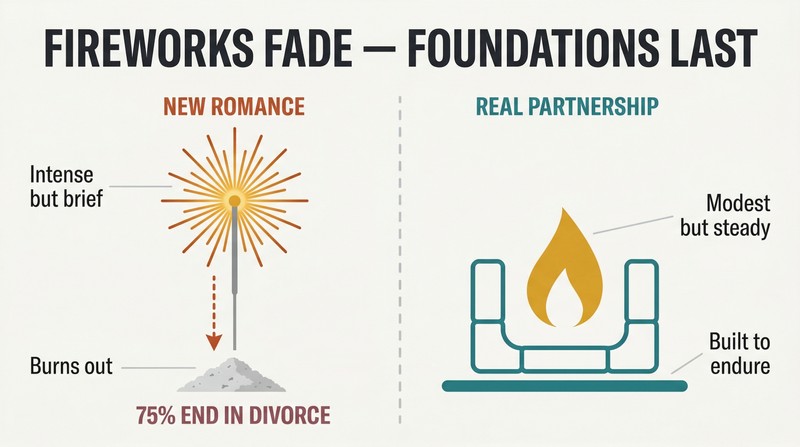
Unfaithful partners commonly say "I love you, but I'm not in love with you." Glass calls this an unfair comparison between Stage I romantic idealization — the dopamine-fueled early phase of any relationship — and reality-based mature love, which involves sharing a past, working toward common goals, and accepting each other's flaws. Affairs seldom survive the transition from stolen moments to daily life.
The numbers confirm this. Seventy-five percent of unfaithful individuals who marry the affair partner end up divorced. The affair partner's appeal is often not superiority over the spouse but difference from the spouse. What attracts in small doses can exhaust as a steady diet. Glass notes the affair partner might be "a nice place to visit" but not somewhere you'd want to live permanently.
Child-centered marriages quietly starve the couple and feed affairs
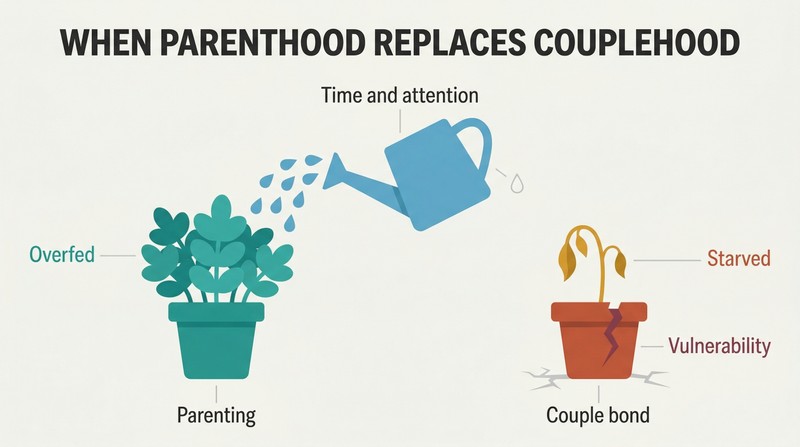
One of the most overlooked vulnerabilities for infidelity is the marriage where parenthood swallows couplehood whole. Ralph and Rachel's story illustrates this: their alternating work schedules, their learning-disabled son's homework demands, and their daughter's activities left no time for the conversations that had brought them together. Their romantic dinners devolved into problem-solving sessions about vaccinations and bedtimes.
Glass found that the child-rearing years are when marital satisfaction is lowest and vulnerability highest. The antidote isn't neglecting your children — it's deliberately scheduling couple time and maintaining an identity beyond "Mom and Dad." As Rachel realized during recovery: "Looking back on it, I can see how my being such a devoted mother made Ralph feel excluded." Parenthood must coexist with couplehood, not replace it.
Forgive to free yourself from the past — not to excuse the betrayer
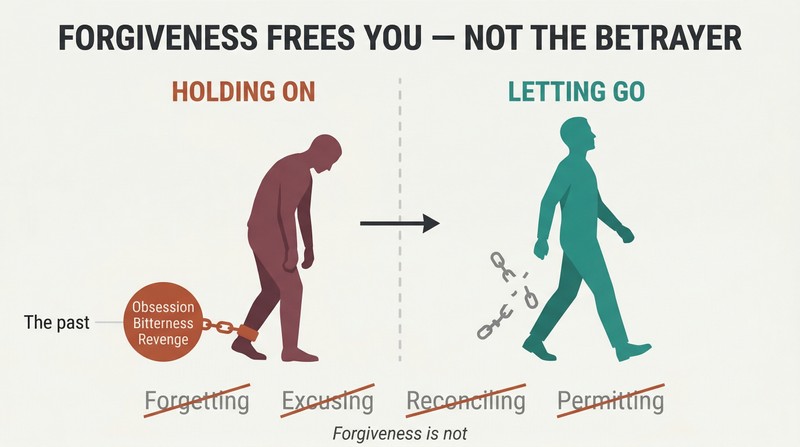
Forgiveness is the final chapter of healing, but Glass warns fiercely against rushing it. Premature or pseudo-forgiveness signals denial, not resolution. True forgiveness requires that all significant details are known, shattered assumptions have been reconstructed, and the unfaithful partner has demonstrated genuine change through action — not just apology.
Forgiveness is not forgetting, excusing, reconciling, or giving permission for future betrayal. It is letting go of obsessiveness, bitterness, and the need for revenge. Glass describes accusatory suffering — when betrayed partners unconsciously keep wounds open because healing might exonerate the perpetrator. The Stanford Forgiveness Project showed that learning to forgive reduced stress, depression, and physical health complaints. Some of Glass's most damaged clients eventually smiled years later and said of the affair partner: "She did me a favor. I really should write that Thank You note."
Analysis
Glass's work occupies a fascinating position at the intersection of attachment theory, trauma psychology, and social ecology. Published in 2003, it anticipated by nearly two decades the proximity crisis that workplace culture, social media, and messaging apps have intensified. Her most radical contribution isn't the walls-and-windows metaphor — elegant as it is — but the reconceptualization of infidelity as interpersonal trauma rather than moral failing. This shift from the moralistic frame to the clinical one was genuinely paradigm-shifting for couples therapy.
What distinguishes Glass from contemporaries like Gottman, Hendrix, or the later Esther Perel is her empiricism. Where others theorize, Glass quantifies — her airport study, her clinical sample of 350 couples, her therapist survey of 465 practitioners. This gives her claims a solidity that purely narrative approaches lack. Her finding that therapists themselves have no consensus on treating infidelity remains troublingly relevant two decades later.
The book has limitations worth noting. Glass's sample skews toward white, middle-class, heterosexual couples seeking therapy — a self-selected group that may not represent the broader population. Her emphasis on emotional affairs as uniquely threatening, while supported by her data on combined-type affairs and divorce rates, arguably underweights the role of power dynamics, sexual compulsion, and what Perel would later frame as existential hunger. Perel's subsequent work offers a necessary complementary lens — though Glass would rightly counter that the distinction matters less to the partner who's been deceived.
Perhaps Glass's most enduring insight is structural: modern life has created unprecedented architecture for intimacy between non-partners — open offices, constant messaging, LinkedIn connections — without updating the cultural software for managing boundaries. Her framework essentially argues that the threat isn't human nature; it's that we've redesigned the environment without redesigning the guardrails. In an age of 'work spouses' and DM culture, that insight grows more relevant, not less.
Review Summary
Not "Just Friends" receives mostly positive reviews for its comprehensive approach to infidelity. Readers appreciate its insights on emotional affairs, prevention strategies, and recovery advice for all parties involved. Many find it helpful for understanding and healing from infidelity, though some criticize its heteronormative focus and outdated examples. The book is praised for debunking myths about affairs and providing practical tools for rebuilding trust. While some find it too long or biased towards reconciliation, most reviewers consider it a valuable resource for couples dealing with infidelity.
People Also Read







Glossary
Walls and windows
Framework for relationship boundariesGlass's signature metaphor for diagnosing and healing relationship boundaries. In a healthy marriage, a 'window' of openness exists between partners, while a protective 'wall' shields the relationship from outside threats. During an affair, this reverses: a wall of secrecy goes up between spouses and a window of intimacy opens to the affair partner. Recovery requires reversing this architecture.
Prevention Myth
False belief love prevents affairsGlass's term for the widespread but unsupported belief that being a loving, attentive partner will protect a marriage from infidelity. Her research showed that many unfaithful partners rated their marriages as happy, and that affairs are often better explained by attraction, opportunity, and boundary failure than by marital deficiency.
Slippery slope
Gradual progression toward infidelityGlass's model describing how platonic friendships escalate into affairs through four incremental steps: (1) platonic friendship with a secure marriage, (2) intimate friendship with an insecure marriage, (3) emotionally involved affair with an emotionally detached marriage, (4) sexually intimate affair with a threatened marriage. Each step feels minor, making the overall slide difficult to recognize in real time.
Combined-type affair
Both emotional and sexual involvementAn affair characterized by both deep emotional attachment and sexual intercourse. Glass's research found these are the most disruptive to marriages and the hardest to recover from. They are also most likely to lead to divorce. More women than men engage in combined-type affairs, which is one reason women's affairs are associated with lower marital satisfaction.
Monogamous infidel
Can only invest in one relationshipGlass's term for an unfaithful person who is fundamentally monogamous and cannot be invested in two relationships simultaneously. Unlike compartmentalizers, monogamous infidels transfer their primary allegiance to the affair partner, withdrawing emotionally and sexually from the marriage. They often feel 'unfaithful' to the affair partner when intimate with their spouse.
Stop and Share
Post-discovery safety protocolGlass's three-step protocol for reestablishing safety after an affair is discovered: (1) Stop all personal contact with the affair partner, (2) Share all unavoidable encounters with the betrayed partner voluntarily and before being asked, (3) Be accountable for whereabouts. Designed to reverse the secrecy that fueled the affair and begin rebuilding trust through transparency.
Fishbowl technique
Structured question-answering method for disclosureA technique Glass developed for couples navigating disclosure. The betrayed partner writes each question on a separate slip of paper and places them in a clear glass bowl. The unfaithful partner pulls out questions at their own pace and chooses which to answer first, allowing both partners control over the process and preventing adversarial interrogation dynamics.
Bull's-eye caring
Giving what your partner actually wantsA concept from Glass's clinical work with Tom Wright. Instead of giving what you would want to receive, you target what your partner actually desires. Glass contrasts this with the traditional Golden Rule, offering her own version: 'Give unto others as others like to give unto you.' Missed targets waste emotional energy; bull's-eye caring strengthens the bond efficiently.
Accusatory suffering
Perpetual victimhood blocking forgivenessA term from Elizabeth and Arthur Seagull that Glass applies to betrayed partners who unconsciously perpetuate their own suffering. They keep wounds open because they believe healing would exonerate the perpetrator—as if recovery would minimize the injury. This pattern blocks forgiveness and can paradoxically push the unfaithful partner back toward infidelity out of hopelessness.
Three stages of disclosure
Evolving process of discussing the affairGlass's framework for how couples discuss the affair over time: (1) Truth seeking—adversarial interrogation with lies and truth traps, (2) Information seeking—neutral, reporter-like exchange of facts, (3) Mutual understanding—empathic, collaborative exploration of meaning. Not all couples progress through all stages; some remain stuck in earlier, destructive patterns.
Error of assumed similarity
Projecting your perspective onto your partnerThe cognitive bias where partners assume the affair has the same meaning for their spouse that it would for them. Women tend to view their husband's affairs through the lens of love ('You must have loved her'), while men view their wife's affairs through the lens of sex ('He must have been better in bed'). These projections create misunderstandings that obstruct recovery.
Cup of coffee syndrome
Gradual escalation from casual meetingsA term from researcher Fred Humphrey describing how two married people begin meeting for innocent coffee breaks, then meet regularly with increasingly intimate conversation, until the relationship becomes emotionally indispensable. Glass uses it to illustrate how empathic communication can be more addictive than caffeine and how affairs grow from seemingly harmless routine interactions.
FAQ
What's Not "Just Friends" about?
- Focus on Infidelity: The book delves into the complexities of infidelity, particularly how emotional affairs often start as friendships and unintentionally cross boundaries.
- Understanding Relationships: Shirley P. Glass provides insights into how emotional intimacy can develop between friends, blurring the lines between platonic and romantic relationships.
- Recovery Strategies: It offers practical advice for couples dealing with infidelity, focusing on rebuilding trust and communication.
Why should I read Not "Just Friends"?
- Expert Insights: Written by Shirley P. Glass, Ph.D., a seasoned therapist and researcher, the book is grounded in clinical experience and research on infidelity.
- Practical Guidance: It provides actionable steps for both partners to navigate the trauma of infidelity, making it a valuable resource for anyone affected by betrayal.
- Understanding Human Behavior: The book helps readers understand the motivations behind infidelity, fostering empathy and insight into their own relationships.
What are the key takeaways of Not "Just Friends"?
- Emotional Affairs Are Common: Many affairs start as emotional connections with someone considered "just a friend," highlighting the need to recognize and maintain boundaries.
- The Importance of Communication: Effective communication is crucial for rebuilding trust after infidelity, requiring couples to openly discuss their feelings and experiences.
- Recovery Takes Time: Healing from infidelity is a process that requires patience and commitment, with stages of recovery outlined to help couples establish safety in their relationship.
What are the best quotes from Not "Just Friends" and what do they mean?
- “You know you’re in trouble when the word ‘just’ appears before the word ‘friends.’”: This quote underscores the danger of emotional intimacy in friendships, suggesting denial of deeper feelings.
- “Infidelity is any emotional or sexual intimacy that violates trust.”: It broadens the understanding of infidelity beyond physical acts, emphasizing the damage of emotional connections.
- “The excitement of an affair can increase passion at home and make sex even more interesting.”: This highlights the paradox that infidelity can sometimes reignite passion in a marriage, complicating emotions.
How does Not "Just Friends" define emotional affairs?
- Emotional Intimacy: An emotional affair involves a deep emotional connection, sharing personal thoughts and feelings that should be reserved for a spouse.
- Secrecy and Deception: These affairs typically involve secrecy, creating a barrier that erodes trust in the primary relationship.
- Potential for Sexual Involvement: Emotional affairs may start without sexual contact but often escalate, complicating the emotional landscape.
What is the "Prevention Myth" in Not "Just Friends"?
- Misconception of Love: The "Prevention Myth" is the belief that being a loving partner is enough to prevent infidelity, which Glass argues is a misconception.
- Need for Boundaries: The book stresses the importance of recognizing and maintaining appropriate boundaries, as love alone does not safeguard against temptation.
- Awareness of Vulnerabilities: Understanding personal and relational vulnerabilities is crucial for preventing infidelity, encouraging proactive discussions.
What specific methods does Shirley P. Glass recommend?
- Fishbowl Technique: This method allows betrayed partners to ask questions about the affair in a non-threatening way, promoting open communication.
- Marital Lifeline Exercise: Couples create a timeline of their relationship to identify patterns and vulnerabilities that may have contributed to the affair.
- Compassionate Communication Skills: Glass emphasizes using "I" messages and active listening to foster empathy and connection during difficult conversations.
How can couples effectively communicate after an affair according to Not "Just Friends"?
- Inhibit Negative Reactions: Both partners should control destructive outbursts and avoid escalating conflicts during discussions about the affair.
- Use "I" Messages: Expressing feelings through "I" statements helps reduce defensiveness and fosters a more open dialogue.
- Practice Active Listening: Partners should acknowledge each other's feelings and perspectives, creating a safe space for sharing and healing.
What are the stages of recovery outlined in Not "Just Friends"?
- Initial Shock: The first stage involves dealing with the immediate emotional fallout and trauma following the revelation of infidelity.
- Understanding and Processing: Couples are encouraged to explore the reasons behind the affair and their own vulnerabilities during this stage.
- Rebuilding and Healing: The final stage focuses on actively working together to rebuild trust, intimacy, and a stronger relationship foundation.
How does Not "Just Friends" address the trauma of discovery?
- Emotional Reactions: The book details the intense emotional reactions, including shock, anger, and grief, that both partners experience upon discovering infidelity.
- Stages of Recovery: Glass outlines stages of recovery, emphasizing that healing takes time and requires effort from both partners.
- Support Systems: The author encourages seeking support from friends, family, or therapists to help cope with the trauma.
How can couples prevent emotional affairs as discussed in Not "Just Friends"?
- Recognize Warning Signs: Be aware of signs that a friendship may be crossing into emotional territory, such as increased secrecy.
- Set Boundaries: Establish clear boundaries in friendships and work relationships to prevent emotional affairs.
- Prioritize the Relationship: Spend quality time together and nurture the emotional connection to reduce the likelihood of seeking intimacy outside the marriage.
What role does individual history play in infidelity according to Not "Just Friends"?
- Childhood Experiences: Past experiences, such as attachment styles and family dynamics, can influence how individuals approach relationships.
- Emotional Allergies: Previous traumas can create heightened sensitivities, leading to misunderstandings and emotional distance.
- Patterns of Behavior: Individuals may replicate unhealthy patterns from their upbringing, affecting their ability to maintain a committed relationship.
Download PDF
Download EPUB
.epub digital book format is ideal for reading ebooks on phones, tablets, and e-readers.








































