
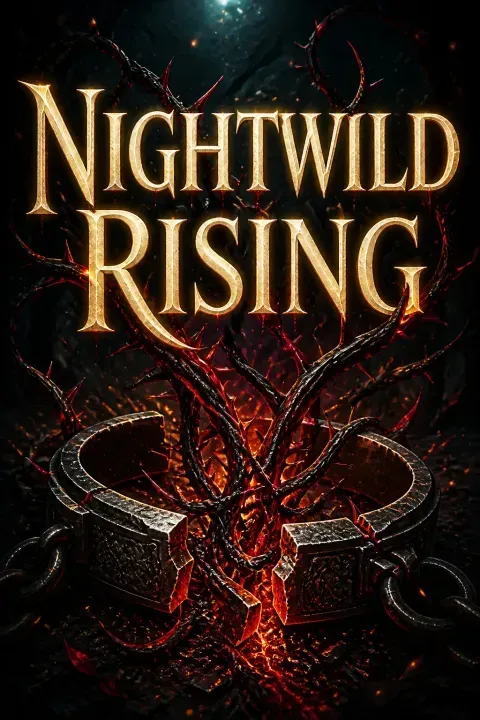


Plot Summary
Prologue
Centuries ago at Therison Vale, Lord Casric commanded the last human army against three hundred fae. Behind him, mages chanted a ritual to seal Underhill, the fae homeland, away forever. Leading the fae charge rode the Hell-Thorn of the Nightwild,2 a warrior in black armor chased with silver thorns, his twelve-strong Nightwild Guard at his back. Casric fell to the Hell-Thorn's2 twin curved blades.
But just as the Hell-Thorn2 reached the ritual circle, the mages completed their work. Underhill vanished. Every fae on the battlefield froze, their connection to home severed. Their silver blood turned red. Weakened, mortal now, the Hell-Thorn2 rallied the survivors with a single command: move, find others, and survive until they find a way back.
The prologue establishes the foundational trauma: the Sealing was not a military defeat but a cosmic severance. The fae lost their home, their power source, and their immortality in a single moment. The Hell-Thorn's transformation from unstoppable killing force to bleeding, cornered survivor mirrors the collective fall of his people. Silver blood turning red is the key symbolic wound: the fae are made mortal, stripped of their divinity, rendered vulnerable to iron and human weapons. This moment calcified into three centuries of human dominance, creating the entire world of preserves, collars, and trophy hunts that the present-day story will unravel. The Hell-Thorn's command to survive is a seed that will grow into revolution.
Alleria arrives at the Dell eager to kill her first fae
Princess Alleria,1 youngest daughter of the king,12 turns twenty-one and receives a fae hunt at Huntsman Dell as her birthday gift. She travels with her handmaid Nella,10 her lifelong guard Brennan,11 and a tracker named Wil. Huntmaster Cowen13 shows her the quarry: a tall creature with a magnificent twelve-point rack of antlers, skin gray-green like lichen, and an iron collar locked around a raw throat.
It stands with its back to her, utterly still, never acknowledging her presence. Alleria1 thrills with excitement. Her father12 chose the modifications himself. She takes up her bow and quiver of iron-tipped arrows, and the handlers release the collared fae into the warded forest. The hunt begins.
Alleria's excitement is not monstrous but the product of lifelong indoctrination. The dehumanizing language she uses (the fae is an 'it,' 'quarry,' 'the creature') reveals how thoroughly human society has constructed fae as animals suitable for sport. The antlers, custom-grown on a living being to please a princess's aesthetic preferences, represent the ultimate commodification of sentient life: a creature reshaped through torture into someone's ideal trophy. Alleria's unquestioning acceptance of this as a birthday gift is the story's moral starting point, the baseline from which her entire arc will pivot toward horror and, eventually, solidarity.
Alleria finds the fae trapped but cannot loose her arrow
Alleria's1 horse bolts, separating her from the hunting party. She stumbles upon the fae tangled by his antlers in branches, helpless. She nocks an arrow, draws, and aims for his heart. Then he turns his head and meets her eyes. Pale gold, intelligent, calculating. He speaks two words dripping with contempt: pathetic human. The shock paralyzes her.
Fae2 don't speak. They're animals. He tears free from the branches, crosses the clearing in two strides, and grabs her. His hand clamps over her mouth, his arm locks around her ribs. Brennan's11 voice calls her name in the distance. She tries to scream, but nothing escapes. The fae drags her deeper into the forest as the search party moves in the wrong direction.
This moment shatters Alleria's paradigm: the 'animal' speaks, thinks, strategizes, and looks at her with a general's calculating disdain. His two words function as a mirror, reflecting back the contempt humans have shown his kind for centuries. Her inability to loose the arrow despite her training reveals that somewhere beneath indoctrination, she recognized something in his eyes that couldn't be reduced to prey. The auditory torture of hearing Brennan call her name while she's silenced inches away establishes the recurring motif of rescue being agonizingly close yet unreachable.
Cairn tastes Alleria's blood and shatters his iron collar
In a warded hollow ringed by glowing mushrooms, the fae cuts Alleria's1 palm open. He presses his mouth to the wound and drinks. Despite her terror, unwanted heat floods her body. He then presses her bleeding hand against the iron collar locked around his throat. The metal heats, cracks, and shatters into pieces at their feet.
His antlers begin crumbling away, his gray-green skin flaking to reveal pale flesh beneath, the collar wounds starting to heal. Using her blood again at ancient standing stones, he breaks the magical wards on the forest's boundary. They walk free of the preserve. Alleria1 understands too late that she was never the hunter. Her blood was the key he needed.
The blood-drinking scene is deliberately queasy and erotic, forcing Alleria and the reader into moral discomfort. Her body's arousal during an act of violation mirrors the fae's centuries of unwanted physical response to their captors. The collar's breaking is the story's first true liberation, but it comes through consuming the princess's life essence: an intimate violation that creates a permanent bond. The crumbling antlers and flaking skin symbolize the shedding of imposed identity, the return of the self beneath the modifications humans carved onto him.
Cairn reflects on captivity while he heals his prisoner
In a cave, Cairn2 uses his returning magic to heal Alleria's1 broken ribs and dislocated shoulder, injuries he inflicted earlier. She passes out during the agonizing process. Through his perspective, the full horror of his captivity emerges: three hundred years passed from owner to owner, collared and used.
Noblewomen selected him from cages for their beds, commanding him to perform desire, to smile, to pretend pleasure. He learned to bury his rage and wait. He remembers the modifications: mages forcing antlers through his skull while guards held him down, reshaping his body to please the king's daughter.1 Now he watches the sleeping princess and weighs all the ways he could repay human cruelty through her flesh.
This chapter inverts the power fantasy of captivity narratives. Cairn's trauma, revealed through his own voice rather than Alleria's horrified gaze, forces the reader to reckon with the full weight of institutionalized evil. The detail that he was passed through generations, that grandmothers and granddaughters used the same fae without knowing it, speaks to systemic cruelty that outlives individual perpetrators. His restraint in not killing Alleria despite wanting to reveals the discipline forged in suffering: he will use her strategically, not emotionally. Healing her after breaking her is the first crack in his armor of pure vengeance.
Cairn makes Alleria fake sexual surrender
At an inn, guards arrive checking fae ownership papers. Cairn2 concocts a desperate ruse: they must be discovered in an intimate moment so the guards leave without close inspection. He strips Alleria1 to the waist, pins her to the bed, and kisses her. She freezes, then her body betrays her. Her lips part, her back arches, she moans against his mouth.
When the guards open the door, they see a noblewoman apparently lost in pleasure with her fae pet, and they retreat in mortified embarrassment. After they leave, Alleria1 lies trembling with shame at her own response. Cairn's2 voice is cold when he tells her this was survival, nothing more. His own hands are shaking.
The scene is a hall of mirrors: Cairn reenacts his own abuse (forced to perform sexual acts for an audience) but this time as the director rather than the performer. Both characters are violated by necessity. Alleria's body responding involuntarily mirrors Cairn's earlier blood-drinking: the body can be made to feel pleasure against the mind's will. His shaking hands betray that 'survival mode' costs him too. The guards' embarrassed retreat proves that the performance of intimacy is more effective at deflecting scrutiny than any protestation of innocence would be, a bitter lesson in how societies police who is seen as fully human.
Cairn's true form emerges, then he releases Alleria near the Dell
They stop at a stream where Cairn2 bathes, scrubbing away the last gray-green pigmentation. Dark marks emerge on his skin: thorn-like patterns recording his rank and victories, burned away by the iron collar but now returning. Alleria1 stares at his scarred body until he catches her. He tells her he intends to return to the Dell to free his people.
Then, unexpectedly, he releases her. She can walk back, claim she escaped, and forget any of this happened. When Dell riders find her, she tells the expected lies about running from the fae. But as she's returned to the lodge, she passes the trophy wall and cannot look at the mounted antlers without seeing the faces of those who wore them.
The stream functions as a baptism, washing away the identity humans imposed on Cairn. His marks returning is a visual manifestation of reclaimed selfhood and power. His decision to release Alleria appears pragmatic ('you've served your purpose'), but there's an undertow of something else: he could have killed her, but didn't. Her lies to the Dell riders mark her first act of complicity with the fae. The mounted trophies, which once excited her as a future hunter, now read as a charnel house. The girl who came to hunt is already gone, replaced by someone who cannot unsee what she has seen.
Alleria demands to see the pens and witnesses systematic atrocity
Before leaving the Dell, Alleria1 asks to see where the fae are kept. Huntmaster Cowen13 reluctantly escorts her through rows of iron cages sunk in mud and filth. She sees fae with collar wounds festered to the bone, spines bent from cages built too short, bodies wasted to skeletons. A female warrior stands straight-backed despite everything, and when Alleria1 approaches, she spits at her.
A guard beats the female with an iron rod while Alleria1 stands frozen. Another female hums a melody of unbearable sorrow. Alleria1 sees the empty cage where Cairn2 lived, its dirt floor worn into a pacing path. Cowen13 offers to show her how modifications are performed. She refuses, barely making it back to the carriage before sobbing.
This is the book's moral fulcrum. Alleria's demand to see the pens suggests a conscience awakening, but her paralysis while Vel is beaten reveals the gap between feeling horror and acting on it. The female who spits understands something Alleria doesn't: that passive sympathy without intervention is its own form of complicity. Serath's humming is a thread of beauty and grief that will follow Alleria into her dreams, an embodied reminder that these are not animals but beings with culture, history, and art. The worn pacing path in Cairn's cage is a haunting detail: three steps, turn, three steps back, for three hundred years.
Through their bond, Alleria watches Cairn slaughter the Dell
Back at the palace, Alleria1 dreams. But it isn't a dream. Through the blood bond, she rides Cairn's2 consciousness as he returns to the Dell with newly freed Therin3 and Vel.4 They kill every guard. Cairn2 finds Cowen13 in his study, breaks the huntmaster's fingers one by one, burns him with a poker, and demands the names of the fae whose antlers line the walls.
Cowen13 knows none of them. Cairn2 beheads him and mounts his head on the trophy wall alongside the forty-three fae trophies. Alleria1 wakes screaming. She felt his satisfaction, his rage, his dark fulfillment. And beneath her horror, she cannot fully condemn what he did.
The dream-vision forces Alleria into unwilling witness, collapsing the distance between passive knowledge and visceral experience. Cairn's question 'what were their names?' is the moral core: Cowen's true crime is not merely cruelty but the absolute erasure of fae personhood. The forty-fourth trophy, a human head among the fae antlers, creates a symmetry that is both justice and atrocity. Alleria's inability to condemn Cairn fully marks her irrevocable separation from her own kind's moral framework. She has felt his rage from the inside, and it makes a terrible kind of sense to her.
Whispers, a severed ear, and a blade turn Alleria into prey
At court, Alleria1 confronts Lord Vessen over his hunting boasts, asking if he would squeal like a pig if someone gutted him while unarmed and collared. She clashes with Lady Maren over casual talk of using fae for entertainment. The courtiers whisper that the fae must have done something to her mind.
Someone leaves a severed fae ear wrapped in bloody cloth on her dressing table with a note reading 'From my kennels.' She burns it rather than report it. Later, in a dark hallway, a man grabs her from behind, calls her a fae lover, and drags a blade down her arm. She bandages the wound herself and tells no one. The palace that was once home has become a hunting ground, and she is the quarry.
The escalation from whispers to physical violence follows the classic pattern of othering: first social ostracism through gossip, then intimidation through symbolic violence (the ear as threat), then direct assault. Alleria's silence after each attack isn't passivity but strategic calculation: she recognizes that reporting would only confirm their narrative that she's been 'tainted' by the fae. The irony is razor-sharp: she's being hunted by her own people for the crime of seeing fae as people. The severed ear is a grotesque mirror of the trophy wall at the Dell.
Cairn frees his people, mercy-kills the broken, and burns the dead
After killing the guards, Cairn,2 Therin,3 and Vel4 use the guards' dying blood to break collars and free seventy-nine fae. But decades in iron have hollowed many beyond recovery. Cairn2 personally mercy-kills twenty-four of them with a blade to the brain stem, fae whose minds will never return, whose bodies are just breathing shells.
They build a pyre and burn the dead. The functional survivors are loaded onto carts, and the group travels to a hidden hollow in the northern forest. There, Cairn2 feels his old bonds with Therin3 and Vel4 reforming through the Nightwild magic, the threads that connect the Guard. He also senses something pulling east: more of his warriors, alive and free somewhere.
The mercy-killing sequence is the book's darkest exploration of what captivity truly does to a being. These fae aren't killed by the enemy but by their own commander, because the iron has already burned everything out of them except a heartbeat. Cairn's willingness to do this personally, rather than delegating, speaks to a leadership defined by bearing the unbearable. The pyre is the antithesis of the trophy wall: ashes scattered to wind rather than corpses mounted for display. The reforming bonds and the eastern pull introduce hope: not everyone was caged, and something is calling them back together.
Cairn steals Alleria from the palace and puts a leash on her
Cairn2 and Therin3 infiltrate the palace using glamour. Cairn2 magically deepens Alleria's1 sleep and carries her from her bed. Back at the fae camp, she wakes in his shelter wearing a seamless silver collar he conjured. He makes her kneel beside his chair whenever he's present, calls her 'pet,' and reminds her that she walked past his people's cages and did nothing.
He strips her, makes her bathe in front of him, and dresses her in a thin tunic like the one he wore as a captive. When she begs to see the sky, he arranges for Vel4 to march her through the camp so every fae can look at her the way humans once looked at them.
Cairn's cruelty here is not random sadism but pedagogical revenge. He is teaching Alleria what captivity feels like through embodied experience. The collar, the kneeling, the forced nudity, the diminutive naming, the walk of exposure: every element is drawn from his own three centuries of suffering. The question the narrative poses is whether this makes him no different from his tormentors, or whether the context of returning violence onto a representative of the oppressor class, with the express purpose of creating understanding rather than merely inflicting pain, creates a moral distinction. His own trauma leaks through every act.
A fae bargain strips Alleria bare, then Cairn offers her freedom
Cairn2 proposes a truth-for-truth bargain. Under its compulsion, Alleria1 confesses her attraction to him, her body's unwanted responses, and even her dark, shameful arousal watching him kill. He reveals that he is the Hell-Thorn2 of legend, the Lord of the Wild Hunt who slaughtered thousands at Therison Vale.
When the bargain ends, he offers another: one night of her body freely given, in exchange for her freedom at sunrise. She agrees. In a night of overwhelming intimacy, he gives her his true name: Luchairn Vaedráfn.2 She whispers it as she climaxes. He intended to ruin her. Instead, something in him cracks open.
The two bargains form a sequence of escalating vulnerability. The truth bargain is psychological stripping; the second is physical. But Cairn's gift of his true name, the most precious and dangerous thing a fae can give, reverses the entire power dynamic. He came to take something from her and instead gave her the means to hold power over him. The word 'Aethryn' (my love) that later slips out when he reaches for her reveals that the Nightwild magic had already claimed her as his, beyond his conscious intention or resistance. His armor of cold control is not as impenetrable as he believed.
Rescuing collared fae and reuniting with three more warriors
Cairn,2 Therin,3 Vel,4 and Alleria1 ride east following the threads of the missing Nightwild Guard. They ambush a transport wagon, killing the guards and merchant, and freeing six collared fae. Alleria1 watches through Cairn's2 eyes during the fight and feels unwanted arousal at his lethal grace.
They reach a village where fae and humans live openly together, protected by a network of sympathizers who have hidden fae for generations. Three more Guard members appear: Kaelith,7 Sorel,9 and Vessara8 (Vel's4 twin). They have been building safe havens, buying fae at auction through intermediaries. The reunion is tearful and fierce. Alleria1 witnesses the depth of bonds between these warriors.
The village represents an alternative possible world: proof that humans and fae can coexist when the power imbalance of the preserves is removed. The Guard's reunion is a masterclass in showing, not telling, the cost of the Sealing. These beings have been separated for longer than human civilizations exist. Their weeping, their embraces, their inability to let go: this is what the humans stole. Alleria's outsider perspective on this intimacy sharpens her own loneliness and her dawning recognition that she has never belonged anywhere the way these fae belong to each other. The network of human sympathizers complicates the story's morality significantly.
Alleria refuses freedom and begins training to fight
At sunrise after their bargain night, Therin3 prepares to escort Alleria1 back to the palace. She refuses. She tells Cairn2 she cannot return to a court that mounts fae heads on walls, cannot pretend she hasn't seen what she's seen. He warns her this means being hunted as a traitor, losing her family, and facing a war. She accepts.
Alleria1 begins training: archery with Therin3 (who throws pebbles at her to teach focus under distraction), stealth with Vessara,8 blade work with Sorel.9 Cairn2 avoids her. Then one night he comes to her room, washes her hair, and tells her the Nightwild magic has been claiming her, weaving her into the Guard. She can accept or refuse. For now, she doesn't have to decide.
Alleria's choice to stay is not framed as romantic sacrifice but as moral necessity: she cannot unknow what she knows. Her training scenes show her earning her place through labor and bruises, not being gifted it. Cairn's avoidance after their night together reads as emotional cowardice, which he partially redeems by telling her the truth about the magic. The revelation that the ancient Nightwild magic chose her, a human princess who came to kill its Eldráfn, is the story's central mystery and grace note: the magic does not care about species, only about some deeper resonance of belonging.
Nella leads Alleria into an ambush; Brennan reclaims her
Nella,10 terrified and unable to accept Alleria's1 transformation, sees Brennan11 among a patrol of disguised King's Guard visiting the village. She passes him a note. Later, she lures Alleria1 on a walk to the edge of the village, where Brennan11 and soldiers wait hidden in the trees. Alleria1 realizes the betrayal only when Brennan11 steps from the shadows.
Vel,4 who followed suspiciously, intervenes but is shot with an iron-tipped arrow. Brennan11 knocks Alleria1 unconscious. Through the blood bond, Cairn2 feels Vel's4 agony and Alleria's1 terror, then the terrible silence when she goes under. He finds Vel4 bleeding, the barbed arrow lodged deep, iron poisoning her flesh. The Nightwild Guard prepares to ride.
Nella's betrayal is not villainy but tragedy: she genuinely believes she's saving Alleria from fae enchantment. Her inability to see the fae as people reflects the same indoctrination Alleria herself held weeks ago, making her a dark mirror of what Alleria might have remained. The iron arrow in Vel's shoulder is both physical wound and symbolic: iron is the substance of fae subjugation, and Vel took that arrow while trying to protect the human she had sworn to hate. The blood bond's transmission of Alleria's terror to Cairn proves the connection he's been fighting is now undeniable, a bond that transcends distance.
Alleria accepts the Guard while Cairn shatters every collar in the kingdom
At the palace, Alleria's father12 summons a mage14 to examine her mind. When the mage14 confirms no enchantment, her choices are her own, her father12 disowns her. Brennan,11 revealing their secret betrothal, chains her in a dungeon and orders the mage14 to tear information from her mind by force.
As the mage's14 magic rips through her, Cairn2 reaches through the bond and builds a sanctuary inside her consciousness. He begs her to accept the Nightwild magic. She says yes. The magic surges, forming an impenetrable barrier around her mind.
Above ground, feeling her beaten through the bond, Cairn's2 rage ignites his restored power into a summons that races across the entire kingdom. Iron collars shatter everywhere. All twelve Nightwild Guard threads reconnect. Hundreds of freed fae rise. Cairn2 in his thorned armor mounts Selveryn and declares the Guard is riding to rescue her.
The climax achieves a twofold liberation: Alleria's internal acceptance of the magic (choosing to belong somewhere, to someone) and Cairn's external shattering of the collars (freeing his people en masse). The king's disownment is the death of Alleria's old identity; the magic's acceptance is the birth of a new one. Brennan's reveal that she was secretly betrothed to him since childhood reframes her entire life at court as a gilded cage. Cairn's world-breaking summons is the narrative's answer to the Sealing of the prologue: where humans once sealed fae away from their home, now a fae lord breaks open every prison humans built. The cliffhanger promises the reckoning is just beginning.
Analysis
Nightwild Rising uses the dark fantasy romance framework to conduct a sustained moral interrogation of systemic oppression, trauma, and the possibility of solidarity across lines of species and power. The novel's central conceit, that the fae are not mystical monsters but a conquered people subjected to centuries of imprisonment, forced bodily modification, sexual exploitation, and ritualized murder for sport, maps disturbingly onto real-world histories of colonization and dehumanization. Alleria1 is not a natural rebel but a product of her society who must undergo the painful process of unlearning everything she was taught. Her arc refuses easy redemption: she cannot undo her complicity by simply feeling bad about it, and the fae around her, particularly Vel,4 do not owe her forgiveness. The novel's treatment of Cairn's2 sexual trauma is notably careful for the genre. His three centuries of being used by human women are not treated as background color but as the defining wound shaping his every interaction. His cruelty toward Alleria1 is contextualized as a trauma survivor reenacting his own abuse from the position of power, a cycle the narrative explicitly names and critiques. When Alleria1 tells him he is becoming what he hates, the accusation lands with full force because the text has built the evidence for it. The blood bond and the Nightwild magic function as metaphors for the involuntary intimacy that oppression creates between oppressor and oppressed. Cairn2 and Alleria1 are bound together by his act of survival (drinking her blood) and by a magic that does not consult their preferences. The relationship that develops between them is neither a sanitized redemption arc nor a straightforward enemies-to-lovers fantasy but something messier: two people carrying incompatible histories who find themselves choosing each other anyway, against every rational argument. The world-building is morally complex in its refusal to make all humans villains. The network of human sympathizers who have hidden fae for generations, the innkeeper Sharla who feeds Alleria1 without judgment, the village where species coexist: these elements prevent the story from collapsing into a simple species-war framework. The real enemy is not humanity as a category but the specific institutions — the preserves and the court — that profit from fae suffering. The novel's cliffhanger, with Cairn's2 power shattering every collar in the kingdom and the full Nightwild Guard finally reunited after three hundred years, promises a sequel that will move from survival and recovery into active revolution. The story has carefully built the moral and emotional foundation for that war, making clear exactly what is being fought for and against.
Review Summary
Nightwild Rising receives an overall strong reception (4.47/5), with most readers praising its dark, addictive enemies-to-lovers storyline, compelling characters—particularly the tortured fae warrior Cairn—and its unique spin on fae mythology. Many highlight the emotional depth, slow burn romance, and shocking ending. Common criticisms include inconsistent pacing in the second half, underdeveloped world-building, insufficient character descriptions, and concerns around consent dynamics. Most readers eagerly anticipate the second book.
Characters
Alleria
Human princess turned fae allyThe youngest daughter of the human king12, turning twenty-one as the story begins. She has always been the spare, more comfortable in stables and archery ranges than in court dress. Her mother died when she was six, leaving her father12 distant with grief. Beneath her privileged naivety lies genuine courage and a fierce, stubborn will. Her journey from eager hunter to horrified witness to someone who chooses the fae over her own people is driven not by romance but by an awakening moral conscience. She is constitutionally incapable of unseeing the truth once she's seen it. Her body's responses to Cairn2, often against her will, become a source of deep shame and confusion that she must learn to untangle from genuine desire.
Cairn / Luchairn Vaedráfn
Eldráfn of the Nightwild GuardAn ancient fae warrior, over a thousand years old, known to humans as the Hell-Thorn, Lord of the Wild Hunt. He led the charge at the battle of Therison Vale and was trapped in the mortal realm when humans sealed Underhill. Spent three hundred years in iron collars, passed from owner to owner, used for sex and entertainment by generations of human noblewomen. His rage is a living thing, carefully leashed for survival. He can be cold, cruel, and calculating, but his cruelty serves purpose rather than pleasure. Beneath the armor of vengeance, he carries deep trauma around touch and consent. His gift of his true name to Alleria1 is the most vulnerable act of his existence.
Therin
Cairn's second-in-commandCairn's2 sword-brother and oldest friend, a member of the Nightwild Guard for centuries. Witty, irreverent, and possessed of an irrepressible humor that survives even the cages. He lightens every tense moment with a smirk or a quip, but his loyalty to Cairn2 is absolute. Freed from the Dell alongside Cairn2, he becomes Alleria's1 primary archery instructor, treating her with an easy respect that helps her earn her place. His relationship with Vel4 is a constant low-grade friction that masks deep mutual reliance.
Vel
Fae warrior, harsh and unyieldingA member of the Nightwild Guard, freed from the Dell where she was caged near Cairn2. Her exterior is all sharp edges and cold fury; she has spent centuries nursing a hatred of humans that has calcified into something almost inhuman. She was the one who spat at Alleria1 in the cages and took a beating for it without flinching. She becomes Alleria's1 most vocal antagonist in the camp, convinced the princess will eventually betray them. Her anger is a shield over profound grief for what was stolen from her. Her twin sister is Vessara8, from whom she was separated at the Sealing.
Serath
Gentle singer of ancient songsA member of the Nightwild Guard known for her sweet nature and her voice. During her decades in the cages, she kept herself alive by humming an ancient melody from Underhill, a song of grief and longing so beautiful it made Alleria1 weep when she first heard it. After being freed, she speaks haltingly, words coming with effort as though she's relearning language. She is the first fae besides Cairn2 to show Alleria1 genuine gentleness, bringing her food and letting her sit with the catatonic Caelum6. Her thread in the Guard bond is described as warm and luminous.
Caelum
Warrior lost inside himselfA member of the Nightwild Guard who retreated so deep into catatonia after his captivity that he seemed beyond reach. He lies unresponsive, eyes open, for weeks after being freed, and Vel4 argues he should be mercy-killed. It is Alleria's1 voice, confessing her own guilt and fear while sitting beside him, that finally pulls him to the surface. He speaks a single broken sentence, beginning his slow recovery. His return is a turning point that challenges Vel's4 certainty that Alleria1 is worthless.
Kaelith
Guard who built the networkA member of the Nightwild Guard who escaped capture at the Sealing. For three centuries, he has built and maintained a secret network of human sympathizers and safe villages where freed fae can live openly. He is patient, strategic, and has learned the long game of survival. When Cairn's2 summons reaches him, he runs to answer it with tears in his eyes. He provides the tactical knowledge of the remaining preserves that allows the Guard to plan their next moves.
Vessara
Vel's warm-hearted twinA member of the Nightwild Guard and Vel's4 twin sister, though they look nothing alike and share none of the same temperament. Where Vel4 is cold and sharp, she is warm, cheerful, and patient. She was separated from Vel4 at the Sealing and spent centuries not knowing if her sister was alive. She becomes Alleria's1 stealth instructor, teaching her how to move unseen and how to observe without being noticed. Her presence in the camp softens some of Vel's4 harder edges.
Sorel
Quiet, intense blade masterA member of the Nightwild Guard, less talkative than the others but fiercely dedicated. He teaches Alleria1 basic blade work with a quiet, exacting patience. His presence is steady rather than flashy, the kind of warrior who holds the line without needing recognition. He coordinates the logistics of moving freed fae through the sympathizer network.
Nella
Alleria's childhood handmaidAlleria's1 closest friend since they were both eight years old, when Nella10 came to the palace as a kitchen girl and was assigned to the young princess. She knows Alleria1 better than anyone, including Alleria's1 sister. Her world is small and her understanding of fae is entirely shaped by the kingdom's indoctrination. When confronted with Alleria's1 transformation and her willing life among the fae, her fear and confusion drive her to a desperate choice born of love twisted by ignorance.
Brennan
Alleria's guard and secret betrothedThe captain assigned to protect Alleria1 since childhood. He taught her to ride and shoot, held her when her mother died, and has been a constant, reassuring presence throughout her life. Unbeknownst to Alleria1, her father12 promised her to Brennan11 in marriage when she was seven, and Brennan11 has been waiting patiently for her to come of age. His protective love curdles into possessive fury when he discovers she has been with a fae2. He embodies the toxic entitlement masked as devotion.
The King
Alleria's father, ruler of the realmA ruler who genuinely loves his daughter but loves his kingdom's order more. He personally selected the modifications for Alleria's1 birthday hunt fae, seeing nothing wrong with the preserves. His grief over his wife's death has hardened into a protective shell around his children that cannot flex to accommodate truths that threaten his worldview. He represents the banality of systemic evil: not a cackling villain, but a father and king who cannot imagine a world where fae are people.
Huntmaster Cowen
Operator of Huntsman DellThe businesslike manager of the fae hunting preserve. He treats the atrocities he oversees with the detached professionalism of someone running a successful enterprise. He offers to show Alleria1 the modification process as though offering a factory tour. His utter lack of curiosity about fae names or identities, even when asked directly, embodies the complete dehumanization that enables the preserve system.
Maester Aedis
The king's mind-ripping mageA human mage in service to the crown, skilled in penetrating and destroying minds. When Alleria1 refuses to give up information about the fae, he is ordered to take it by force regardless of the damage done to her. He approaches his work with clinical detachment, even a kind of gentle regret, which makes his violation of her consciousness all the more horrifying. He represents the weaponization of magic in service to power.
Plot Devices
The Blood Bond
Accidental two-way psychic linkWhen Cairn2 drinks Alleria's1 blood to break his iron collar, he inadvertently creates a permanent two-way bond between them, far stronger than the temporary one-way link he intended. The connection allows them to share emotions, see through each other's eyes during moments of high feeling, and eventually speak mind-to-mind. It cannot be severed without unknown consequences, and it grants Alleria1 horrifying access to Cairn's2 massacre of the Dell. The bond also allows Cairn2 to feel when Alleria1 is in danger, which drives him to kidnap her from the palace to prevent mages from using her to find the fae. It is distinct from the Nightwild magic but becomes intertwined with it.
Iron Collars and Wards
Magical suppression of fae powerIron collars are the primary tool of human control over the fae. They drain fae magic, suppress their natural abilities, and burn flesh if the wearer resists commands. The collars also block the Nightwild Guard bonds, preventing the warriors from sensing each other. Breaking a collar requires blood contact from a non-collared being, which is why Cairn2 uses Alleria's1 blood. The magical wards around the hunting preserves function similarly, creating invisible boundaries that collared fae cannot cross. The Sealing of Underhill itself can be understood as the ultimate iron ward, trapping the fae in a realm that is inherently hostile to their nature.
The Nightwild Magic
Ancient bond choosing Guard membersAn ancient, semi-sentient magic that chooses the members of the Nightwild Guard and binds them to the Eldráfn through unbreakable threads. Each member has a unique resonance within the bond. The magic was severed for centuries by the iron collars but began reforming as soon as Cairn2 was freed. Unprecedentedly, the magic reaches for Alleria1, a human, weaving her into the Guard despite her lack of fae blood. Accepting the bond would tie her permanently to Cairn2 and the Guard. The magic can be called upon by the Eldráfn to summon the entire Guard across vast distances and, at the climax, Cairn's2 rage-fueled summons shatters every iron collar in the kingdom simultaneously.
Fae Modifications
Forced bodily alteration for sportHuman mages at the preserves use magic to reshape fae bodies into desired hunting forms: growing antlers from skulls, changing skin coloration, altering proportions. The process is excruciating, involving bone being forced through skin and magic reshaping flesh. The modifications are customized for specific patrons; Cairn's2 twelve-point rack was designed per the king's12 specifications for Alleria's1 birthday hunt. The modifications degrade and crumble once the iron collar is removed, as the fae's natural magic reasserts itself. The antlers in particular become a symbol of the grotesque commodification of fae bodies, literally turning living beings into decorations for human walls.
The Sealing of Underhill
The cosmological wound driving the conflictThree centuries before the story's present, human mages performed a ritual that permanently sealed the fae homeland, Underhill, cutting off all fae trapped in the mortal realm from their source of power and their home. The Sealing weakened the fae, turning their silver blood red and making them vulnerable to iron in ways they hadn't been before. It enabled the entire system of preserves, collars, and hunts to develop. The fae have been seeking a way to reverse the Sealing ever since, but no one knows whether the fae Courts closed the gates to save Underhill from human invasion, or whether the humans themselves caused the closure. This ambiguity haunts fae identity: were they abandoned or were they victims of theft?
Download PDF
Download EPUB
.epub digital book format is ideal for reading ebooks on phones, tablets, and e-readers.








































