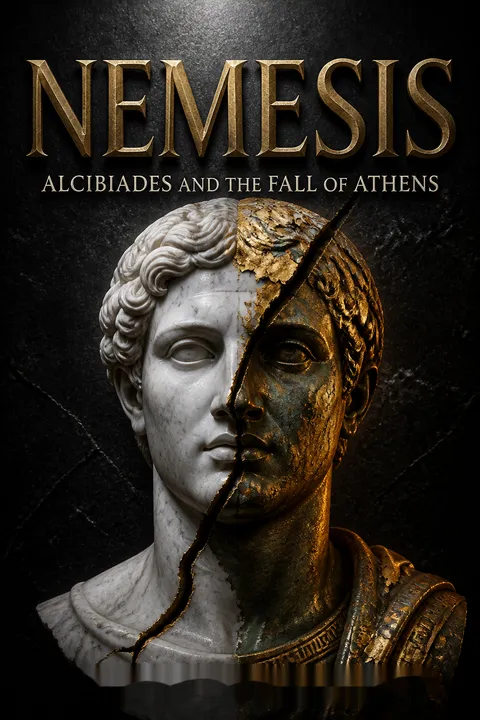

Key Takeaways
1. Alcibiades: A Prodigy Forged in Athenian Turmoil
In childhood, youth and manhood, his beauty blossomed with each season—desirable, and sweet.
Orphaned and privileged. Alcibiades was born into Athens' most influential families, the Alcmaeonids and Eurysacids, but was orphaned young when his father, Cleinias, died in battle at Coronea in 447 BC. He and his younger brother became wards of his mother's cousin, the powerful statesman Pericles, who oversaw their upbringing amidst the city's political and cultural ferment.
Precocious and defiant. From an early age, Alcibiades displayed remarkable charisma, intelligence, and a defiant streak, often disregarding social norms. Anecdotes from his youth, such as lying in front of a cart to win a game or punching a schoolmaster, highlighted his imperious will and determination to always win, foreshadowing his later controversial actions.
Shaping his image. His elite education, encompassing rhetoric, music, and athletics, was crucial for an aspiring Athenian aristocrat. Notably, he rejected playing the aulos, claiming it distorted his handsome features, demonstrating an early awareness of public image and a knack for influencing trends among his peers.
2. The Siren Song of Ambition and Socrates' Warning
What ever Alcibiades decides to get involved with, he always has to win.
Early political ascent. Alcibiades' ambition was evident in his swift entry into public life, including his role in reassessing Athens' tribute lists at a remarkably young age. He honed his rhetorical skills in the law courts, captivating audiences with his distinctive lisp (traulism) and persuasive arguments, quickly establishing himself as a rising political star.
Socrates' complex influence. His relationship with the philosopher Socrates was profound yet ultimately conflicted. Socrates saw Alcibiades' immense potential for both good and evil, attempting to guide him towards virtue and self-knowledge. However, Alcibiades, while acknowledging Socrates' wisdom, consistently prioritized worldly success and public adulation over philosophical discipline.
Master of self-promotion. Alcibiades understood the power of theatricality in Athenian democracy. Incidents like the "quail incident" in the Assembly, where he deliberately caused a commotion to draw attention, showcased his flair for self-promotion and his ability to manipulate public sentiment, even through seemingly trivial acts.
3. Athens' Sicilian Gamble and Alcibiades' Exile
So, it was agreed that he should sail.
Advocating for conquest. Alcibiades passionately championed the Sicilian Expedition, presenting a grand vision of an Athenian empire extending across the Mediterranean. Despite the cautious warnings of Nicias, his persuasive oratory and promises of immense wealth swayed the Athenian Assembly to commit an unprecedentedly large and costly invasion force.
Sacrilege and political turmoil. Just before the fleet's departure, Athens was plunged into hysteria by the widespread mutilation of the Herms and accusations of profaning the Eleusinian Mysteries. Alcibiades, already a controversial figure, was implicated in both, with his enemies portraying these acts as part of an oligarchic plot to overthrow the democracy.
Forced into exile. Despite his demands for an immediate trial to clear his name, his political adversaries cunningly ensured he sailed to Sicily, intending to recall him later to face a hostile jury in his absence. This maneuver led to his dramatic flight from the state trireme Salaminia at Thurii, effectively exiling him and leaving the ill-fated expedition under the command of Nicias and Lamachus.
4. The Chameleon: Adapting to Spartan and Persian Courts
He had the knack... of taking on and embracing the habits and lifestyle of other men, transforming more completely than a chameleon.
Embracing Spartan austerity. Fleeing Athens, Alcibiades sought asylum in Sparta, Athens' long-standing enemy. He seamlessly adopted their austere lifestyle, growing his hair long, eating simple meals, and speaking with their characteristic brevity. He skillfully leveraged old family ties and his past generosity to Spartan prisoners of war to gain their trust and influence.
Cuckolding a king. His time in Sparta was not without scandal. He engaged in an affair with Queen Timaea, wife of King Agis, even fathering a child, Leotychidas, whom Timaea privately called "Alcibiades." This act of personal betrayal would later fuel King Agis's relentless hatred and desire for revenge.
Shifting to Persian luxury. When Spartan trust began to wane, Alcibiades deftly shifted his allegiance to the Persian satrap Tissaphernes. He embraced Persian opulence, adopting their elaborate dress, perfumes, and courtly manners. He advised Tissaphernes to prolong the Peloponnesian War by playing Athens and Sparta against each other, weakening both for Persia's strategic benefit.
5. Strategic Betrayals: Decelea and Persian Influence
If I harmed you badly as an enemy, I can do you great good as a friend.
Devastating advice to Sparta. Alcibiades' counsel to the Spartans to fortify Decelea in Attica proved strategically brilliant and devastating for Athens. This permanent Spartan outpost crippled Athens' agricultural production and led to the desertion of over twenty thousand slaves from the Laurium silver mines, severely impacting the city's finances and war effort.
Manipulating Persian policy. His influence with Tissaphernes, though often exaggerated for his own ends, was instrumental in shaping Persian policy. He convinced the satrap to delay full financial and naval support for Sparta, ensuring a prolonged conflict that drained both Greek powers, aligning with his goal of weakening Athens' enemies.
Ruthless pragmatism. These calculated betrayals, while serving his immediate survival and long-term ambition to return to Athens, inflicted immense damage on his homeland. His actions demonstrated a ruthless pragmatism, prioritizing personal gain and revenge over consistent loyalty to any state or ideology, embodying the Machiavellian spirit before its time.
6. A Triumphant Return: Reclaiming Athens' Trust
The city longs for him, but at the same time hates him, too. But on balance it must have him!
Recalled by the fleet. After years of exile, Alcibiades was recalled by the Athenian fleet at Samos, which had rejected the oligarchic coup in Athens. He skillfully presented himself as a champion of democracy and the only man capable of securing crucial Persian aid, despite his previous advocacy for oligarchy.
A meticulously staged homecoming. His return to Athens was a masterclass in theatrical self-promotion. He arrived with a victorious fleet, timing his entry to coincide with the Plynteria festival, a day of ritual purification when the city was veiled. His emotional speech to the Assembly, acknowledging past suffering and promising future victories, captivated the populace.
Supreme command and piety. The Athenians, desperate for strong leadership, appointed him general-in-chief (strategos autocrator) with supreme command on land and sea. He further solidified his image by leading the sacred Eleusinian procession overland, a feat previously deemed too dangerous due to Spartan occupation, publicly demonstrating his piety and courage.
7. The Fall from Grace: Notium and Public Disfavor
We’re in command now. You’re not.
Antiochus's fatal error. Despite his triumphant return, Alcibiades' military campaign in Ionia quickly faltered. He left his fleet under the command of his helmsman, Antiochus, with strict orders not to engage the Spartan fleet. Antiochus, however, impetuously provoked a battle at Notium.
Costly defeat and blame. The resulting defeat, where Athens lost numerous ships, was a major setback. Alcibiades was blamed for his poor judgment in appointing an inexperienced subordinate and for his perceived absence, allegedly pursuing personal pleasures and wealth. This fueled renewed accusations of self-interest and incompetence.
Dismissal and second exile. The Athenians, weary from war and economic hardship, quickly turned against him. His past failures and alleged betrayals resurfaced, leading to his dismissal from command and a second, final exile. The generals at Aegospotami, wary of his influence, famously rejected his strategic advice, sealing Athens' fate.
8. Final Exile and the Shadow of Nemesis
In all things we must look to see how matters turn out in the end. Yes! For the god leads many people to expect good fortune, and then destroys them, root and branch.
Flight to Persia. Stripped of command, Alcibiades fled first to his fortresses in Thrace, then to the Persian satrap Pharnabazus. He sought to leverage his knowledge of Persian court politics to expose Prince Cyrus's plot against his brother, hoping to gain favor with the Great King and undermine Lysander, his Spartan nemesis.
Conspiracy and assassination. However, his numerous enemies—including the Thirty Tyrants in Athens (led by his former friend Critias), King Agis of Sparta (still aggrieved by the affair with Timaea), and the Spartan general Lysander—conspired to eliminate him. Pharnabazus, under pressure from Sparta, reluctantly agreed to his assassination.
A dramatic end. Alcibiades was ambushed at his compound in Melissa. His house was set ablaze, and his weapons were secretly removed. Charging out, unarmed, he was cut down by a hail of arrows and javelins. His dramatic death, far from Athens, marked the violent end of a life defined by brilliance, ambition, and constant betrayal.
9. An Enduring, Contradictory Legacy
For the subject of the former, the Romans chose Pythagoras. For the latter, they chose Alcibiades.
Ambivalent memory. Alcibiades' death did not diminish his legend; his memory remained deeply controversial in Athens. His son faced numerous lawsuits, forcing him to defend his father's complex legacy against accusations of sacrilege, tyranny, and disloyalty, reflecting the city's enduring ambivalence towards its most charismatic figure.
Influence beyond Athens. His impact extended far beyond his native city. In Sparta, the legitimacy of King Agis's alleged son, Leotychidas, was questioned due to Alcibiades' affair with Timaea. Later, Roman emperors like Hadrian honored him, and his image, often conflated with Alexander the Great, became a symbol of military prowess and charismatic leadership.
A cautionary tale. Alcibiades embodied the turbulent era of the Peloponnesian War, a period of shifting loyalties, moral ambiguity, and intense political struggle. His life serves as a powerful, cautionary tale about the dangers of unchecked ambition, the fickle nature of public opinion, and the profound consequences of personal choices in a democracy.
Review Summary
Nemesis by David Stuttard receives overwhelmingly positive reviews (4.28/5) for its compelling biography of Alcibiades, the charismatic yet treacherous Athenian general. Readers praise Stuttard's ability to make ancient history accessible and engaging, comparing it to dramatic storytelling. The book chronicles Alcibiades's extraordinary life—his multiple defections between Athens, Sparta, and Persia, his brilliant oratory, and ultimate assassination. Reviewers appreciate the rich historical context about the Peloponnesian War and Greek society, though some note occasional editing issues and wish for more personal detail. Most find it an outstanding work combining scholarly research with narrative excellence.
People Also Read





Download PDF
Download EPUB
.epub digital book format is ideal for reading ebooks on phones, tablets, and e-readers.








































