
Key Takeaways
1. The Negro Leagues: A Necessary Response to Segregation's Economic Realities
Providing entertainment for thousands of fans throughout the country, baseball functioned as a critical component of the separate economy catering to black consumers in the urban centers of the north and south.
Born of necessity. Unofficially banned from white professional baseball in the late 19th century, African Americans built their own institutions, including professional baseball leagues, as a response to pervasive discrimination and segregation. These leagues were not just about sport; they were vital economic and social hubs within burgeoning black communities, especially in northern industrial cities. Early figures like Andrew "Rube" Foster and Edward W. Bolden capitalized on the Great Migration, which swelled urban black populations and created a viable market for black-owned enterprises.
Depression's harsh reality. The Great Depression, however, brought immense hardship, crippling black communities with unemployment rates often exceeding 50%. This economic devastation severely impacted black businesses, including baseball, as discretionary income vanished. The once-thriving Hilldale Club, for instance, disbanded in 1932 after drawing only 295 fans to its last two home games, illustrating the industry's precarious state.
Underworld lifeline. In this desperate climate, black underworld figures, particularly those involved in the illegal numbers lottery, emerged as crucial financial backers. William Augustus "Gus" Greenlee, a Pittsburgh entrepreneur with legitimate and illegitimate ventures, became a prominent example, investing heavily in the Pittsburgh Crawfords and even building Greenlee Field. This influx of capital, though controversial, was often the only means to keep professional black baseball alive, earning the NNL the nickname "Bankers' League."
2. Internal Conflicts and External Pressures Defined the Early Years
The owners . . . can only go so far with their midget minds. They have too many complexes, too many petty scruples, too many false ambitions, with not even a child’s sense of cooperation or gratitude.
A league in name only. The newly formed Negro National League (NNL) in 1933 faced immediate challenges beyond the Depression, including weak administration, individualistic owners, and inadequate financing. Despite initial promises of unity, cooperation among owners was rare, with many prioritizing personal gain over league stability. This led to chaotic scheduling, inconsistent publicity, and a lack of accurate statistics, frustrating fans and sportswriters alike.
Talent drain and rivalries. The league's inability to enforce player contracts led to frequent defections, notably to lucrative foreign leagues in the Dominican Republic, Mexico, and Venezuela. This talent drain, coupled with intense rivalries between powerful owners like Greenlee and Cum Posey, further destabilized the league. The rise of individual black sports heroes like boxer Joe Louis and Olympian Jesse Owens also diverted attention and pride from the often-flawed collective enterprise of black baseball.
White promoters' enduring influence. White booking agents and park owners, like Nat Strong and Eddie Gottlieb, maintained significant control over schedules and venues, often to the detriment of league interests. Despite criticism, black teams remained dependent on these relationships for profitable games against white semiprofessional clubs. This reliance, combined with internal disunity, left the NNL struggling to establish itself as a truly organized and self-sufficient institution throughout the 1930s.
3. World War II: A Brief Economic Boom for Black Baseball
The fact that three sepia baseball games—in three successive Sundays—drew nearly 100,000 cash customers . . . clearly shows the possibilities of the colorful tan-tinted version of the great American pastime.
Wartime prosperity. World War II dramatically transformed the economic landscape for African Americans, creating unprecedented job opportunities in defense industries and boosting discretionary income. This newfound prosperity directly fueled a "golden era" for Negro League Baseball, with attendance soaring to record levels. The East-West game, the annual all-star showcase, became a phenomenal success, drawing over 50,000 fans in 1943.
Star power and new venues. The leagues capitalized on charismatic figures like Satchel Paige, whose unique pitching style and colorful personality made him a national celebrity and a massive drawing card. The Ethiopian Clowns, a team blending comedy and athleticism, also proved immensely popular, attracting large, often interracial, crowds. This era saw black teams regularly renting major league parks like Yankee Stadium, Comiskey Park, and Griffith Stadium, which provided larger capacities and greater legitimacy.
Administrative adaptation. Despite the boom, administrative deficiencies persisted, but the leagues made some efforts to professionalize. They successfully lobbied the Office of Defense Transportation (ODT) for bus travel exemptions, recognizing the unique challenges of segregated travel. The introduction of statistical services and the establishment of an official World Series between the NNL and NAL in 1944 marked steps toward greater organization, though these reforms were often belated and imperfect.
4. The Persistent Fight to Integrate Organized Baseball
Even without reading between the lines, it has become as vivid as today’s news that there is no way under the sun for one to make the grade if he is a Negro.
The unspoken barrier. For decades, Organized Baseball maintained a de facto color line, denying black players opportunities despite their undeniable talent. While some white players and journalists occasionally spoke out, the industry's conservative nature and fear of alienating white fans, particularly in the South, kept the barrier firmly in place. Commissioner Kenesaw Mountain Landis consistently denied the existence of a ban, shifting responsibility to individual club owners.
Growing pressure. The 1930s saw increased agitation, notably from the black press and liberal white sportswriters like Heywood Broun. The Jake Powell incident in 1938, where a Yankee player made a racist remark, sparked widespread black protests and forced Landis to issue a rare suspension, highlighting the growing power of the black dollar. Wendell Smith's 1939 poll of major league managers revealed some openness to integration, but no concrete action followed.
WWII as a catalyst. World War II intensified the moral imperative for integration, as the fight against fascism abroad exposed the hypocrisy of racial discrimination at home. The Communist Party, labor unions, and civil rights groups escalated their campaigns, leading to symbolic tryouts for black players with the White Sox and Red Sox in 1945. These efforts, though initially unsuccessful, kept the issue in the national spotlight and set the stage for a monumental breakthrough.
5. Branch Rickey's Strategic Integration Ignored Black Baseball's Rights
We are getting so much hell which we don’t deserve, as we have built the League and did not hurt anybody while we were building it.
Rickey's "Great Experiment." In October 1945, Branch Rickey, president and general manager of the Brooklyn Dodgers, shocked the baseball world by signing Jackie Robinson to a contract with the Montreal Royals, the Dodgers' top minor league affiliate. Rickey, a shrewd and innovative executive, saw integration not just as a moral imperative but as a strategic advantage, believing black players offered a vast, untapped talent pool that could give the Dodgers a competitive edge. His motivations were complex, blending idealism with pragmatism.
A public relations nightmare. Rickey's actions, however, were not without controversy. He bypassed the Kansas City Monarchs, Robinson's team, claiming black leagues were "rackets" and not legitimate organizations, thus avoiding compensation. This uncompensated "raid" infuriated black owners, who felt betrayed and robbed of their investments. Cum Posey, a vocal critic, denounced the move as "the most humiliating experience Negro baseball has yet suffered from white organized baseball."
Black baseball unprepared. Despite years of warnings, the NNL and NAL were ill-prepared for integration. Their flimsy contracts and lack of a strong reserve clause left them vulnerable to such "raids." While some owners, like Ed Bolden, supported integration, many feared the economic impact on their businesses. Rickey's subsequent signings of other black stars like John Wright, Roy Campanella, and Don Newcombe, often without compensation, further highlighted the leagues' precarious position and their inability to protect their assets.
6. The Post-Robinson Era: A Rapid Decline for Black Institutions
The Negroes are so happy whenever one of their number is accepted in a position from which all Negroes have been barred, that they naturally emote.
Robinson's seismic impact. Jackie Robinson's debut with the Brooklyn Dodgers in 1947 was a watershed moment, not just for baseball but for American society. His success electrified black communities nationwide, drawing thousands of black fans to major league parks and inspiring unprecedented racial pride. This shift in allegiance, however, came at a devastating cost to Negro League Baseball.
The "co-existence" dilemma. The postwar era saw a growing sentiment among African Americans that integration was paramount, often at the expense of separate black institutions. Many viewed black baseball as an anachronism, a "Jim Crow affair" that perpetuated segregation. This ideological shift, coupled with the undeniable appeal of seeing black players compete in the "real" major leagues, led to a rapid decline in Negro League attendance and interest.
Economic fallout. The financial impact was immediate and severe. In 1947, NNL attendance plummeted, with teams like the Newark Eagles and New York Cubans suffering massive losses. The leagues' reliance on expensive major league park rentals, which now saw black fans flocking to integrated games, became an unsustainable liability. The once-thriving "million dollar empire" found itself in a desperate struggle for survival, unable to compete with the symbolic power and superior resources of Organized Baseball.
7. Player Sales: A Double-Edged Sword for Survival
The Negro league is a thing of the past. It is no longer a function, it merely exists. Its president, Dr. J. B. Martin, contends that the majors must still draw the potential star from this circuit. What he has neglected to watch is the trend on the part of most rookies to avoid it.
A new revenue stream. As attendance dwindled, player sales to Organized Baseball became a crucial, albeit temporary, lifeline for struggling Negro League franchises. Teams like the Cleveland Buckeyes sold Sam Jethroe to the Dodgers, and the New York Cubans sold Minnie Minoso to the Indians, providing desperately needed cash flow. The most publicized sale was Satchel Paige to Bill Veeck's Cleveland Indians in 1948, a transaction that brought the Monarchs $5,000 and Saperstein $15,000.
Undermining the product. While providing financial relief, the continuous sale of star players stripped the Negro Leagues of their best talent, leading to a noticeable decline in the quality of play. This further alienated fans who were already gravitating towards the integrated major leagues. The lack of formal affiliation with Organized Baseball meant black teams had little leverage in negotiations, often receiving "bargain basement prices" for their stars.
Bypassing the leagues. Major league teams soon began to bypass the Negro Leagues altogether, signing black high school, college, and semipro players directly. This trend not only deprived the NAL of talent but also eliminated a vital income source. The leagues' inability to monopolize black talent, coupled with their administrative weaknesses, meant that player sales, initially a means of survival, ultimately accelerated their demise.
8. The Final Years: A Struggle Against Irrelevance and Changing Tides
It’s A.B.C. logic that you cannot penetrate organized baseball to a large extent and still hold on to a highly successful Negro league. That is the problem that Negroes face.
Collapse and consolidation. By 1948, the NNL was in disarray, with the Black Yankees disbanding and the Newark Eagles suspending operations due to heavy losses. The remaining NNL teams—the Philadelphia Stars, Baltimore Elite Giants, and New York Cubans—merged with the Negro American League (NAL), a humbling move for the once-dominant eastern circuit. This consolidation, however, did little to stem the tide of declining interest.
Southern refuge, temporary at best. Many black teams, including the Eagles and Buckeyes, relocated to southern cities, hoping to escape direct competition from integrated major league baseball due to continued segregation laws. However, even the South began to integrate, with black players gradually entering minor leagues below the Mason-Dixon line. This left the NAL with no exclusive territory, forcing it into a futile fight for survival.
Novelty acts and the end. Desperate for attendance, the NAL resorted to gimmicks, such as signing female players like Toni Stone and white players like Louis Clarizio. While these novelties provided temporary boosts, they further eroded the league's athletic credibility. By the mid-1950s, the NAL was a shadow of its former self, with teams like the Indianapolis Clowns relying heavily on comedy for white audiences. The league finally collapsed in 1963, largely unnoticed by a black community whose focus had irrevocably shifted to the integrated major leagues.
9. An Enduring Legacy: Opportunity and Pride in a Segregated World
In the absence of the opportunity, the blacks created that opportunity, created . . . a baseball world for themselves, so they could demonstrate their abilities. And so many of them were ready when the doors were opened, so from that vantage point I felt that we were winners.
A vital training ground. Despite their flaws and eventual demise, the Negro Leagues played an indispensable role in American history. They provided a professional platform for hundreds of talented black athletes who were otherwise excluded from Organized Baseball. This "baseball world for themselves" fostered skills, nurtured talent, and allowed black players to maintain their athletic prowess, ensuring they were "ready when the doors were opened."
Beyond the diamond. The leagues were more than just sports organizations; they were integral social and economic institutions within black communities. They offered entertainment, fostered a sense of collective solidarity and racial pride, and provided employment opportunities for players, managers, and support staff. This institution-building, though born of segregation, created a vibrant cultural space that transcended the limitations imposed by a discriminatory society.
A complex legacy. The integration of major league baseball, while a triumph for civil rights, undeniably contributed to the destruction of black baseball and other separate black enterprises. This trade-off sparked debate about the value of integration versus the preservation of black-controlled institutions. However, the Negro Leagues' enduring legacy lies in their profound contribution to American sports and their pivotal role in paving the way for the eventual desegregation of baseball, demonstrating the resilience and talent of African Americans in the face of systemic injustice.
Review Summary
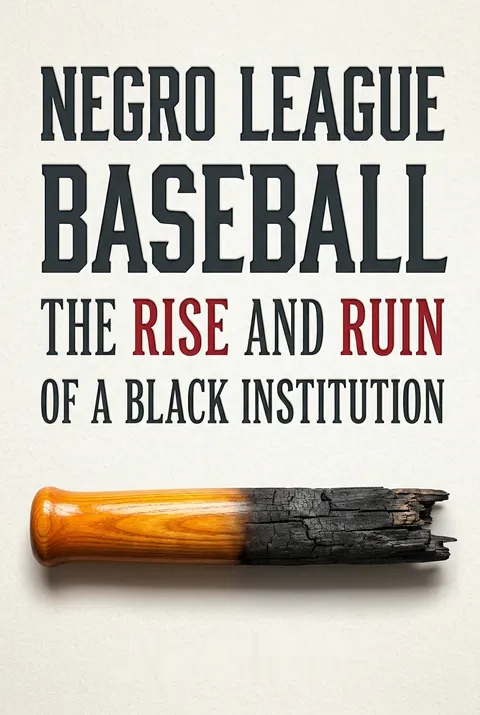
Negro League Baseball receives generally positive reviews (3.94/5) for its scholarly approach and meticulous research into the business, organizational, and economic aspects of the Negro Leagues from 1933-1958. Reviewers appreciate the focus on team owners, league executives, and the social/historical context rather than players and statistics. Some readers found it dense and repetitive, wishing for more coverage of games and players themselves. Most agree it's essential reading for deep understanding of the leagues' structure and eventual decline following integration, though not recommended as an introductory text on the subject.
Download PDF
Download EPUB
.epub digital book format is ideal for reading ebooks on phones, tablets, and e-readers.








































