

Key Takeaways
You are not a stranded soul; you are nature happening
The core delusion is separateness. Watts argues that Western culture trains us to feel like a lonely ego, a pinpoint of consciousness peering out at an alien world of objects. He calls this the feeling of being cut in two: the small controlling "I" versus the vast, disquieting "myself" of the body and universe. This is not a metaphysical fact but a bad habit imposed by language and social conditioning.
Watts uses the image of an endless knot. You are a loop in a seamless knot where every event depends on every other. When you pull one strand, another pulls back, and you cannot find where the impulse began. The subject-object split is a linguistic convenience mistaken for reality, like assuming the "it" in "it is raining" names a real rainmaker.
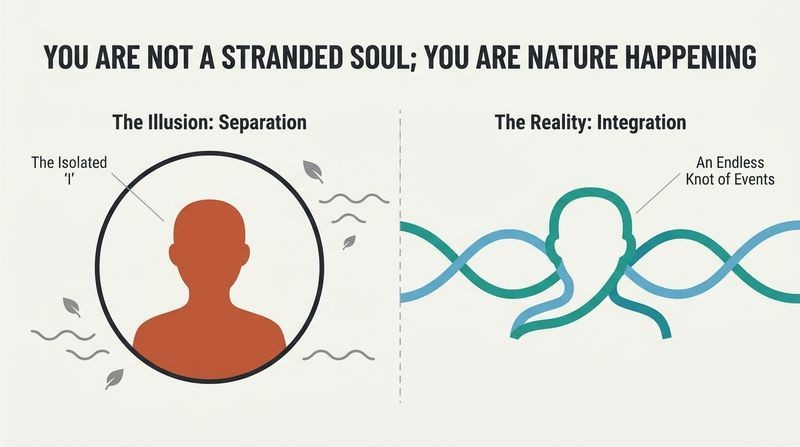
What's striking is how Watts anticipates findings in systems biology and ecology, where organisms are now understood as inseparable from their environments (an organism does not merely live in an ecosystem, it constitutes one pole of it). His "endless knot" resembles what physicist David Bohm called the implicate order and what ecologists mean by the impossibility of doing merely one thing. The claim that selfhood is a social artifact prefigures decades of research in developmental psychology on how the self-concept is constructed. Skeptics note that a felt boundary has real evolutionary utility, but Watts concedes the ego is useful, just not ultimate.
Nature grows from within; machines are built from without
Watts contrasts two verbs: making and growing. The Christian and mechanistic West imagines the universe as an artifact, assembled part by part by an external designer, the way a carpenter builds a house from outside. The Chinese Taoist view sees the world as organic, elaborating itself from the inside out, the way a crystal appears all at once in solution or a plant partitions itself from whole to parts.
This is the meaning of tzu-jan and wu-wei. Tzu-jan means "of itself so," spontaneity, the self-directing character of natural forms. Wu-wei means nonstriving or nonmaking. To illustrate the difference between an inside and an outside, Watts recounts cutting a grape with his children to find God, discovering only "more outsides." The truly inward can never become an object of inspection.
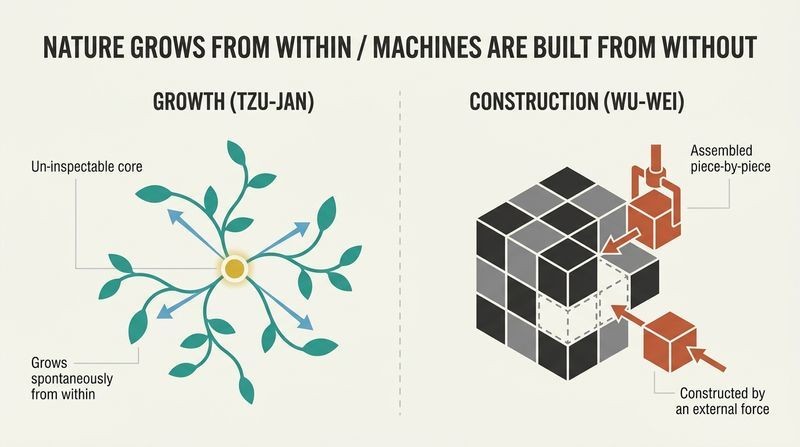
This maps neatly onto the distinction biologists draw between self-organizing systems and engineered ones. A snowflake, a slime mold, and an embryo all display what complexity theorists call emergence: global order arising without a global blueprint. Watts is essentially rejecting intelligent-design thinking a half-century before it became a culture-war flashpoint, on aesthetic and phenomenological rather than empirical grounds. The grape parable is a compact teaching on why introspection cannot capture the observer. One limitation: the making-versus-growing binary is itself a bit too clean, since human technology increasingly borrows growth logic (neural networks, genetic algorithms, grown biomaterials) blurring Watts's tidy opposition.
Science measures the world by chopping it into thinkable bits
Attention is selective, and things are its units. Watts argues that the eye sees a total field, but the mind carves it into "things" and "facts" the way a ruler carves wood into inches. These divisions are tools of measurement, not features of nature. The word "matter" itself derives from a root meaning "to measure." A thing cannot exist alone; there must always be at least two, which proves their interdependence.
Laws of nature are invented, not discovered. He notes that twentieth-century science increasingly sees its laws as descriptive human tools, like knives, rather than commandments nature obeys. When we superimpose a grid on a random path and predict its "statistical" trend, the object obeys nothing. Our regularized model obeys the statistics.
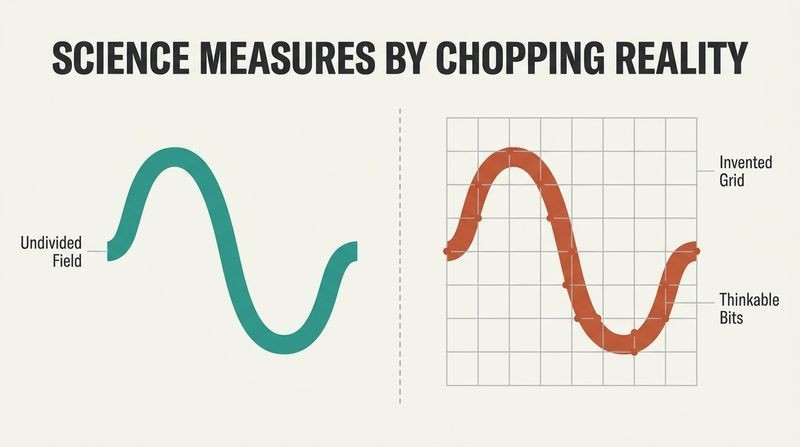
Watts is channeling a genuine shift in philosophy of science, from the law-realism of Newton toward the instrumentalism later associated with figures like Nancy Cartwright, whose book title How the Laws of Physics Lie captures his point exactly. His observation that classification precedes perception aligns with modern cognitive science on predictive processing: the brain imposes categories to reduce sensory overwhelm. The deeper claim, that complexity is an artifact of our clumsy notation rather than nature itself, is provocative and only partly defensible. Turbulence and protein folding seem genuinely complex, not merely badly described. Still, the caution against confusing the map with the territory remains bracingly relevant to data-driven modeling.
Stop straining to grasp life; watch it like a heron
Watts introduces kuan, wordless contemplation. This is a mode of open, relaxed awareness that takes in whole fields at once, as opposed to the narrow, staring, one-thing-at-a-time attention that produces the sense of a separate ego. He pictures a heron standing motionless at a pool, not hunting yet ready, all pool. The seer and the seen dissolve into pure seeing.
The ego is a chronic muscular cramp. The feeling of being a controlling "I" is, Watts claims, an unnecessary strain, like tensing your muscles while lying flat for fear of dissolving. Trying to remember a forgotten name shows the principle: relax and it surfaces spontaneously. Even scientists do their best work by "puttering," letting intuition grasp relations that linear analysis cannot. Princeton's great mathematicians, he notes, are paid to stare out windows.
This connects directly to modern research on the default mode network and the psychology of insight, where breakthroughs (the classic aha moment) reliably arrive during mind-wandering rather than effortful focus. Csikszentmihalyi's flow and the concept of relaxed alertness in sports psychology echo kuan almost exactly: peak performance is effortless attention, not gritted teeth. The distinction between straining consciousness and open awareness also underlies mindfulness-based stress reduction. Watts's insistence that mental effort degrades understanding is overstated as a universal (deliberate practice clearly builds skill) but his real target is the misplaced effort of trying to feel spontaneous, a genuine double bind therapists still wrestle with.
Fighting your feelings traps you in a double bind
Feelings are motions, not fixed states. Anger, grief, and fear are directions of psychic movement, not demons squatting in the unconscious. Watts insists there is no anger, only acting angrily, and like a swishing wind it cannot sustain itself if left alone. The trouble is our resistance, which compresses feeling like steam in a sealed vessel until it explodes into reckless action.
The self-control model is backwards. Trying to govern feelings from outside, as a controlling ego pitted against unruly passions, assumes a political rather than organic order. What actually needs surrendering is the controller itself. When the mind sees it can neither improve nor abandon its situation by effort, it drops the struggle unconditionally, and a spontaneous stillness descends, like heavy snowfall, with feelings passing trackless as birds.
Watts arrives intuitively at what modern acceptance-based therapies formalize. Acceptance and Commitment Therapy treats experiential avoidance (the struggle against unwanted feelings) as the engine of suffering, and emotion researchers confirm that suppression amplifies rather than reduces distress, while allowing and labeling emotions dampens amygdala activity. His point that anger is a process, not a thing, is echoed in affective neuroscience: emotions are transient physiological cascades lasting seconds to minutes unless rehearsed by rumination. One subtlety Watts glosses: he distinguishes his radical surrender from therapeutic "acceptance," arguing the latter still smuggles in an observing ego waiting for change. That distinction is real but slippery in practice.
Suffering fully felt turns into ecstasy, not agony
Withdrawal from pain intensifies pain. Watts distinguishes flinching from a spike (healthy) from the deeper refusal to be capable of feeling pain at all (suicidal). The hardened, contracted ego, shrinking from suffering, becomes more vulnerable, like a man with a stomach wound craving the water that will kill him. The soft and yielding, per Lao-tzu, outlasts the hard and rigid.
Unresisted pain becomes ananda. When the organism is allowed its full, orgiastic response to suffering, pain passes beyond the pleasure-pain duality into ecstasy. Watts cites natural childbirth, where reframing contractions as tension rather than pain lets a mother relax into them as physical ecstasy. Bernini's St. Theresa wears a face equally of rapture and torture. The problem of death, he adds, is our revulsion, not death itself.
The childbirth example refers to Grantly Dick-Read's real and influential work on fear-tension-pain cycles, a genuine forerunner of Lamaze and modern pain-reprocessing therapy, which teaches chronic-pain patients that fear amplifies nociceptive signals. Neuroscience supports the core claim: pain has a strong appraisal component, and identical stimuli register as agony or thrill depending on context and expectation. That said, Watts risks romanticizing suffering, and the claim can shade into a spiritual bypass that minimizes genuine trauma or torture, which he half-acknowledges. The insight is most useful for the anticipatory dread and resistance that surround pain, less so for its raw sensory reality.
Chasing happiness in the future starves you in the present
Progressive cultures live for a tomorrow that never arrives. Watts contrasts historical, goal-driven societies with traditional, nonhistorical ones that aim at the present rather than the future. The progressive worker eyes the clock, rushing to finish shoddy products so leisure can begin, then tires of the toys and craves the next gimmick. Reaching goals ever faster, he cuts out the journey, like eating only the two ends of a banana.
Enjoyment cannot be seized, only received. Grasping at a moment to extract pleasure makes it vanish, because enjoyment is a function of receptive nerves, not grasping muscles. The faster you travel to a resort, the faster it is "spoiled" into resembling everywhere else. A life of pure end-points is a vicious circle mistaken for progress.
This is a devastating critique of what economists call the hedonic treadmill and what Watts frames as a civilizational disease rather than a personal flaw. His banana image prefigures Daniel Kahneman's distinction between the experiencing self and the remembering self: we optimize for anticipated and recalled pleasure while neglecting lived experience. The observation that speed homogenizes destinations anticipates critiques of globalization and "generic" placelessness (Marc Auge's non-places). Where Watts overreaches is in nearly demonizing all future-orientation. Delayed gratification and long-term planning are also hallmarks of wellbeing and civilization. The corrective is not abolishing goals but refusing to postpone all satisfaction until they arrive.
Sex is troubled because we never gave it a philosophy
The man-nature split becomes the man-woman split. Watts argues that cultures which feel estranged from nature also feel squeamish about sex, and they symbolically code spirit as male and nature as female. Christianity, born in Roman cities, absorbed an urban distrust of the "pagan" countryside and treated sexuality as a regrettable animal urge, tolerated (per St. Paul, better to marry than to burn) but never sanctified.
Sex became abstract maya. Because it is the one sanctioned outlet for self-transcendence in an ego-bound culture, sex gets overloaded, pursued in the abstract as "the great delight," a fixation on stylized parts rather than a particular person. Watts notes Victorian prudery and licentiousness were twin poles of the same fixation. Puritanism, he quips, exploits sex by titillation as surely as black underwear.
Watts's genealogy of Western sexual anxiety tracks closely with historians like Peter Brown on early Christian asceticism and with Foucault's later argument that repression and obsessive discourse about sex are two faces of the same coin. His claim that puritanism and libertinism share a premise (that sex is the supreme delight) is a genuinely useful reframe, dissolving a false binary. The maya concept, borrowed from Vedanta, here means the world as mentally divided and abstracted. One critique: Watts treats the male gaze as nearly universal while acknowledging its cultural contingency, and his 1950s framing of gender essentialism (male spirit, female nature) is exactly the coding he critiques, uneasily inhabited rather than escaped.
Accept yourself completely before trying to change anything
Self-acceptance is the ground, not the goal. Watts argues you cannot act sincerely from a position you are at war with. Total self-acceptance means consenting to be exactly what you are and to feel exactly what you feel this moment, even before acceptance changes it. Whatever you are right now is, in a sense, what you ideally should be, captured in the Zen saying that your ordinary mind is the Tao.
This is freedom, not license. He compares it to a democracy where citizens freely vote for restrictions: naturalness is the background from which even self-restraint arises. Grounding right and wrong in an absolute God, by contrast, made Western morality so rigid that it invited violent revolt. Distinguishing up from down locally while knowing there is no cosmic up or down, one gains ethical judgment without metaphysical terror.
This is the paradox at the heart of humanistic psychology: Carl Rogers found that people change only when they feel fully accepted as they are, and clinicians now call it the acceptance-change dialectic (central to Dialectical Behavior Therapy). Watts frames it philosophically rather than clinically, but the mechanism is identical: self-rejection fragments the agent, making sincere action impossible. His warning that absolutist morality breeds rebellion has historical teeth, from the Reformation to modern purity-culture backlashes. The obvious objection, that radical self-acceptance could excuse anything, Watts meets by noting acceptance includes accepting one's discernment of better and worse. Whether that fully answers the worry is debatable, but the therapeutic evidence favors him.
Approach a lover contemplatively, receiving rather than grasping
Contemplative love applies kuan to sex. Watts proposes bringing open, unhurried, ungrasping attention to sexual love, drawing on Taoist and Tantric maithuna (ritualized sexual union as sacrament). The couple sits still, often in a quiet embrace, letting the orgasm come of itself rather than being forced by deliberate motion. The point is never to stop the orgasm but not to grasp it, exactly as one watches the breath and lets its rhythm slow naturally.
Pleasure is a grace, not a deed. Just as forced pleasure frustrates, received pleasure deepens. Simple contacts (a look, touching hands, the voice) regain their "electric" charge when not treated as mere preliminaries to a goal. Sexuality becomes a radiance pervading the whole relationship rather than a dissociated "act," an initiation into the felt unity of self and world.
Watts wisely separates the psychological attitude from the anatomical folklore, dismissing the ancient notion that semen is a vital fluid to hoard. The core insight, that goal-fixation undermines arousal, is confirmed by modern sex therapy: Masters and Johnson's sensate focus technique treats performance anxiety by banning goal-directed intercourse and prescribing exactly the unhurried, receptive touching Watts describes. Contemporary research on female arousal supports his emphasis on time and non-demand contact. The framing of intimacy as mutual rather than initiator-and-responder also anticipates later feminist critiques of scripted heterosexuality. The main caveat is that Watts universalizes a fairly specific contemplative temperament, and not every fulfilling encounter needs to be a mystical rite.
The world is purposeless nonsense, and that is its glory
Meaninglessness is not depressing but liberating. Watts likens realizing the world's unity to prizing a dead cat's head: priceless precisely because it has no use, no result, no payoff. Nature has no goal beyond the figures it is dancing now. Birds and squirrels pursue food and mating with total devotion but never justify it as serving higher ends or contributing to progress.
Communing with nature restores sanity. Watts describes his garden transfigured one twilight, leaves suddenly incandescent, every detail perfectly interconnected and "right." The love of nature works, he says, because nature is free of self-importance and humbug. Seen this way, human pomposity dissolves into laughter, revealed as just another natural marvel like the peacock's absurd tail. Action springing from fullness, not from a sense of lack, is the only genuinely creative action.
Watts distinguishes eros (hungering love born of lack) from agape (generous love born of fullness), arguing Western creativity is fatally powered by inadequacy. This resonates with self-determination theory in psychology, which finds intrinsic motivation (doing something for its own sake) more sustainable and creative than deficit-driven extrinsic motivation. His transfigured-garden episode is a textbook peak experience in Maslow's sense, and neuroscientists studying awe find it reliably shrinks the self-important ego and boosts wellbeing. The bracing move here is treating cosmic purposelessness as good news, inverting existentialist dread into play. The risk is that "purposeless" nonsense could license passivity, though Watts insists fullness generates more action, not less.
Analysis
Nature, Man and Woman (1958) is a work of comparative philosophy disguised as a meditation, and its difficulty for summary lies in its method: Watts deliberately avoids linear argument in favor of circling, poetic accretion, because his thesis is that linear thought itself created the problem he diagnoses. The book is thesis-driven but antisystematic. Its central claim is that Western culture, shaped by an urban Christianity that pitted a transcendent God against fallen nature, bequeathed us a felt split between spirit and nature, mind and body, ego and world, and that this split is not a fact but a linguistic and social artifact. Watts's remedy is drawn from Taoism and Zen: a shift from grasping, analytic attention to kuan, open contemplative awareness, and a recovery of tzu-jan, the spontaneity from which we never actually departed.
What makes the book prescient is how thoroughly it anticipated later intellectual currents: instrumentalism in philosophy of science, systems ecology, acceptance-based psychotherapy, the mindfulness movement, and critiques of the hedonic treadmill. Watts was a popularizer, not an original scholar, and he leaned heavily on Needham's sinology and Zimmer's indology, but his gift was synthesis and phenomenological vividness. The grape, the heron, the endless knot, and the dead cat's head are teaching images that outperform argument.
The book's boldest and most vulnerable move is Part Two, where it extends the nature-philosophy to sexuality, arguing that cultures estranged from nature are estranged from sex, and proposing contemplative love as a path to felt unity. Here Watts's 1950s gender essentialism sits awkwardly against his own critique of rigid categories, and his romanticization of suffering and purposelessness invites the charge of spiritual bypass. Yet the throughline is coherent and humane: stop straining, accept what is, receive rather than seize, and the exile from nature dissolves, revealing it was never real.
Review Summary
Nature, Man and Woman by Alan Watts explores Eastern philosophies and their relevance to Western thought, focusing on humanity's relationship with nature and sexuality. Readers appreciate Watts' accessible writing style and thought-provoking ideas, though some find parts challenging to grasp. The book challenges conventional Western views on spirituality, nature, and gender roles, drawing from Taoism and Buddhism. While some readers find certain sections dated or controversial, many praise the book for its profound insights and potential to expand one's perspective on life, relationships, and the human experience.
People Also Read


FAQ
What is "Nature, Man and Woman" by Alan W. Watts about?
- Explores Spirit-Nature Duality: The book examines the historical and cultural division between spirit and nature, particularly in Western thought, and how this duality shapes our relationship with the world and ourselves.
- Integrates Eastern Philosophy: Watts draws on Taoist, Buddhist, and Hindu philosophies to present an alternative, non-dualistic view of nature and human experience.
- Connects Sexuality and Spirituality: The book delves into the symbolic and real connections between man’s relationship to nature and to woman, especially through the lens of sexuality and love.
- Critiques Western Attitudes: It critiques the Western tendency to compartmentalize, control, and alienate both nature and sexuality, advocating for a more integrated, contemplative approach to life.
Why should I read "Nature, Man and Woman" by Alan W. Watts?
- Challenges Conventional Thinking: The book questions deeply ingrained Western assumptions about the separation of mind and body, spirit and nature, and offers fresh perspectives.
- Bridges East and West: Watts provides accessible insights into Eastern philosophies, making them relevant to modern Western readers seeking meaning beyond materialism.
- Addresses Sexuality and Love: It offers a thoughtful, non-moralistic exploration of sexuality, love, and gender roles, topics often treated superficially or dogmatically.
- Encourages Self-Understanding: Readers are invited to reconsider their own experiences, feelings, and relationships in light of a more holistic, interconnected worldview.
What are the key takeaways from "Nature, Man and Woman" by Alan W. Watts?
- Spirit and Nature Are Not Opposites: The perceived conflict between spirit and nature is a cultural construct, not an inherent reality.
- Integration Over Duality: True wisdom and fulfillment come from integrating, rather than separating, the spiritual and the natural aspects of life.
- Sexuality as Spiritual Experience: Sexual love, when approached contemplatively, can be a profound means of self-transcendence and connection with the world.
- Contemplative Awareness: Cultivating a receptive, non-grasping awareness (kuan) is essential for experiencing the fullness of life and overcoming alienation.
How does Alan W. Watts define the spirit-nature duality in "Nature, Man and Woman"?
- Historical Roots: Watts traces the duality to Western religious and philosophical traditions that separate the spiritual (male, mind, order) from the natural (female, body, chaos).
- Language and Thought: He argues that language and analytic thought reinforce this split by categorizing and abstracting reality.
- Contrast with Eastern Views: In contrast, Eastern philosophies like Taoism see spirit and nature as inseparable aspects of a single process.
- Consequences of Duality: This split leads to alienation from both the body and the environment, resulting in psychological and social problems.
What is the role of Eastern philosophy in "Nature, Man and Woman" by Alan W. Watts?
- Taoism and Non-Duality: Watts uses Taoist concepts such as tzu-jan (spontaneity) and wu-wei (non-striving) to illustrate a worldview where nature and spirit are unified.
- Zen and Contemplation: Zen Buddhism’s emphasis on direct, wordless experience (kuan) is presented as a remedy for the Western obsession with analysis and control.
- Critique of Western Science: Eastern thought is shown to offer a more holistic, relational understanding of the world, as opposed to the Western focus on objects and laws.
- Practical Application: These philosophies inform Watts’s advice on how to approach sexuality, love, and daily life with openness and acceptance.
How does "Nature, Man and Woman" by Alan W. Watts connect sexuality and spirituality?
- Symbolic Parallels: The book explores how the relationship between man and woman mirrors the relationship between humanity and nature.
- Sexuality as Union: Watts argues that sexual love, when free from grasping and abstraction, can be a direct experience of unity and transcendence.
- Critique of Repression: He critiques both puritanical repression and hedonistic indulgence, suggesting both are symptoms of the same dualistic mindset.
- Sacred Sexuality: Drawing from Tantra and Taoism, Watts presents sexuality as potentially sacred, not in opposition to spiritual life but as its expression.
What is the concept of "kuan" (contemplative awareness) in "Nature, Man and Woman" by Alan W. Watts?
- Wordless Contemplation: Kuan refers to a mode of awareness that is open, receptive, and non-judgmental, allowing one to experience reality directly.
- Beyond Analysis: It contrasts with the Western habit of dissecting and categorizing, which distances us from the fullness of experience.
- Foundation for Integration: Kuan is essential for overcoming the spirit-nature split, as it enables a sense of unity with the world and others.
- Practical Implications: This attitude is key in art, science, and especially in love and sexuality, where it allows for genuine connection and spontaneity.
How does Alan W. Watts critique Western attitudes toward nature and science in "Nature, Man and Woman"?
- Nature as Object: Watts criticizes the Western tendency to see nature as an object to be controlled, measured, and exploited.
- Limits of Analysis: He points out that scientific analysis, while powerful, fragments reality and can lead to a sense of alienation and complexity.
- Relational Reality: The book advocates for understanding nature as a web of relationships, not as a collection of separate things.
- Need for Intuition: Watts suggests that intuition and holistic awareness are necessary complements to scientific reasoning for a balanced life.
What does "Nature, Man and Woman" by Alan W. Watts say about the relationship between man and woman?
- Symbolic and Real Union: The relationship is both a symbol and a reality of the union between humanity and nature.
- Critique of Gender Roles: Watts challenges rigid, culturally imposed gender roles and the association of masculinity with spirit and femininity with nature.
- Mutual Fulfillment: True sexual and emotional fulfillment arises from mutual openness, acceptance, and the transcendence of roles.
- Sacred and Profane Love: The book distinguishes between love based on social convention (profane) and love that is spontaneous, authentic, and sacred.
What practical advice or methods does Alan W. Watts offer in "Nature, Man and Woman" for integrating spirit and nature?
- Cultivate Contemplative Awareness: Practice kuan—open, non-grasping attention to experience, especially in relationships and sexuality.
- Embrace Spontaneity: Allow feelings and actions to arise naturally, without excessive control or self-consciousness.
- Transcend Dualities: Recognize and let go of the artificial divisions between mind and body, spirit and nature, self and other.
- Celebrate Relationship: Approach love and sexuality as opportunities for genuine connection and self-transcendence, not as means to an end.
What are the best quotes from "Nature, Man and Woman" by Alan W. Watts and what do they mean?
- "The world is a whole greater than the sum of its parts because the parts are not merely summed—thrown together—but related."
- Emphasizes the importance of relationships and patterns over isolated entities, a core theme of the book.
- "Enjoyment is always gratuitous and can come no other way than of itself, spontaneously."
- Highlights the value of spontaneity and the futility of trying to force pleasure or fulfillment.
- "To know nature, the Tao, and the 'substance' of things, we must know it as, in the archaic sense, a man 'knows' a woman—in the warm vagueness of immediate contact."
- Suggests that true understanding comes from direct, intimate experience rather than abstract analysis.
- "The experience of sexual love is therefore no longer to be sought as the repetition of a familiar ecstasy, prejudiced by the expectation of what we already know."
- Encourages openness and presence in love, rather than chasing past experiences or ideals.
How does "Nature, Man and Woman" by Alan W. Watts remain relevant to modern readers?
- Addresses Ongoing Alienation: The issues of alienation from nature, the body, and authentic relationships are still prevalent in modern society.
- Guides Toward Integration: Watts’s call for integrating spirituality, sexuality, and daily life resonates with contemporary movements toward mindfulness and holistic living.
- Challenges Cultural Norms: The book’s critique of rigid gender roles, materialism, and the pursuit of control is increasingly relevant in discussions about identity and well-being.
- Offers Practical Wisdom: Its emphasis on contemplative awareness, spontaneity, and genuine connection provides timeless guidance for personal growth and fulfillment.
About the Author
Other books by Alan W. Watts

Download PDF
Download EPUB
.epub digital book format is ideal for reading ebooks on phones, tablets, and e-readers.








































