

Key Takeaways
The Greeks built gods in humanity's flawed image, not the reverse
Divinity as a mirror of us. Fry's retelling begins from an empty universe and insists the Greek myths are not solemn scripture but addictive, human entertainment. The gods are warlike yet creative, loving yet jealous, tender yet brutal. The Greeks did not grovel before them. They assumed that whoever fashioned this cruel, beautiful, chaotic world must themselves be cruel, beautiful, and chaotic.
A literature, not a religion. Fry stresses that Greek myth was uniquely captured by great poets like Homer and Hesiod, preserved in an unbroken written line. Unlike the sky fathers of Mesopotamia from which they descend, these stories became coherent narratives with rounded, surprising personalities, which is precisely why they endure as stories worth telling for pleasure alone.
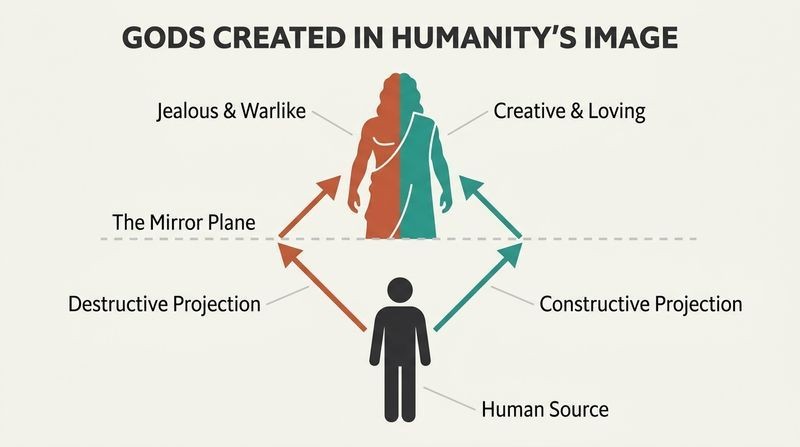
What's striking is Fry's inversion of the usual assumption that religion elevates humanity toward perfection. The Greek gods model dysfunction rather than virtue, which anthropologists like Walter Burkert note made them psychologically useful: they normalized human frailty rather than shaming it. Compare the jealous, adulterous Zeus with the omnibenevolent monotheistic God, and you see two entirely different projects. One explains why the world is messy; the other demands the world be just. Jungians would add that these flawed archetypes function as maps of the psyche, giving names to lust, rage, and grief so mortals could recognize and manage them.
Every generation of power is overthrown by the child it fears
A cycle of prophesied patricide. Ouranos imprisons his monstrous children inside Gaia, so she arms his son Kronos, who castrates him with an adamantine sickle. Ouranos curses Kronos: your own children will destroy you as you destroyed me. Terrified, Kronos swallows each newborn whole. Rhea smuggles away baby Zeus, feeds Kronos a swaddled stone instead, and raises Zeus to depose his father.
Fear creates the outcome it dreads. Each tyrant's paranoid attempt to prevent succession guarantees it. Kronos eating his children directly produces the rescuer who unmakes him. Zeus later swallows the pregnant Metis for the same reason, and still Athena is born from his skull. The pattern is the engine of the entire creation story.
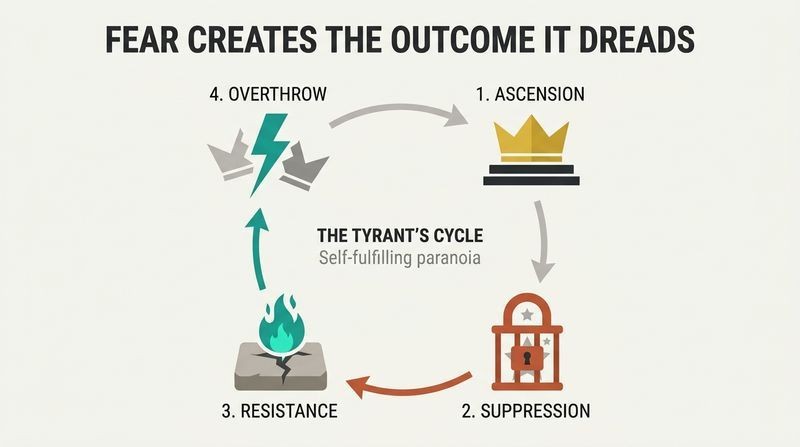
This succession myth maps almost exactly onto the Babylonian and Hittite predecessors Fry acknowledges, suggesting a deep Indo-European template. Freud borrowed the structure wholesale for his Oedipal theory, though the Greeks framed it as political rather than sexual: it is about who rules. There is a shrewd psychology here that modern organizational theory echoes. Leaders who hoard power and suppress capable successors often engineer their own downfall, a dynamic seen in dictatorships and family businesses alike. The self-fulfilling prophecy is the real villain. Kronos's cannibalism is fear made literal, and fear, not fate, does the destroying.
Prometheus proves loyalty to your creation can trump loyalty to power
Fire as rebellion. Zeus, bored and cosmically lonely, has Prometheus mold humans from clay. But Zeus forbids giving them fire, fearing they will rival the gods. Prometheus, who loves mankind more than he fears Zeus, smuggles a burning fennel stalk down from Olympus. Fire unleashes tools, cooking, metalwork, and civilization itself.
Punishment without repentance. Zeus chains Prometheus to a mountain where vultures tear out his regenerating liver daily, forever. Yet Prometheus does not recant. He weighed his own eternal agony against humanity's future and chose humanity. Fry frames him as mankind's creator, advocate, and friend, the being who, unlike the vain Olympians, never demanded worship. His name means forethought, and his gift includes the inner spark of human curiosity.
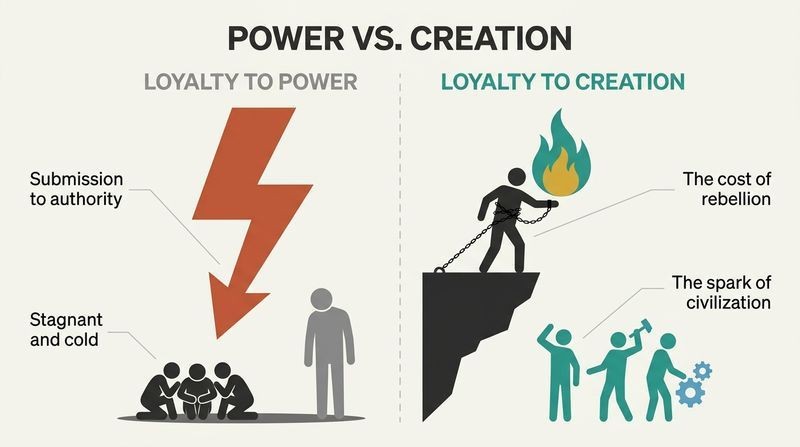
Prometheus became the patron saint of Enlightenment humanism precisely because he embodies knowledge stolen from jealous authority. Mary Shelley subtitled Frankenstein The Modern Prometheus, capturing the double edge: creation and hubris entwined. What Fry surfaces beautifully is the asymmetry of motives. Prometheus wants nothing back, while the gods crave endless flattery. This maps onto modern debates about whistleblowers and open-source pioneers who sacrifice standing to democratize knowledge. Bertrand Russell, whom Fry cites, saw forethought as the very hinge of civilization, the capacity to endure present pain for future gain. Prometheus gave humans both fire and the mental fire to plan ahead.
Every gift from the gods hides a trap, so read the fine print
Wishes granted with malicious literalism. Fry returns again and again to the danger of divine bargains. King Midas asks that everything he touches turn to gold, then starves as his food, wine, and even his daughter petrify. Eos begs Zeus to make her mortal lover Tithonus immortal but forgets to ask for eternal youth, condemning him to shrivel endlessly until she turns him into a grasshopper.
The oath as weapon. Phaeton extracts a rash promise from his father Apollo and dies driving the sun chariot. Semele forces Zeus to reveal his true form and is incinerated. The recurring lesson: the gods honor the letter of a promise precisely to punish the spirit of a foolish request. As Tennyson wrote, the gods themselves cannot recall their gifts.
This motif is a folklore universal, the three-wishes structure found from the Arabian Nights to W. W. Jacobs's The Monkey's Paw. Behaviorally, it dramatizes what economists call the hidden cost of getting exactly what you want. The Midas problem anticipates modern anxieties about optimization gone wrong, from lottery winners who unravel to artificial intelligence alignment, where a system given a literal goal (maximize paperclips) pursues it catastrophically. The Greeks intuited that specifying desire is perilous because reality contains constraints our wishes ignore. The deeper wisdom is humility about our own preferences, since we rarely understand what we actually want.
Hubris against the gods brought inventive, tailored, eternal punishment
The crime of overreaching. Hubris, to the Greeks, meant a pride that presumes to equal or surpass the divine, and it was answered with punishments fitted to the offense with cruel precision. Arachne, the peerless weaver who claimed to outdo Athena, is turned into the first spider, condemned to weave forever. Marsyas the satyr challenges Apollo's music and is flayed alive. Niobe boasts of her fourteen children over Leto's two, and watches all fourteen shot dead.
Tantalus and Sisyphus. Tantalus, who fed the gods his own son, stands eternally in water that recedes and beneath fruit that lifts away. Sisyphus, who twice cheated Death itself, pushes a boulder uphill forever. Fry notes the Greeks relished the aptness of these torments, like Dante designing his hellscapes.
Camus famously reimagined Sisyphus as absurdist hero, arguing we must imagine him happy, finding meaning in the struggle itself. Fry gestures at this, noting philosophers see courage and resilience in the refusal to submit. What the punishment myths reveal sociologically is a culture policing the boundary between mortal and divine, a boundary that doubled as a boundary of social order. Hubris was dangerous not just theologically but politically, since it threatened hierarchy. Yet there is tension: many hubristic figures are also artists and innovators. Arachne genuinely was the better weaver. The myth punishes excellence that refuses to bow, which is a conservative, uncomfortable moral.
The seasons exist because a grieving mother stops the world's growth
Persephone's abduction. Hades erupts from the earth and seizes Persephone, daughter of the harvest goddess Demeter. Demeter's grief is so total that she abandons her duties and the whole world withers into famine. Zeus intervenes, but Hades tricks Persephone into eating six pomegranate seeds, and the law of the underworld dictates that whoever tastes its food must return.
A rhythm born of loss. Persephone must spend six months each year below with Hades and six above with her mother. Demeter's mourning becomes autumn and winter; her joy at reunion becomes spring and summer. Fry notes Persephone grows to genuinely love her role as Queen of the Underworld, making the arrangement less a tragedy than a negotiated rhythm the world learns to keep.
This is a classic aetiological myth, explaining a natural phenomenon through story, and it belongs to a wide family of dying-and-returning vegetation deities studied by James Frazer in The Golden Bough. What Fry adds by noting Persephone's genuine contentment complicates the pure victim reading feminist scholars have debated for decades. The pomegranate detail is psychologically rich: consuming the food of a place binds you to it, an idea echoed in fairy-tale prohibitions everywhere. The myth also encodes agricultural knowledge, the Mediterranean fallow season, into an emotionally memorable narrative, which is precisely how oral cultures preserved practical information across generations.
Hoarding your gift can get you stung, so let talent be shared
Melissa the bee's fatal wish. At the wedding feast of Zeus and Hera, a small creature named Melissa invents honey and wins a prize: any favor. But she demands a deadly sting to kill anyone who raids her hoard. Zeus, contemptuous of jealous hoarding, grants a barbed sting that kills the bee itself when used. A talent, he declares, should be shared out, not selfishly guarded.
The generous inversion. Fry contrasts this with generosity rewarded. Hephaestus, cast from Olympus and rejected by his mother, returns without vengeance and simply wants to be useful, making gifts for all the gods. He earns a permanent home. The honeybee's suicidal sting and the wasp's painless one become a moral emblem about the cost of possessiveness.
The etymology Fry highlights is real: melissa remains Greek for honeybee, and Hymenoptera means wedding wings. Biologically the story is a just-so tale, since the barbed sting evolved for hive defense, not divine punishment. But as a parable about knowledge economies it is prescient. The instinct to wall off one's expertise often backfires, whereas open contributors, like Hephaestus the eternal craftsman, accrue durable status. Modern network theory and the success of open-source software both vindicate the honey-should-be-shared ethic. The bee that dies defending its hoard is a vivid warning against zero-sum thinking, where protecting what you have costs you everything.
Zeus survives by ruling through consensus, not raw omnipotence
Power constrained by its own rules. After the ten-year war against the Titans, Zeus does not simply dominate. He distributes domains, drawing lots so Hades gets the underworld and Poseidon the sea, and he builds a cabinet of twelve Olympians. Fry compares him to a chief executive after a hostile takeover, installing his people and delegating spheres of authority.
The cost of legitimacy. When Hera curses the pregnant Leto and denies her land to give birth, Zeus cannot simply override his wife, because his authority rests on respecting the other gods' rights to rule their own spheres. He complains, as leaders do, that he is the least free of his subjects. He also carries Metis (wisdom) inside him as a permanent counselor, tempering his recklessness with reason.
Fry's reading of Zeus as a constitutional rather than absolute monarch is politically astute and historically resonant. The Greeks who told these stories were inventing democracy and oligarchy, and their chief god reflects a distributed, negotiated power structure rather than an Oriental despot. The detail of Metis internalized as counsel is a striking image of wisdom as a check on impulse, almost a proto-theory of the deliberative mind restraining passion, anticipating Plato's charioteer and modern dual-process psychology. The tension is that Zeus constantly violates his own order through his affairs, showing that even rule-bound power struggles to bind the ruler's appetites.
Kindness to strangers was sacred law, tested by gods in disguise
Xenia, the duty of hospitality. To the Greeks, xenia, the reciprocal obligation between host and guest, was so sacred that Zeus himself guarded it, sometimes going by the name Zeus Xenios. The gods regularly tested mortals by arriving in disguise, a practice called theoxenia. Betraying this bond was among the gravest sins.
Philemon and Baucis. An elderly poor couple welcome two disguised travelers, Zeus and Hermes, after the whole town has turned them away with stones and dogs. The couple offer their last food and try to kill their only goose. The gods flood the inhospitable town but transform the couple's cottage into a temple and grant their wish to die together, becoming intertwined oak and linden trees. Ixion and Tantalus, by contrast, abuse hospitality and are damned forever.
Fry rightly flags the near-identical structure in Genesis, where angels visit Sodom and only Lot's family shows decency. This convergence points to a shared Near Eastern moral grammar, where hospitality was survival infrastructure in a world without inns or police. Anthropologists note that guest-friendship networks enabled trade and travel across hostile territory, so encoding it as divine law had real economic function. The theoxenia device, the god who might be the beggar at your door, is a powerful ethical technology: it makes every stranger potentially sacred, extending moral concern beyond kin. It survives in the medieval Christian idea of welcoming Christ in the poor.
Narcissus and Echo name two failures of genuine connection
Two halves of a broken mirror. Echo, a nymph cursed by Hera to only repeat others' final words, falls hopelessly for the beautiful youth Narcissus, but can never speak her own heart. Narcissus, who has cruelly spurned every lover, is doomed to fall in love with his own reflection in a pool, pining away until he becomes the flower that bears his name.
A definition of narcissism. Fry offers a sharp formulation: narcissism is the need to treat other people as mirrored surfaces that satisfy us only when they reflect a flattering image of ourselves. When we look into another's eyes, we look not to see who they are but how we appear. Both echolalia and narcissistic personality disorder are now clinical terms drawn from this myth.
Fry's gloss anticipates exactly how clinical psychology defines pathological narcissism, marked by grandiosity, a hunger for admiration, and an inability to see others as fully real. His closing provocation, that none of us can wholly disown our share of narcissism, aligns with research showing narcissistic traits exist on a spectrum. The Echo half is equally acute: a person who can only reflect others, never assert a self, is the codependent counterpart to the narcissist, and the two often bond destructively. That these ancient figures gave their names to a diagnostic manual shows myth's enduring power to name psychological truths before science formalizes them.
Hope may be humanity's last comfort or its cruelest curse
Pandora's jar. Fashioned by the gods as All-Gifted and given a sealed jar (mistranslated over centuries as a box), the first woman Pandora cannot resist opening it. Out swarm illness, violence, deceit, misery, old age, and every hardship, released forever into the world. She slams the lid just in time to trap one last spirit inside: Elpis, Hope.
An unresolved riddle. Fry lays out competing readings rather than settling it.
1. Hope was denied to us, deepening the curse.
2. Hope is really dread of the worst, and trapping it spares us foreknowledge of our doom.
3. Nietzsche's view: hope is the most pernicious evil because it prolongs human suffering with false promises, so Pandora's containment of it was a mercy.
We are left, hopefully or hopelessly, to decide for ourselves.
The ambiguity Fry preserves is genuinely present in Hesiod's original and has fueled scholarly argument for millennia, hinging on whether the jar keeps things for us or from us. Nietzsche's dark reading in Human, All Too Human is the most provocative: hope as the torment that keeps us on the wheel. Yet behavioral science leans the other way. Research on learned helplessness and optimism suggests hope is adaptive, sustaining effort through adversity. The myth's brilliance is that it refuses resolution, making Elpis a genuine philosophical inkblot. Whether hope is a lifeline or a lie may depend less on the myth than on the reader's temperament.
Analysis
Mythos is not a work of scholarship but an act of transmission, and its method is its message. Stephen Fry, a comedian and classicist by love rather than credential, deliberately refuses to interpret, allegorize, or psychoanalyze the myths, insisting they stand as stories. Yet by the sheer act of arranging them into a coherent narrative arc, from Chaos through the reign of the Olympians, he makes an implicit argument: that Greek myth is a single evolving drama about the emergence of order, personality, and eventually humanity from formless void.
The book's structural cleverness lies in its restraint of scope. Fry stops before the heroes (Heracles, Theseus, the Trojan War), covering only the cosmogony and the early tales of gods and mortals. This lets him foreground the creation of the world and of humankind, which are the myths richest in philosophical content. His signature move is etymological delight, tracing how ocean, panic, echo, tantalize, cereal, and volcano all descend from these figures, demonstrating that the myths are not dead but embedded in the language we speak daily.
The recurring moral architecture is worth naming. Fry surfaces a consistent Greek worldview: gods are powerful but not good, promises are traps, hubris is punished, hospitality is sacred, and fate cannot be escaped even by those who engineer it. This is a tragic and non-redemptive cosmos, utterly unlike the providential universe of Abrahamic religion, and Fry's affection for it is precisely an affection for its unillusioned honesty about power and suffering.
The risk of the approach is that pure storytelling can feel like a catalogue, and the density of names occasionally overwhelms. But Fry's wit, contemporary asides, and refusal of reverence keep the material alive. The book succeeds as a gateway drug: it makes a three-thousand-year-old imaginative world feel addictive, approachable, and astonishingly human, which was exactly his stated aim.
Review Summary
Mythos is praised for its witty and accessible retelling of Greek mythology. Readers appreciate Fry's humorous approach, making complex stories engaging and relatable. The book serves as an excellent introduction for newcomers and a delightful revisit for mythology enthusiasts. Fry's narrative style and personal commentary add depth to the myths. While some found the volume of information overwhelming, most reviewers lauded the book's entertainment value and educational merit. Many readers expressed eagerness to continue with Fry's mythology series.
People Also Read
FAQ
What's Mythos: The Greek Myths Retold about?
- Modern retelling: Stephen Fry offers a contemporary retelling of ancient Greek myths, making them accessible and engaging for today's readers.
- Character focus: The book highlights the personalities of gods, heroes, and mythical creatures, emphasizing their human-like traits and emotions.
- Cultural exploration: Fry delves into the origins and cultural significance of these myths, illustrating their impact on Western literature and culture.
Why should I read Mythos: The Greek Myths Retold?
- Engaging narrative: Fry's witty and humorous prose makes the myths entertaining, appealing to both newcomers and those familiar with Greek mythology.
- Cultural enrichment: Understanding these myths enhances appreciation for literature, art, and history, as they have influenced countless works throughout the ages.
- Accessible entry point: The book is designed for readers with no prior knowledge of Greek mythology, making it a great starting point for anyone interested in the subject.
What are the key takeaways of Mythos: The Greek Myths Retold?
- Human nature of gods: The myths illustrate that the gods are flawed and relatable, embodying traits like jealousy, love, and vengeance.
- Themes of creation and chaos: The book explores the concept of Chaos as the origin of the universe, highlighting themes of order and the cyclical nature of existence.
- Interconnected myths: Fry shows how various myths are interlinked, creating a rich tapestry of stories that reflect life's complexities.
What are the best quotes from Mythos: The Greek Myths Retold and what do they mean?
- “In the beginning was Chaos.”: This quote emphasizes the Greek belief in the universe's origin from disorder, setting the stage for creation.
- “The Greeks created gods that were in their image.”: Reflects the idea that gods personify human traits, making them relatable and highlighting Greek self-understanding.
- “Pleasure is what immersing yourself in the world of Greek myth is all about.”: Fry suggests that engaging with these stories is meant to be enjoyable and accessible.
How does Stephen Fry portray the gods in Mythos: The Greek Myths Retold?
- Flawed and human-like: The gods are depicted with emotions and traits that mirror human behavior, making them relatable and complex.
- Power dynamics: Fry explores the relationships between gods and mortals, highlighting tension and conflict in their interactions.
- Cultural reflections: The portrayal of gods reflects ancient Greek values and beliefs, providing insight into their society and worldview.
What role do women play in Mythos: The Greek Myths Retold?
- Diverse representations: Women range from powerful goddesses like Athena to mortal figures like Psyche, showcasing varied roles and attributes.
- Agency and influence: Many female characters exert significant influence over events, challenging traditional gender roles of the time.
- Themes of love and jealousy: Interactions often revolve around love, desire, and jealousy, illustrating relationship complexities in the myths.
What is the significance of Chaos in Mythos: The Greek Myths Retold?
- Origin of the universe: Chaos is described as the primordial state from which everything emerged, contrasting with later order.
- Cycle of creation: Introduces the idea that creation and destruction are part of a continuous cycle, reflecting Greek understanding of existence.
- Philosophical implications: Chaos serves as a metaphor for life's unpredictability, suggesting that order can arise from disorder.
How does Mythos: The Greek Myths Retold differ from other retellings of Greek mythology?
- Personal touch: Fry infuses his own voice and humor into the narratives, making them distinctively engaging compared to traditional retellings.
- Focus on storytelling: Emphasizes storytelling over mere summarization, bringing characters and events to life vividly.
- Cultural commentary: Provides insights into the cultural significance of myths, connecting them to contemporary themes and issues.
What are some of the major themes explored in Mythos: The Greek Myths Retold?
- Love and desire: Explores various forms of love and the complexities arising from desire, reflecting human emotions' duality.
- Hubris and consequences: Many characters exhibit hubris, leading to their downfall, emphasizing humility's importance.
- Transformation and identity: Transformation is prevalent, with characters undergoing changes, exploring identity and existence.
Who are the main characters in Mythos: The Greek Myths Retold?
- Zeus: King of the gods, representing authority and power, but also embodying flaws like jealousy and impulsiveness.
- Hera: Zeus's wife and queen, known for her fierce loyalty and jealousy, often reacting strongly to Zeus's infidelities.
- Prometheus: A Titan who defies Zeus by stealing fire for humanity, symbolizing rebellion and the quest for knowledge.
How does Stephen Fry approach the retelling of these myths in Mythos: The Greek Myths Retold?
- Humorous tone: Employs a humorous and conversational tone, making the myths engaging and relatable.
- Personal reflections: Intersperses personal anecdotes and reflections, connecting myths to contemporary life.
- Respect for tradition: Modernizes language and style while maintaining respect for the original myths and their cultural significance.
What is the overall message of Mythos: The Greek Myths Retold?
- Embrace the human experience: Encourages readers to appreciate myths as reflections of human nature, with all its complexities.
- Value of storytelling: Underscores the importance of stories in understanding ourselves and our place in the world.
- Joy in exploration: Invites readers to immerse themselves in the myths for pleasure and enjoyment, celebrating Greek mythology's richness.
Stephen Fry's Great Mythology Series
About the Author
Other books by Stephen Fry


Download PDF
Download EPUB
.epub digital book format is ideal for reading ebooks on phones, tablets, and e-readers.








































