

Key Takeaways
The Indian Ocean, not Europe, is the twenty-first century's map
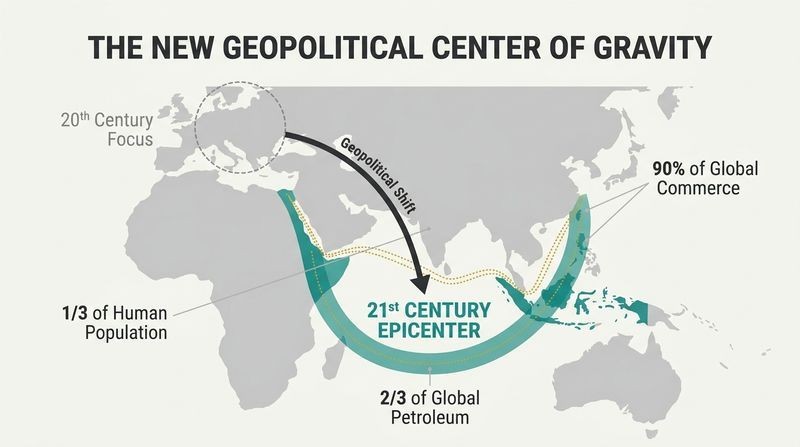
Geography is destiny reborn. Kaplan argues that as Europe defined twentieth-century power politics, the Greater Indian Ocean (from the Horn of Africa past Arabia and India to Indonesia) defines the new century. This arc holds the world's energy jugular, its youngest and most volatile Muslim populations, and the overlapping ambitions of a rising China and India.
Trade runs through here. Roughly 90% of global commerce and two-thirds of petroleum travel by sea, and this ocean carries half the world's container traffic. Forty percent of seaborne crude passes through the Strait of Hormuz alone. Thirty-seven littoral countries hold a third of humanity. Kaplan's method is unusual: he travels port by port, reading landscapes, mosques, and harbors to forecast where power is shifting.
What's compelling is Kaplan's revival of geographical determinism at the height of "flat world" globalization rhetoric. His debt to geopolitical thinkers like Mahan and Mackinder is explicit. The framing has aged with mixed results: China's Belt and Road and militarized South China Sea islands vindicate his emphasis on maritime choke points, yet the American "decline" he forecasts proved slower than implied. Critics note the map-centric lens can flatten human agency, which Kaplan himself concedes when profiling individual leaders. Still, the core reframing, that coastlines and sea-lanes matter more than pundits assumed, remains a bracing corrective to borderless-world triumphalism.
China reaches south by sea, India spreads east and west
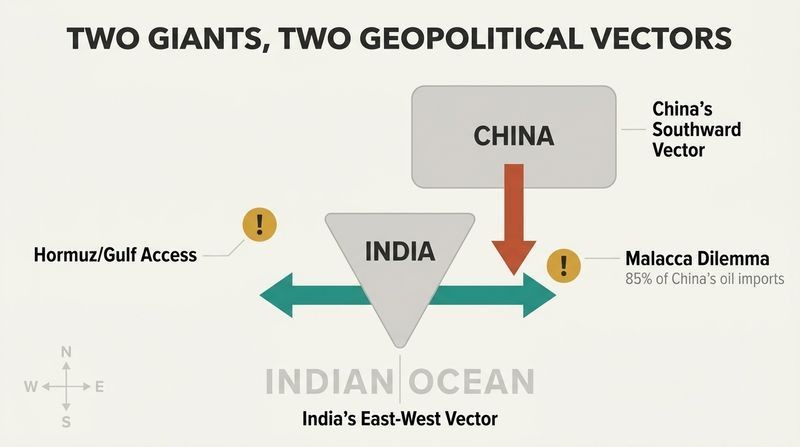
Two rising giants, two vectors. Kaplan's organizing image: China expands vertically, pushing southward toward the warm Indian Ocean to secure oil routes, while India expands horizontally, reaching along the old borders of British India. China fears its "Malacca dilemma," its dependence on the narrow Strait of Malacca, through which over 85% of its oil passes.
The string of pearls. To escape this vulnerability, China cultivates port access across the rimland: Gwadar in Pakistan, Hambantota in Sri Lanka, Chittagong in Bangladesh, and bases in Burma. Kaplan stresses these are not overt military bases but dual-use civilian facilities dependent on friendly bilateral ties. India answers with a naval buildup, new bases like Karwar, and its own "Hormuz dilemma" anxiety about China blocking its Gulf access.
The "string of pearls" phrase, coined by a 2004 Booz Allen report, became strategic shorthand, though Kaplan wisely flags skeptics who doubt China's intentions. His nuance holds up well: China pursued access, not colonial bases, and Hambantota's 2017 debt-for-equity lease to China vindicated fears about leverage without formal occupation. What the framing underweights is economic interdependence as a brake on conflict, plus India's own hedging via the Quad grouping with the US, Japan, and Australia. The vertical-horizontal metaphor is memorable but risks tidiness; real strategy is messier, with both powers simultaneously cooperating on trade and jockeying at sea.
Absolute monarchy built a better state than elections would have
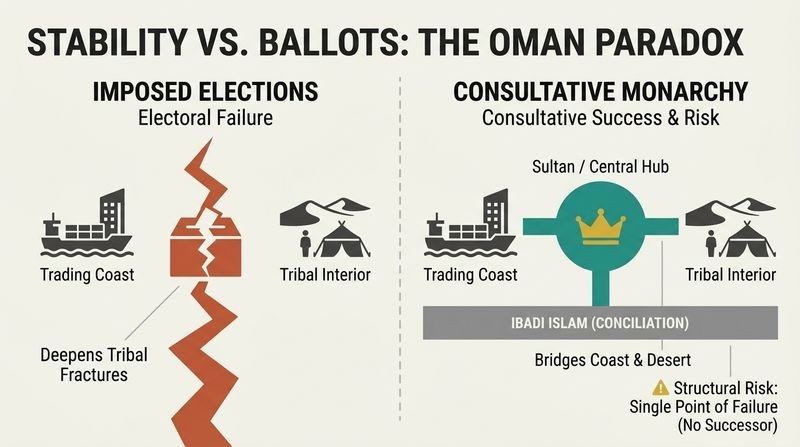
Oman defies Western assumptions. Sultan Qabus, who seized power from his father in a near-bloodless 1970 coup, unified a country long split between a cosmopolitan trading coast and an anarchic tribal desert interior. He offered amnesty to rebels, built wells and roads, made traditional dress mandatory to forge unity, and ruled through consultation with tribal elders rather than ballots.
Justice over voting. Kaplan's point: in much of the Middle East, legitimacy flows from informal consultation, religious authority, and tribal balance, not from elections. Oman's calming Ibadi Islam (neither Sunni nor Shiite, stressing conciliation) reinforces stability. The danger is structural: hyper-centralized authority works brilliantly under an enlightened ruler and catastrophically under a poor one, and Qabus had no heir.
Kaplan channels Samuel Huntington's argument that order must precede liberty and that institutions matter more than elections. The steelman is strong: Oman's stability amid regional chaos is real, and the West's habit of equating democracy with voting alone is genuinely reductive. Yet the case invites pushback. Betting a nation's fate on one benevolent autocrat is a succession gamble, precisely the fragility Kaplan flags. Oman navigated Qabus's 2020 death smoothly, but Syria and Libya show how personalist regimes can implode. The deeper insight, that political forms should fit local history rather than imported templates, is sound; the romance of the enlightened despot is riskier.
Where sea meets desert, cosmopolitanism and anarchy split a nation
Two geographies, two political fates. Kaplan's recurring lesson: coastlines, connected by predictable monsoon winds, breed trade, mixing, and tolerance, while deserts and mountains breed isolation, tribalism, and violence. Oman embodies both. So does Pakistan's Makran coast and Baluchistan, a wild transition zone more Arabian than subcontinental.
Gwadar as litmus test. The Chinese-built deepwater port at Gwadar could become a "Rotterdam of the Arabian Sea," a hub linking Central Asian energy to the ocean. But Baluch separatists, displaced by land grabs and denied the wealth, threaten to bomb the pipelines. Whether Gwadar thrives depends less on engineering than on whether Islamabad strikes a bargain with the Baluch. The port is a barometer for half the Indian Ocean's stability.
The sea-versus-desert dichotomy echoes Ibn Khaldun's classic contrast between sedentary civilization and desert solidarity, and Fernand Braudel's environmental history. It is evocative and partly true, but Kaplan himself admits it is "never that cut-and-dried," citing Arab desert migrations that spread ideas widely. The Gwadar analysis proved prescient: the port remains underused and plagued by Baluch insurgent attacks on Chinese workers, exactly as warned. The broader takeaway, that infrastructure megaprojects fail without political inclusion of marginalized locals, applies far beyond Pakistan, from Nigerian oil deltas to Amazonian dams. Geography sets the stage; governance writes the script.
Education breeds ethnic hatred faster than poverty does
Hindu nationalism rises with the middle class. Kaplan finds that Hindutva (Hindu-ness ideology) is strongest not among India's poor but among scientists, engineers, and lawyers. Mass communication standardized once-local Hindu cults into a unified political identity, while education gave newly prosperous professionals historical grievances (like the medieval Muslim destruction of temples) they never previously nursed.
Gujarat's warning. He profiles Narendra Modi, then chief minister, whose 2002 riots saw some 2,000 Muslims killed while police stood aside, yet who governs with machine-like efficiency, luring more investment than any Indian state. Kaplan calls him a hybrid: part ruthless ideologue, part CEO. The same pattern (radicalism among the educated, not the destitute) appears in al-Qaeda recruits and Indonesian engineers.
This counterintuitive claim aligns with serious scholarship. Studies of jihadist recruitment (Gambetta and Hertog on engineers, Krueger's work showing terrorists skew educated and middle-class) support Kaplan's pattern. The mechanism, that literacy plus mass media manufacture unified, grievance-laden identities from formerly diffuse local practices, resonates with Benedict Anderson's "imagined communities." The observation about Modi is uncomfortably durable given his later premiership. One caveat: correlation is not the whole story; economic anxiety, status threat, and elite political entrepreneurs weaponizing history all interact. Kaplan's portrait avoids caricature by crediting Modi's competence, which makes the danger he describes more plausible, not less.
Climate change plus weak states equals a religious radicalization engine
Bangladesh is the crucible. With 150 million people packed at sea level, an eight-inch rise in the Bay of Bengal by 2030 could displace over ten million. Salinity from rising seas already kills crops and poisons wells, while upstream Indian and Chinese dams starve the delta of fresh water. Kaplan calls it the likeliest site of history's greatest humanitarian catastrophe.
How environment feeds extremism. The chain is indirect: environmental ruin drives rural migrants into anonymous urban slums, where they lose tribal and family ties and become receptive to a starker, Saudi-funded Wahabist Islam replacing the gentle, Hinduized local faith. NGOs like BRAC and Grameen fill the vacuum left by dysfunctional government, but so do al-Qaeda affiliates. Democracy that cannot govern, Kaplan argues, can be worse than a dictatorship that can.
Kaplan was early to frame climate as a threat multiplier rather than a standalone issue, a view now mainstream in defense circles (the Pentagon's own assessments echo it). The insight that displacement severs the social bonds that moderate belief, leaving atomized migrants open to ideological substitutes, connects to Durkheim's anomie and to research on how urbanization disrupts traditional authority. The BRAC and Grameen story is genuinely hopeful, showing bottom-up institution-building can outperform failed states. The provocative claim, that a governing dictatorship may protect rights better than an ungoverned democracy, deliberately echoes Huntington and will unsettle readers, which is precisely its intent.
Individuals bend history: one man's nerve won Britain India
Against pure determinism. Having argued geography shapes fate, Kaplan pauses on the Hooghly River to insist history is also made by individuals, luck, and moral choice. His case study is Robert Clive, the East India Company clerk who, at Plassey in 1757, scattered a force of sixty thousand with three thousand men and effectively founded British India.
Genius and moral stain. Clive was fearless, manic-depressive, and eventually suicidal. He forged a treaty signature, enriched himself with hundreds of thousands of pounds, yet reformed Company corruption by raising salaries. Kaplan, via Macaulay, argues that without Clive's specific audacity Britain might never have ruled India as it did. The port-by-port method reveals that vast impersonal forces and singular personalities both write the story.
This is Kaplan hedging his own thesis, a mark of intellectual honesty. The tension between structure and agency is one of history's oldest debates, from Tolstoy's determinism in War and Peace to Carlyle's "great man" theory. Kaplan's synthesis, that geography sets constraints while individuals exploit or squander openings, mirrors how modern historians actually work. The Clive portrait resists hagiography by foregrounding the corruption and cruelty, making it more useful than triumphalist imperial narrative. The lesson travels: contingency matters, and betting everything on structural forecasts (or dismissing leadership as irrelevant) misreads how outcomes are actually produced at hinge moments.
Beyond nationalism lies Tagore's map with no borders, only transitions
Two visions from one city. In Kolkata, Kaplan contrasts two figures. Lord Curzon, the imperial viceroy, represents realpolitik and the "neo-Curzonian" strategy some Indians embrace: expanding influence across the subcontinent through commerce and pipelines rather than conquest. The poet Rabindranath Tagore, Nobel laureate of 1913, represents the opposite: a rejection of nationalism as "unaesthetic."
Rooted universalism. Tagore saw Asia as a seamless tapestry where India dissolves into Persia and Malay culture, where a Kurdistan can layer atop Turkey, Iraq, and Iran rather than contradict them. Yet he was no rootless globalist; he grasped that appreciating other cultures requires deep grounding in one's own. Kaplan's synthesis: for India's outward strategy to succeed, it must adopt Tagore's borderless generosity to win its neighbors' trust.
Pairing a hard-power strategist with a humanist poet is Kaplan at his most literary, and the move enriches a book that could have been purely geopolitical. Tagore's "rooted cosmopolitanism" anticipates thinkers like Kwame Anthony Appiah, who argue that genuine openness grows from, not against, particular identity. Amartya Sen's insistence that Tagore was no mystic guru but a rigorous pluralist supports Kaplan's reading. The practical claim, that soft power and cultural magnanimity are strategic assets, not sentimental luxuries, is increasingly validated by scholarship on influence. The subtle warning: a rising India obsessed only with Curzonian dominance will alienate the very neighbors it needs.
China's arms sold Sri Lanka victory without human rights lectures
A new bipolarity of aid. When Sri Lanka moved to crush the Tamil Tigers, the US cut military support over human rights abuses. China stepped in, boosting aid from a few million dollars in 2005 to $1 billion in 2008, supplying fighter jets, and shielding Colombo at the UN. The government won, drowning and starving civilians in the final months, with about 10% of the war's 70,000 dead killed in 2009 alone.
Realism without conscience. Kaplan frames the world splitting between states that fold human rights into policy and those that do not. China does not interfere in others' internal affairs and tolerates no interference in its own. Yet geography constrains China: Sri Lanka sits in India's shadow, forcing a delicate nonalignment between the two giants.
The Hambantota port, built with Chinese money and later leased to China for 99 years after Sri Lanka could not service the debt, became the textbook case for "debt-trap diplomacy," though economists debate whether the trap was intentional or incidental. Kaplan's "two-camp" framing, conditional versus unconditional aid, captures a real fault line now visible across Africa and Asia, where Beijing's no-strings model competes with Western conditionality. The uncomfortable truth he surfaces is that human rights conditionality can cede strategic ground to rivals who impose none. His counterweight, that India's proximity limits China's reach, proved accurate as Colombo later recalibrated toward New Delhi.
Indonesia proves Islam can be layered, tolerant, and democratic
Islam as top layer, not conqueror. In the world's most populous Muslim country, Kaplan finds Islam arrived not by the sword but through Indian Ocean commerce, seeping gradually atop older Hindu-Buddhist civilization. Anthropologist Clifford Geertz's phrase captures it: Islam here "appropriated" a civilization rather than building one. Muslim schoolchildren flock to the Buddhist temple of Borobudur; women wear headscarves with tight jeans.
Syncretism versus imported purity. The 2004 tsunami, which killed roughly 250,000, reshaped Acehnese religion and ended a separatist war. Kaplan sees a genuine contest for Islam's soul: local, tolerant tradition versus Saudi Wahabist money and Al Jazeera's pan-Islamic sensibility. Radicals poll around 5%. Indonesian scholars spontaneously champion pluralism and good relations with Jews, a stark contrast to the Middle East.
Kaplan's reliance on Geertz's "Islam Observed" grounds the chapter in serious anthropology, and the demographic point deserves emphasis: the religion's center of gravity sits in South and Southeast Asia, not the Arab world, where roughly 300 million live versus half a billion Muslims eastward. The insight that geography and pre-existing culture shape how a faith is actually practiced undercuts monolithic "clash of civilizations" thinking, ironically Huntington's, whom Kaplan otherwise admires. A fair challenge: syncretism faces real erosion from petrodollar-funded orthodoxy and global media homogenization, a trend Kaplan documents honestly. Indonesia's peaceful democratic consolidation since 1998 remains one of the era's underreported success stories.
Somali piracy is anarchy's ripple, not the ocean's exception
Piracy signals prosperity and failed states. Kaplan reminds us that pirates have haunted these waters since antiquity, from the Malacca Strait to the Gulf of Aden, flourishing precisely when trade booms and states weaken. Somali piracy is the maritime echo of collapse on land. He recounts the USS Nassau's 2006 capture of pirates who saw themselves as a crude coast guard taxing foreign ships.
Puntland points the way. The pirates were malnourished, clan-less youths born during "the fighting," for whom, as one said, the gun is the government. Kaplan argues Somalia is not one failed state but three, and that the semi-functional pirate region of Puntland offers a handle: engage its clan authority with aid and pressure. Anarchy, he suggests, is often the slow breakdown of European-drawn borders and the return of clan and tribe.
The historical framing is valuable: treating piracy as an ancient, recurring feature of busy sea-lanes rather than a modern aberration reframes the policy problem. Kaplan's insistence that Somalia be disaggregated into Somaliland, Puntland, and the south anticipated later thinking on "good enough" governance and working with sub-state actors. Economists studying Somali piracy found it genuinely functioned as an industry with investors and ransom markets, matching his reporting. The provocative reframe, that "anarchy" is often the reassertion of older, sturdier clan identities beneath artificial colonial states, connects to debates over the arbitrariness of Africa's borders and remains analytically fertile.
Trade, not conquest, will rule the borderless ocean of the future
A system, not a superpower. Kaplan's closing vision: no single power, not even China, will dominate the Indian Ocean. Instead a trading system will, resurrecting the pre-Portuguese Muslim-Hindu cosmopolis, now fueled by Chinese and Indian investment reaching even into Africa. Zanzibar, the old Omani-ruled spice and slave hub where Persians, Arabs, Indians, and Africans mingled, embodies both this cosmopolitan promise and its post-colonial wreckage after the 1964 revolution.
The rising audience. He points to a new Muslim middle class across the region, whose materialistic hopes will pressure regimes toward better governance. Al Jazeera, broadcasting from Qatar at the ocean's center, gives this bourgeoisie a voice. America's real challenge, Kaplan concludes, is less countering China than earning legitimacy with these Afro-Asian billions who ultimately confer or withhold it.
The trade-as-power thesis draws on Janet Abu-Lughod's work on the pre-European world system, a medieval network with no single hegemon, and Kaplan's Zanzibar reporting gives it emotional weight through novelist Abdulrazak Gurnah's themes of separation and loss. The forecast of a legitimacy-driven order, where a connected middle class judges great powers on the merits of each crisis, feels prescient in an age of viral outrage and networked opinion. The optimism is real but contestable: petrostate authoritarianism, Chinese surveillance exports, and democratic backsliding complicate the bourgeois-liberalization story. Still, the reframing of American strategy from dominance to indispensability and legitimacy is the book's most durable prescription.
Analysis
Monsoon is a hybrid: part travelogue, part geopolitical forecast, part maritime history. Kaplan's wager is that the Greater Indian Ocean will be the twenty-first century's decisive theater, and his method, walking its ports and reading landscapes, gives the argument texture that pure strategy writing lacks. The book's structure is geographic rather than thematic, sweeping from Oman to Zanzibar, which makes it hard to compress: each chapter braids energy politics, Islam, ethnicity, colonial history, and environment specific to one place.
The intellectual spine is a productive tension. Kaplan is a geographic determinist who repeatedly undercuts himself, insisting that individuals like Clive and Qabus, plus luck and moral choice, bend structural forces. This honesty saves the book from the crude fatalism that dogs some of his other work. His guiding influences are visible: Mahan on sea power, Mackinder and Spykman on the Eurasian rimland, Huntington on order preceding liberty, and Braudel and Abu-Lughod on the deep history of trade networks.
Written in 2010, the book's forecasts have aged unevenly. He was strikingly right about China's port strategy (Hambantota's debt lease, Gwadar's Baluch troubles), climate as a security threat, and the durability of figures like Modi. He was too quick to project American naval decline and underweighted how economic interdependence and the Quad would constrain Sino-Indian rivalry.
The book's most transferable ideas are not the specific predictions but the analytic habits: read choke points, distinguish sea-facing cosmopolitanism from land-locked tribalism, recognize that democracy means little without governing institutions, and understand that Islam is refracted through local geography rather than uniform. Its deepest limitation is a tendency to aestheticize, occasionally romanticizing autocrats and reducing messy societies to tidy geographic archetypes. Yet as a corrective to borderless-world complacency, it remains bracing and, for a general reader, an unusually literary education in strategy.
Review Summary
Monsoon is a geopolitical analysis of the Indian Ocean region, blending history, travelogue, and strategic insights. Readers praise Kaplan's scholarship, engaging writing, and prescient predictions about the region's importance. The book explores how geography, trade, and power dynamics shape the area's future. Some criticize its Eurocentric perspective and dated views on imperialism. Overall, reviewers find it an informative and thought-provoking read, though a few consider it misnamed or overly focused on American interests.
People Also Read




Glossary
Malacca dilemma
China's oil-route chokepoint vulnerabilityChina's strategic anxiety over its dependence on the narrow Strait of Malacca, through which over 85% of its imported oil passes. A hostile power could theoretically block it. This fear drives China to seek alternative energy routes: overland pipelines, and port access across the Indian Ocean so tankers need not all funnel through the strait.
String of pearls
China's Indian Ocean port networkA phrase for China's strategy of securing access to a chain of ports and facilities across the Indian Ocean rim, including Gwadar (Pakistan), Hambantota (Sri Lanka), Chittagong (Bangladesh), and sites in Burma. Kaplan stresses these are dual-use civilian-military facilities dependent on friendly relations, not overt bases, giving China presence along vital sea-lanes.
Neo-Curzonism
India's soft-hegemony regional strategyA strategic outlook among some Indian thinkers, named for imperial viceroy Lord Curzon, favoring India's return to preeminence within its geographic sphere through commerce, pipelines, and influence rather than conquest. Unlike Hindu nationalist expansionism, it is comfortable allying with nondemocratic neighbors and focuses westward toward the Middle East.
Hindutva
Hindu-ness nationalist ideologyAn ideology of Hindu cultural nationalism, first named in a 1923 pamphlet, that treats India as fundamentally a Hindu civilization. Kaplan finds it strongest among educated professionals rather than the poor, fueled by mass media that standardized local Hindu practice into a unified political identity and gave the prosperous middle class historical grievances.
abangan / santri
Syncretic versus orthodox Indonesian MuslimsTerms from anthropologist Clifford Geertz for two strands of Indonesian Islam. Abangan Muslims practice a syncretic faith blended with older Hindu-Buddhist and animist traditions; santri Muslims are orthodox. Kaplan notes no more than a third of Indonesian Muslims are orthodox, illustrating how Islam layered atop existing civilization rather than replacing it.
Ibadism
Oman's conciliatory non-Sunni-Shiite IslamThe distinctive form of Islam practiced in Oman, neither Sunni nor Shiite, descended from the Kharijite tradition. Though historically capable of democratic-cum-anarchic disputes, Kaplan describes its modern character as stressing conciliation, avoidance of conflict, and saving face, giving Oman a calming, tolerant religious identity that reinforces national unity.
About the Author
Other books by Robert D. Kaplan



Download PDF
Download EPUB
.epub digital book format is ideal for reading ebooks on phones, tablets, and e-readers.








































