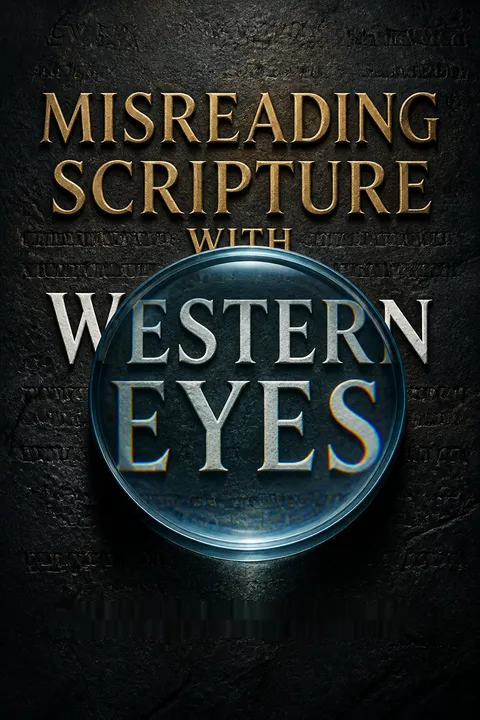

Key Takeaways
1. Western Eyes Distort Biblical Meaning
To open the Word of God is to step into a strange world where things are very unlike our own.
Unseen influences. Our cultural context profoundly shapes how we read and apply the Bible, often without our conscious awareness. Like the majority of an iceberg hidden beneath the surface, most of our worldview—including cultural values and assumptions—remains invisible, yet powerfully influences our interpretation. When biblical passages seem to have "gaps," we instinctively fill them with our own unspoken cultural assumptions, leading to misreadings.
Laodicea's lesson. Consider the familiar passage from Revelation 3:15-16, where Jesus tells the Laodiceans, "You are neither cold nor hot. I wish you were either one or the other!" Western sermons often interpret this as a call for spiritual zeal, preferring a "cold" (lost) person to a "lukewarm" (nominal) one because it's "honest." However, standing in the ruins of Laodicea, one realizes the city imported water from hot springs (Hierapolis, salubrious) and cold springs (Colossae, refreshing). By the time it reached Laodicea, it was lukewarm and useless. Jesus desired their discipleship to be useful, like hot or cold water, not spiritually lukewarm.
The forgotten famine. Similarly, in the parable of the prodigal son, American readers often overlook the famine (Luke 15:14) that precipitates the son's return, focusing instead on his "prodigal" (wasteful) nature and need for repentance. Yet, in cultures familiar with famine, this detail is crucial, shifting the story's application from individual rebellion to God's faithfulness in hopeless situations. Our cultural lens can cause us to miss obvious details and their intended meaning.
2. Cultural Mores Shape Our Moral Compass
Mores are the social conventions that dictate which behaviors are considered appropriate or inappropriate.
Unquestioned beliefs. Mores are deeply ingrained, unquestioned views that a community accepts as fundamental moral truths, often learned in childhood. They dictate everything from language (like the British vs. American meaning of "fanny") to food choices (eating dog meat in Indonesia vs. squirrel in the American South) and even marriage customs. These unspoken rules can lead Christians to assume their specific moral code is universally biblical, even when it's culturally derived.
Conflicting values. Christians often navigate conflicting mores between their faith tradition and broader Western culture. For instance, a generation ago, many conservative Christians condemned alcohol, citing Proverbs 20:1 ("wine is a mocker"). Today, younger conservatives challenge this, pointing to 1 Timothy 5:23 ("use a little wine for thy stomach's sake"). This tension highlights how cultural mores can lead us to emphasize certain scriptures while ignoring others, or to compromise in ways that satisfy both cultural and religious expectations.
Misreading sin. Our cultural mores can profoundly influence how we perceive sin in the Bible. For Westerners, the sin of Sodom (Genesis 19:1-9) is clearly "sodomy," even naming a sin after it. To Indonesian Christians, however, the primary sin is "inhospitality," supported by Ezekiel 16:49. Both agree Sodom was sinful, but their cultural lenses highlight different aspects, demonstrating how our ingrained values can lead us to misinterpret the specific nature of biblical condemnation.
3. Race and Ethnicity Influence Interpretation
To ignore them is naive and can result in serious misunderstanding.
Beyond colorblindness. While Westerners often strive for "colorblindness" and believe ethnic differences shouldn't matter, this can lead to ignoring crucial ethnic distinctions in biblical texts. This naive approach can blind us to the prejudices and social dynamics that were obvious to the original audience. For example, a Korean missionary in Alabama asking about black and white differences needs an honest answer about existing prejudices, not a pious "everyone is the same" response.
Ancient stereotypes. Biblical writers and their audiences were acutely aware of ethnic differences and stereotypes. Paul's harsh address to the "foolish Galatians" (Galatians 3:1) was likely an ethnic slur, as "Galatians" (Celts) were considered barbarians by Greeks. Similarly, Roman soldiers mistook Paul for an Egyptian (Acts 21:38) based on his appearance, reflecting a common prejudice that "all those people look alike." Our modern discomfort with such generalizations can prevent us from understanding these undercurrents in the text.
Misinterpreting status. Our own prejudices can lead us astray, as seen in the story of Moses' Cushite wife (Numbers 12:1). Western scholars often assumed Cushites (dark-skinned Africans) were a slave race, leading to the misinterpretation that Miriam and Aaron were upset because Moses married "below himself." However, in the ancient Near East, Cushites were respected soldiers, and Hebrews were the former slave race. Miriam and Aaron were more likely upset that Moses married "above himself," challenging his authority.
4. Language Differences Go Beyond Mere Words
Behind the words that make up language is a complex system of values, assumptions and habits of mind that reveal themselves in the words we use and leave unsaid.
Vocabulary reflects values. Language is more than just words; it's a window into a culture's values. Western languages, particularly English, have specialized vocabulary for things important to us, like different types of cars. Conversely, we have only one word for "rice," while Indonesians have three (padi, beras, nasi) because rice is central to their culture. This "sufficiency" assumption—that if something is important, we'll have a word for it—can lead us to miss nuances in biblical languages that have multiple words for concepts like "love" (agape, philia, eros, storge) or "kindness" (chesed).
The illusion of equivalency. Monolingual Westerners often assume a one-to-one relationship between languages, believing that concepts translate directly. This "equivalency" assumption can lead to profound misreadings. For example, the medieval church mistakenly equated the Latin "do penance" with the Greek "repent," fundamentally altering the path to salvation. Similarly, the absence of a word for "privacy" in some Eastern languages reveals a cultural value for community over solitude, which impacts how we interpret Jesus' "private" prayer in Gethsemane.
Clarity over ambiguity. Western thought prioritizes clear, propositional language over metaphorical or ambiguous expressions, especially for important truths. We tend to distill "hard facts" from parables and metaphors, often missing the richness and interconnectedness they convey. For instance, Jesus' claim "I am the good shepherd" (John 10:14) is not just a critique of bad leaders; it's a metaphor connecting him to God (Ezekiel 34) and King David (1 Chronicles 11:2), a profound theological statement easily missed if we only seek propositional meaning.
5. Individualism Blinds Us to Community
In a collectivist culture, the most important entity is the community-the family, the tribe or the country-and not the individual.
Self-first mentality. Western societies are largely individualistic, valuing self-expression, independence, and personal choice above all else. This contrasts sharply with collectivist cultures where community harmony, family honor, and group identity are paramount. Our individualistic lens shapes everything from our views on school uniforms (inhibits individuality) to marriage (personal "love" vs. family arrangement) and even how we perceive personal names (first name emphasis vs. family name emphasis).
"Me and Jesus" vs. "Us and Jesus." This individualistic bias profoundly affects our understanding of Christian conversion and church life. In the West, conversion is a personal decision ("I have decided to follow Jesus"), often leading to a "me and Jesus" faith. However, in collectivist societies, group conversions (whole households, Acts 16:31) are common, as individuals make major decisions in consultation with family elders. This challenges the Western assumption that true faith must be an isolated, individual experience.
The body of Christ. Our individualistic worldview can distort our understanding of the church as the "family of God." We often view church as a voluntary association, a "health club" we join if it "feeds" us, rather than a permanent, spiritual family with inherent obligations. Paul's metaphor of the church as a single body (1 Corinthians 12) or a "spiritual house" (1 Peter 2:5) emphasizes corporate identity and interdependence, a concept often lost when we read the "you" in Scripture as singular rather than plural.
6. Honor and Shame Drive Ancient Societies
In a shame culture, it is not the guilty conscience but the community that punishes the offender by shaming him.
External vs. internal. Unlike Western innocence/guilt cultures where an internal conscience dictates right and wrong, honor/shame cultures are driven by external pressures and community expectations. Actions are deemed good or bad based on how the community interprets them, and the goal is to avoid bringing shame upon oneself or one's family. This means that without public knowledge, there may be no "guilt" in the Western sense, as seen in Paul's blameless life before his conversion (Philippians 3:6).
David's honor. The story of David and Bathsheba (2 Samuel 11-12) is steeped in honor/shame dynamics, often misunderstood by Western readers who assume David was plagued by a guilty conscience. David's actions—from sending for Bathsheba to trying to cover up her pregnancy—were primarily aimed at preserving his honor as king. Uriah's refusal to go home publicly shamed David, forcing his hand. God, however, used the prophet Nathan to publicly shame David, demonstrating that God works through cultural systems to bring about repentance, even if it's through external conviction rather than internal guilt.
Public judgment. The New Testament also employs honor/shame. Paul's description of the "white throne judgment" (2 Corinthians 5:10) as a public event where misdeeds are displayed would have terrified his first-century hearers, who understood the devastating impact of public shame. Jesus himself navigated the "honor game" with Jewish leaders, whose public challenges were contests for honor. His victory led to their decision to kill him, not just for blasphemy, but to reclaim their lost honor through his public disgrace.
7. Time is Not Universal, Nor is God's Schedule
The quality of the event is the primary issue, not the quantity of minutes or hours.
Chronos vs. Kairos. While Westerners perceive time as a linear, quantifiable commodity (chronos), many non-Western cultures, and biblical authors, prioritize "kairos"—the opportune moment or fittingness of an event. This "event orientation" means that things begin when conditions are right, not by a clock. For example, Indonesian church starts "midday" (when it's hot), not at a precise hour, and people arrive when they arrive.
Misreading biblical timing. Our chronos-centric view leads us to misinterpret biblical narratives. The Christmas story, for instance, is often compressed into a single night, but Joseph and Mary likely stayed in Bethlehem for up to two years, as Joseph seized work opportunities (kairos) while in the area. Similarly, our preoccupation with the "end of time" (chronos) leads us to constantly predict Christ's return, often missing Jesus' emphasis on being ready at any "hour" (Matthew 24:44) and the importance of living in the "kairos" of God's kingdom now.
Sequence and meaning. Westerners often assume that biblical events are presented in strict chronological order, and any deviation implies inaccuracy. However, biblical writers, like ancient storytellers, often arranged events thematically to convey meaning (kairos) rather than strict chronology (chronos). Mark's sandwiching of the temple cleansing between the cursing of the fig tree (Mark 11:12-25) is a deliberate sequencing to interpret the temple's fruitlessness, not a chronological error. Our focus on chronology can obscure the author's intended message.
8. Rules vs. Relationships: A Deep Divide
In contrast to the modern Western worldview, in ancient worldviews it went without saying that relationships (not rules) define reality.
Enlightenment's legacy. The Enlightenment fostered a Western belief in a universe governed by fixed, discoverable rules, leading us to prioritize rules and laws in all relationships. This contrasts with ancient worldviews where relationships, not rules, were the foundational reality. Rules were merely the visible expression of underlying relationships. This shift makes us assume God operates like a watchmaker, setting rules and then disengaging, rather than an intimately involved Father.
Rules define relationships. Westerners tend to define relationships by explicit rules and contracts, expecting them to apply universally and without exception. This is evident in our legal systems and even personal interactions. However, in ancient cultures, relationships (like the patron-client system or family ties) dictated expectations, and rules were flexible guidelines. Paul's complex relationship with the Philippian church regarding gifts (Philippians 4) illustrates his struggle to maintain his relationship with God as his sole patron, rather than becoming indebted to human patrons.
Exceptions to the rule. Our insistence on universal rules makes it difficult to understand biblical instances where rules seem to have exceptions. Paul's strong stance against circumcision (Galatians 5:2) yet his decision to circumcise Timothy (Acts 16:3) is perplexing if we view it as a rigid rule. However, if understood through the lens of relationships, Paul's action was to avoid offending local Jews and facilitate ministry. This highlights that in a relationship-driven worldview, wisdom often lies in discerning when to apply a rule and when to make an exception for the sake of a greater relationship.
9. Virtues and Vices Are Culturally Defined
The unconscious cultural lessons often influence the way we perceive certain behaviors in Scripture and can lead us to ignore clear biblical teaching on vice and virtue if it challenges a previously held cultural value.
Cultural conditioning. Our understanding of virtues and vices is deeply shaped by cultural narratives (like "The Little Red Hen" promoting hard work and self-sufficiency) and popular media. These influences can lead us to prioritize certain behaviors as virtues (e.g., self-sufficiency, fighting for freedom, leadership, tolerance) or vices (e.g., procrastination, plagiarism) that are either non-biblical or even anti-biblical, while overlooking others. This creates a tension when biblical teachings challenge our ingrained cultural values.
Ranking sins. Western Christians often unconsciously rank vices, viewing sexual sins as worse than others, while downplaying sins like pride or gluttony. This selective emphasis can lead to inconsistencies in church discipline or personal application. Paul's lists of vices (Colossians 3:5, 8-9) were not exhaustive or ranked by severity; they were thematic examples, often summarized by a broader vice like "idolatry" or "lying." The goal was a holistic pursuit of godliness, not just avoiding a select few "worst" sins.
Overlooking biblical virtues. Our cultural focus on avoiding vices often overshadows the active pursuit of virtues. We may value spontaneous virtue over disciplined habit, making it harder to recognize biblical calls to cultivate character through intentional practice (Psalm 101). Furthermore, some Western "virtues" directly contradict Scripture. For example, the parable of the rich fool (Luke 12:16-21) challenges the Western virtue of excessive saving, suggesting it can be a vice (greed) if it prevents sharing with the needy, a virtue emphasized throughout Scripture.
10. "It's All About Me" Misplaces God's Will
We are confident that at the center will be me.
Self-centered interpretation. Generations of Western culture, from early American individualism to modern "me generation" and "helicopter parent" mentalities, have fostered a deep-seated self-centeredness. This leads us to interpret every biblical promise and blessing as applying specifically to "me," assuming God's plan is primarily centered around our individual lives. This is reinforced by ministry models that focus on "felt needs" and what the gospel can do for "me."
Misreading promises. This "me-centric" lens often leads to misreading passages like Jeremiah 29:11 ("plans to prosper you and not to harm you"). While a popular blessing for graduates, its original context was a promise to the exiled nation of Israel (a collective "you") for a future return, not an individual guarantee of personal prosperity in the immediate future. Similarly, Romans 8:28 ("God works all things together for the good") is often misapplied as a personal promise that every bad event will turn out good for me, rather than a corporate promise that God uses all circumstances to train his people for godliness.
Unrealistic expectations. Our preoccupation with "me" can lead to unrealistic expectations of God, causing doubt when personal circumstances don't align with our individualistic interpretations of promises. We may assume God's "plan" must unfold in our lifetime, leading to misinterpretations of apocalyptic prophecies (e.g., Y2K, Hal Lindsey's predictions). This self-focus can blind us to the broader, corporate narrative of God's redemptive work in Christ, where individual believers are part of a larger story, not its central focus.
11. Removing Blind Spots Requires Intentionality
We're trying to help you become a certain kind of reader: the kind of reader who is increasingly aware of his or her cultural assumptions.
No easy shortcuts. There are no "three easy steps" to remove cultural blinders; it's a lifelong process requiring time, self-reflection, and hard work. Westerners, with their preference for systems and methodologies, must resist the temptation to seek quick fixes. Instead, the goal is to cultivate an ongoing awareness of how our cultural assumptions influence our reading of Scripture, embracing the complexity that multiple presuppositions can affect a single text.
Beware overcorrection. As we identify cultural interpretations, it's crucial to avoid overcorrection—abandoning a concept entirely just because it has cultural elements. For instance, recognizing that not every biblical promise applies individually doesn't mean no promises apply to us. Nuance is key; we must allow for the possibility that God's promises can be true for his people collectively, even if individual experiences vary, and that God retains the right to judge.
Read together, learn from error. Becoming a culturally sensitive reader means being teachable, willing to abandon old assumptions, and embracing the learning that comes from making mistakes. Most importantly, it requires reading Scripture together with Christians from diverse cultures and ages. This communal approach breaks the "echo chamber" of homogenous interpretations, allowing us to see our own blind spots and appreciate how different worldviews illuminate different facets of God's Word.
Review Summary
Misreading Scripture with Western Eyes is widely praised for its accessible, thought-provoking exploration of how Western cultural assumptions shape Bible interpretation. Most readers appreciate its humor, cross-cultural anecdotes, and insights on individualism, honor/shame dynamics, and language. Critics note occasional over-reliance on personal anecdotes, strained exegesis, and perceived anti-Western bias. The book's iceberg metaphor for surfacing hidden cultural assumptions resonates strongly. Despite mixed opinions on specific interpretations, most agree it valuably challenges readers to recognize their cultural blinders when engaging Scripture.
People Also Read

Download PDF
Download EPUB
.epub digital book format is ideal for reading ebooks on phones, tablets, and e-readers.








































