
Key Takeaways
1. The Bible's Truth Isn't Dependent on Perfect Copies
"The inerrancy of the Bible means simply that the Bible tells the truth. Truth can and does include approximations, free quotations, language of appearances, and different accounts of the same event as long as those do not contradict."
Understanding inerrancy. The notion that the Bible must contain word-for-word agreement across all manuscripts or parallel accounts is a relatively recent assumption. Ancient cultures did not prioritize verbatim repetition in the same way modern readers might. The core question isn't whether every word is identical, but whether the available texts sufficiently convey the inspired truth God intended.
Acknowledging variations. It is true that original New Testament writings are lost, and surviving copies contain thousands of differences. However, these variations do not undermine the Bible's inerrancy. The goal is to determine if the available copies are accurate enough to grasp the truth God intended in the first century, and the answer is a resounding "yes."
Sufficient accuracy. Despite variations, the ancient manuscripts were copied with enough accuracy for us to comprehend the original authors' intent. The presence of differences doesn't negate divine inspiration; rather, it highlights the human element in the transmission process, which God often uses to reveal his glory.
2. Early Copyists Were Conservative, Not Reckless
"Most scribes, no doubt, tried to do a faithful job in making sure that the text they reproduced was the same text they inherited."
Scribal intent. While some ancient copyists were indeed "barely literate" and errors did creep into manuscripts, the overwhelming majority of scribes were committed to preserving the text. Their primary concern was not to modify the tradition but to conserve it for future generations, as even Bart Ehrman acknowledges.
Insignificant variations. Ehrman's estimate of 400,000 variants among New Testament manuscripts, while numerically correct, grossly overestimates their significance. Over 99% of these variations are minor:
- Differences in spelling
- Word order
- Relationships between nouns and definite articles
These changes are often unnoticeable in translation and do not affect the meaning of the text.
Textual criticism's role. The science of textual criticism allows scholars to compare manuscripts and determine the original wording with remarkable accuracy. By assuming that not all copyists made the same mistake simultaneously, critics can trace errors and reconstruct the earliest form of the text. This process, though imperfect, is a pathway God has chosen to preserve and restore the words of Scripture.
3. "Significant Changes" Don't Alter Core Christian Beliefs
"In every case in which two or more options remain possible, every possible option simply reinforces truths that are already clearly present in the writings of that particular author and in the New Testament as a whole; there is no point at which any of the possible options would require readers to rethink an essential belief about Jesus or to doubt the historical integrity of the New Testament."
Over-zealous clarifications. Many noticeable changes in the New Testament documents stem from copyists who felt it necessary to clarify concepts already taught in the texts. For example, a scribe might emphasize Jesus' virgin birth in Matthew 1:16, even though the surrounding verses already affirm it. These additions highlight existing truths rather than introducing new, contradictory ones.
Adding Scripture to Scripture. Copyists sometimes incorporated other well-known Scriptures or traditions into biblical texts. The doxology of the Lord's Prayer in Matthew 6:13, or the story of the woman caught in adultery in John 7:53-8:11, are examples of beloved passages that were likely later additions. While these additions are identifiable through textual criticism, they do not contradict or alter any cardinal doctrine of Christian faith.
No essential beliefs affected. Even in cases where Ehrman suggests "highly significant" alterations, such as Jesus' supposed anger in Mark 1:41 or the "missing clause" in 1 John 5:7-8, careful examination reveals no impact on core Christian beliefs. The textual evidence consistently shows that any possible original reading or scribal alteration reinforces truths already clearly present in the New Testament.
4. Oral Tradition Preserved Jesus' Story Accurately
"For I handed over to you what I also received: That the Messiah died on behalf of our sins according to the Scriptures, And that he was buried, And that he rose on the third day according to the Scriptures, And that he was seen by Cephas, then the Twelve; then, he was seen by more than five hundred brothers at once; . . . then, he was seen by James, then by all the apostles."
Ancient oral culture. Unlike modern, print-centric societies, the first century relied heavily on oral transmission for preserving important truths. Especially among Jews, teachings were conveyed through rhythmic, repetitive patterns to aid memorization and ensure consistency across generations. The "Telephone game" analogy, often used to discredit oral tradition, fails to account for these ancient cultural practices.
Early, consistent tradition. Historical evidence suggests that a consistent oral account of Jesus' death and resurrection emerged very early, likely from eyewitnesses. Paul's quotation in 1 Corinthians 15:3-7, written around A.D. 53, explicitly states he "handed over" what he "received"—terms indicating oral tradition. Linguistic clues (Aramaic names, Semitic grammatical patterns) suggest this tradition originated in Judea/Galilee.
Eyewitness validation. Paul likely received this Aramaic oral tradition around A.D. 35 during his visit to Jerusalem to "interview Cephas" (Galatians 1:18), less than three years after Jesus' crucifixion. This means a fixed tradition was circulating while Jesus' first followers and family members were still alive to verify it. The consistency of this tradition, proclaimed by Paul across various regions, demonstrates that the stories of Jesus were not changed with "reckless abandon."
5. Gospels Were Attributed to Authors Early and Consistently
"The identification of the author, however, never varies in any New Testament fragment or manuscript that has its title intact."
Challenging anonymity. Ehrman claims the Gospels were originally anonymous and names were ascribed later by "proto-orthodox" Christians seeking apostolic authority. However, this overlooks a crucial detail: while the form of Gospel titles varied (e.g., "Gospel According to Matthew," "According to Matthew"), the authorial name itself remained remarkably consistent across all surviving manuscripts and regions of the Roman Empire.
Statistical improbability. If second-century churches had arbitrarily assigned names to anonymous Gospels, it's statistically improbable that every congregation across the vast Roman Empire would independently arrive at the same four names for the same four Gospels. Without central authority or instant communication, such uniformity points to an underlying, consistent tradition.
Oral traditions of origin. The most plausible explanation for this consistency is that when each congregation received a copy of a Gospel, they also received an accompanying oral tradition about its origin. Early church leaders like Papias of Hierapolis (early 2nd century) and Irenaeus of Lyons (late 2nd century) explicitly recorded these traditions, linking Mark to Peter's testimony and Matthew to the apostle Matthew. These consistent oral histories, stemming from the first readers, ensured the uniform attribution of authorship.
6. Eyewitnesses Formed the Foundation of the Gospels
"From the first century onward, a consistent strand of Christian tradition tied the truth of the New Testament Gospels to eyewitness testimony."
Gospels claim eyewitnesses. Two New Testament Gospels explicitly state their reliance on eyewitness accounts: Luke's preface (Luke 1:2) mentions information "handed down... by those who were eyewitnesses from the beginning," and John's Gospel (John 19:35; 21:24) affirms its testimony comes from "the one who saw this." Early Christian writers like Justin Martyr and Tertullian of Carthage consistently echoed these claims, emphasizing the apostolic authorship or association of the Gospels.
Eyewitnesses were alive. Ehrman argues the Gospels were written "not by people who were eyewitnesses, but by people living later." However, the generally accepted dates for the Gospels (Mark: 65-70 AD; Matthew/Luke: 75-85 AD; John: 75-95 AD) mean that many individuals who had seen the risen Jesus would still have been alive. Paul's letter to the Corinthians (1 Corinthians 15:6), written around A.D. 53, notes that "more than five hundred brothers" had seen Jesus, "most of whom are still living."
Literacy of the authors. Ehrman's claim that Jesus' followers were "uneducated, lower-class, illiterate" is challenged by the evidence. Matthew, a tax collector, would have been highly literate and skilled in record-keeping, likely in multiple languages. Luke, described as a physician, would also have possessed the capacity to read, write, and compile detailed reports from various sources. Even if Mark and John were less literate, professional scribes were readily available in the ancient world to transcribe oral accounts into polished Greek documents, a common practice even for literate individuals like Paul.
7. The Canon Was Shaped by Apostolic Eyewitness Testimony
"Their goal was to determine which books could be connected to eyewitnesses of the risen Lord."
Beyond Athanasius. Ehrman suggests that the New Testament canon was not settled until Athanasius's letter in A.D. 367, implying a late and arbitrary decision. While Athanasius's list is the first to perfectly match our current 27 books, it reflected an existing consensus rather than creating one. The primary standard for authoritative texts emerged much earlier: connection to eyewitnesses of the risen Lord.
Early standards for authority. From the first century, the words and writings of apostles and their close associates carried unique authority. The Muratorian Fragment (c. A.D. 160) explicitly rejected books like "The Shepherd of Hermas" from public reading, not because it was bad, but because it was written "after their time" (the apostles'). This demonstrates an early, consistent principle: eyewitness testimony was paramount.
Why "lost Christianities" were lost. Documents like the "Gospel of Peter" or "Acts of Paul" were not "lost" but largely rejected as authoritative. When Serapion of Antioch examined the "Gospel of Peter," he found inconsistencies with established apostolic teachings, concluding it wasn't from Peter. Similarly, the "Acts of Paul" was exposed as a pious fantasy by an elder who "concocted the stories 'out of love for Paul.'" These rejections were driven by a desire to preserve historical truth rooted in eyewitness accounts, not merely "proto-orthodox" bias.
8. Christian Faith "Fits the Lock" of History and Experience
"We are dealing with something actually rooted in history."
Historical consistency. Despite the debates and textual variations, a remarkable consistency exists within the New Testament documents and early Christian traditions. Even Ehrman acknowledges this, noting the "certain consistency among otherwise independent witnesses in placing Mary Magdalene both at the cross and at the tomb on the third day." This suggests a historical core, not mere storytelling.
The scandal of the cross. The early Christian message centered on a crucified God, a concept considered "foolishness" and "idiocy" in the Roman world. Crucifixion was a vulgar, shameful death. The widespread and fervent embrace of this message, leading many to martyrdom, is inexplicable without a truly extraordinary event. Only an event as profound as the resurrection can account for the radical transformation and zeal of Jesus' first followers.
Faith and history intertwined. The author's personal journey, moving from blind faith to "thoughtful trust," highlights that grappling with tough historical questions can deepen, not destroy, faith. The "real danger" is not critical scholarship but "ignorance of how Christianity as we know it came into existence." The New Testament, with all its human elements, remains a reliable witness to a divine reversal: death turned into life, rooted in history, and compellingly "fits the lock" of human experience.
Review Summary
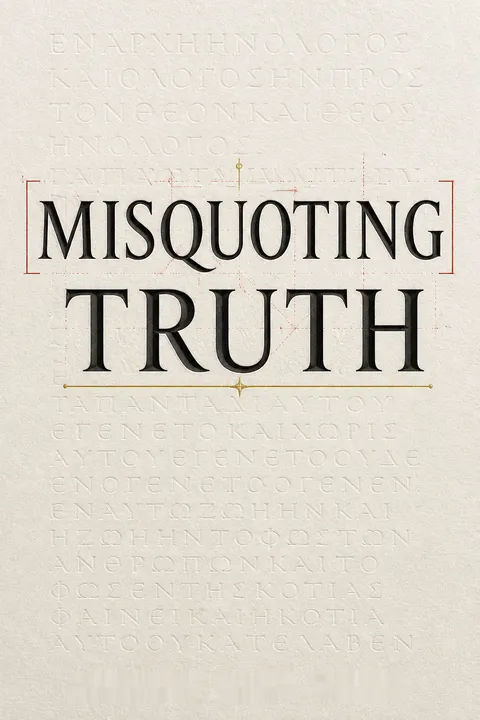
Misquoting Truth receives mixed reviews, with ratings ranging from 1 to 5 stars. Positive reviewers praise Jones' accessible writing style and his responses to Ehrman's arguments. They appreciate his balanced approach and encouragement to ask questions. Critics argue that Jones fails to adequately refute Ehrman's points and relies too heavily on faith-based reasoning. Some readers find the book's formatting distracting and its arguments unconvincing. Overall, the book is seen as a useful introduction to textual criticism for Christians, but less persuasive for skeptics.
People Also Read


Download PDF
Download EPUB
.epub digital book format is ideal for reading ebooks on phones, tablets, and e-readers.








































