
Plot Summary
Brooklyn's Web of Tension
Miles Morales, a Black and Puerto Rican teen from Brooklyn, navigates the pressures of a prestigious boarding school, Brooklyn Visions Academy, while staying rooted in his vibrant, sometimes harsh neighborhood. He feels the weight of expectations from both his family and his community, and the tension between being seen as a "troublemaker" at school and a "hero" at home. The city pulses with life, noise, and possibility, but also with the threat of being misunderstood or erased. Miles's identity is a patchwork of cultures, histories, and dreams, and he's constantly aware of how easily he could be misread by those in power. The city's energy is both a source of strength and a reminder of the obstacles he faces.
The Desk, The Floor
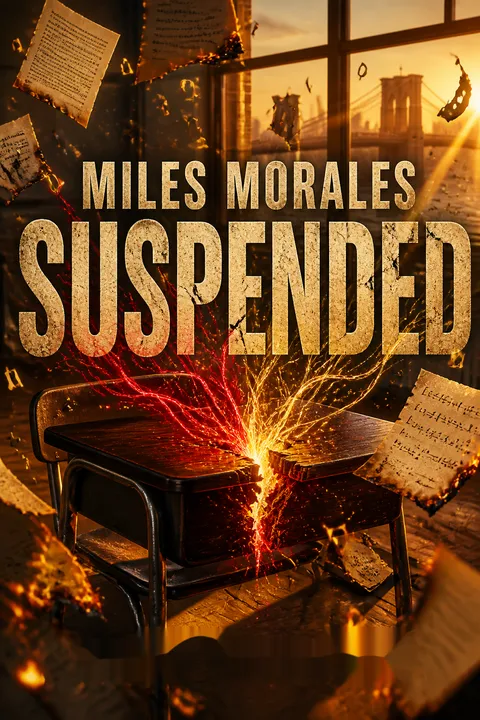
After being falsely accused of theft and enduring the racist microaggressions of his history teacher, Mr. Chamberlain, Miles reaches a breaking point. When Chamberlain orders him to sit on the floor as punishment for breaking his desk (an accident caused by his superhuman strength), Miles refuses. This act of defiance is not just about a desk—it's about dignity. The classroom becomes a battleground for respect, and Miles's refusal to be diminished sparks a chain reaction. His classmates, especially Alicia, rally behind him, chanting a manifesto of self-worth. The moment is both humiliating and empowering, setting the stage for Miles's suspension and the larger fight against systemic injustice.
Voices Against Chamberlain
Alicia Carson, Miles's classmate and crush, leads a protest against Mr. Chamberlain's racist teachings. The students' collective refusal to accept dehumanization transforms the classroom into a site of resistance. Their voices, echoing Miles's earlier stand, force the administration to respond with suspensions. The protest is both a personal and communal act, highlighting the power of solidarity in the face of institutional oppression. The cost is high—suspension, scrutiny, and the risk of being labeled "troublemakers"—but the act plants seeds of change. The students' courage reverberates beyond the classroom, challenging the school's complicity in perpetuating harmful narratives.
Family Letters and Ghosts
Miles receives a letter from Austin, a cousin he never knew existed, who is incarcerated. The letter opens old wounds about his uncle Aaron's criminal past and his father's efforts to break the cycle. Visiting Austin in jail, Miles confronts the reality of generational trauma and the thin line separating his own path from those who didn't escape. Nightmares of his uncle's voice—taunting him as a future criminal—blur the boundaries between fate and choice. Yet, the family's love and resilience offer hope. The letters and memories become both burdens and bridges, connecting Miles to a lineage of struggle and survival.
The Warden's Pipeline
Miles uncovers a sinister plot: the Warden, a centuries-old villain, manipulates teachers like Chamberlain to funnel Black and Brown students from schools to prisons. The "school-to-prison pipeline" is literalized as a monstrous conspiracy, with the Warden's minions enforcing discipline that crushes spirits and futures. Miles's battle with the Warden is both physical and symbolic—a fight against the machinery of oppression. Though he defeats the Warden, the roots of the system remain, embodied in teachers like Chamberlain who don't need supernatural control to perpetuate harm. The victory is bittersweet, revealing the depth and persistence of institutional racism.
Spidey Senses and Sausages
Miles is accused of stealing sausages from the campus store—a setup orchestrated by Chamberlain. The incident exposes how easily Black students can be criminalized for minor infractions. Miles's Spidey Sense, usually attuned to physical danger, now buzzes with the anxiety of being surveilled and misunderstood. The lack of evidence saves him from expulsion, but the experience leaves a mark. The episode underscores the precariousness of his position at school and the constant vigilance required to survive. It also sharpens his awareness of the invisible webs of power and prejudice that entangle him.
Patterns in the Walls
Miles notices strange patterns—termites, ants, and dust—infesting the school's walls and furniture. These infestations mirror the insidiousness of racism and the way harmful systems burrow into institutions. The patterns also evoke memories of family, community, and the lessons passed down through generations. Miles's reflections on patterns in nature—rivers, trees, lightning—become metaphors for inherited trauma and resilience. The walls, both literal and figurative, are alive with history, secrets, and threats. The infestation foreshadows the deeper rot within the school and the battles Miles must fight, both seen and unseen.
In-School Suspension
Assigned to In-School Suspension (ISS), Miles joins Alicia, Brad, and Tobin under the watchful eyes of Coach Holt and the guard Brewton. The ISS room is a microcosm of the school's contradictions—discipline masquerading as care, discomfort as character-building. The students, each with their own reasons for being there, form a reluctant community. The day is structured by packets of busywork, but real learning happens in the cracks: jokes, confessions, and moments of solidarity. The suspension is both a punishment and a rite of passage, forcing Miles to confront who he is and who he wants to become.
Calculus of Identity
A calculus assignment asks students to find the equations and patterns that define their lives. Miles struggles to translate his experiences—Brooklyn, family, racism, heroism—into mathematical terms. The exercise becomes a meditation on identity, inheritance, and agency. He wonders if he's destined to repeat the patterns of his father, uncle, and cousin, or if he can chart his own course. The math of his life is messy, nonlinear, and resistant to easy solutions. Yet, in wrestling with the assignment, Miles claims the right to define himself, refusing to be reduced to a variable in someone else's equation.
Chemistry of Bruises
In chemistry, Miles is asked to reflect on "green bananas"—how proximity to decay accelerates ripening. The metaphor extends to people: how environments, relationships, and histories shape who we become. Miles considers the "brown and bruised" in his life—his uncle, cousin, friends, and himself. He rejects the idea that bruises are flaws, instead seeing them as marks of survival and beauty. The lesson is both scientific and spiritual: transformation is inevitable, but not all change is loss. The chemistry of his body—altered by the spider bite—mirrors the chemistry of his soul, forged in struggle and hope.
The Book Eater
Rumors swirl that Tobin, the quiet library assistant, has been stealing and eating books. As Miles observes Tobin's strange behavior—chewing paper, attracting termites—he realizes something is deeply wrong. The destruction of books becomes a symbol for the erasure of marginalized stories and histories. Tobin, possessed by a monstrous force, embodies the threat to knowledge, memory, and resistance. The revelation that certain books—those telling Black, queer, and radical stories—are being targeted underscores the stakes of the battle. The fight for survival is also a fight for the right to tell and keep one's story.
Erasure and Vanishing Words
As the day wears on, Miles experiences hallucinations: words on his worksheets rearrange, crawl off the page, or vanish entirely. Assignments meant to foster critical thinking are twisted into tools of oppression, with questions morphing into racist taunts. The erasure of language mirrors the erasure of identity and agency. Miles's struggle to hold onto meaning becomes a metaphor for the broader struggle against forces that seek to silence, distort, or destroy marginalized voices. The battle is not just physical but epistemological—a fight over who gets to define reality.
Termites in the Foundation
The termite infestation, once a background nuisance, erupts into crisis. Chairs collapse, books disintegrate, and the very structure of the school is threatened. The termites, like racism and censorship, are everywhere—hidden, persistent, and destructive. The infestation is not just a maintenance issue but a metaphor for the rot at the heart of the institution. The battle against the termites becomes a battle for the soul of the school, and by extension, the community it serves. The crisis forces everyone to confront the consequences of neglect, denial, and complicity.
The Battle Behind the Walls
Miles is dragged behind the walls by a monstrous, termite-infested version of Tobin. In a nightmarish confrontation, Miles must use all his powers—webs, camouflage, Venom Blast—to survive. The fight is both literal and symbolic: a struggle against forces that consume, erase, and hollow out. The termites' appetite for certain books reveals a targeted attack on stories that challenge the status quo. Miles's victory is hard-won, achieved by embracing his full identity as both Spider-Man and Miles Morales. The battle leaves scars but also clears the way for healing and renewal.
Stories Worth Saving
In the aftermath, Miles and Alicia discover that the termites have destroyed books by and about marginalized people—stories that offer hope, truth, and resistance. The library, once a place of refuge, becomes a site of loss and a call to action. Mrs. Tripley, the librarian, vows to protect what remains and to rebuild. Miles and Alicia commit to starting a book drive for incarcerated youth, recognizing the power of stories to liberate minds and hearts. The fight for books becomes a fight for dignity, memory, and the future.
Harlem and Brooklyn, Together
Miles and Alicia, from different neighborhoods and histories, find common ground in their shared struggles and dreams. Their budding romance is a symbol of hope—a bridge between Harlem and Brooklyn, between past wounds and future possibilities. Their connection is forged in resistance, vulnerability, and mutual respect. Together, they imagine new ways of being, loving, and fighting for justice. The personal becomes political, and the political becomes personal, as their story intertwines with the larger struggle for liberation.
The Library's Secret War
The destruction of books is revealed as part of a broader campaign to silence dissent and erase inconvenient truths. The students, led by Miles and Alicia, organize to protect and restore the library's collection. The battle against censorship is ongoing, requiring vigilance, courage, and creativity. The library becomes a symbol of what is at stake: the right to know, to remember, and to imagine. The war over words is a war over who gets to belong, to matter, and to shape the future.
Finding the Light
As the day ends, Miles reflects on the lessons learned: the importance of standing up, the power of community, and the necessity of telling one's story. He finds solace in family, friendship, and love, and in the knowledge that even in the darkest times, there is light to be found. The scars of the day remain, but so does the resolve to keep fighting—for himself, for his community, and for all those whose stories are at risk of being lost. The journey is ongoing, but Miles is no longer alone in it.
Analysis
A modern parable of resistance, identity, and the fight for narrative survival"Miles Morales Suspended" is more than a superhero story—it's a meditation on what it means to exist, resist, and thrive as a young person of color in a world that often seeks to erase or diminish you. Jason Reynolds uses the language of comics, poetry, and magical realism to explore the intersections of race, power, and storytelling. The novel exposes the ways in which institutions—schools, prisons, libraries—can become battlegrounds for dignity and memory. Through Miles's journey, readers are invited to consider the importance of standing up for oneself and others, the necessity of preserving marginalized stories, and the transformative power of solidarity and love. The book's lessons are urgent and timeless: that survival requires both vigilance and vulnerability, that change is possible but never easy, and that every voice, every story, matters. In a world of shifting narratives and hidden dangers, finding the light—and helping others find theirs—is the ultimate act of heroism.
Review Summary
Miles Morales Suspended receives mostly positive reviews, averaging 3.81/5. Readers praise Jason Reynolds' blend of prose and poetry, meaningful commentary on censorship, book banning, and systemic racism, and authentic portrayal of Miles as a Black teenager. Many appreciate the unique structure and social themes, though some feel the Spider-Man elements are underdeveloped or feel like an afterthought. Critics note pacing issues and that it doesn't match the strength of the first book. Overall, it's widely recommended, especially for reluctant teen readers.
Characters
Miles Morales
Miles is a sixteen-year-old Black and Puerto Rican teen from Brooklyn, gifted with Spider-Man's powers but burdened by the expectations of family, community, and school. He is sensitive, introspective, and deeply aware of the injustices around him. Miles's journey is one of self-discovery—learning to balance vulnerability with strength, and individuality with solidarity. His relationships with his parents, his late uncle Aaron, and his cousin Austin shape his understanding of legacy and choice. Miles's superpowers are both a blessing and a metaphor for the extra vigilance required to survive as a young man of color in America. Over the course of the story, he grows from a boy trying to avoid trouble to a young man willing to confront it head-on, using both his voice and his webs.
Alicia Carson
Alicia is Miles's classmate, fellow protestor, and love interest. She is bold, articulate, and unafraid to challenge authority, leading the charge against Mr. Chamberlain's racism. Alicia's poetry and activism inspire Miles to find his own voice. She is both a source of comfort and a catalyst for change, embodying the power of solidarity and the importance of self-expression. Her Harlem roots and her willingness to bridge divides make her a symbol of hope and possibility. Alicia's presence in Miles's life encourages him to embrace vulnerability and to see love as an act of resistance.
Mr. Chamberlain
Chamberlain is Miles's history teacher and the story's primary antagonist. He represents the persistence of white supremacy in educational spaces, using his authority to demean, punish, and erase students of color. Chamberlain's connection to the Warden and his role in the "school-to-prison pipeline" literalize the dangers of unchecked power. He is both a product and a perpetuator of a system designed to control and exclude. Chamberlain's refusal to change, even after the Warden's defeat, underscores the depth of the problem and the need for ongoing resistance.
The Warden
The Warden is a supernatural villain who manipulates teachers and administrators to maintain the school-to-prison pipeline. He is a symbol of the deep, historical roots of systemic racism—an evil that adapts but never disappears. The Warden's power lies in his ability to control minds and institutions, turning educators into enforcers of injustice. His defeat by Miles is a victory, but not a final one, as the structures he built continue to shape lives. The Warden's legacy is a reminder that the fight against oppression is never truly over.
Ganke Lee
Ganke is Miles's Korean American best friend and roommate. He provides emotional support, practical help, and much-needed humor. Ganke is the only person who knows Miles's secret identity, and his unwavering loyalty helps Miles navigate the pressures of heroism and adolescence. Ganke's presence grounds Miles, reminding him of the importance of friendship, laughter, and staying true to oneself. He is a bridge between cultures and a model of allyship, always ready to stand by Miles in moments of crisis.
Tobin E. Rogers
Tobin is a quiet, awkward student and library assistant who becomes the vessel for the story's most surreal horror. Possessed by a monstrous force, Tobin destroys books and becomes a literal "book eater," targeting stories that challenge the status quo. His transformation into a termite-infested creature symbolizes the dangers of internalized oppression and the erasure of marginalized voices. Tobin's fate is both tragic and cautionary, illustrating how individuals can be consumed by the very systems they serve.
Austin Davis
Austin is Miles's long-lost cousin, serving time in a youth detention center. His letters to Miles open a window into the realities of the carceral system and the impact of generational trauma. Austin's story is a reminder of how easily lives can be derailed by circumstance and prejudice. He is both a cautionary tale and a source of inspiration, challenging Miles to use his privileges and powers for good. Austin's presence in the narrative deepens the exploration of family, fate, and the possibility of redemption.
Coach Holt
Coach Holt oversees In-School Suspension and coaches the boys' basketball team. She is strict but not unkind, enforcing rules while recognizing the humanity of her students. Holt's presence in ISS creates space for moments of reflection, growth, and solidarity. She represents the possibility of adults who, while complicit in flawed systems, can still offer guidance and support. Her character complicates the binary of "good" and "bad" authority, showing that change is possible, even within institutions.
Brewton
Brewton is the security guard assigned to ISS, known for his intimidating presence and strict adherence to rules. He is both a product of the school's disciplinary culture and a reminder of the constant surveillance faced by students of color. Brewton's interactions with Miles and his friends are often antagonistic, but he is also a figure of comic relief. His character highlights the ways in which authority can be both oppressive and absurd, and the importance of resisting dehumanization.
Mrs. Tripley
Mrs. Tripley is the school librarian, a gentle but determined advocate for books and students. She recognizes the power of stories to heal, inspire, and liberate. Tripley's efforts to protect the library's collection and support students like Miles and Alicia make her a quiet revolutionary. She is a model of resistance within the system, using her position to nurture curiosity, critical thinking, and hope. Her character underscores the importance of memory, knowledge, and the fight against censorship.
Plot Devices
Dual Narrative Structure
The novel weaves together Miles's internal struggles with external battles against systemic injustice. The narrative alternates between poetic introspection and action-driven scenes, mirroring the duality of Miles's life as both a regular teen and a superhero. This structure allows for a rich exploration of identity, agency, and the interplay between personal and political transformation.
Magical Realism and Surreal Horror
The story employs elements of magical realism—hallucinations, talking insects, vanishing words—to dramatize the psychological and emotional impact of racism and censorship. The infestation of termites and the transformation of Tobin into a monster literalize the insidiousness of oppression. These devices heighten the stakes and create a sense of pervasive threat, while also offering metaphors for resistance and survival.
Foreshadowing and Symbolism
The recurring motifs of webs, patterns, and infestations foreshadow the revelation of systemic rot within the school. The destruction of books and the erasure of words symbolize the ongoing battle over memory, history, and identity. These symbols invite readers to look beyond surface events and consider the deeper forces at work in shaping lives and institutions.
Intertextuality and Meta-Narrative
References to classic works (The Metamorphosis, "Girl," The Fire Next Time) and the focus on the library highlight the importance of storytelling as both weapon and shield. The novel's engagement with other texts creates a meta-narrative about the role of literature in shaping consciousness and challenging oppression. The act of reading, writing, and preserving stories becomes an act of resistance.
Manifestos and Collective Action
The use of manifestos, chants, and group protests underscores the power of collective action. These moments disrupt the narrative flow, creating space for communal voices and shared agency. The story celebrates the courage required to stand together, even in the face of punishment and backlash.
Miles Morales novels Series
About the Author
Other books by Jason Reynolds
Download PDF
Download EPUB
.epub digital book format is ideal for reading ebooks on phones, tablets, and e-readers.








































