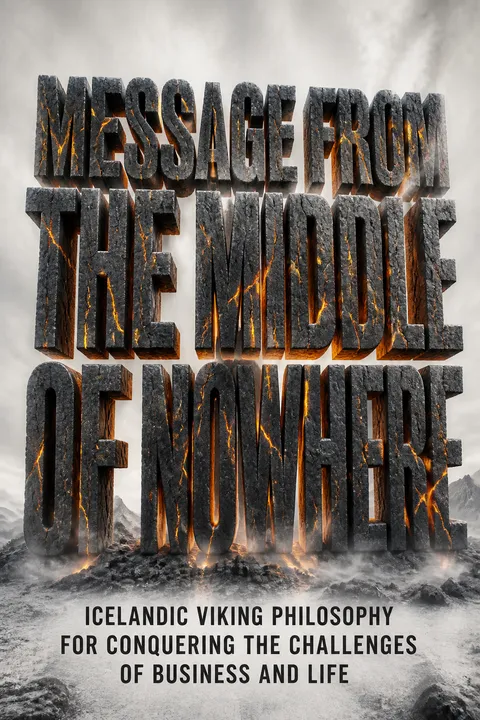


Key Takeaways
Turn every disaster into fuel with one reframe: this improves my story
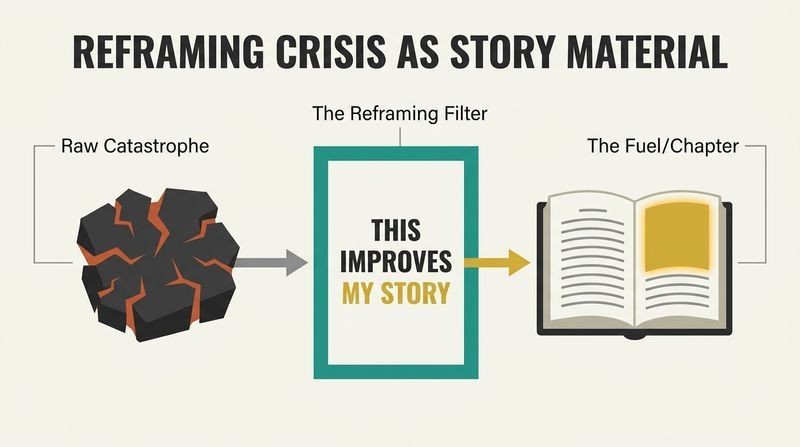
A mantra that converts pain into material. Gunnar Andri Thorisson, an Icelandic salesman who rose from poverty to become his country's best-known sales trainer, built his life philosophy on a single recurring thought: whenever he lost everything (a business, a partner, his savings), he told himself, "This will only make my book even better." It reframes catastrophe as raw content, robbing it of despair.
His life earned him the material. At six, the day after a 1973 volcanic eruption forced his relatives to flee the Westman Islands with nothing, he sold newspapers shouting the eruption headline. He later survived being trapped between two avalanches in a book-filled van, lost a fiancee and a company in Greece the same week, and watched Iceland's 2008 crash erase his consulting income overnight. Each collapse became a chapter.
The reframe echoes Viktor Frankl's logotherapy: suffering becomes bearable the moment it acquires meaning. It also anticipates "benefit finding" and post-traumatic growth research, which shows narrative reconstruction predicts resilience better than the severity of the trauma itself. The subtle risk is that treating every wound as "content" can become emotional bypassing, a way to skip grief rather than process it. Thorisson mostly avoids this because he pairs the mantra with action, not just optimism. The device works best as a bridge from shock to agency, not as a substitute for actually feeling the loss.
Positive thinking without a map leaves you a motivated fool
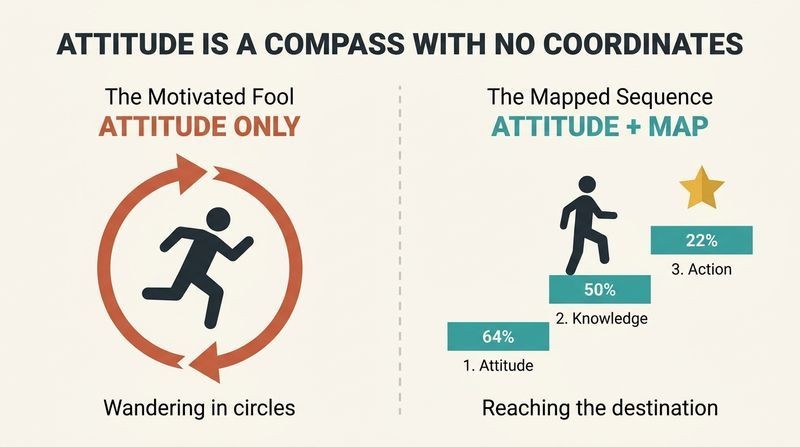
Attitude alone is a compass with no coordinates. At seventeen, Thorisson landed his dream sales job hawking a bakery's products. He was thrilled, confident, and utterly positive. He sold nothing. The prices were fine and customers liked the products, yet he didn't know the rules of the game. He coined the term "motivated fool": someone brimming with enthusiasm but lost, like a tourist wandering Reykjavik in circles with no map.
His fix was a three-part sequence:
1. Get the right attitude.
2. Acquire the right knowledge (books, courses, seminars).
3. Take action without fearing failure.
He called this "mapping." You first decide what you want, then seek the education to get there, then chart the route. He devoured Tom Hopkins, Brian Tracy, and Zig Ziglar, turning his car into a "traveling university" of cassette tapes.
This is a pointed corrective to the law-of-attraction genre Thorisson openly critiques, noting that The Secret forgot the word WORK. Modern research supports him: Gabriele Oettingen's studies on "positive fantasies" found that vividly imagining success actually drains the energy needed to achieve it, because the brain treats the fantasy as partial completion. Her WOOP method (Wish, Outcome, Obstacle, Plan) mirrors his mapping almost exactly, pairing desire with concrete obstacle planning. The insight that skill is learnable, not innate, also aligns with Carol Dweck's growth mindset and Anders Ericsson's deliberate practice work.
Count your noes and you turn rejection into a paycheck
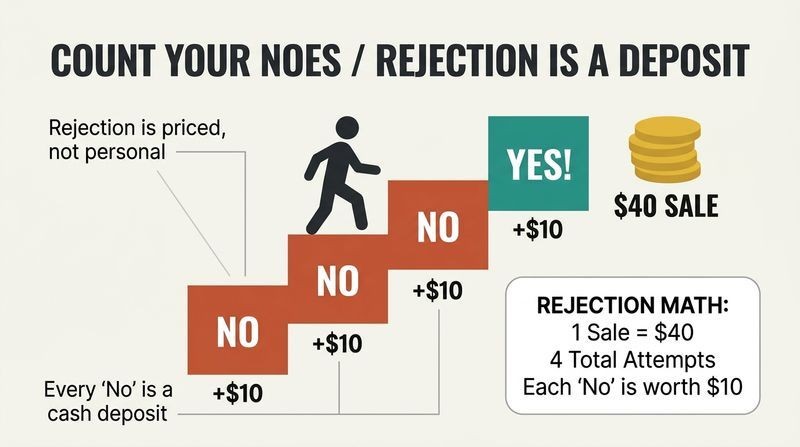
Rejection is priced, not personal. Door-to-door book selling across Iceland taught Thorisson that knocking cold gets a no 80 to 90% of the time. But if you get people talking, the odds flip: closing becomes 80 to 90% likely. A veteran colleague once tallied his rejections on a two-week trip: 4,384 noes, yet over 40,000 dollars in sales. The lesson: the noes don't matter, only the yeses count.
His mental trick was to divide total earnings by the number of noes, calculating how much he got paid per rejection. Each no became a small deposit toward the inevitable yes. Children, he notes, are the best salespeople precisely because they never take no personally, they are honest, they wait for the right moment, and they never quit.
This is a folk version of what sales scientists call the "funnel metric" and what behavioral economists frame as expected-value thinking. Reframing rejection as a countable, paid transaction is a documented defense against the emotional sting that causes salespeople to quit. Psychologist Albert Ellis built an entire therapy (REBT) around desensitizing people to rejection through repeated exposure, deliberately seeking noes. Where Thorisson may overstate: not all noes are equal, and treating them as interchangeable currency can blind a seller to qualifying leads better and wasting fewer knocks. Still, for combating call reluctance, the arithmetic reframe is genuinely powerful.
Sell only what you'd genuinely recommend, and speak from the heart
Authentic conviction outsells slick technique. On his first night selling books, Thorisson sold nothing. The next night he broke the company's sales record. What changed? He stopped pushing everything and started selling the books he had actually read and loved, like the Icelandic Sagas, talking about them with real enthusiasm. People buy the person before they buy the product; they must first "buy into you" as a human being, trust you, and like you.
He reinforced this with honesty as strategy. A Greek sales veteran he studied under once praised, rather than punished, a salesman who admitted doing zero presentations that week, holding him up as a model of truth-telling. The next week that same man topped the leaderboard. Dishonesty spreads fast; a reputation for it would have ended Thorisson's 20-year training career.
The claim that "people buy people" is well supported by trust research: Amy Cuddy's work shows we judge others first on warmth (trustworthiness), then competence, and warmth carries more weight in initial encounters. Selling from genuine belief also reduces the cognitive load of deception, which is why authentic sellers appear more relaxed and congruent. There is a scope limit worth naming: heartfelt passion sells well for products you can love, but plenty of commerce involves commoditized goods nobody feels poetic about. There, process and consistency matter more than passion. Thorisson's own toilet-paper anecdote (winning on price-per-weight math) shows even he knows logic sometimes closes the deal.
Write your goal down, attach a fierce why, and break it into days
A burning reason makes the method appear. Facing a shrinking market where selling four vacuum cleaners a month was considered decent, Thorisson set a goal of 52 sales so he could move to Greece with his girlfriend and baby. Colleagues laughed; one bet him a bottle of champagne he couldn't hit fifteen. He deliberately targeted the towns everyone called hopeless and hit 52 easily, once selling fourteen in a single week.
His goal formula:
1. Feel burning passion, force like an erupting volcano.
2. Convince yourself it's possible (his "Fight Between Fire and Ice," fire being conviction, ice being self-doubt).
3. Write it down, read it aloud repeatedly, and promise someone close to you.
He tracked each sale on a physical deck of cards, removing one per customer. He insists on short horizons: months, weeks, days, hours, never distant long-term goals.
Goal-setting theory (Locke and Latham) confirms that specific, difficult, written goals outperform vague "do your best" intentions, and public commitment boosts follow-through via accountability. The emphasis on WHY over HOW aligns with Simon Sinek and with self-determination theory: intrinsically meaningful goals sustain effort longer than externally imposed ones. His tactile card deck is a clever instance of what habit researchers call progress visualization, the same mechanism behind Seinfeld's "don't break the chain." One caution: his dismissal of long-term goals overstates. Research suggests distant vision plus proximal sub-goals works best. He effectively does both, using Greece as the far star and daily sales as the steps.
Spend on learning, not entertainment: the EvE ratio predicts who wins
Most people invert the ratio that matters. Thorisson cites the EvE Ratio (Education versus Entertainment), the observation that the average person pours roughly 100 hours and dollars into entertainment (TV, social media, coffee houses) for every single hour spent on self-education. He considers this a slow-motion disaster, because "if you're not getting better, you're getting worse", there is no status quo.
He practiced what he preached obsessively. He listened to a six-cassette Brian Tracy seminar three times in a row (18 straight hours), converted his commute into a rolling classroom, and read books with two passes: pencil underlining on the first read, highlighter on the second for what must be permanently remembered. He never lends books, because the good ones never come back. His core belief, borrowed from Brian Tracy: all skills are learnable.
The EvE framing is memorable even if the exact 100-to-1 figure is anecdotal rather than measured. The underlying claim tracks Malcolm Gladwell's popularization of deliberate practice and the well-documented "self-education" habits of high performers (Warren Buffett's reading, for instance). His two-pass annotation method resembles what learning scientists call elaborative encoding and retrieval practice, active engagement beats passive consumption for retention. The sharper modern nuance: not all "entertainment" is waste, and not all "education" content builds skill; endless podcast consumption can become its own passive trap. The real variable is active application, doing the reps, which Thorisson supplies through relentless practice, not just intake.
The giant blocking your path shrinks when you recruit a troll
Don't fight bigger rivals alone, borrow strength. As a six-year-old paperboy, Thorisson wanted the profitable corner monopolized by Oli "The Newspaper King," who threatened to call the police. Rather than surrender or fight directly, the boy befriended a giant Salvation Army collector nearby, offered him a cut of the earnings for protection, and returned with his "troll." Oli's threats evaporated; both sold their papers in peace. Thorisson soon out-sold even the King.
The principle: no one is bigger than you, and asking for reinforcement is a strength, not a weakness. Successful people, he insists, are usually willing to share what they know; the only thing blocking you is the fear of asking, the same fear of no that stops most sales. He repeated this pattern his whole career, from studying and imitating top salesmen to building teams.
The childhood fable dresses up a serious strategic principle: coalition-building beats solo confrontation against a dominant incumbent. Business strategists call this leveraging complementary assets or forming alliances to neutralize a stronger competitor's advantage. Game theory frames it as changing the players rather than the game. There is also an emotional-intelligence layer: Thorisson turned a zero-sum territorial fight into a positive-sum arrangement where the collector, the boy, and even the charity all won. The one nuance worth flagging is that alliances require something to offer in return (he gave a percentage). Recruiting reinforcement isn't free; it's an exchange, and knowing your tradeable value is the prerequisite.
No one can offend you without your permission
Your reaction, not the insult, is the real variable. Selling in a Reykjavik apartment block, Thorisson was shoved into an elevator by a furious tenant who scattered his books and sent him down. Rather than flee, he rode back up, ready to confront the man. But when the door opened, the tenant broke down in tears: he had just learned of a death in the family minutes before the knock. The rage dissolved into shame and mutual understanding, and they parted as friends.
The episode crystallized two rules. First, you can never know what private battle another person is fighting, so withhold judgment. Second, offense requires your consent; from that day he refused to let anyone injure his self-respect. His old sales manager's warning framed it: the day you lose your self-respect, quit the business.
This is Stoicism in Viking dress. Epictetus argued that we are disturbed not by events but by our judgments about them, and Marcus Aurelius practiced imagining the hidden burdens of those who wrong us, precisely the empathy Thorisson stumbled into. Modern cognitive behavioral therapy operationalizes the same move: an insult is an activating event, but the emotional consequence flows through your interpretation. The nuance worth adding: "no one can offend you without permission" can curdle into victim-blaming or emotional suppression if pushed too far. The healthier reading, and the one the story supports, is not numbness but reappraisal plus curiosity about the other person's context.
Everyone is selling constantly; the only question is how good you are
Sales is a life skill disguised as a job. Thorisson's central thesis is that selling is not a niche profession but the water everyone swims in. Parents sell ideas to children, coaches sell belief to teams, politicians sell promises, and every social media post is an attempt to get others "sold" on your message. The only difference between people is how skilled they are at drawing out one small word: yes.
He watched Icelanders resist this idea for years (asking why he didn't get a "real job"), then watched the culture come around. His own self-awarded credential mocks the snobbery: he calls himself a P.D.T.D.S., a Professional Door-To-Door Salesman, and once printed it under his name in a full-page newspaper ad. His point: a credentialed person who stops self-improving is worth less than an uneducated one who never stops.
Daniel Pink made the identical argument in To Sell Is Human, citing data that roughly 40% of non-sales work time is spent in "non-sales selling": persuading, influencing, moving others. Thorisson arrived there through street experience rather than survey data, which lends it credibility. The reframe is genuinely useful because it removes the stigma that makes people bad at persuasion by making them ashamed of it. The counterpoint: framing literally everything as "selling" can flatten important distinctions between manipulation, genuine service, and collaboration. Thorisson guards against this with his relentless honesty rule, which is what separates persuasion-as-service from persuasion-as-exploitation.
Price is emotional, so defend your value instead of apologizing for it
What one client calls expensive, another calls cheap. A traveling salesman once walked into the grocery store where a teenage Thorisson worked, got told his toilet paper cost too much, and silently slammed a roll on the meat scale. It weighed far more than the standard roll. The manager placed a large order on the spot. Price is not an objective fact; it is only a measure of how much a client values what you offer.
Thorisson applied this when raising his own training fees, arguing that value and built-in knowledge matter more than time spent. Would you prefer a dentist who pulls a tooth in an hour or one who does it painlessly in minutes? He would rather justify a high price upfront than make excuses for cheap work later, quoting Red Adair: if you think hiring a professional is expensive, wait until you hire an amateur.
Behavioral economics validates his "price is emotional" claim through anchoring and reference-point effects: the same number feels expensive or cheap depending entirely on what it's compared against. The toilet-paper demonstration is a textbook value reframe, shifting the anchor from unit price to price-per-performance. Value-based pricing (charging for outcome rather than hours) is now standard advice in consulting and SaaS, and Thorisson intuited it decades early. The honest limitation: this logic can also rationalize overcharging, and "you get what you pay for" is not always true, plenty of expensive things are merely expensive. The safeguard is his insistence that the value must actually be delivered.
Break a first impression into words, voice, and body, then win all three
People decide about you in a heartbeat. Thorisson's five-step sales process opens with the first impression because judgments form instantly and are hard to reverse. He leans on Albert Mehrabian's often-cited breakdown of face-to-face communication: roughly 7% words, 38% tone of voice, and 55% body language. The practical upshot: what you say matters less than how you say it and how you carry yourself, which is why attire (covering about 90% of your body) signals who you are.
His full sequence:
1. First impression (be a welcome guest, ask open questions).
2. Analyze the need (selling is listening and asking, not telling).
3. Handle objections and close ("I'll think about it" means "I'm not yet convinced").
4. Say goodbye well (the last words are what people remember).
5. Follow up after the sale to build a lasting relationship.
A necessary correction: the Mehrabian 7-38-55 figures are among the most misquoted statistics in business. Mehrabian's experiments measured only how people resolve contradictory signals about feelings and attitudes, not all communication, and he himself warned against generalizing them. The deeper truth Thorisson is reaching for survives the bad number: nonverbal congruence and tone heavily shape trust in emotionally charged moments. His objection-handling insight is the sharpest part: treating "I'll think about it" as a diagnostic question rather than a rejection, then going silent so the client names the real obstacle, mirrors modern consultative selling and negotiation tactics like calibrated questions in Chris Voss's work.
When one door slams, work the drawer you shelved for later
Recovery favors those who kept options ready. After Iceland's 2008 banking collapse, Thorisson went, in his words, from ON to OFF; his high-end consulting income and receivables vanished overnight. Rather than sulk, he pulled a coupon website (2fyrir1.is) out of his "bottom drawer," a venture he had bought months earlier when everyone said Icelanders would never use coupons. In a suddenly cash-strapped nation, it thrived, growing to 44,000 registered users.
The pattern repeats across his life: a fortune-teller, a squeaky-shoe heckler named Bjarki, and even a cheating card game (which sent him to buy the scratch ticket that won a Europe trip) all became doorways. His stance: opportunities often arrive disguised as problems, when you hit bottom the only way is up, and it's fine to rest but never to quit. Iceland's own volcano-driven tourism boom after the 2010 Eyjafjallajokull eruption proved disaster and windfall are often the same event.
This is antifragility in practice, Nassim Taleb's concept of systems that gain from disorder, embodied by someone who kept dormant side ventures ready to activate when his main income failed. Entrepreneurship research calls this "effectuation": rather than predicting the future, resourceful founders assemble what's at hand and pivot as conditions shift. His coupon-site timing also illustrates counter-cyclical positioning, discount services boom precisely when discretionary income contracts. The honest caveat is survivorship bias: for every shelved side project that becomes salvation, many stay dead in the drawer, and we rarely hear those stories. The durable lesson is optionality: keep small bets alive so at least one can catch you when the main structure falls.
Analysis
This is a story-driven business memoir dressed in Norse mythology, a genre hybrid that is both its charm and its challenge to summarize. Thorisson braids three strands: an autobiography of a poor Reykjavik boy turned self-made sales trainer, a practical sales manual, and a love letter to Icelandic culture (trolls, elves, volcanoes, the sagas). The difficulty is that the actionable content is scattered through anecdote and buried under end-of-chapter "Messages" lists that repeat and sometimes contradict in emphasis. The intellectual core, however, is coherent and surprisingly rigorous for a book that also discusses ghost visitations and fortune-tellers.
The philosophy reduces to a tight loop: attitude plus knowledge plus fearless action, sustained by relentless self-education and honesty. What distinguishes it from generic motivation literature is the geographic determinism Thorisson embraces. He argues that Iceland's harsh, unpredictable environment (weather that changes in fifteen minutes, avalanches, eruptions, a market of only 330,000 people) forged adaptability, resilience, and comfort with existential risk. "The middle of nowhere" is reframed from limitation into training ground, a genuinely original organizing metaphor.
The weakest link is epistemological inconsistency. Thorisson praises hard data and rejects The Secret's magical thinking, yet credits a fortune-teller and telepathic dreams with real predictive power. He wants both the Viking rationalist's sword and the folklore believer's runes. Readers should extract the operational wisdom (funnel math on rejection, value-based pricing, coalition-building, optionality through side ventures) while treating the mysticism as cultural texture rather than method.
What gives the book lasting value is its lived credibility. These are not hypothetical scenarios but a man who literally survived two avalanches in a book-laden van, sold vacuum cleaners door to door until he vomited from exhaustion to fund a Greek adventure, and rebuilt after losing everything more than once. The recurring mantra, that every catastrophe merely improves the story, transforms an ordinary sales guide into a meditation on turning adversity into narrative capital.
Review Summary
Message From The Middle Of Nowhere received mostly positive reviews, with readers praising its inspirational and motivational content. Many appreciated the author's personal journey, from selling newspapers as a child to becoming a successful salesman in Iceland. The book was lauded for its blend of sales advice, life lessons, and Icelandic culture. Readers found the writing style engaging and the lessons applicable to both business and personal growth. Some particularly enjoyed the Viking philosophy and practical sales tips included throughout the book.
FAQ
What's "Message From The Middle Of Nowhere" about?
- Icelandic Viking Philosophy: The book explores Icelandic Viking philosophy and how it can be applied to conquer challenges in business and life.
- Personal Experiences: Gunnar Andri Thorisson shares his personal journey from growing up in poverty in Iceland to becoming a renowned salesman and sales trainer.
- Unique Stories: The narrative intertwines life lessons with stories of trolls, Vikings, and natural disasters, offering a unique perspective on personal and professional growth.
- Sales and Life Lessons: It provides insights into sales techniques and life strategies, emphasizing resilience, honesty, and the power of storytelling.
Why should I read "Message From The Middle Of Nowhere"?
- Inspiration and Motivation: The book offers motivational stories and lessons that can inspire readers to overcome their own challenges.
- Practical Sales Advice: It provides practical advice on sales and communication, useful for anyone looking to improve their business skills.
- Cultural Insights: Readers gain insights into Icelandic culture and philosophy, which are woven into the author's personal and professional experiences.
- Unique Perspective: The blend of personal anecdotes with business lessons offers a fresh and engaging approach to self-help and professional development.
What are the key takeaways of "Message From The Middle Of Nowhere"?
- Resilience and Adaptability: The importance of resilience in the face of adversity and the ability to adapt to changing circumstances.
- Honesty and Integrity: The value of honesty in business and personal relationships, and how it leads to long-term success.
- Continuous Learning: The necessity of lifelong learning and self-improvement to achieve personal and professional goals.
- Cultural Wisdom: The application of Icelandic cultural wisdom and Viking philosophy to modern business practices.
How does Gunnar Andri Thorisson apply Icelandic Viking philosophy to business?
- Facing Fears: Emphasizes facing fears head-on, much like the Vikings did, to overcome obstacles in business and life.
- Strategic Thinking: Uses Viking strategic thinking to plan and execute business strategies effectively.
- Community and Support: Highlights the importance of community and support, drawing parallels to Viking societal structures.
- Resilience and Strength: Encourages building resilience and inner strength, akin to the Viking spirit, to navigate challenges.
What are the best quotes from "Message From The Middle Of Nowhere" and what do they mean?
- "WORK is the magic word." This emphasizes the importance of hard work and effort in achieving success.
- "If you don’t ask, the answer will always be no." Encourages taking initiative and being proactive in seeking opportunities.
- "First we make habits and then the habits become us." Highlights the power of habits in shaping our lives and outcomes.
- "The giant in your path can turn into a gnome if you have a troll on your side." Suggests that challenges can be overcome with the right support and mindset.
What is the significance of the Vegvísir symbol on the cover?
- Guidance and Direction: The Vegvísir is an Icelandic magical stave intended to help people find their right path, symbolizing guidance and direction.
- Cultural Heritage: It reflects the book's connection to Icelandic culture and the author's heritage.
- Metaphorical Meaning: Represents the journey of life and the importance of staying on course despite challenges.
- Personal Journey: Ties into the author's personal journey of finding his path in life and business.
How does Gunnar Andri Thorisson's personal story enhance the book's message?
- Authenticity and Relatability: His personal experiences add authenticity and make the lessons relatable to readers.
- Overcoming Adversity: His journey from poverty to success exemplifies the book's themes of resilience and perseverance.
- Cultural Context: Provides a cultural context that enriches the narrative and offers unique insights.
- Inspiration: His story serves as an inspiration for readers to pursue their own goals despite obstacles.
What sales techniques does Gunnar Andri Thorisson recommend?
- Building Relationships: Emphasizes the importance of building genuine relationships with clients.
- Listening and Understanding: Advocates for listening to clients' needs and understanding their perspectives.
- Honesty and Transparency: Stresses the importance of honesty and transparency in sales interactions.
- Continuous Improvement: Encourages continuous learning and improvement in sales skills and strategies.
How does the book address the concept of failure?
- Learning from Mistakes: Encourages viewing failures as learning opportunities and stepping stones to success.
- Resilience: Highlights the importance of resilience in bouncing back from setbacks.
- Positive Mindset: Promotes maintaining a positive mindset and using failures to fuel future success.
- Personal Growth: Suggests that failures contribute to personal growth and development.
What role does Icelandic culture play in the book?
- Cultural Wisdom: Icelandic cultural wisdom and folklore are woven into the narrative, providing unique insights.
- Philosophical Approach: The book uses Icelandic philosophy to offer a different perspective on business and life challenges.
- Cultural Stories: Includes stories of trolls, Vikings, and natural disasters to illustrate life lessons.
- Heritage and Identity: Reflects the author's heritage and identity, enriching the book's message.
How does "Message From The Middle Of Nowhere" blend storytelling with business advice?
- Engaging Narrative: Uses engaging storytelling to convey business advice and life lessons.
- Personal Anecdotes: Personal anecdotes are used to illustrate key concepts and make them relatable.
- Cultural Elements: Incorporates cultural elements to provide a unique perspective on business strategies.
- Practical Lessons: Blends practical business lessons with entertaining stories for a comprehensive approach.
What is the overall message of "Message From The Middle Of Nowhere"?
- Resilience and Perseverance: The importance of resilience and perseverance in achieving success.
- Cultural Wisdom: The value of cultural wisdom and philosophy in navigating life's challenges.
- Continuous Growth: The necessity of continuous growth and learning for personal and professional development.
- Honesty and Integrity: The role of honesty and integrity in building lasting relationships and achieving long-term success.
Download PDF
Download EPUB
.epub digital book format is ideal for reading ebooks on phones, tablets, and e-readers.








































