
Key Takeaways
1. Unlock Your Memory Superpowers: Forget Limiting Beliefs & Embrace Core Tools
Memory is a skill that you can improve just like playing the piano, ice-skating, or painting (and is actually probably easier to do than all of those other things).
Shatter old myths. Many believe a bad memory is innate, a fixed trait you're born with, or that the brain can "fill up" like a parking garage. These are false and hinder your potential. Your brain is an unlimited, ever-growing spiderweb of connections, and memory is a skill, not a gift, that anyone can train and improve. Embrace this truth to unlock your true memorization potential.
The SEE-LINK-GO! framework. To transform your memory, you need three fundamental "mind tools." First, SEE everything you want to remember as a vivid mental picture, no matter how outrageous. Second, LINK this picture to something you already know, creating an accessible mental "folder" for retrieval. Third, GO! by making the linked image unforgettable through exaggeration, humor, senses, movement, weirdness, or even grossness, ensuring it sticks like superglue.
Cultivate a positive mindset. Beyond the tools, success hinges on trust, attention, and fun. Trust your memory's capacity, knowing it will fight back if doubted. Practice unwavering attention and focus, eliminating distractions to be fully present in the moment of learning. Most importantly, approach memorization as a fun, silly game—it's a superpower that makes learning enjoyable and effortless.
2. Master Lists with the Story Method: Link Images in a Vivid Narrative
The way it works is, you take all the images you create from your SEE tool, then you connect them all in a story, where one picture connects—or LINKs—to the next, and the next one connects to the next, and so on, creating a long chain of images.
Chain of images. The Story Method is a quick and easy way to memorize lists by creating a fantastical narrative where each item in the list is an image that directly interacts with the next. Imagine a washing machine filled with apples, then a chef dressed as the Mad Hatter, then a man rowing—each image flows into the next, forming an unbroken chain. This method ensures that recalling one item naturally triggers the memory of the next.
Sequential recall. This technique is ideal for remembering ordered lists, such as grocery items, to-do lists, or historical sequences. By visualizing the story from beginning to end, you can effortlessly recall each item in its correct order. The more bizarre and sensory-rich your story, the stronger the links and the easier it is to retrieve the information.
Real-world application. Our adventure down the river, for instance, secretly helped us memorize the first fifteen U.S. presidents. Each element of the story—from the "WASHING MACHINE" (Washington) to the "BOOK-CANNON" (Buchanan)—was a mnemonic image for a president's name. This demonstrates how the Story Method transforms abstract information into a memorable, engaging sequence, making learning both effective and entertaining.
3. Conquer Names and Faces: Transform Foreign Words into Memorable Pictures
Names are sort of their own language of weird, foreign words. When you meet a person, they tell you that strange word that is their name and you’re expected to remember it.
Names are abstract. We often struggle with names because they lack inherent meaning, much like foreign words. To make a name memorable, you must first give it a concrete, visual representation. This involves using the SEE tool to transform the name into a picture that either rhymes with it, sounds like another word, or reminds you of someone or something familiar.
Link to a unique feature. Once you have a mental picture for the name, the next crucial step is to LINK it to a distinctive feature on the person's face. This could be anything that immediately stands out—a prominent nose, a unique hairstyle, freckles, or a particular smile. This facial feature becomes your "anchor point," ensuring that every time you see the person, your linked image for their name is instantly triggered.
Amplify with GO! and review. Finally, apply the GO! tool by making the linked image as bizarre, exaggerated, and sensory-rich as possible. Imagine a "wiggly candlewick" (Wickley) burning in a guard's "scraggly beard." To cement the name, use it aloud in conversation immediately after learning it, asking questions or making comments that incorporate their name. This active recall reinforces the memory, making it stick for the long term.
4. Decode Words and Facts: Visualize Spelling, Definitions, and Foreign Languages
Take the word you’re looking at and come up with a mental picture for it. Then, take the other word, spelling rule, definition, or whatever it is that the original word represents and come up with a picture for that, too. Then link them together in a fun and memorable way.
Visualize the abstract. Whether it's a tricky spelling, a complex vocabulary definition, a foreign word, or a country's capital, the core strategy remains the same: convert abstract information into vivid mental pictures. For spelling, embed the difficult part of the word into a memorable scene, like imagining "a rat" trying to "SEPARATE" the letters in the word "separate."
Simplify definitions. For vocabulary, create an image for the word itself and another for its simplified definition, then link them. For "EVIDENT" (sounds like "heavy dent"), which means "obvious," picture a car with a "heavy dent" that is "SO obvious" everyone notices. This breaks down complex meanings into digestible, visual components.
Bridge language barriers. Foreign words become accessible by finding an English sound-alike and linking it to the word's meaning. "CHOU" (shoe), meaning "cabbage," can be remembered by picturing a "shoe stomping on a cabbage." Similarly, for states and capitals, link a visual for the state to a visual for its capital, like a "doll wearing" (Delaware) a "dove" (Dover). This method makes learning diverse facts engaging and efficient.
5. Organize Information with the Peg Method: Anchor Data to Familiar Lists
The method is called THE PEG METHOD. THE PEG METHOD is another memory technique that allows you to keep the order of a list of things you want to memorize.
Anchoring to known sequences. The Peg Method is a powerful technique for memorizing ordered lists by "pegging" new information onto a pre-memorized sequence you already know, such as the alphabet or numbers. Each item in your known sequence (the "peg") becomes a mental hook for a new piece of information. This allows for both forward and backward recall, and even jumping to specific items in the list.
Alphabetical pegs. Our encounter with Peg the Pirate demonstrated this by linking each letter of the alphabet to a bizarre animal, which in turn represented an element from the periodic table. For example, an "Alligator with a fire hydrant" (Hydrogen) for 'A', or a "bear holding a helium balloon" (Helium) for 'B'. This system transforms a daunting list into an engaging, interactive mental exercise.
Versatile peg lists. The beauty of the Peg Method is its flexibility; your peg list can be anything you know well. While the alphabet is a common choice, you could create peg lists using numbers, foods, sports teams, or any other ordered category. For short-term memorization, you can reuse peg lists, but for information you want to retain permanently, it's best to create a dedicated, unique peg list to avoid confusion.
6. Build a Mind Palace: Leverage Your Brain's Spatial Superpower for Vast Information
This method is so powerful for one simple reason: Our brains are hardwired for it! We remember pictures and information about places and locations better than any other kind of information.
Ancient wisdom, modern power. Originating thousands of years ago with the ancient Greeks, the Memory Palace (or Mind Palace) is the most powerful memory technique. It involves imagining a familiar place—your house, school, or even a video game map—and creating a mental path through it. Along this path, you designate "anchor points" (rooms, furniture, landmarks) where you LINK the images of the things you want to memorize.
Spatial memory advantage. Our brains are exceptionally adept at remembering places and spatial relationships. By converting abstract information into vivid images and placing them within a familiar mental landscape, you're leveraging your brain's natural strengths. This makes vast amounts of information, like a deck of cards or thousands of digits, incredibly easy to store and retrieve in perfect order.
Layering information. The Memory Palace allows for incredible depth. You can place an image for a country on an anchor point, then add a small detail to that image to represent its capital. For example, on your "head" (anchor point) you place the "Great Wall of China" (China), and then add a "beige ring" (Beijing) to the wall. This layering enables you to store multiple layers of related information within a single, organized structure.
7. Befriend Numbers: Convert Digits into Memorable Shapes, Rhymes, and Words
Numbers are symbols. And symbols don’t mean much to people. That’s why people don’t have good number sense—that’s why numbers aren’t friendly!
Give numbers meaning. Numbers are inherently abstract symbols, making them difficult to remember. To overcome this, you must transform them into concrete, meaningful images. The Number-Rhyme System (e.g., 1=bun, 2=shoe) and the Number-Shape System (e.g., 1=stick, 2=swan) provide quick, single-digit images. These systems make numbers "friendly" by giving them visual identities, allowing you to SEE any digit.
Chunking for efficiency. For longer numbers, relying on single-digit images can become cumbersome. The solution is "chunking"—breaking large numbers into smaller, manageable groups. These chunks can then be converted into words or images and linked using methods like the Story Method or a Memory Palace. For example, the year 1066 (Battle of Hastings) can be visualized as a "pencil" (1), "orange" (0), "golf club" (6), "golf club" (6).
The Major System for mastery. For ultimate number memorization, the Major System is unparalleled. It assigns a unique consonant sound to each digit (e.g., 1=T/D, 2=N, 3=M). By combining these consonant sounds and adding vowels, you can convert any sequence of digits into memorable words. For instance, 86 becomes "FISH" (F=8, SH=6). Pre-learning images for all two-digit combinations (00-99) allows you to convert any number, no matter its length, into a series of easily memorized words, making you a true number genius.
8. Memorize Text Word-for-Word: Use First Letters and Memory Palaces for Speeches
The best way to memorize word for word is to use a memory palace to LINK (it’s the safest and most secure, in my opinion), and to put a few words at a time on each anchor.
Instant recall with First Letters. For short texts, the First Letter Method offers astonishingly fast memorization. Simply read the sentence, then write down only the first letter of each word (including punctuation). When you read this abbreviated version, your brain will magically fill in the complete words, allowing you to recite the sentence perfectly. This technique highlights your brain's incredible ability to reconstruct information with minimal cues.
Strategic text breakdown. For longer passages, like poems or speeches, a word-for-word approach is often necessary. Start by reading the text multiple times to grasp its meaning, flow, and structure. Then, break the text into manageable phrases or sentences. Instead of memorizing every single word, focus on the key words and concepts, using preset images for common "filler" words (e.g., a circle for "and," a square for "or") to streamline the process.
Memory Palace for structure. The most reliable method for word-for-word memorization is to use a Memory Palace. Assign each phrase or chunk of text to an anchor point within your chosen palace. Create vivid, interactive images for these phrases and link them to their respective locations. This spatial organization provides a robust framework, ensuring you can navigate the text sequentially and recall every word, even under pressure, making rote memorization obsolete.
9. Tackle Equations and Passwords: Visualize Symbols and Chunk Information
Memorizing something and understanding something isn’t always the same thing. Remember, all the techniques I’m showing you are designed to help you memorize faster; to get information in your brain faster.
Equations as visual stories. Mathematical equations, filled with abstract symbols and numbers, can be daunting. Apply the SEE-LINK-GO! framework by creating images for each component. For letters, use images related to their meaning (e.g., 'V' for volume could be a "volume knob"). For symbols, create a quick, intuitive image (e.g., 'π' as a "pizza pie," '/' as a "samurai sword"). Then, string these images together in a mini-story, linking the left and right sides of the equation.
Password construction. Complicated passwords, a mix of letters, numbers, and symbols, are perfect candidates for these techniques. Assign a unique image to each character: a capital 'L' could be a "Lamborghini," '65' could be "JAIL" using the Major System, '!' could be a "baseball bat," and '@' could be "EMAIL." Link these images sequentially using the Story Method.
Context is key. The most crucial step for both equations and passwords is to LINK the entire memorized sequence to what it represents. For an equation, link the story to the concept it defines (e.g., a "cone-shaped volume knob" on the equation's radio). For a password, link its story to the account it unlocks (e.g., the password story unfolding on a "huge bank vault"). This ensures you not only remember the information but also its vital context.
10. Sustain Your Memory: Review, Focus, and Nurture Your Brain
To keep all these things you want to memorize in your head forever, you’ll need to do something that isn’t always enjoyable. But you must. And that is: review.
The power of review. While memory techniques help you quickly encode information, long-term retention requires consistent review. Your brain is designed to forget over time, so regular mental "rehearsals" are essential. Reviewing doesn't have to be tedious; if you've used SEE-LINK-GO! effectively, it simply means thinking about your vivid mental images from time to time. Spaced repetition, where review intervals gradually increase, is highly effective for cementing memories.
Mastering attention. Many memory lapses stem from a lack of attention. Cultivate mindfulness by being present and focused in the moment. Simple strategies can combat common forgetfulness:
- Names: Consciously tell yourself, "I want to remember this name."
- Misplaced items: Perform a bizarre action or sound when placing an item.
- Tasks: Use the "Throw the Pen Method" by tossing an object to trigger a morning reminder.
- Walking into a room: Return to the previous room to jog your memory.
Holistic brain health. Beyond techniques, a sharp memory is supported by overall well-being. Prioritize adequate sleep (8+ hours), as it's crucial for focus and memory consolidation. Fuel your brain with healthy foods like fish and blueberries, avoiding excessive sugar. Regular exercise boosts blood flow to the brain, enhancing cognitive function. Finally, manage stress, as it can impair memory; cultivate a relaxed, positive outlook to optimize your brain's performance.
Review Summary
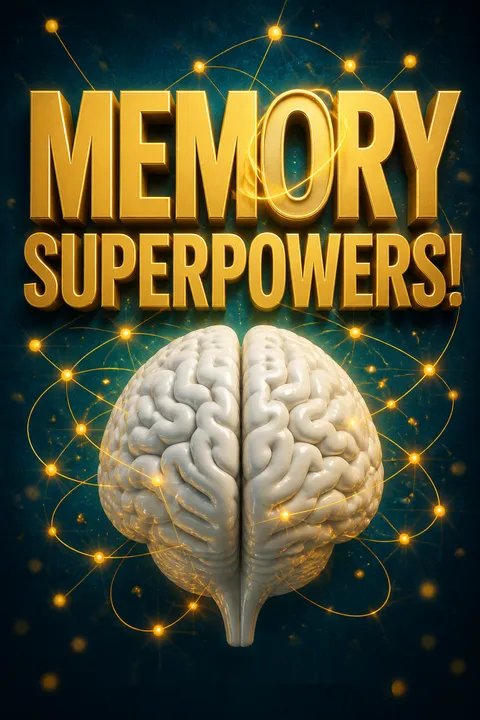
Memory Superpowers! receives mostly positive reviews (4.3/5) for its engaging approach to teaching memory techniques. Readers appreciate the adventure-story format featuring Mt. Foreverist and the Memory Thief, though some find it childish for adults. The book is best suited for 9-12 year-olds but benefits all ages. Reviewers praise practical methods like the Mind Palace technique for remembering names, numbers, and academic material. Many wish they'd learned these skills earlier. Some criticism notes overly descriptive writing and U.S.-centric examples. The illustrations receive special mention.
People Also Read



About the Author
Download PDF
Download EPUB
.epub digital book format is ideal for reading ebooks on phones, tablets, and e-readers.








































