


Key Takeaways
A 30-minute weekly marriage meeting keeps marriages from drifting apart
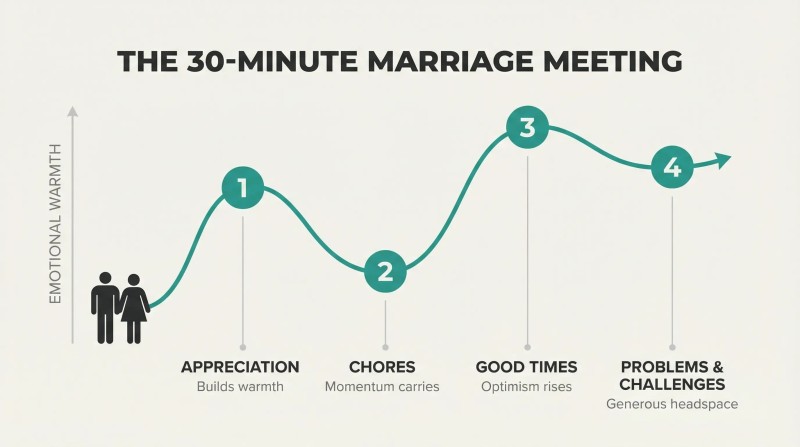
The marriage meeting is a structured, 30-minute weekly conversation following a fixed 4-part agenda:
1. Appreciation — each partner takes turns expressing specific compliments
2. Chores — coordinate household tasks like a business meeting
3. Plan for Good Times — schedule dates, individual activities, family outings
4. Problems and Challenges — address concerns using positive communication skills
The sequence is critical. Berger compares it to a roller coaster: the warm momentum from Appreciation carries you through the businesslike Chores part, Plan for Good Times builds optimism, and by Problems and Challenges, you're in a generous headspace. She and her husband have held these meetings for over 24 years. In a follow-up survey, every couple who continued meetings after her workshops reported a happier, more loving relationship.
Lead with specific appreciation — vague praise barely registers
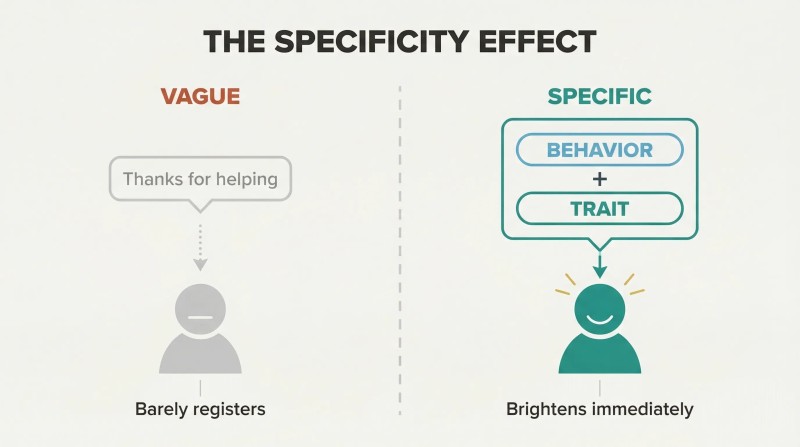
Specificity transforms compliments. When Janine told her husband Fred "I appreciate your thoughtfulness," his expression stayed bland. When she got specific — "I loved it when you surprised me with the gorgeous long-stemmed red roses on Friday, and I also appreciated your thoughtfulness in putting them in the vase" — he brightened immediately. "I don't know why it works to be specific, but it really does," Fred said.
Name the behavior and the character trait. Instead of "Thanks for helping," try "I appreciate your consideration in calling last night to say you'd be home late." Keep a running list during the week so you arrive prepared. When your partner finishes their appreciation and asks "Did I leave anything out?" — mention what else you'd like acknowledged.
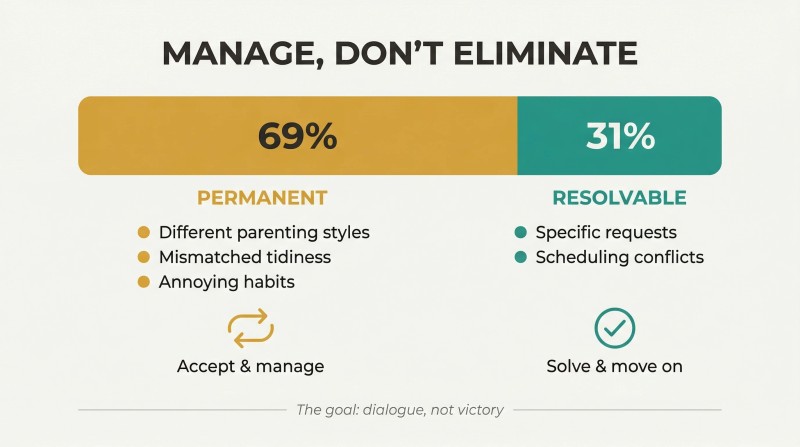
69% of marital conflicts never get resolved — learn to manage them
Most problems are permanent. John Gottman's research revealed that 69% of marital problems never get solved. But they don't have to be. Couples can live with unresolvable conflicts — different parenting styles, annoying habits, mismatched tidiness standards — as long as those issues aren't deal breakers like addiction, infidelity, or fundamentally incompatible values.
The key is management, not elimination. Lew's wife Ellie dresses too casually for his taste. He doesn't demand a personality overhaul. Instead, during their meeting he asks her to dress up for one specific dinner with his boss. He appreciates the effort afterward. Accept the overall pattern, address the moments that truly matter, and let the rest go. As one rabbi quipped: "People are annoying. So find the person who annoys you least and marry that one."
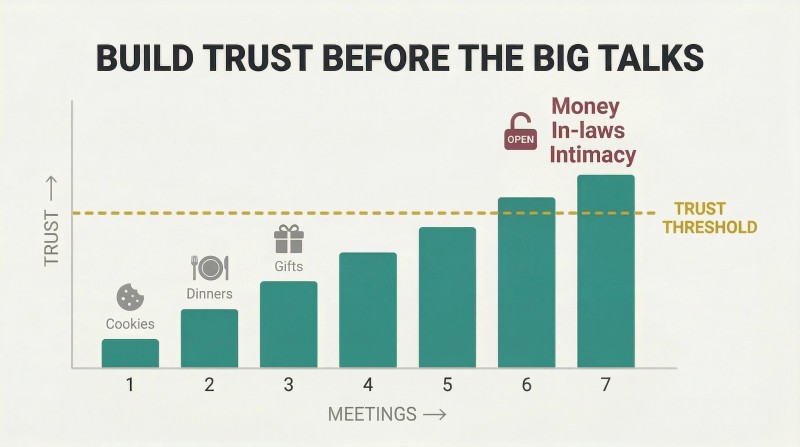
Keep first meetings light — trust precedes tough conversations
Resist the urge to unload. Hank brought up his wife Yvette's silent treatment in their very first meeting. She felt attacked and refused to meet ever again. Wally told Judy she needed to lose weight during their first Problems and Challenges segment. She was hurt and ashamed. That was their first and last meeting.
Build confidence for 4-6 meetings first. Start with easy-to-resolve challenges: asking your partner to hide the cookies while you diet, suggesting more vegetarian dinners, or requesting input on a birthday gift. These early wins teach both partners that the meeting is a safe space, not a courtroom. Emotionally charged topics — sex, money, in-laws — should wait until you've built a track record of respectful, productive conversations.
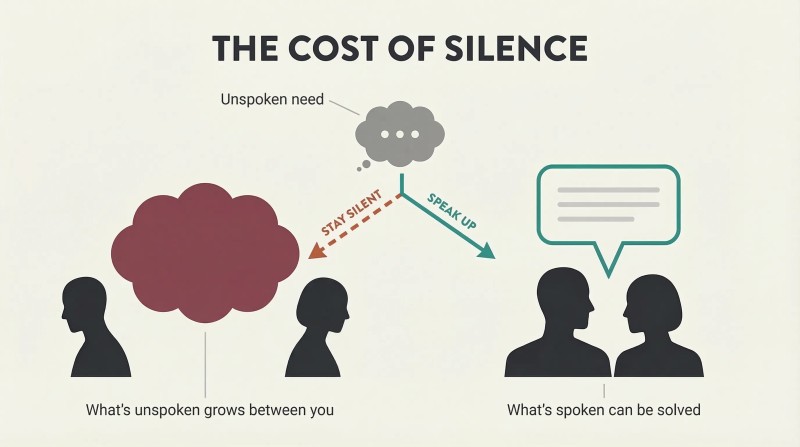
Stop expecting your spouse to read your mind
Mind reading belongs in fairy tales. Cindy believes her husband should know when she wants pizza versus sushi, what she wants for her birthday, and what turns her on — without saying a word. Even the most sensitive, intuitive partner cannot reliably guess what you need.
Silence can destroy marriages. Lilly never told Jonathan she was miserable staying home, that she missed her nursing career, or that she resented his control over spending. She played the contented wife in public — until the day she served him divorce papers. He was stunned. A single honest conversation might have saved them: part-time work, personal spending money, or shared financial decisions. The cost of speaking up feels high in the moment. The cost of staying silent compounds over years.
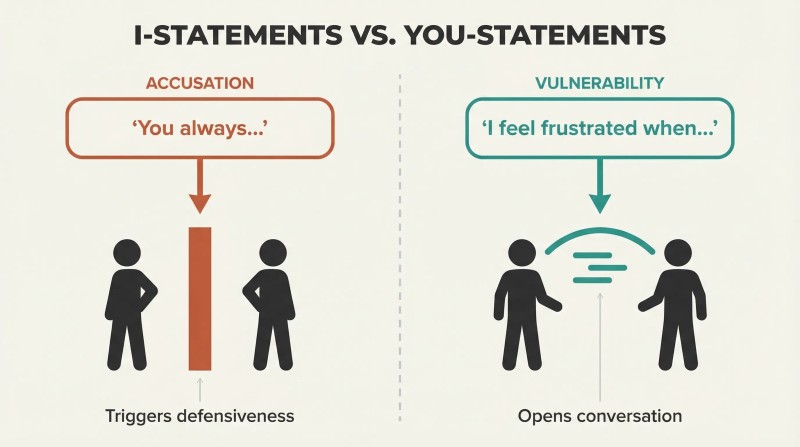
Say 'I feel frustrated when…' instead of 'You always…'
I-statements defuse defensiveness. The formula is straightforward:
1. State how you feel: "I feel frustrated…"
2. Name the specific behavior: "…when I have to ask three times to take out the trash."
3. Say what you want: "I'd like you to take it out the first time."
4. (Optional) Note a natural consequence: "Fruit flies will invade if it overflows."
You-statements trigger counterattacks. When Amy's mother-in-law criticized her weight and housekeeping, Amy wanted to tell her husband Ned, "You never defend me. You're a wimp." Instead she said, "I feel hurt and abandoned when you don't defend me when your mother criticizes me." The shift from accusation to vulnerability opened a conversation rather than igniting a fight.
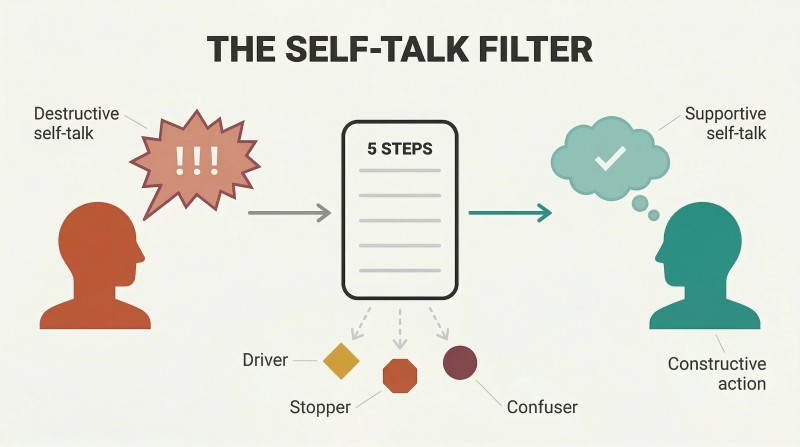
Fix your inner monologue before confronting your spouse
Self-talk — the messages we tell ourselves — shapes how we treat our partner. Psychologist Pamela Butler's 5-step method can transform destructive inner dialogue:
1. Be aware of what you're telling yourself
2. Evaluate whether it's helpful
3. Identify the distortion — the Driver (demanding perfection), Stopper (catastrophizing), or Confuser (missing the big picture)
4. Replace with supportive self-talk
5. Decide on a constructive action
One wife resented her husband for staying in a low-paying job. Using self-talk, she realized her Confuser was hiding the full picture: he chose low stress deliberately so he could relax evenings and weekends — the very easygoing nature that attracted her. Her action plan? Appreciate what she has, or earn more herself. No confrontation needed.
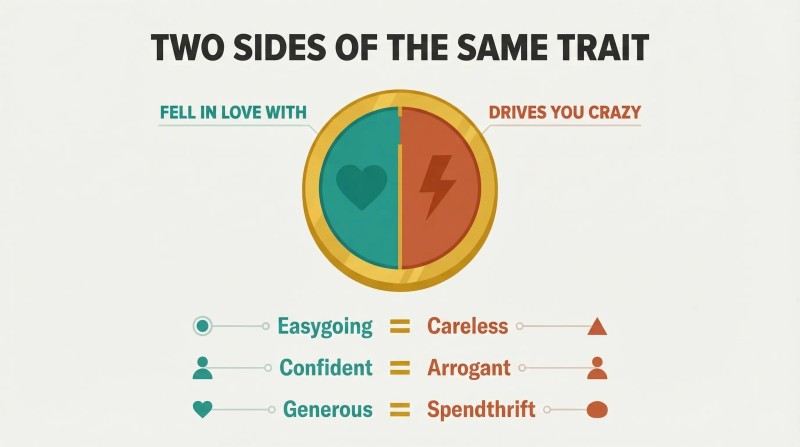
The trait you fell in love with will eventually drive you crazy
Opposite qualities attract, then collide. Lauren adored Ken's easygoing nature — until his "carefree" became "careless." He forgot avocados, ignored lightbulbs, and refused to use an appointment book. She felt uncared for; he felt nagged. The same gentle temperament that once calmed Lauren now infuriated her.
Recognizing the flip side restores perspective. Carol loved Roger's kind personality — then grew frustrated by his permissive parenting. But she reminded herself his gentleness and his leniency are two sides of the same coin. Through their meetings, she learned to request specific support ("Please check with me before ending Timmy's time-out") rather than trying to overhaul his entire personality. Work around the limitation; appreciate the strength it comes from.
Schedule weekly dates outside the house — the couch doesn't count
You fell in love on dates, not while doing laundry. Watching a movie at home doesn't qualify — the house is full of undone chores and distracting obligations. Go out. If money is tight, pack a picnic, attend a free library talk, take a scenic walk, or nurse one coffee at a cozy café. The point is escaping daily responsibilities so you can dream aloud and share feelings.
Fill your own cup too. Berger borrows Julia Cameron's "artist date" concept: schedule at least two hours weekly alone doing something purely self-nurturing. A depleted partner has nothing to give. And don't confuse constant togetherness with closeness — too much fused-at-the-hip time drains vitality from both of you and starves the individuality that made you attractive in the first place.

Over-giving kills marriages — the martyr trap is a DIY escape
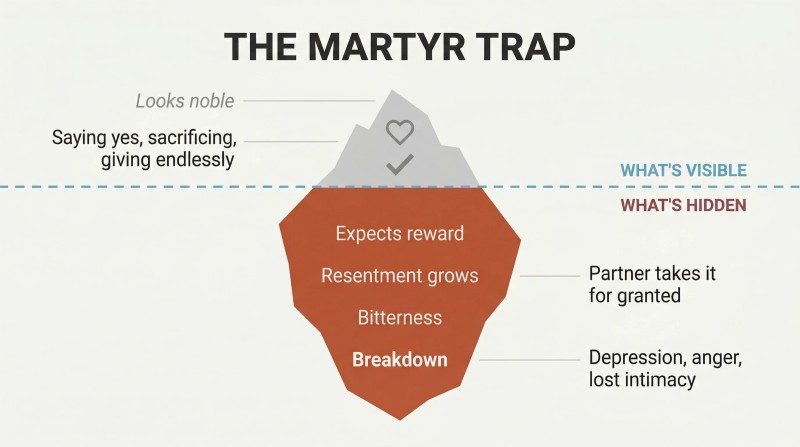
Selflessness sounds noble until resentment eats you alive. The martyr gives endlessly, sacrifices preferences, and says yes when they mean no — then feels bitter when nothing comes back. Warning signs: depression, anger, lost interest in sex, insomnia, increased drinking or overeating. The partner, meanwhile, takes the sacrifices for granted and expects more.
Lilly's story is a cautionary tale. She quit her nursing career at Jonathan's urging, deferred on every spending decision, and played the contented wife — until she couldn't bear it and filed for divorce, blindsiding him. Had she spoken up earlier using I-statements during a marriage meeting, they might have found a compromise. The cure: balance self-care with concern for your partner, set limits on what you'll take on, and stop waiting for permission to prioritize yourself.
Analysis
Berger's Marriage Meetings for Lasting Love occupies an interesting niche in the crowded couples-advice landscape: it's less about grand theory and more about operational hygiene. While Gottman provides research and Chapman maps love languages, Berger delivers the actual meeting agenda — the calendar invite, if you will, that turns good intentions into weekly practice. Her central insight isn't that couples need better communication (every relationship book says that); it's that without a recurring, structured container for that communication, even the best advice eventually evaporates into old habits.
The book's greatest strength is its sequencing logic. The 4-part agenda — Appreciation, Chores, Plan for Good Times, Problems and Challenges — works precisely because it's ordered and predictable. Berger understands that most relationship friction isn't caused by catastrophic events but by the slow accumulation of unspoken frustrations, forgotten compliments, and deferred conversations. The meeting structure creates what behavioral scientists call an 'implementation intention' — a pre-committed time, place, and process that dramatically increases follow-through compared to vague resolutions.
Where the book shows its era is in its occasionally heteronormative framing and reliance on gender generalizations about female brains being 'wired for more verbal expression.' The case studies, while illustrative, sometimes telescope — couples with domestic violence, addiction, and infidelity are presented alongside those squabbling about lightbulbs, which can inadvertently make serious pathology seem manageable with checklists alone. Berger does note that meetings aren't sufficient for every relationship, but her optimism occasionally outpaces her caveats.
Still, the framework earns its modest ambitions. The insistence on starting with appreciation isn't mere feel-good advice — it mirrors Gottman's finding that stable marriages maintain roughly a 5:1 positive-to-negative interaction ratio. And the counterintuitive counsel to keep early meetings light reflects sound behavioral psychology: small wins build self-efficacy, which enables tackling bigger challenges later.
Review Summary
Marriage Meetings for Lasting Love receives overwhelmingly positive reviews, with readers praising its practical approach to strengthening relationships. Many appreciate the structured weekly meeting concept, focusing on appreciation, chores, planning, and problem-solving. Reviewers found the communication techniques helpful and applicable beyond marriage. Some noted the book's heteronormative focus as a drawback. Overall, readers report improved intimacy, better conflict resolution, and stronger relationships after implementing the book's strategies. Many recommend it for both new and long-term couples seeking to enhance their connection.
People Also Read









Glossary
Marriage Meeting
Weekly structured couple conversationA 30-minute weekly meeting between spouses following a fixed 4-part agenda: Appreciation, Chores, Plan for Good Times, and Problems and Challenges. The sequence is designed so each part creates positive momentum for the next. Meetings should occur in a private, distraction-free setting with a 45-minute maximum time limit.
I-statement
Self-focused, non-accusatory expressionA communication technique for expressing thoughts, feelings, and desires beginning with 'I' rather than 'you.' The formula involves four steps: state how you feel, name the specific behavior, say what you want to happen, and optionally note a natural consequence. Designed to prevent defensiveness and foster cooperation, as opposed to accusatory you-statements.
Self-talk (5-step method)
Technique for fixing inner dialogueA cognitive technique from psychologist Pamela Butler for transforming destructive internal messages into supportive ones. The five steps are: (1) Be aware of what you're telling yourself, (2) Evaluate whether it's helpful, (3) Identify which distortion — Driver, Stopper, or Confuser — is operating, (4) Replace with supportive self-affirmation, (5) Decide on a constructive action based on the new message.
The Driver
Inner voice demanding perfectionOne of three cognitive distortions in Pamela Butler's self-talk framework. The Driver is an inner self that commands you to be perfect, hurry up, be strong, please others, or try hard. It maintains destructive self-talk by setting unrealistically high standards for yourself or your partner.
The Stopper
Inner voice that catastrophizesOne of three cognitive distortions in Butler's self-talk framework. The Stopper is an inner self that catastrophizes, labels the self negatively, judges harshly, and sets rigid requirements. It maintains destructive self-talk by assuming the worst possible outcome from a situation.
The Confuser
Inner voice that distorts realityOne of three cognitive distortions in Butler's self-talk framework. The Confuser is an inner self that makes arbitrary inferences, fails to see the full picture, overgeneralizes, and creates other cognitive distortions. It maintains destructive self-talk by causing you to draw false conclusions about your partner's motivations or your situation.
Congruent communication
Authentic, mutually respectful expressionA communication style identified by family therapist Virginia Satir in which the speaker's message is authentic and mutually respectful — words, tone, and body language all align. One of five communication styles people use during disagreement; the others are blaming, placating, being overly 'reasonable' (ignoring feelings), and being irrelevant (deflecting). Congruent communication fosters emotional closeness.
Sandwich approach
Feedback wrapped in complimentsA technique for delivering constructive criticism by layering it between positive statements: (1) Start with a genuine compliment, (2) State your concern about a specific behavior, (3) Describe what you'd like instead, (4) Close with another compliment. Uses I-statements throughout to maintain a respectful tone and prevent defensiveness.
Brainstorming for solutions
Structured joint problem-solving processA 10-step technique for resolving disagreements by generating multiple options without judgment. Partners first define the problem in a way that respects both viewpoints, then list all possible solutions — including unconventional ones — without evaluating them. Each partner can veto options, and remaining ideas are ranked by pros and cons until both agree on one or more to implement.
Love cup
Self-nurture energy reservoirA concept from marriage educator Ellen Kreidman describing each person's reservoir of emotional well-being that must be regularly refilled through self-nurturing activities. When the love cup is depleted from neglecting personal needs, the result can be depression, anger, decreased interest in sex, or addictive behaviors. Regularly engaging in pleasurable solo activities keeps the cup full.
FAQ
1. What is "Marriage Meetings for Lasting Love" by Marcia Naomi Berger about?
- Structured Weekly Meetings: The book introduces a simple, research-based method for couples to hold weekly "marriage meetings" to enhance communication, intimacy, and teamwork.
- Four-Part Agenda: Berger outlines a four-part agenda—Appreciation, Chores, Plan for Good Times, and Problems and Challenges—to guide each meeting.
- Practical Communication Skills: The book provides step-by-step instructions and communication techniques to help couples resolve conflicts and strengthen their relationship.
- Real-Life Examples: It includes illustrative stories and case studies to show how couples have benefited from marriage meetings, regardless of their relationship stage or challenges.
2. Why should I read "Marriage Meetings for Lasting Love" by Marcia Naomi Berger?
- Proven, Practical Approach: The book offers a straightforward, time-efficient method (30 minutes a week) to improve marital satisfaction and prevent issues from escalating.
- Applicable to All Couples: Whether your marriage is thriving or facing challenges, the marriage meeting method can help maintain or restore connection and harmony.
- Skill-Building Focus: Berger emphasizes learning and practicing positive communication skills, which can benefit not only your marriage but also other relationships.
- Ripple Effect: The positive changes from marriage meetings often extend to family dynamics, parenting, and even professional relationships.
3. What are the key takeaways from "Marriage Meetings for Lasting Love"?
- Regular Communication is Essential: Scheduling weekly meetings creates a safe, predictable space for open dialogue and prevents issues from festering.
- Structure Matters: Following the four-part agenda ensures meetings are balanced, positive, and productive, building momentum for addressing challenges.
- Start Small, Build Trust: Begin with easy-to-resolve topics and appreciation to foster goodwill before tackling more sensitive issues.
- Positive Communication Skills: Using I-statements, active listening, and self-talk are crucial for expressing needs and resolving conflicts respectfully.
4. How does the four-part marriage meeting agenda work in Marcia Naomi Berger’s method?
- Appreciation: Each partner takes turns expressing specific things they appreciated about the other during the past week, setting a positive tone.
- Chores: Partners collaboratively discuss and assign household tasks, set priorities, and give progress reports, promoting teamwork and fairness.
- Plan for Good Times: Couples schedule a date for themselves, individual self-care activities, family outings, and vacations, ensuring fun and connection.
- Problems and Challenges: Partners bring up one or two concerns, using positive communication skills to address issues constructively and find solutions.
5. What are the most important communication skills taught in "Marriage Meetings for Lasting Love"?
- I-Statements: Expressing feelings, needs, and requests from a personal perspective to avoid blame and foster understanding.
- Active Listening: Fully concentrating, reflecting back, and empathizing with your partner’s words before responding.
- Self-Talk: Monitoring and transforming negative internal dialogue to support constructive interactions.
- Congruent Communication: Ensuring that words, tone, and body language align for authentic, respectful exchanges.
- Constructive Criticism & Brainstorming: Offering feedback in a supportive way and generating solutions together without judgment.
6. What common marriage myths does Marcia Naomi Berger debunk in "Marriage Meetings for Lasting Love"?
- Myth of Problem-Free Marriage: Berger explains that all marriages have conflicts; the key is managing them constructively.
- Myth of Effortless Love: She dispels the idea that good marriages don’t require work, emphasizing the need for regular maintenance.
- Myth of Mind Reading: The book stresses that partners cannot expect each other to know unspoken needs or feelings.
- Myth of Total Resolution: Not all problems are solvable; some can only be managed or accepted.
- Myth of Meetings as a Cure-All: While marriage meetings are powerful, they are not a panacea for every relationship issue.
7. How should couples handle sensitive or emotionally charged topics according to "Marriage Meetings for Lasting Love"?
- Start with Easy Topics: In early meetings, avoid bringing up major or long-standing issues; focus on building trust and positive momentum.
- Use Positive Communication: Employ I-statements, active listening, and a respectful tone to discuss sensitive matters.
- Limit the Agenda: Address only one or two challenges per meeting to prevent overwhelm and maintain focus.
- Move Heated Topics: If a discussion becomes too emotional during another agenda part, move it to Problems and Challenges or postpone for a future meeting.
- Seek Outside Help if Needed: For issues that feel unmanageable, Berger recommends consulting a therapist or counselor.
8. What are some real-life examples or case studies included in "Marriage Meetings for Lasting Love"?
- Opposites Attract: Ken and Lauren use marriage meetings to manage differences in temperament and improve reliability and trust.
- In-Law Issues: Ned and Amy resolve ongoing criticism from a mother-in-law by using meeting structure and self-talk techniques.
- Money Conflicts: Sally and Michael address financial inequality and insecurity through marriage meetings and, when needed, therapy.
- Verbal Abuse Recovery: Wendy and Zack progress from destructive communication to healthier relating by practicing meeting skills in therapy.
- Severe Challenges: Oliver and Robin, facing infidelity and violence, use marriage meeting techniques in therapy to rebuild trust and connection.
9. What are the best quotes from "Marriage Meetings for Lasting Love" and what do they mean?
- “A successful marriage requires falling in love many times, always with the same person.” (Mignon McLaughlin) – Emphasizes the ongoing effort needed to maintain love and connection.
- “There is more hunger for love and appreciation in this world than for bread.” (Mother Teresa) – Highlights the importance of expressing appreciation in relationships.
- “Attack the problem, not each other!” – Berger’s core advice for addressing conflicts constructively rather than resorting to blame.
- “It is not a lack of love, but a lack of friendship that makes unhappy marriages.” (Friedrich Nietzsche) – Stresses the value of friendship and positive communication in marriage.
10. How can couples overcome reluctance or resistance to starting marriage meetings as advised by Marcia Naomi Berger?
- Don’t Worry About Initiation: It’s common for one partner (often the wife) to initiate; the important thing is to make meetings happen.
- Reframe the Meeting: View it as an investment in your relationship, not a chore or burden.
- Address Fears: Recognize and discuss concerns about criticism, time constraints, or discomfort with formal meetings.
- Start Light and Positive: Keep initial meetings upbeat and focused on appreciation to build enthusiasm and reduce resistance.
- Adapt as Needed: If a guideline doesn’t fit, experiment and modify while maintaining the core agenda and positive intent.
11. What are the long-term benefits of practicing the marriage meeting method from "Marriage Meetings for Lasting Love"?
- Enhanced Intimacy and Teamwork: Regular meetings foster emotional closeness, romance, and a sense of partnership.
- Prevention of Grudges: Weekly check-ins prevent small irritations from growing into major resentments.
- Improved Conflict Resolution: Couples become skilled at addressing issues constructively, reducing the need for crisis intervention or therapy.
- Positive Ripple Effect: The skills and goodwill generated often improve family dynamics, parenting, and even professional relationships.
- Personal Growth: Both partners develop better self-awareness, communication, and empathy, benefiting all areas of life.
12. How can readers implement the marriage meeting agenda from "Marriage Meetings for Lasting Love" in their own relationship?
- Schedule Weekly Meetings: Set aside 30–45 minutes each week in a private, comfortable setting, free from distractions.
- Follow the Four-Part Agenda: Begin with Appreciation, move to Chores, then Plan for Good Times, and finish with Problems and Challenges.
- Use Communication Tools: Apply I-statements, active listening, self-talk, and brainstorming as outlined in the book.
- Keep Meetings Positive and Focused: Limit the number of issues discussed, stick to the agenda order, and end on an upbeat note.
- Be Patient and Persistent: Allow time to adjust to the structure; with practice, meetings will feel more natural and rewarding.
Download PDF
Download EPUB
.epub digital book format is ideal for reading ebooks on phones, tablets, and e-readers.








































