


Key Takeaways
80% of raising emotionally intelligent kids is working on yourself
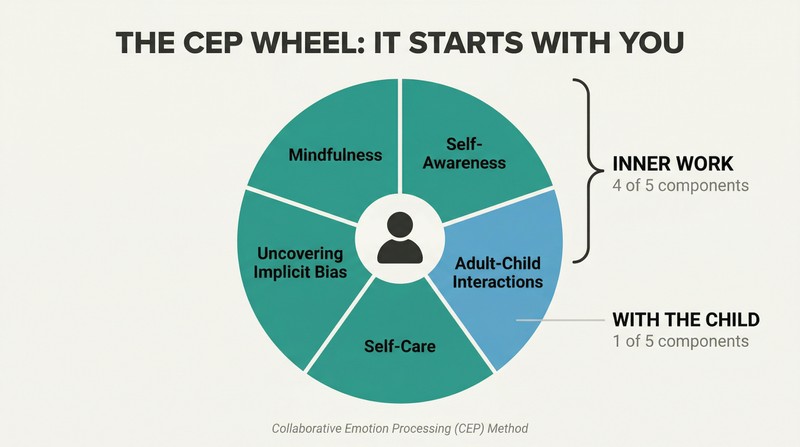
The method starts with you. Collaborative Emotion Processing has five components in its CEP Wheel: mindfulness, self-awareness, self-care, uncovering implicit bias, and adult-child interactions. Only one of those five is about what you do with the child — the other four are inner work on yourself. Campbell and Stauble both spent years in therapy learning skills their parents never taught them: how to feel emotions, develop coping strategies, and stay regulated under pressure.
Your childhood patterns are driving the bus. Psychologist Lynyetta Willis calls inherited helpful patterns "legacy blessings" and harmful ones "legacy burdens." When your child screams and you feel rage or shutdown, that's often a legacy burden taking the wheel. The goal isn't perfection — it's noticing those patterns and gradually choosing a different response.
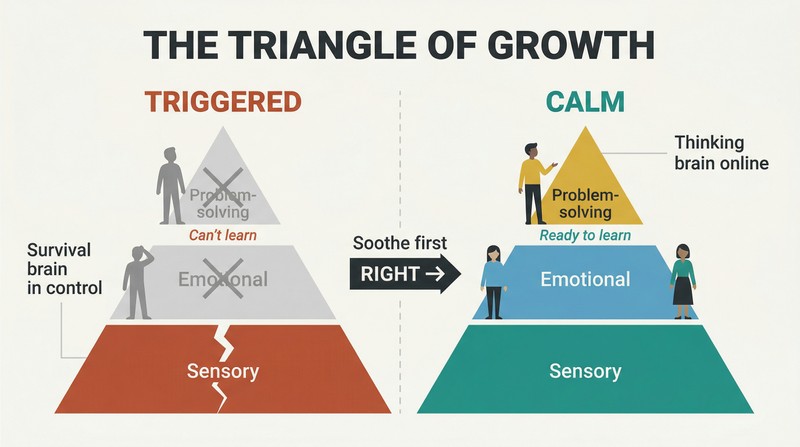
Soothe first, teach later — a triggered brain can't learn
The Triangle of Growth is a hierarchy: sensory regulation at the base, emotional regulation in the middle, communication and problem-solving at the top. When a child is flailing on the grocery store floor, their amygdala (survival brain) has seized control and their prefrontal cortex (thinking brain) is offline. No amount of reasoning — "We don't hit" or "Use your words" — will reach them.
Ask one question: calm or teach? If the child is in distress — uncontrollable sobbing, flailing, vomiting from crying — provide co-regulation through squeezes, humming, or movement. Even if just dysregulated (defiant, silly, bouncing off walls), calming comes first. A boy named Jonah who was hitting and kicking needed races in the backyard before he could discuss respecting his sister's space. Teaching happens only after the nervous system feels safe.
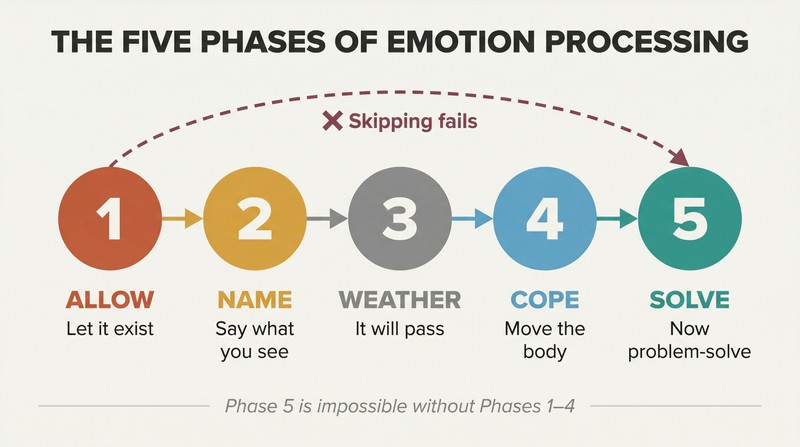
Allow, name, weather, cope, then solve — always in that order
The Phases of Emotion Processing guide both adults and children through big feelings:
1. Allow the emotion to exist — resist distracting or dismissing
2. Name the perceived emotion ("You sound frustrated!")
3. Help them feel secure that this emotion is temporary — like clouds passing
4. Offer coping strategies (jumping, hugging, breathing)
5. Move on by problem-solving or letting it go
Skipping phases backfires. When a girl named Amaya erupted over a broken cereal bar at snack, her teacher didn't lecture or problem-solve. She validated the frustration, jumped together with Amaya to calm her body, and only then brainstormed what to do about snack. Amaya couldn't have navigated her options until she was regulated — Phase 5 is impossible without Phases 1 through 4.
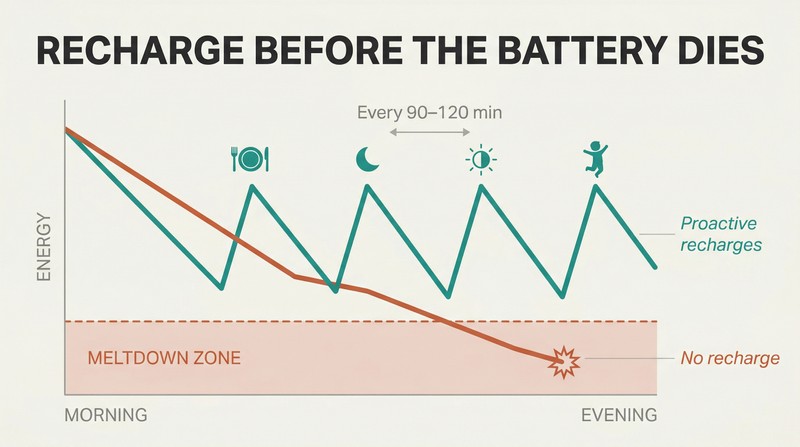
Treat your child's nervous system like a phone — recharge it proactively
The nervous system drains cumulatively throughout the day. Children's bodies need heavy proprioceptive input — big body movement — every 90 minutes to two hours. The authors tracked their toddler's bumps and falls and found he was six times more likely to fall within an hour of naptime, a sign his vestibular system was depleted.
Five proactive recharging strategies:
1. Predictable, consistent eating times
2. Adequate sleep for the season
3. Brain breaks — reducing light, sound, and stimulation
4. Big body play every 90 – 120 minutes (jumping, running, hugs)
5. Movement and balance activities (swinging, going upside down)
One parent sat phone-free in her car for five silent minutes before daycare pickup — a micro brain break that helped her show up regulated for the transition home.
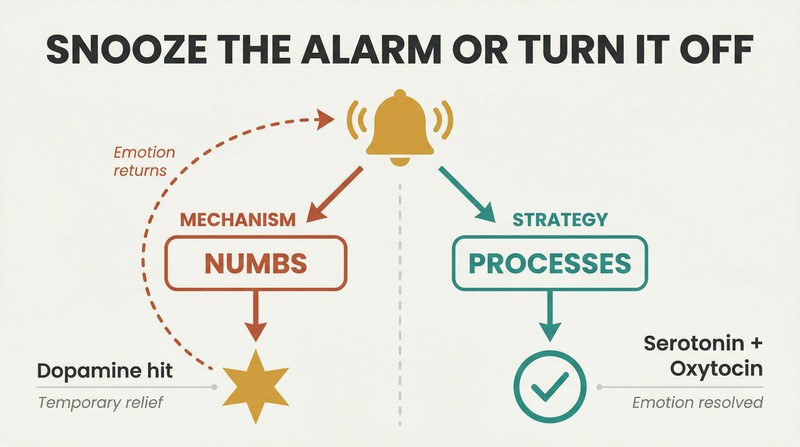
Coping mechanisms numb feelings; coping strategies process them
Mechanisms snooze the alarm; strategies turn it off. Coping mechanisms — scrolling social media, pouring a glass of wine, excessive exercise — produce dopamine for temporary relief. Coping strategies — breathing, walking in nature, drawing, talking to a friend — halt cortisol production and generate serotonin and oxytocin, genuinely calming the nervous system so emotions can be integrated.
The same activity can be either. Wine with a friend while connecting is a strategy; reaching for the glass alone after a hard day to avoid feelings is a mechanism. The gym is a strategy; working out until you're sick after an emotional day is a mechanism. Children have their own versions: screens and pacifiers as mechanisms, ten big jumps or a snuggle as strategies. The goal isn't eliminating mechanisms — it's noticing them and choosing a strategy instead, as often as you can.
Set boundaries by telling kids what they CAN do
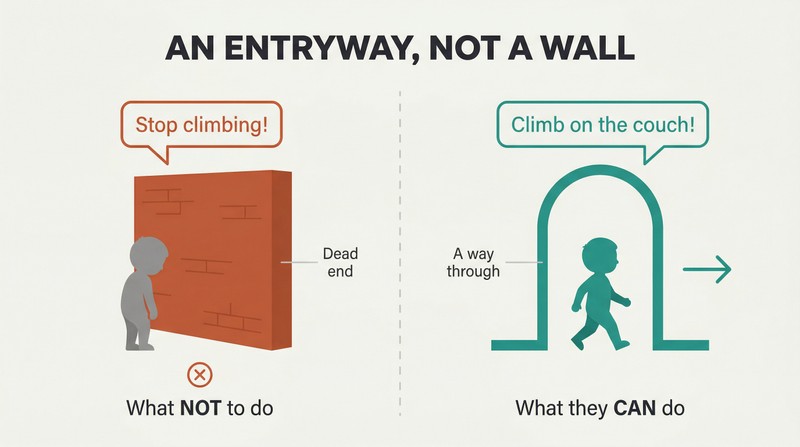
Find the yes. Instead of "Stop climbing the table!" try "Feet on the floor, please — you can climb on the couch." Instead of "Stop yelling!" try "Can you make your voice match mine?" When toddler Mika threw a block at a group of parents, her teacher slid close and said, "I won't let you throw blocks. If you want someone to play, say 'Play.'" Mika walked over and said it.
Boundaries are different from threats. A boundary states what you'll accept plus its consequence: "I won't let you hit. If you hit, I'll move to keep myself safe." A threat uses power to manipulate: "If you hit me, you won't get a doughnut later." Children push boundaries to confirm they're real — to see if you'll actually keep them safe. Consistent enforcement builds trust; inconsistency breeds more testing.
Reframe 'attention-seeking' behavior as a bid for connection
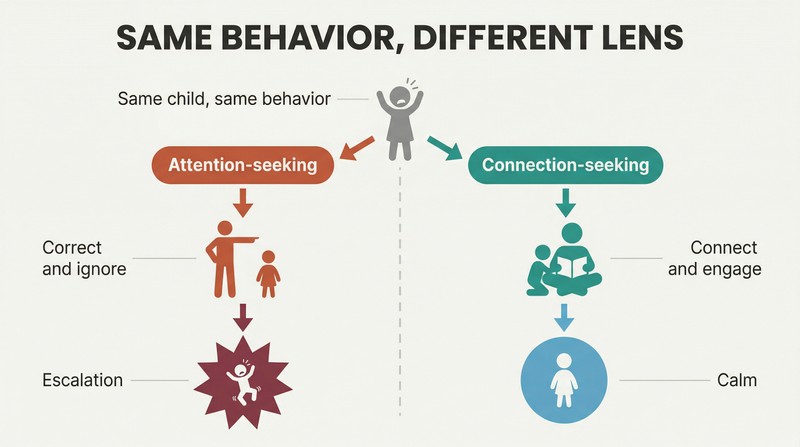
Jazmine's story reveals the pattern. After returning from a family vacation with one-on-one adult attention, she ran around her classroom stealing toys and climbing forbidden surfaces. Every correction escalated the behavior. When teachers stopped chasing and instead started reading her favorite book aloud, Jazmine joined in from across the room. Once connected, the boundary-pushing stopped.
Ignoring doesn't address the need. Throwing a cup, pulling your shirt, yelling "I hate you!" — these are clumsy bids for your presence. Five ways to fill a child's connection cup: screen-free time together, child-led play, doing an activity you know they love, noticing small moments ("I saw you help your sister"), and setting a timer for dedicated play before you shift to other tasks.
Express your feelings to kids without handing over ownership
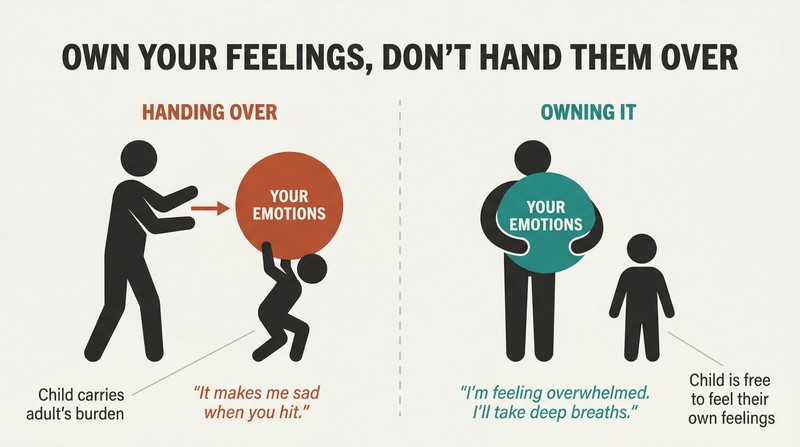
Phrases that backfire. "It makes me sad when you hit" or "You're scaring me running in the parking lot" hand children enormous, inappropriate power over adult emotions. Instead, model your feelings while owning them: "I'm feeling overwhelmed. I'm going to take deep breaths to calm my body before we keep talking."
Compare these shifts:
Instead of "It makes me happy when you clean up" — try "Thanks for cleaning up. It's comfortable to walk without stepping on toys."
Instead of "Don't run in the parking lot, it scares me!" — try "My job is to keep you safe. Let's hold hands."
The difference: your child learns emotions are manageable and that they aren't responsible for regulating you. You become the person they can safely fall apart with.
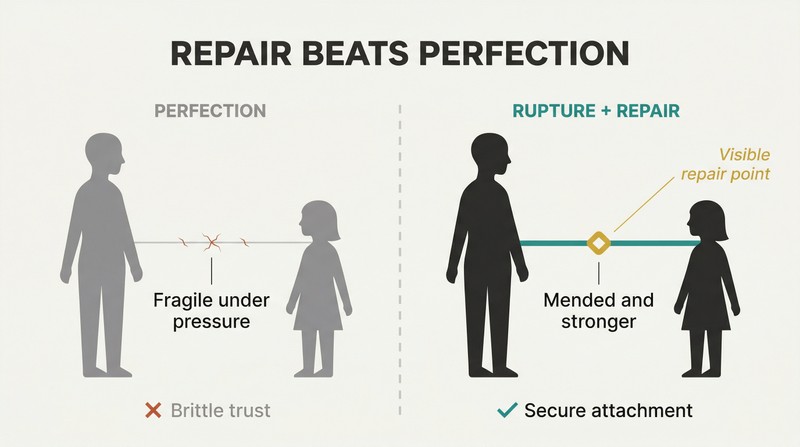
Repair after your blowups — it builds more trust than perfection
First-day-of-kindergarten meltdown. Kristin Gallant, co-founder of Big Little Feelings, lost her cool trying to snap a photo while both kids and her husband melted down. She yelled, "Can we just take one picture?!" Her daughter said, "Mommy, can we take a break?" Kristin paused, co-regulated with her girls, owned her part, and got the picture once everyone was calm.
Repair is the cornerstone of secure attachment. It can sound like: "I yelled when I got overwhelmed after grocery shopping. I'm sorry. Next time I'll take deep breaths." This models accountability and growth — the exact skills you want kids to develop. Attachment researcher Tina Payne Bryson notes parents can make plenty of mistakes as long as children feel safe, seen, and soothed most of the time.
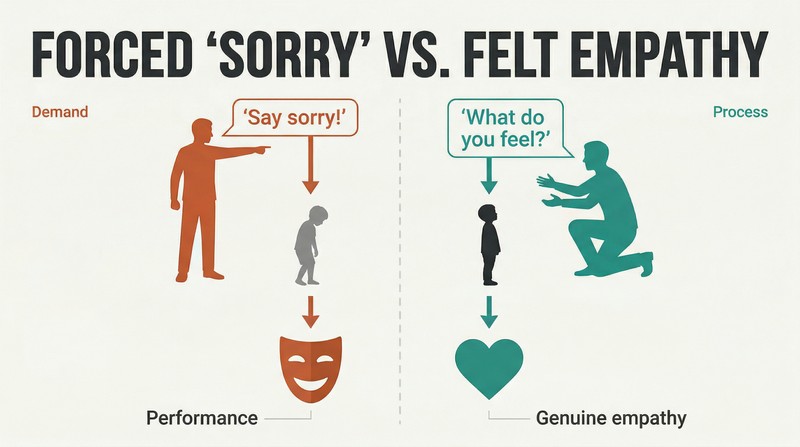
Stop forcing 'sorry' — it teaches lying, not empathy
Forced apologies are performance, not processing. Research in NurtureShock shows that demanding apologies before a child feels regret teaches them to lie. A meta-analysis of 175 studies found apologies powerfully predict forgiveness — but only when perceived as genuine and sincere by the injured party.
What to do instead. Help the child who made the mistake identify what they were feeling — left out? Embarrassed? Angry? Coach them through the Phases of Emotion Processing to build skills for next time. Separately, comfort the hurt child; their healing shouldn't depend on someone else's apology. Empathy develops when children see it modeled consistently, not when they're shamed into performing it. As the authors note, teaching a child to "check in" with someone they hurt before the child is regulated enough to feel empathy simply doesn't work.
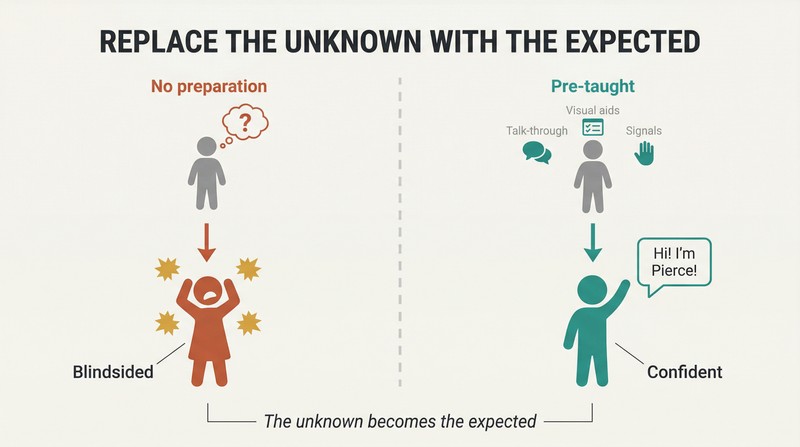
Pre-teach what's coming next so kids aren't blindsided
Pierce and the political rally. When three-year-old Pierce unexpectedly joined a crowded event, his cousin spent the 30-minute drive preparing him: who he'd meet, what they might ask, what to expect, and a signal for overwhelm ("Squeeze my hand"). At the rally, Pierce announced, "Hi! I'm Pierce and I'm three!" — heading off every stranger's question.
Pre-teaching works daily, not just for big events. Before the grocery store: "We're getting five things. You can help find the bananas." The authors also use "what if" games as low-stakes rehearsals: "What if all the swings are taken?" These conversations build neural pathways children can access in the real moment. Combined with visual aids — daily schedules, timers, emotion cards — pre-teaching dramatically reduces the frequency of meltdowns by replacing the unknown with the expected.
Analysis
Campbell and Stauble have built something uncommon in parenting literature: a method that is rigorously research-informed yet designed to be accessed in the thirty-second window when a toddler is screaming on the kitchen floor. The book's most radical architectural choice is inverting the typical formula. Where most guides implicitly say 'here's what to do with your kid,' Collaborative Emotion Processing (CEP) says 'here's who you need to become first' — then proves the case through neuroscience, attachment theory, and constructed-emotion research.
The theoretical scaffolding is eclectically sourced — Barrett's constructed emotions, Bowlby-Ainsworth attachment, Gottman's emotion coaching, Shanker's self-regulation framework, Buddhist-rooted mindfulness — yet the synthesis is coherent rather than patchwork. The Triangle of Growth resolves the core frustration every parent knows: 'Why won't they just listen?' The answer — that a hijacked amygdala literally cannot process reasonable instructions — reframes the adult from disciplinarian to co-regulator.
The integration of implicit bias into emotional development is genuinely novel. Citing research that Black boys are disproportionately labeled with behavioral disorders and that teachers unconsciously anticipate challenging behavior from Black children regardless of the teacher's own race, the authors connect individual emotion coaching to systemic equity in a way few parenting books attempt.
A fair critique: while acknowledging neurodivergence and cultural variation, the primary strategies are optimized for verbal, neurotypical children in relatively stable family structures. The method's emphasis on verbal emotion coaching may require significant adaptation for children with autism, severe developmental delays, or complex trauma. The effectiveness evidence — drawn from the authors' own action research with teacher participants — deserves replication in larger, independent studies.
Still, this book will be most transformative for parents who recognize themselves in its opening pages: adults raised to suppress emotions who now find themselves paralyzed or reactive when their children express them. The real curriculum isn't for tiny humans — it's for the grown-ups still learning to feel.
Review Summary
Tiny Humans, Big Emotions receives mostly positive reviews, with readers praising its approach to emotional intelligence and parenting. Many find the Collaborative Emotion Processing (CEP) method helpful and appreciate the focus on self-reflection. Reviewers highlight the book's practical advice, scientific basis, and emphasis on understanding both adult and child emotions. Some readers note the book can be overwhelming or repetitive at times. Overall, it's recommended for parents, caregivers, and educators seeking to improve their interactions with children and manage emotions effectively.
People Also Read







Glossary
Collaborative Emotion Processing (CEP)
Method for teaching emotional intelligenceA comprehensive method created by Campbell and Stauble for adults and children to learn how to process emotions together. CEP encompasses five components (visualized as the CEP Wheel) and five sequential Phases of Emotion Processing. It emphasizes that the adult's own emotional development is the foundation for supporting children's emotional growth.
CEP Wheel
Five-component visual frameworkA wheel-shaped diagram showing the five components of Collaborative Emotion Processing: mindfulness (at the hub), self-awareness, self-care, uncovering implicit bias, scientific knowledge, and adult-child interactions. The wheel design emphasizes that only one of five components directly involves the child—the rest focus on the adult's own development.
Phases of Emotion Processing
Five steps through big feelingsThe five sequential steps for processing emotions: (1) Allowing one's emotions to exist, (2) Recognizing the perceived emotion by associating symbols with feelings, (3) Feeling secure in experiencing a range of emotions over time, (4) Seeking support through coping strategies, and (5) Moving on by solving the problem or letting it go. Skipping phases—especially jumping to Phase 5—undermines the entire process.
Triangle of Growth
Sensory-emotional-language processing hierarchyA framework showing that sensory (nervous system) regulation forms the base, emotional regulation sits in the middle, and language/communication/problem-solving is at the top. A child must regulate their nervous system before they can process emotions, and must process emotions before they can access rational thinking and communication skills.
Coping Strategies Toolbox
Personal set of calming toolsAn individual's collection of coping strategies—actions that help process emotions by calming the nervous system (e.g., breathing, jumping, hugging, drawing, talking to a friend). Distinguished from coping mechanisms, which numb or temporarily suppress feelings (e.g., scrolling social media, excessive exercise, reaching for alcohol). Both adults and children build their own toolboxes.
Legacy blessings and legacy burdens
Inherited generational emotional patternsA framework from psychologist Lynyetta Willis describing how each generation passes on both helpful emotional patterns (legacy blessings) and harmful ones (legacy burdens) like a relay race baton. Grandparents passed patterns to parents, who healed some burdens and passed the rest to us. Recognizing which patterns are blessings to keep and which are burdens to heal is central to Collaborative Emotion Processing.
Come Watch
Group emotion processing techniqueA technique borrowed from yoga teaching where, instead of sending bystander children away when one child is having big emotions, the adult invites curious children to witness and participate in the emotion processing. This teaches empathy, normalizes emotional expression, and gives regulated children a chance to practice recognizing emotions in others—as long as the expressing child's culture and temperament support it.
Surface acting
Suppressing emotions to appear fineWhen someone judges their emotions as bad and pushes them aside, acting as if everything is fine. The authors connect surface acting to teacher burnout and warn against inadvertently teaching it to children by dismissing their feelings. Distinct from self-regulation, which involves genuinely calming the nervous system rather than merely performing calm.
Restraint collapse
Post-school emotional release at homeThe phenomenon where children 'let go' of all the emotions they held together during the school day once they arrive home and feel safe. It can look like meltdowns, defiance, or clinginess and indicates the strength of the child's secure attachment at home—not a failure of parenting. Supporting it involves checking physiological needs, connecting, processing, and allowing unstructured play.
Brain break
Reducing stimuli to rest nervesA proactive recharging strategy where stimuli are intentionally reduced—decreasing light, sound, and touch—to give the nervous system a break from scanning the environment. Examples include lying in a dark room, looking at the sky, turning off background noise, or closing your eyes and breathing. The authors recommend scheduling two five-minute brain breaks per day for both adults and children.
FAQ
What's Tiny Humans, Big Emotions about?
- Focus on Emotional Intelligence: The book emphasizes nurturing emotional intelligence in children from a young age, highlighting its importance in their development.
- Collaborative Emotion Processing Method: Introduces the CEP method, which helps adults and children navigate emotions together, promoting emotional understanding and regulation.
- Practical Guidance: Offers actionable advice for parents, teachers, and caregivers on responding to children's emotions and teaching emotional regulation.
Why should I read Tiny Humans, Big Emotions?
- Empowerment for Caregivers: Equips caregivers with tools to foster emotional intelligence, crucial for children's development and emotional well-being.
- Research-Based Insights: Combines the authors' experience in early childhood education with current research, providing a solid foundation for the methods presented.
- Real-Life Applications: Includes relatable anecdotes and strategies that can be immediately applied in everyday situations with children.
What are the key takeaways of Tiny Humans, Big Emotions?
- Understanding Emotions: Emphasizes recognizing and validating both adults' and children's emotions as complex and unique experiences.
- CEP Method: Central theme focusing on modeling emotional intelligence and supporting children in processing their feelings through five phases.
- Importance of Connection: Highlights the significance of empathy, secure attachments, and open communication in adult-child interactions.
What is the Collaborative Emotion Processing (CEP) method?
- Definition of CEP: A framework for collaboratively processing emotions between adults and children, emphasizing emotional intelligence in relationships.
- Five Phases of Emotion Processing: Includes allowing emotions, recognizing them, feeling secure, seeking support, and moving on, each building on the previous.
- Focus on Adult Awareness: Encourages adults to reflect on their emotional responses to better support children, fostering a safe emotional environment.
How can I help my child process their emotions using the CEP method?
- Allow Emotions to Exist: Create a safe space for your child to express feelings without judgment, encouraging emotional exploration.
- Recognize and Validate: Use language that acknowledges their feelings, helping them feel understood and connected.
- Introduce Coping Strategies: Teach coping strategies like deep breathing or physical activities, empowering them to manage emotions independently.
What are the five phases of emotion processing in the CEP method?
- Phase 1: Allowing Emotions: Let emotions exist without suppression, creating a safe space for feelings.
- Phase 2: Recognizing Emotions: Help children identify and label their emotions with words or symbols.
- Phase 3: Feeling Secure: Develop a sense of security in experiencing emotions, understanding they are temporary and manageable.
- Phase 4: Seeking Support: Focus on using coping strategies to manage emotions, guided by adults.
- Phase 5: Moving On: Involves problem-solving or letting go of emotions, teaching children to navigate feelings and find resolution.
How do I set and hold boundaries with my child according to Tiny Humans, Big Emotions?
- Clear Communication: Clearly state boundaries and consequences, ensuring children understand expectations.
- Expect Boundary Testing: Recognize that testing boundaries is a natural part of development, requiring consistency.
- Empathy and Connection: Acknowledge your child's feelings when enforcing boundaries, maintaining empathy and understanding.
What are some effective coping strategies for children suggested in Tiny Humans, Big Emotions?
- Physical Activities: Encourage movement-based strategies like jumping or dancing to release energy and emotions.
- Breathing Techniques: Teach deep breathing exercises to help children calm down, using simple phrases like “breathe in, breathe out.”
- Creative Expression: Use art, music, or storytelling for emotional expression, providing a safe and constructive outlet.
How can I model emotional intelligence for my child?
- Share Your Feelings: Be open about your emotions and coping methods, teaching children it's okay to express feelings.
- Practice Mindfulness: Engage in mindfulness to stay present and aware of emotions, setting an example for children.
- Use Empathy: Show empathy towards your child's feelings, fostering a strong emotional connection and encouraging empathy in return.
What role does empathy play in emotional intelligence according to Tiny Humans, Big Emotions?
- Core Component: Empathy is crucial for connecting with others emotionally, alongside self-awareness, self-regulation, motivation, and social skills.
- Fostering Connections: Helps children understand and relate to others' feelings, crucial for social skills and emotional development.
- Modeling Empathy: Caregivers can teach empathy by demonstrating empathetic behavior, setting a foundation for children to express empathy.
How can I create a culture of empathy in my home?
- Model Empathetic Behavior: Demonstrate empathy in daily interactions, using phrases that validate feelings and show understanding.
- Encourage Perspective Taking: Teach children to consider others' feelings by asking questions about how someone else might feel.
- Read Books About Emotions: Incorporate books exploring emotions and empathy, discussing characters' feelings and real-life connections.
What are the best quotes from Tiny Humans, Big Emotions and what do they mean?
- “Emotions are not problems to be solved.”: Encourages acceptance and understanding of emotions rather than suppression or fixing.
- “You are not at the mercy of emotions that arise unbidden to control your behavior.”: Empowers readers to manage emotions and responses, taking control of emotional experiences.
- “The future is emotionally intelligent.”: Reflects the vision for a world prioritizing emotional intelligence, underscoring its importance for a better future.
Download PDF
Download EPUB
.epub digital book format is ideal for reading ebooks on phones, tablets, and e-readers.








































