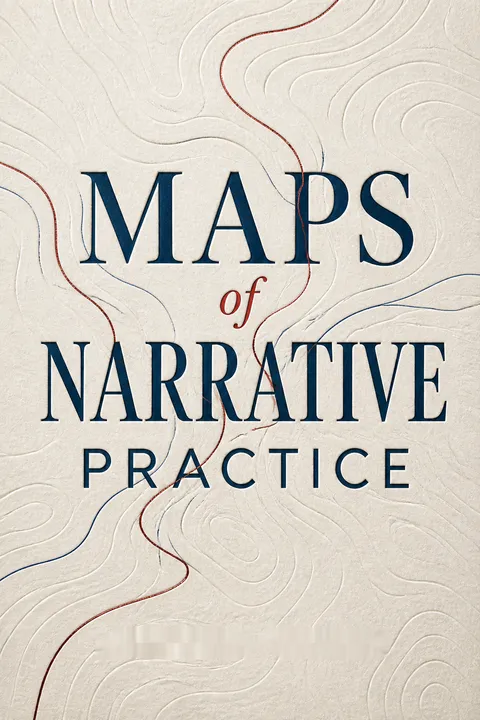

Key Takeaways
1. Maps, Not Mandates: Guiding Life's Unpredictable Journeys
I do not recall our having any specific travel goal at the outset of each day, just a number of possible destinations. And the routes to these possible destinations were not predetermined.
Embrace uncertainty. Therapeutic journeys, like geographical expeditions, rarely have predetermined routes or fixed destinations. The author views maps as flexible guides, not rigid mandates, for navigating the unknown territories of people's lives. This approach fosters a spirit of exploration and discovery, allowing for unexpected turns and novel understandings.
Beyond confirmation. The purpose of these journeys is not to confirm what is already known about a person's problems, but to explore what is possible. Clients often modify their goals mid-conversation, embracing objectives they couldn't foresee initially, such as shifting from resolving differences to celebrating them in a relationship. This highlights the dynamic and co-creative nature of narrative practice.
Reflective practice. While maps provide guidance, the therapist's role is not to police conversations but to respond in ways that open opportunities for clients to explore neglected aspects of their lives. This continuous reflection on practice, viewing it as an "apprenticeship without end," ensures that therapists remain open to new possibilities and avoid unquestioned reproduction of familiar methods.
2. Externalize the Problem, Not the Person: Shifting Blame to Empower Action
Externalizing conversations employ practices of objectification of the problem against cultural practices of objectification of people.
Problem as entity. Many clients internalize problems, believing they reflect inherent flaws in their identity or others'. Externalizing conversations objectify the problem, making it a separate entity from the person. This crucial shift allows individuals to experience an identity distinct from the problem, transforming "I am the problem" into "the problem is the problem."
Countering cultural norms. This practice directly counters pervasive cultural phenomena, traced by Foucault, where "dividing practices," scientific classification, and "normalizing judgment" objectify people's identities. By externalizing, therapists challenge these cultural forces that often lead to negative self-conclusions and exacerbate problems.
Unraveling negative conclusions. Separating the person from the problem doesn't absolve responsibility but enables it. It creates space to unravel negative identity conclusions (e.g., "I am worthless") and reveal the "politics" of problems, exposing power relations that shaped these beliefs. This opens avenues for successful problem resolution and more positive self-perceptions.
3. Re-Authoring: Weaving New Threads into Life's Dominant Stories
The great writer’s gift to a reader is to make him a better writer.
Beyond problem-saturated narratives. Clients often present problem-saturated stories, focusing on loss, failure, and hopelessness. Re-authoring conversations invite them to develop these stories further, but crucially, to include "unique outcomes" or "exceptions" that are "out of phase" with the dominant plotlines. These neglected events become entry points for alternative narratives.
Dual landscapes of story. Drawing from Bruner, stories are understood through a "landscape of action" (events, plot) and a "landscape of identity" (what protagonists know, think, feel, value). Re-authoring thickens both landscapes, encouraging clients to recruit lived experience, imagination, and meaning-making resources to fill gaps in their subordinate storylines.
Intentional over internal states. The process prioritizes "intentional state understandings" (purposes, values, aspirations) over "internal state understandings" (needs, traits). This shift emphasizes personal agency, portraying individuals as active shapers of their lives, rather than passive manifestations of an essential self. This fosters a sense of being joined with others around shared themes, countering isolation.
4. Re-Membering: Cultivating Identity Through a Chorus of Valued Voices
Re-membering, then, is a purposive, significant unification, quite different from the passive, continuous fragmentary flickerings of images and feelings that accompany other activities in the normal flow of consciousness.
Identity as an association. Re-membering conversations are founded on the concept of identity as an "association of life" or a "club," rather than a singular, encapsulated self. This association comprises significant figures from a person's past, present, and projected future, whose voices influence identity construction.
Revising membership. These conversations offer a chance to revise this "membership," upgrading or honoring some voices while downgrading or revoking others. This active re-engagement with relational history allows for the reconstruction of identity, moving away from isolating, single-voiced self-perceptions prevalent in Western culture.
Two-way contributions. A key aspect is exploring not just what significant figures contributed to the client's life, but also what the client contributed to their lives. This mutual understanding resurrects a sense of personal agency, displacing "passive recipient" narratives and fostering a multivoiced identity rooted in shared, precious themes.
5. Definitional Ceremonies: The Transformative Power of Witnessed Acknowledgment
Definitional ceremonies deal with the problems of invisibility and marginality; they are strategies that provide opportunities for being seen and in one’s own terms, garnering witnesses to one’s worth, vitality, and being.
Rituals of regrading. Definitional ceremonies are structured therapeutic rituals that acknowledge and "regrade" people's lives, contrasting with cultural rituals that often judge and degrade. They provide a platform for clients to tell their stories to an audience of carefully chosen "outsider witnesses," who respond in a specific, non-judgmental way.
Outsider witness tradition. These witnesses engage in a unique form of acknowledgment, focusing on: the expressions they were drawn to, the images these evoked, the personal resonance with their own lives, and how they were transported or changed by the story (katharsis). This avoids common pitfalls like advice-giving, interpretation, or mere affirmation, ensuring deep, resonant acknowledgment.
Three-stage structure. The ceremony unfolds in three distinct stages: the client's telling of their story, the outsider witnesses' retelling of what they heard, and the client's retelling of the retelling. This layered process amplifies identity claims, fosters a sense of solidarity, and provides powerful verification, often leading to profound turning points and a renewed sense of personal authenticity.
6. Highlighting Unique Outcomes: Discovering Seeds of Alternative Futures
The identification of such out-of-phase aspects of lived experience can provide a point of entry for the development of alternative storylines of people’s lives.
Beyond the blip. Much of lived experience remains unmeaningful, "out of phase" with dominant problem-saturated narratives. Conversations highlighting unique outcomes focus on these neglected "blips" – exceptions or initiatives that contradict the prevailing story. The therapist's role is to help clients render these potentially significant experiences weighty and meaningful.
Decentered authorship. Unlike approaches where therapists might impose meaning, this practice maintains a "decentered" stance, privileging the client's authorship. It uses a modified "statement of position" map to guide inquiry, moving from defining the unique outcome to mapping its effects, evaluating them, and justifying the evaluation with "why" questions.
Springboard for action. By exploring these unique outcomes, clients articulate intentions for their lives and what they value, often for the first time. This process provides a "springboard for action," enabling them to address problems in ways coherent with their newly articulated values and aspirations, leading to the development of rich, alternative storylines.
7. Scaffolding Conversations: Bridging the Gap Between What Is and What Can Be
This zone is the distance between what the child can know and achieve independently and what is possible for the child to know and achieve in collaboration with others.
Traversing the proximal zone. Clients often feel stuck, reproducing familiar, unhelpful patterns. Scaffolding conversations, inspired by Vygotsky's "zone of proximal development," help clients traverse the gap between their "known and familiar" and what is "possible" to know and do. This is achieved through conversational partnerships that break down complex learning into manageable steps.
Social collaboration for agency. Personal agency and responsible action are not innate but emerge from this social collaboration. The therapist, and others, provide "scaffolding" through specific "distancing tasks" – from characterizing unnamed events (low-level) to forming abstract concepts about life and identity (high-level). This incremental process fosters self-regulation and self-mastery.
Language and concept development. Language is crucial for this journey. As word meanings evolve and are abstracted from concrete experiences, they become guiding "concepts" (e.g., "freedom," "belonging"). This conceptual development empowers individuals to influence their own actions and shape their lives purposefully, moving beyond conclusions of incompetence or inadequacy.
8. The Therapist's Art: Decentered Influence and Ethical Curiosity
This decentered but influential role can be difficult to achieve, for we are often meeting with people who are expressing considerable degrees of frustration and hopelessness, who have exhausted all other known avenues, and who are desperate to achieve some relief from pressing concerns.
Decentered, not disengaged. The narrative therapist adopts a "decentered" posture, meaning they are not the author of the client's story or solutions. However, this is not a passive role; it is "influential" through the careful crafting of questions and the structuring of conversations that open new possibilities for client authorship and meaning-making.
Avoiding expert traps. In situations of client desperation, therapists can be tempted to assume an "expert" position, imposing interpretations or solutions. This closes the door on collaboration and burdens the therapist. Narrative practice consciously resists this, instead inviting clients to define their own positions, values, and intentions, fostering a sense of empowerment.
Ethical responsibility. Therapists hold a profound ethical responsibility for the consequences of their words and actions, especially in shaping identity. This includes continually questioning the metaphors used, avoiding totalizing descriptions of problems, and ensuring that conversational structures (like definitional ceremonies) genuinely serve the client's rich story development and sense of authenticity.
9. Beyond Deficit: Embracing Life's Multistoried Complexity
The imaginative application of the narrative mode leads . . . to good stories, gripping drama, believable . . . historical accounts. It deals in human or human-like intention and action and the vicissitudes and consequences that mark their course.
Challenging problem-saturated views. Narrative practice fundamentally challenges the pervasive tendency to define individuals by their problems or perceived deficits. Instead, it operates from the premise that every life is "multistoried," containing rich, often neglected, narratives of competence, resilience, and preferred identity that exist alongside problem stories.
Unraveling cultural assumptions. Many problems brought to therapy are cultural in nature, stemming from societal norms that objectify people or promote isolating ideals of the "encapsulated self." Narrative practices actively deconstruct these cultural assumptions, creating space for diverse, relational understandings of identity and action.
Hope and possibility. By focusing on unique outcomes, intentional understandings, and the social co-construction of identity, narrative therapy cultivates hope. It moves beyond simply alleviating symptoms to helping individuals re-author their lives in ways that are deeply resonant with their cherished values, opening up horizons of possibility previously unimaginable.
Review Summary
Maps of Narrative Practice receives high praise from readers, with an average rating of 4.36 out of 5. Many reviewers appreciate White's insights into narrative therapy, finding the techniques and case studies valuable for their own practice. Some note the book's density and academic tone, requiring careful reading. Therapists and students alike appreciate the philosophical underpinnings and practical applications presented. While a few readers found it challenging, most consider it an essential resource for understanding and implementing narrative therapy techniques.
People Also Read






Download PDF
Download EPUB
.epub digital book format is ideal for reading ebooks on phones, tablets, and e-readers.








































