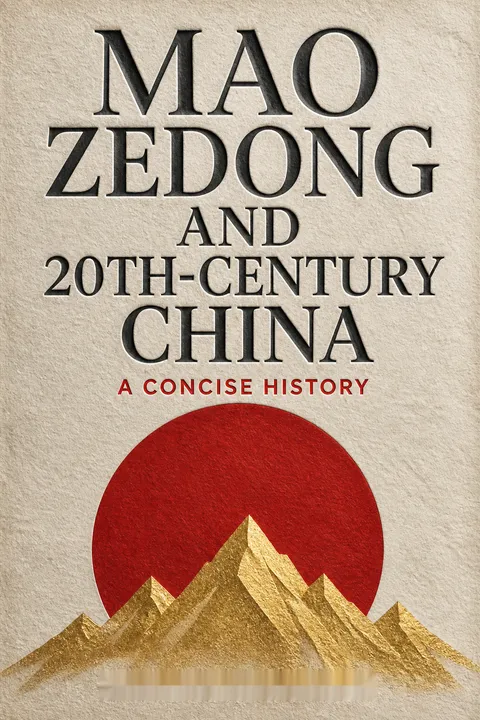

Key Takeaways
1. China's Century of Humiliation Fueled Mao's Revolutionary Drive
This marks the beginning of what the Chinese later would call the ‘‘century of humiliation,’’ a century Mao is credited with ending by the founding of a strong and sovereign China in 1949.
Early life in a fractured China. Mao Zedong was born in 1893 into a China reeling from foreign aggression and internal decay. The Qing dynasty, weakened by the Opium Wars and unequal treaties, faced repeated assaults from aggressive foreign powers, notably Britain and later Japan, leading to a loss of territorial integrity and political sovereignty. This period, known as the "century of humiliation," deeply influenced Mao's early political consciousness.
Exposure to new ideas. Mao's education, initially traditional Confucian rote learning, expanded to include Western philosophy, politics, and modern histories of nations like England, Russia, and the United States. He was exposed to anti-dynastic thought and the fermenting "new culture" intellectual movement, which rejected Chinese "tradition" and promoted physical strength and modern ideals. His early political views, though vague, were shaped by a growing sense of national crisis and a desire for transformation.
From liberal to communist. The 1911 Revolution, which overthrew the Qing dynasty, saw Mao briefly join the revolutionary army. His subsequent self-study and engagement with intellectual circles in Changsha and Beijing introduced him to Marxism, albeit initially filtered through anarchist concepts. While not immediately impactful, the Russian Revolution of 1917 and the May Fourth Movement of 1919, a nationalist and anti-imperialist uprising, solidified his commitment to radical change, leading him towards Bolshevism and the eventual founding of the Chinese Communist Party (CCP) in 1921.
2. Mao Forged a Peasant-Led Revolution Against Orthodox Marxism
As far as Mao was concerned, the historic mission of China’s revolution now rested not in the urban areas alone, not among ccp or gmd leaders alone, but rather upon the shoulders of the peasants.
The CCP's theoretical paradox. The founding of the CCP presented a fundamental challenge: Marxist theory posited a proletariat-led revolution in industrial societies, but 1920s China was overwhelmingly agrarian with a small, foreign-dominated industrial sector. This mismatch forced Chinese Communists to reconcile their ideology with the reality of an impoverished peasant society, raising questions about who would lead the revolution and against whom it would be targeted.
Early labor organizing and Nationalist alliance. Mao initially focused on organizing urban labor in Hunan, achieving impressive results in unionization and strikes. However, the brutal February Seventh Massacre in 1923, which crushed the labor movement, revealed its fragility. This led to the Comintern-mandated United Front between the CCP and the larger Nationalist Party (GMD), despite their irreconcilable differences on capitalism versus social revolution.
Shift to peasant power. Disillusioned by the United Front and the GMD's urban focus, Mao returned to Hunan in 1925 and became increasingly convinced of the peasantry's revolutionary potential. His 1927 "Report on an Investigation of the Hunan Peasant Movement" passionately argued that peasants, spontaneously organizing against landlords and warlords, were the key to China's revolution. This marked a significant departure from orthodox Marxist views and laid the groundwork for a distinctively Chinese path to revolution.
3. Guerilla Warfare and Base Areas Were Crucial for Communist Survival
Not only would the ccp need to strengthen its own military capacity to fight against a well-armed and well-funded foe, but, even more important, it would need to define and forge a united revolutionary will that would weld its military capacity to the Communist Party and to the mobilized peasant masses.
Survival amidst White Terror. Following the GMD's brutal "White Terror" in 1927, which decimated the CCP's urban base, Mao and other surviving Communists fled to remote rural areas. In places like Jinggangshan, they established revolutionary base areas, experimenting with social, cultural, military, and economic practices that would become hallmarks of "Maoism." This period saw the CCP overcome its dependence on the Comintern's urban-centered directives.
Innovations in military strategy. The Red Army, under Mao and military general Zhu De, survived through lean times by adopting a specific form of guerilla warfare known as "protracted war" and adhering to strict discipline. Their tactics included:
- "Luring the enemy deep" into hostile territories.
- Combining concentration of forces with mobility and flexibility.
- Adhering to an eight-point code of conduct, ensuring respect for villagers and facilitating recruitment.
This approach allowed them to inflict defeats on numerically and technologically superior GMD forces.
Internal struggles and the Long March. The Jiangxi Soviet, established in 1930, offered an opportunity to hone revolutionary practices, but also saw bloody internal purges (Futian Incident) and GMD "extermination campaigns." Mao's "Xunwu Report" emphasized "Without investigation there is no right to speak," linking theory to practice in everyday life. The fall of Jiangxi in 1934 led to the arduous Long March, a year-long odyssey that, despite immense losses, saw Mao emerge as the undisputed leader of the CCP at the Zunyi Conference in 1935, declaring independence from Moscow's dogma.
4. Mao Zedong Thought: A Distinctive Chinese Marxism
This mutual interpretation is the motivating dialectic of Mao’s theory and revolutionary practice.
Developing a unique theoretical framework. Settled in Yan'an after the Long March, Mao systematically studied Marx, Lenin, and Soviet texts, aided by his secretary Chen Boda. He developed "Mao Zedong Thought," a radical reinterpretation of Marxism that integrated Chinese history and specific conditions. This theory became the standard for disciplining the CCP, waging guerilla warfare, and creating a revolutionary culture capable of mobilizing the Chinese people against Japan.
"On Protracted War" and "Politics in Command." Faced with the superior Japanese military, Mao elaborated his theory of protracted war in 1938, emphasizing:
- Objective necessity: A dispassionate evaluation of China's semi-colonial, semi-feudal state against imperialist Japan.
- Active protraction: A strategy to prolong the war, "luring the enemy deep," and using "jigsaw" tactics adapted to local conditions.
- Historical analysis: Linking Japan's aggression to the "dying world order" of global fascism and imperialism.
Crucially, Mao argued that "politics"—the self-mobilization of the masses through revolutionary consciousness—must take priority over social structure, enabling the Chinese to overcome material limitations.
New Democracy and revolutionary culture. Mao's "new democracy" theory (1940) called for a gradual transition to socialism under a CCP-led coalition of "patriotic classes" to resist Japan and develop productive forces. This allowed for a mixed economy and moderate land reform. His "Talks at the Yan'an Forum on Art and Literature" (1942) redefined "culture" as a tool for revolution, demanding art serve the "proletariat" (revolutionary masses), reflect their lives, and be accessible through a "mass style." This period also saw the rise of the Mao cult, as his texts became canonized and ideological purity enforced through Party Rectification campaigns.
5. The PRC's Founding Marked China's Sovereignty Amidst Global Cold War
Having survived more than twenty years of remote exile, brutal war, civil strife, power struggles, decimation and growth, Mao and the Communist Party he now led had, against all odds, reached the pinnacle of Chinese power.
A new era of sovereignty. In September 1949, with final victory against the GMD at hand, Mao declared, "Chinese people have begun to stand up," proclaiming the establishment of the People's Republic of China (PRC) on October 1, 1949. This monumental achievement unified China for the first time in over a century, ending the "century of humiliation" and marking an absolute divide between "pre-liberation" darkness and "liberation" light.
People's Democratic Dictatorship. The PRC adopted a "people's democratic dictatorship," a Maoist concept where "the people" (supporters of the revolution and CCP) were guaranteed "new" democracy, characterized by centralized rule and mass participation. "Non-people" (counter-revolutionaries) faced dictatorship and coercion until re-education. This dual state form, while theoretically justified, created fluid and arbitrary boundaries for citizenship, which would plague Chinese political society.
Stabilizing a ruined nation. The CCP faced a country in ruins: stripped of assets by the fleeing GMD, rampant banditry, displaced refugees, destroyed commerce, and hyperinflation. Initial tasks included:
- Stabilizing social and financial situations in cities.
- Eradicating opium smoking and curbing prostitution through re-education.
- Passing a new marriage law (1950) guaranteeing freedom of choice, divorce, and property rights for women.
- Launching land reform to destroy the landlord-gentry class and boost agricultural production.
Internationally, facing a US embargo, Mao was forced to "lean to one side," securing crucial, albeit minimal, economic and technical aid from Stalin's Soviet Union.
6. The Great Leap Forward: A Catastrophic Attempt at Accelerated Socialism
Maoism gone horridly awry was at the root of the problems; sycophantic and cowed advisors abetted them.
Accelerating the socialist transition. By 1957, Mao, dissatisfied with slow progress and growing Party bureaucracy, sought to accelerate China's transition to socialism. He launched the "Great Leap Forward" (1958-1959), driven by the slogan "Go all-out, aim high, and build socialism with greater, faster, better, and more economical results." This signaled a shift from economic planners to a mass movement, believing revolutionary masses could overcome objective obstacles to productivity.
Communes and backyard furnaces. The Great Leap saw the rapid formation of "people's communes," larger units amalgamating collectives to integrate agricultural and small-scale industrial production, aiming for rural self-sufficiency and a higher stage of socialism. Mao's rash promise to surpass England in steel production led to the disastrous "backyard furnaces" campaign, which wasted resources, consumed labor needed for harvests, and produced useless steel.
- Communes aimed to replicate urban work units, providing medical and educational facilities locally.
- "Iron women" emerged as women were fully mobilized in production, often taking on traditionally male tasks.
Famine and political fallout. The combination of irrational initiatives, inflated production statistics, and Mao's dismissal of criticism led to a catastrophic famine from 1959-1961, claiming an estimated 15 to 20 million lives, predominantly peasants. At the Lushan Conference in 1959, Minister of Defense Peng Dehuai's critique of the Great Leap led to his dismissal, demonstrating Mao's intolerance for dissent. By 1960, Mao resigned as Chairman of the PRC, retaining his Party title, and effectively withdrew from daily management, leaving Liu Shaoqi and Deng Xiaoping to lead the economic "restoration."
7. The Cultural Revolution: Mao's Radical Bid to Reassert Revolutionary Purity
The Cultural Revolution was a failure. It failed to achieve any of its lofty or base goals.
A movement to seize politics. Beginning in 1966, Mao launched the Great Proletarian Cultural Revolution, a complex and often contradictory movement aimed at reasserting his vision of revolutionary purity and cleansing the Party of "bourgeois elements" and "capitalist roaders." For Mao, it was an attempt to restore mass politics and revolutionary momentum, which he believed had been usurped by Party bureaucrats.
Red Guards and the "Four Olds." Mao's call to "Dare to rebel against authority" mobilized millions of students, who formed Red Guard groups. They used "big-character posters" to denounce authority figures and launched a violent campaign to destroy the "four olds"—old ideas, culture, customs, and habits. This led to:
- Attacks on teachers, professors, and intellectuals, labeled "the stinking ninth category."
- Destruction of temples, cultural artifacts, and anything deemed "bourgeois."
- The "bloodline" theory, which cast suspicion on those from non-proletarian backgrounds.
The movement spiraled into chaos, with Red Guard factions fighting each other and the Party apparatus being systematically dismantled.
"Bombard the Headquarters" and military intervention. Mao's August 1966 big-character poster, "Bombard the Headquarters," called for the dismantling of the Party's power structures. This led to the "January Revolution" in Shanghai, where workers took over Party functions, affirmed by Mao as a "great revolution." However, the ensuing widespread chaos and violence prompted Mao to call in the People's Liberation Army (PLA) in early 1967 to restore order. The PLA's intervention, often brutal, suppressed mass activism and began the process of "normalcy," leading to the "Down to the Countryside" movement, which dispersed millions of urban students to rural areas.
8. Mao's Final Years: Diplomatic Shifts and Internal Power Struggles
Explaining this development to the people—who knew Lin as Mao’s ‘‘closest comrade in arms’’—was going to be another story altogether; it would take more than a year before Mao coordinated a minimally plausible line through which to denounce Lin publicly.
Sino-Soviet split and US rapprochement. The Sino-Soviet split became official in 1960, exacerbated by ideological differences and border clashes. This, coupled with US involvement in Vietnam, prompted Mao to seek a strategic opening to the United States. Through "Ping-Pong Diplomacy" in 1971, and Henry Kissinger's secret visit, President Nixon's historic trip to China in February 1972 normalized PRC-USA relations, fundamentally altering the global Cold War landscape. This also led to the PRC gaining its seat in the United Nations in 1971.
The fall of Lin Biao. The unity proclaimed at the Ninth Party Congress in 1969 was short-lived. Mao's designated successor, PLA commander Lin Biao, became a rival. In September 1971, Lin, his wife, and son died in a plane crash in Mongolia while allegedly fleeing after a failed coup attempt against Mao. The "Lin Biao affair," shrouded in mystery, led to a thorough tarnishing of his reputation and a purge of military commanders, further destabilizing the Party leadership.
Declining health and the Gang of Four. Mao's health deteriorated significantly after 1971, with his powers of speech failing by 1973. Despite this, he continued to exert influence, bringing Deng Xiaoping back to power in 1973 to manage daily administration as Zhou Enlai battled cancer. Mao's wife, Jiang Qing, along with three Shanghai radicals (Yao Wenyuan, Zhang Chunqiao, Wang Hongwen), formed the "Gang of Four," who wielded immense power in cultural and media spheres and engaged in fierce political infighting against older revolutionaries, particularly Deng. Their "Criticize Lin, Criticize Confucius" campaign (1973-1974) was a thinly veiled attack on Zhou and Deng.
9. Post-Mao China: Repudiation of Maoism and Market-Driven Transformation
Only in repudiating Maoism and everything Mao stood for is it possible for current Communist Party leaders to retain Mao as their fig leaf of legitimacy.
The end of an era. Mao Zedong died on September 9, 1976, marking the end of an era. His designated successor, Hua Guofeng, briefly held power, promoting the "two whatevers" (unwavering loyalty to Mao's decisions and instructions). However, Hua's weakness allowed CCP veterans, led by Deng Xiaoping, to quickly move against the Gang of Four, arresting them in October 1976. Their public trial in 1980-81 symbolically closed the Cultural Revolution era.
Deng's rise and de-Maoification. Deng Xiaoping, rehabilitated after his second fall from power, rapidly consolidated control. He championed the ideology that "Practice is the sole criterion of truth," effectively dismantling Maoist dogma. The 1981 "Resolution on Certain Questions in the History of Our Party" famously declared Mao 70% correct and 30% wrong, affirming CCP legitimacy while repudiating the Cultural Revolution and Mao's later "subjectivist" errors.
- Economic reforms: Hua initiated market-based agricultural policies, which Deng expanded into the "household contract system," allowing peasants to market surplus for profit. This led to a rural boom but also growing inequality.
- Cultural and educational shifts: "Scar literature" emerged, entrance exams were reintroduced, and elite education was restored, reversing Maoist massification policies.
Marketization and its consequences. Deng's "Southern Tour" in 1992 spurred an all-out market-based race for wealth, leading to China's extraordinary economic growth. However, this came with significant social costs:
- Rural decline: The collective economy was dismantled, leading to increased inequality, corruption, and a decline in rural services.
- One-child policy: Implemented in the early 1980s, it led to female infanticide and a severe gender imbalance.
- Urban/industrial reform: State-owned enterprises were dismantled, leading to mass layoffs (rustbelt) and the rise of foreign-invested sweatshops (sunbelt) with precarious migrant labor.
- Tian'anmen Square (1989): Student-led protests for democracy and against corruption were brutally suppressed, hardening the Party's resolve against political liberalization.
Today, China's modernization is "ugly, uneven, and unjust," yet also "exhilarating," with Mao's legacy commodified and his revolutionary vision largely repudiated by the very Party he founded.
People Also Read


Download PDF
Download EPUB
.epub digital book format is ideal for reading ebooks on phones, tablets, and e-readers.








































