

Key Takeaways
A skeptical Yale psychiatrist watched hypnosis unlock apparent past lives
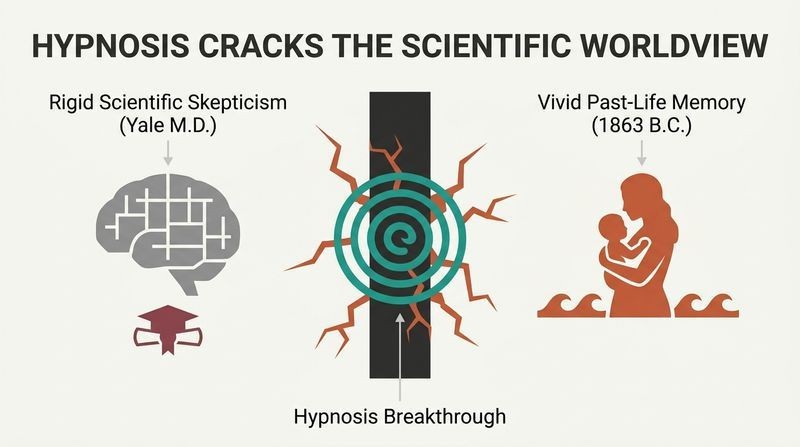
The credentials matter to the claim. Brian Weiss was no fringe mystic. He graduated Phi Beta Kappa from Columbia, earned his M.D. at Yale, chaired a major psychiatry department, and had published thirty-seven scientific papers in biological psychiatry and brain chemistry. He distrusted anything unprovable by traditional methods and dismissed parapsychology as farfetched.
Then came Catherine, a 27-year-old lab technician crippled by phobias, panic attacks, and nightmares. After eighteen months of conventional talk therapy failed, Weiss tried hypnosis. Instead of recalling childhood, she began describing herself as Aronda in 1863 B.C., drowning in a flood clutching her baby. The detail was too vivid, too specific, and too foreign to her Catholic upbringing to be fabricated. His scientific worldview cracked.
What gives this book its unusual grip is the author's resume, deployed as evidence. The implicit argument is a credibility syllogism: a rigorous scientist would not risk his reputation on fantasy, therefore the phenomenon must be real. Yet this is also its vulnerability. Credentials establish honesty, not correct interpretation. Hypnosis is now known to be a powerful generator of confabulation, and the same suggestibility that lifts phobias can manufacture vivid false memories, a concern researcher Elizabeth Loftus documented extensively. The reader is invited to weigh sincerity against mechanism. Weiss is almost certainly reporting honestly what he witnessed. Whether reincarnation is the best explanation remains the open question.
Symptoms rooted in past-life trauma dissolved when relived, not medicated
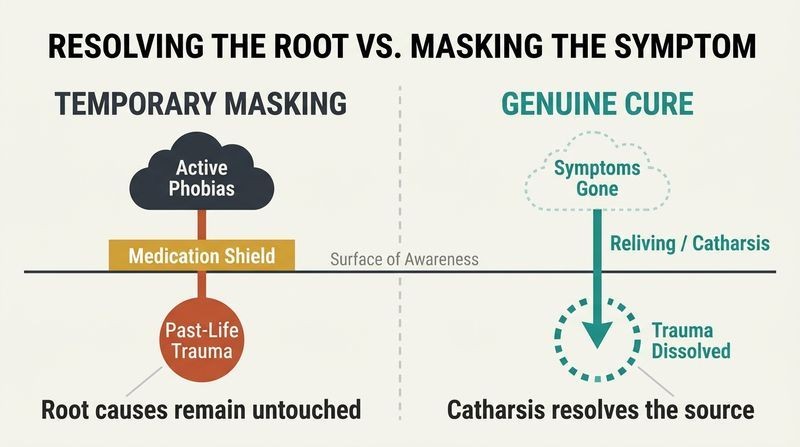
Reliving beat suppressing. Catherine feared water, choking, darkness, and enclosed spaces. Conventional therapy uncovered real childhood horrors, including sexual abuse by her drunk father at age three, yet her symptoms stayed intact. Only when she relived apparent past-life deaths did the phobias vanish.
After reliving Aronda's drowning, her lifelong fear of water disappeared. After hearing surgeons discuss her throat swelling during anesthesia, her choking terror lifted. In a few months, without drugs or group therapy, she was essentially cured, radiant, and calm. Weiss frames this against standard treatment: high-dose tranquilizers and antidepressants that merely mask symptoms. His point is that catharsis reaching the perceived origin of a fear can produce genuine cure rather than lifelong management.
Strip away the metaphysics and something clinically recognizable remains. Exposure and abreaction, confronting a feared memory until it loses charge, are foundational to trauma therapy from Freud through modern EMDR and prolonged exposure protocols. The narrative structure of a symptom having a discoverable origin story that, once told, releases its grip mirrors how the brain consolidates and reconsolidates memory. Whether the origin scene is a genuine past life or a symbolically potent narrative the mind constructs may matter less therapeutically than the emotional completion it provides. The provocative implication is that belief and vivid experiential reliving, not the literal truth of the memory, may drive healing.
Fearing death shrinks life; knowing you continue expands it
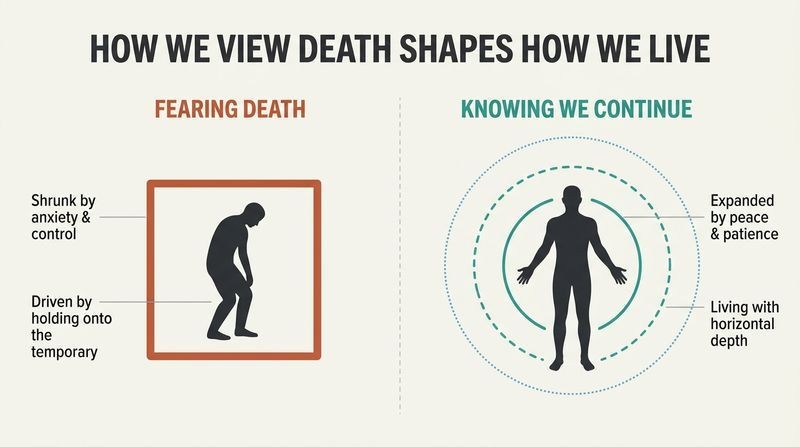
The core fear is death. Weiss argues that dread of dying is the hidden engine behind much human misery, driving midlife crises, obsessive accumulation, cosmetic surgery, affairs, and the frantic pursuit of youth. People are so busy avoiding death that they forget to live.
As Catherine's sessions convinced Weiss that consciousness survives, his own fear of death fell away. He became calmer, more patient, less controlling. A traffic jam that once enraged him became time to enjoy his son. The book's therapeutic thesis is that if people truly believed life is continuous, that we were never really born and never truly die, the anxiety at the root of greed, vengeance, and pettiness would loosen. The message is aimed not only at the dying but at the living.
This lands squarely in the territory of Terror Management Theory, the psychological research program showing that mortality reminders measurably increase defensiveness, materialism, and in-group bias. Ernest Becker's Pulitzer-winning The Denial of Death made the same claim Weiss makes: civilization is partly an elaborate defense against knowing we will die. Where secular psychology prescribes accepting finitude, Weiss offers the opposite balm, denying finitude entirely. Both routes aim at the same destination, reduced death anxiety and a life less governed by fear. The pragmatic question a reader might hold: does one need to believe in immortality to gain the peace, or merely to make peace with mortality?
Catherine channeled secret facts about Weiss's dead father and son
The moment that broke his skepticism. Between lives, in what Weiss calls the in-between state, Catherine's voice changed and she delivered information she could not possibly have known. She said his father was present, that his Hebrew name was Avrom, and that Weiss's infant son had died of a heart defect so his heart was backward, like a chicken's.
This was devastatingly accurate. Weiss's firstborn, Adam, died at 23 days from an extraordinarily rare condition (roughly one in ten million) in which the pulmonary veins entered the heart on the wrong side. His father Avrom had died of heart disease. Catherine, a simple lab technician who knew nothing of his private life, had no access to these facts. For Weiss this was proof no coincidence could explain.
This episode is the book's evidentiary keystone, and it is where readers divide sharply. It resembles a mediumship reading, and skeptics point to cold reading, unconscious cueing, and the fact that all verification runs through Weiss's own testimony with no independent controls. Weiss, trained to spot malingering and dissociation, insists none applied. The honest position acknowledges the account cannot be verified and cannot be dismissed by anyone not in the room. What is analytically interesting is how a single emotionally overwhelming data point, touching his deepest grief, overrode fifteen years of methodological training. Grief and evidence are hard to disentangle when the message concerns a lost child.
Souls reincarnate in groups to settle debts across lifetimes
We travel together. Across her regressions, Catherine repeatedly recognized people from her present life in ancient ones. Her niece Rachel was her daughter in Egypt. Her friend Judy was her daughter in wartime Germany. Stuart, her difficult lover, was the enemy soldier who slit her throat in a raiding party. The pediatrician Edward appeared again and again as her father.
Weiss presents the idea, drawn from the material, that clusters of souls reincarnate together to work through karma, defined as debts owed to others and unlearned lessons. Difficult relationships are not accidents but assignments. Her present father, who abused her, had failed to pay his debts and would have to return again, while her beloved grandfather had learned to love and moved forward. Relationships become curricula.
The group-soul concept reframes interpersonal conflict as pedagogy, which can be psychologically useful independent of its literal truth. Viewing a difficult person as a teacher rather than a tormentor is a cognitive reframe echoed in Stoicism, where Marcus Aurelius treated obstructive people as training in patience. The risk is fatalism or victim-blaming: if abuse is a karmic debt being repaid, does that excuse the abuser or burden the abused with cosmic responsibility? The book partly guards against this by having the Masters insist only God, not humans, may judge or punish. Still, the framework's power lies in transforming resentment into curriculum, a move with real therapeutic leverage.
Growth comes only through the flesh, where pain teaches
Why bother being born? The between-lives voices explain that learning happens faster in the spirit state, yet souls must repeatedly return to physical bodies because certain lessons require pain, relationships, and embodied experience that spirit form cannot provide. In spirit there is only peace and renewal; on earth there is the friction that forges wisdom.
A dominant vice or trait, greed, lust, anger, is assigned to each life to be overcome. Fail to master it, and you carry it into the next life alongside a new burden, making each successive life harder. Master it, and the next life is easier. You choose your re-entry, your circumstances, and your challenges. Physical existence is not punishment but a school deliberately designed with difficulty because difficulty is where growth occurs.
The claim that suffering is instrumental rather than meaningless resonates far beyond this book. Viktor Frankl, surviving Auschwitz, argued that finding meaning in unavoidable suffering is the defining human capacity. Post-traumatic growth research confirms that many people report deepened purpose after ordeal. Where Weiss's framework adds a twist is the notion of a self-authored curriculum: you selected these trials. This can be empowering or crushing depending on temperament. A counterpoint worth holding is that not all suffering ennobles; trauma also fragments, embitters, and destroys. The tidy moral economy in which every hardship yields a lesson risks glossing over senseless, uncompensated pain that teaches nothing.
Wisdom must be lived into the bones, not just understood
Knowing is not enough. A recurring theme in the messages, and in Weiss's later dream-lectures from a teacher named Philo, is that intellectual knowledge must be transformed into emotional, subconscious knowledge through repeated practice before it becomes permanent. Reading about love and charity in Sunday school changes nothing. You must act it, feel it, habituate it.
The metaphor: theoretical knowledge without practical application withers and fades. Behavioral practice is the catalyst that makes an insight permanent. This explains Catherine's frustrating gap: in trance she was profoundly wise, diagnosing her own flaws and others', yet awake she was anxious and superficial and could not access it. Insight alone did not transform her; the reliving and repeated experience did. Virtue, in this view, is a trained habit, not a memorized concept.
This is one of the book's most defensible and least mystical claims, and it aligns with Aristotle's virtue ethics: we become just by doing just acts, courageous by doing courageous ones. Modern skill-acquisition and habit research says the same, that declarative knowledge becomes procedural only through repetition. The gap between Catherine's trance wisdom and waking anxiety also dramatizes a real clinical puzzle: intellectual insight in therapy famously fails to produce behavior change on its own, which is why experiential and somatic modalities emphasize felt, embodied processing over mere understanding. Stripped of reincarnation, this is sound cognitive science: knowing what to do and being able to do it are different achievements.
Every person hides a flawless thousand-faceted diamond under grime
Radical equality beneath appearances. In a dream-vision, Weiss received an answer to how all souls can be equal despite obvious differences in talent, virtue, and intelligence. Imagine each person contains a diamond a foot long with a thousand facets, each caked in dirt and tar. The soul's work across lifetimes is to clean each facet until it blazes.
Some people have cleaned many facets and shine brightly; others have cleaned only a few. But beneath the grime, every diamond is identical and utterly perfect, with no flaws. The visible inequalities among people are merely different stages of cleaning, not differences in essential worth. When all facets are polished, the diamond dissolves back into pure conscious energy, a rainbow of light. Judging others by their current shine misses the perfect gem beneath.
The diamond image offers a compelling reconciliation of an ancient philosophical tension: how to honor obvious human differences while affirming fundamental equality. It parallels the Quaker notion of an inner light in everyone and the Hindu atman, the divine self identical in all beings. Practically, it undergirds the book's ethic against judging: if the person before you is a perfect diamond mid-cleaning, contempt makes no sense. The developmental framing also echoes humanistic psychology's belief in an actualizing tendency beneath dysfunction. A skeptic might note the metaphor is unfalsifiable, but as a working stance toward other people, seeing potential perfection under accumulated damage, it is quietly transformative and hard to weaponize.
Nature stays balanced; humans destroy through excess and will pay
Harmony is the forgotten foundation. The Masters warned that nature lives in balance, beasts kill only what they need, plants are consumed and regrow, while humans do everything to excess: eating, drinking, worrying, running, accumulating, even helping. This chronic imbalance, driven by greed, ambition, and fear, will eventually lead humanity to destroy itself, though nature and the plants will survive.
Happiness, the messages insist, is rooted in simplicity. Excess clouds basic values and diminishes joy. The prescription is neither asceticism nor indulgence but the middle path of balance and moderation across thought and action. Weiss connects this to a humbler life focus, shifting from accumulation toward humanistic values. The warning is stark and pessimistic about collective human behavior, yet the individual remedy is gentle: reclaim harmony by refusing the cultural pull toward more.
The balance-and-moderation teaching is essentially the Buddhist middle way and the Greek ideal of nothing in excess, dressed in ecological language decades before climate anxiety became mainstream. The observation that humans uniquely violate ecological equilibrium anticipates the Anthropocene discourse and planetary-boundaries science. What is notable is the fatalism: the messages say destruction cannot be stopped because you cannot reach everyone. This is more resigned than modern environmentalism, which insists collective action can alter the trajectory. The tension between individual spiritual balance and collective systemic change goes unaddressed; polishing one's own diamond does little to decarbonize an economy. As personal philosophy it is wise, as social prescription incomplete.
An independent psychic reading matched Catherine's regressions in stunning detail
A second channel, same data. After therapy ended, Catherine visited Iris Saltzman, a psychic astrologer, giving only her birth date, time, and place, and nothing about her sessions. Iris independently described a young man whose throat was cut in wartime, a sailor in short pants and buckled shoes with a wounded left hand from a sea battle off England, a Spanish prostitute whose name began with L, and an Egyptian involved in burial rites with braided hair.
These matched Johan, Christian, Louisa, and Aronda, the exact lifetimes Catherine had reported under hypnosis. Weiss offers this as convergent evidence while remaining careful: he says it was not a controlled experiment, and Iris may have read Catherine's mind telepathically rather than accessed real past lives. Either way, two different methods reached identical content.
Weiss deserves credit for flagging the confound himself: if telepathy is granted, Iris could simply have read memories already stored in Catherine's mind, which would confirm psychic ability but not reincarnation. The episode illustrates a persistent problem in parapsychology, that multiple extraordinary hypotheses become mutually contaminating, making clean tests nearly impossible. It also shows selective matching: readers naturally notice hits and forget misses, the same cognitive bias that sustains horoscopes and cold reading. Weiss's call for rigorous methodology, hypotheses tested under controlled, replicable conditions, is the intellectually honest response, and he names serious researchers like Ian Stevenson, whose careful case studies of children with verified past-life memories represent the field's more defensible edge.
Highly trained professionals hide their psychic experiences out of fear
The closet of the credentialed. As Weiss cautiously shared his story, he discovered how common paranormal experiences are among accomplished people who never speak of them. A respected clinical department chairman spoke with his dead father, who had warned him of danger. A professor solved research problems in dreams. A psychologist navigated Rome flawlessly on her first visit, as if from memory, and was repeatedly mistaken for a native.
Weiss's point is that these events are far more frequent than believed; they only seem rare because people fear being labeled odd. The more elite the training, the greater the reluctance, because scientific education runs opposite to such experiences. He counted himself among the silent. His decision to publish, risking his reputation, was framed as breaking this professional taboo so others could speak.
The sociological observation is sharp and probably accurate: surveys consistently find that large fractions of the general public report anomalous experiences like premonitions or sensing a deceased loved one, yet reporting drops among those whose professional identity depends on rationalist norms. This is a spiral of silence, where perceived isolation enforces continued silence even when the experience is widespread. The dynamic is real regardless of what causes the experiences themselves, which may range from grief hallucinations and coincidence to genuine anomalies. Weiss frames disclosure as courage, echoing how stigmatized experiences from mental illness to near-death episodes gain legitimacy only when respected figures risk speaking first. Testimony from the credentialed shifts what counts as sayable.
The therapist's job is to erase fear, the greatest weapon
Fear stifles the soul's purpose. The original Master Spirit told Weiss he was on the right path: the proper treatment is to eradicate fear from people's minds, because fear wastes the energy needed to fulfill why one was sent here. To reach someone, you must guide them to a level so deep they no longer feel the body, because troubles live on the surface while ideas are created deep within the soul.
The volcano metaphor captures it: the center of the mountain is calm; only the outside erupts in trouble. Humans see only the surface, but healing requires going deep. Weiss extended this beyond phobias into grief and death-and-dying counseling, guiding his dying mother-in-law Minette through a peaceful death. His clinical mission became connecting two worlds, the physical of the five senses and the nonphysical of the soul.
The idea that surface symptoms mask deeper generative structures is standard depth psychology, from Freud's iceberg to modern schema and parts-based therapies. What Weiss adds is positioning fear, specifically death fear, as the master variable whose removal cascades into healing across domains. This is testable in spirit: interventions that reduce existential anxiety, such as psilocybin-assisted therapy for terminal cancer patients, have produced dramatic, durable drops in death dread and depression, some of the most striking results in modern psychiatry. That convergence lends unexpected empirical weight to the book's central therapeutic wager. Whether the mechanism is metaphysical revelation or profound altered-state reframing, dissolving the fear of death appears genuinely to transform how people live.
Analysis
Many Lives, Many Masters is a memoir-as-argument, structured around the verbatim transcripts of a single patient's hypnotic regressions and the philosophical messages delivered from what Weiss calls the in-between state. Its persuasive engine is not data but authorial transformation: a rigorously trained biological psychiatrist narrates his own conversion from materialist skeptic to believer, inviting readers to make the same journey through his eyes. The book's difficulty for a summarizer is that its evidence is inseparable from its testimony. Nothing was independently verified; everything rests on Weiss's honesty and interpretive frame.
Read as spirituality, it is a synthesis of perennial ideas, karma, group souls, spiritual planes, radical equality, the middle way, drawn eclectically from Hindu, Buddhist, kabbalistic, and Gnostic sources and delivered with the reassuring authority of a Yale M.D. Read as psychology, it is more interesting than its metaphysics suggests. The therapeutic core, that reaching and reliving the felt origin of a fear produces cure where symptom suppression fails, that death anxiety is a master variable, that virtue must be practiced into habit rather than merely understood, aligns with abreactive trauma therapy, Terror Management Theory, and Aristotelian virtue ethics. Modern psilocybin research on death anxiety in terminal patients unexpectedly vindicates the book's central wager that dissolving mortality dread transforms living.
The honest critical stance is neither debunking nor endorsement. Hypnosis reliably generates vivid confabulation; the father-and-son revelation, though emotionally overwhelming, cannot be checked; convergent psychic confirmation is confounded by telepathy and selective matching. Weiss himself repeatedly names these alternatives and calls for controlled, replicable study, which is more scientific humility than critics grant him. The book's lasting value lies less in proving reincarnation than in modeling how loosening the grip of death fear, by whatever means, frees people to live with patience, love, and simplicity. That prescription stands regardless of what one concludes about the Masters.
Review Summary
Many Lives, Many Masters receives mixed reviews. Some readers find it life-changing and enlightening, praising its spiritual insights and potential to reduce fear of death. Others criticize it as unscientific and lacking evidence, questioning the credibility of past-life regression therapy. Skeptics point out inconsistencies and implausibilities in the patient's accounts. However, many readers appreciate the book's thought-provoking nature, even if they don't fully believe the content. The book's impact seems to depend largely on the reader's openness to spiritual concepts and willingness to suspend disbelief.
People Also Read


FAQ
What's "Many Lives, Many Masters" about?
- Past-life therapy exploration: "Many Lives, Many Masters" by Brian L. Weiss explores the concept of past-life therapy through the true story of a psychiatrist and his patient, Catherine, who recalls past-life traumas during hypnosis.
- Spiritual awakening: The book details Dr. Weiss's unexpected spiritual awakening as he navigates the unconventional territory of reincarnation and spiritual messages.
- Therapeutic breakthrough: It highlights how past-life therapy led to the resolution of Catherine's chronic fears and anxieties, which traditional psychotherapy couldn't alleviate.
- Integration of science and metaphysics: The narrative bridges the gap between science and metaphysics, challenging conventional psychiatric practices.
Why should I read "Many Lives, Many Masters"?
- Unique therapeutic insights: The book offers a unique perspective on therapy, suggesting that past-life regression can be a powerful tool for healing psychological issues.
- Spiritual exploration: It provides an intriguing exploration of spiritual concepts like reincarnation, the afterlife, and the existence of spiritual guides or Masters.
- Personal transformation: Readers can gain insights into overcoming fears and anxieties, as demonstrated by Catherine's transformation.
- Thought-provoking narrative: The book challenges readers to consider the possibility of life beyond death and the continuity of the soul.
What are the key takeaways of "Many Lives, Many Masters"?
- Reincarnation as therapy: Past-life regression can uncover deep-seated traumas and lead to significant psychological healing.
- Spiritual guidance: The existence of spiritual guides or Masters who provide wisdom and guidance from beyond the physical realm.
- Fear of death: Understanding and accepting the concept of reincarnation can diminish the fear of death and enhance the quality of life.
- Interconnectedness of lives: The book suggests that our current lives are influenced by past experiences and that we are all interconnected through our spiritual journeys.
How did past-life therapy help Catherine in "Many Lives, Many Masters"?
- Resolution of fears: Catherine's chronic fears and anxieties, which were resistant to traditional therapy, were alleviated through past-life regression.
- Understanding of trauma: By recalling past-life traumas, Catherine gained insights into the root causes of her current-life symptoms.
- Spiritual growth: The therapy facilitated a spiritual awakening, leading to a more peaceful and fulfilled life.
- Improved relationships: Catherine's newfound understanding and inner peace positively impacted her relationships and interactions with others.
What role do the Masters play in "Many Lives, Many Masters"?
- Guidance and wisdom: The Masters are highly evolved spiritual entities who provide guidance and wisdom to Catherine and Dr. Weiss during the sessions.
- Messages from beyond: They communicate profound messages about life, death, and the purpose of human existence.
- Facilitators of healing: The Masters help facilitate Catherine's healing by revealing truths about her past lives and spiritual journey.
- Connection to the divine: They represent a connection to a higher spiritual realm, offering insights that transcend conventional understanding.
What are the best quotes from "Many Lives, Many Masters" and what do they mean?
- "By knowledge we approach God": This quote emphasizes the importance of learning and understanding as a path to spiritual enlightenment and connection with the divine.
- "Life is endless; so we never die; we were never really born": It highlights the concept of the eternal soul and the continuity of life through reincarnation.
- "Patience and timing … everything comes when it must come": This quote underscores the importance of patience and trusting the natural flow of life and spiritual growth.
- "We are all the same. One is no greater than the next": It reflects the book's message of equality and interconnectedness among all souls.
How does Dr. Weiss's perspective change in "Many Lives, Many Masters"?
- Skeptic to believer: Initially skeptical, Dr. Weiss becomes a believer in reincarnation and spiritual dimensions through his experiences with Catherine.
- Integration of science and spirituality: He learns to integrate scientific methods with spiritual insights, expanding his therapeutic approach.
- Personal transformation: The experience leads to a personal transformation, making him more patient, empathetic, and spiritually aware.
- Professional impact: Dr. Weiss's newfound beliefs influence his professional practice, leading him to explore and document similar cases.
What is the significance of the title "Many Lives, Many Masters"?
- Multiple lifetimes: The title reflects the concept of reincarnation, where individuals live multiple lives across different times and places.
- Guidance from Masters: It highlights the role of spiritual Masters who guide and teach souls through their various incarnations.
- Journey of learning: The title suggests a journey of learning and growth through many lifetimes, guided by the wisdom of the Masters.
- Interconnected experiences: It emphasizes the interconnectedness of past lives and the influence of spiritual guidance on personal development.
How does "Many Lives, Many Masters" challenge conventional psychotherapy?
- Introduction of past-life therapy: The book challenges traditional psychotherapy by introducing past-life regression as a therapeutic tool.
- Spiritual dimensions: It incorporates spiritual dimensions and metaphysical concepts, which are often excluded from conventional therapy.
- Holistic healing: The narrative advocates for a holistic approach to healing, addressing both psychological and spiritual aspects.
- Questioning scientific boundaries: It questions the boundaries of science and encourages openness to alternative methods of understanding the mind and soul.
What are the spiritual lessons conveyed in "Many Lives, Many Masters"?
- Overcoming fear: The book teaches that understanding the continuity of the soul can help overcome the fear of death and other anxieties.
- Importance of love and forgiveness: It emphasizes the importance of love, forgiveness, and compassion in personal and spiritual growth.
- Learning from past experiences: The narrative suggests that learning from past experiences, both in this life and previous ones, is crucial for spiritual evolution.
- Interconnectedness of all beings: It conveys the message that all beings are interconnected and that our actions impact others across lifetimes.
How does "Many Lives, Many Masters" address the concept of immortality?
- Eternal soul: The book presents the idea that the soul is eternal and continues to exist beyond physical death through reincarnation.
- Life as a learning journey: It portrays life as a journey of learning and growth, with each lifetime offering opportunities for spiritual development.
- Diminishing fear of death: By understanding immortality, individuals can diminish their fear of death and embrace life more fully.
- Connection to the divine: The concept of immortality is linked to a connection with the divine, suggesting that spiritual growth leads to a closer relationship with God.
What impact did "Many Lives, Many Masters" have on Dr. Weiss's career and life?
- Shift in therapeutic approach: Dr. Weiss's experiences with Catherine led him to incorporate past-life therapy into his practice, expanding his therapeutic approach.
- Increased intuition: He developed a heightened sense of intuition and empathy, enhancing his ability to connect with and heal patients.
- Personal transformation: The experience transformed his personal life, making him more patient, loving, and spiritually aware.
- Advocacy for open-mindedness: Dr. Weiss became an advocate for open-mindedness in the scientific and therapeutic communities, encouraging exploration of spiritual dimensions.
About the Author
Other books by Brian L. Weiss

Download PDF
Download EPUB
.epub digital book format is ideal for reading ebooks on phones, tablets, and e-readers.








































