

Key Takeaways
A free press can propagandize more effectively than a censored one
The book's central claim inverts common sense. In authoritarian states, monopoly ownership and official censorship make media servility obvious. In the United States, where outlets compete, expose corporate malfeasance, and celebrate themselves as watchdogs, the propaganda function is invisible, and therefore far more potent. Herman and Chomsky argue the media serve the powerful interests that own and finance them.
The mechanism is not conspiracy but selection. Owners rarely issue orders. Instead they hire right-thinking personnel who internalize what counts as newsworthy. Dissent and inconvenient facts appear, but stay 'at the margins,' small enough not to disturb the official agenda. Because the system looks open and adversarial, audiences trust it, which makes a patriotic agenda more credible than any commissar could achieve through overt control.
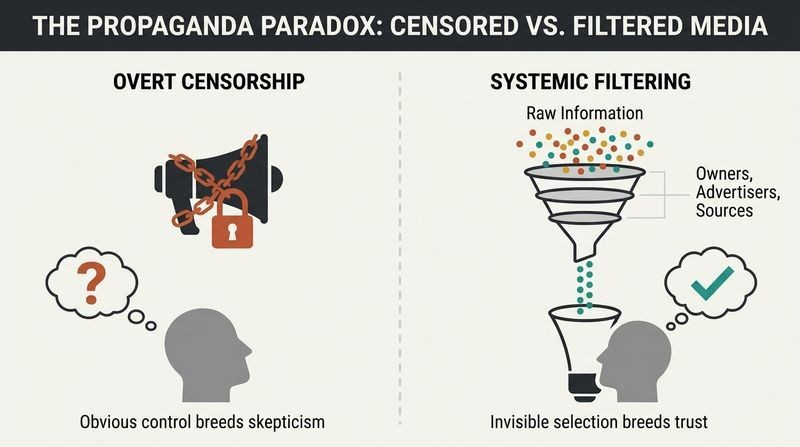
The framing echoes Walter Lippmann, who in the 1920s praised the deliberate 'manufacture of consent' by a specialized class, and Antonio Gramsci's concept of cultural hegemony, where rule operates through consent rather than coercion. What's striking is the authors' insistence that sincerity and servility coexist: journalists can feel entirely free while conforming, because the constraints are structural, not felt. Critics counter that the model is too deterministic and underrates journalistic agency and elite disagreement. The authors concede limited autonomy exists but argue it functions as a pressure valve, demonstrating openness while leaving the dominant frame untouched.
Five filters screen the news before it ever reaches you
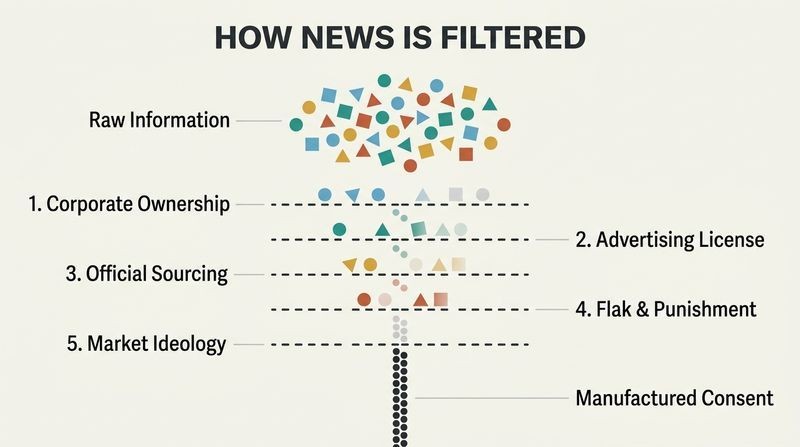
The propaganda model is a set of filters that raw news must pass through, leaving only a 'cleansed residue.' They are:
1. Concentrated corporate ownership and profit orientation (a handful of wealthy giants set the agenda)
2. Advertising as the primary revenue source
3. Reliance on government and corporate sources plus approved 'experts'
4. Flak (organized punishment for straying)
5. Anticommunism, later broadened to faith in 'the miracle of the market'
These reinforce one another automatically. Ben Bagdikian tracked the collapse from 50 dominant firms in 1983 to 23 by 1990 to just 9 global conglomerates by 2000. The filters explain not just individual stories but what becomes newsworthy at all, and why journalists operating 'with complete integrity' still produce systematically biased results.
The model's durability is its most impressive feature. Its logic predicts outcomes without requiring memos or villains, which makes it falsifiable in a way conspiracy theories are not: track the coverage and see if it dichotomizes by power interest. The fifth filter proves the most dated in wording but most adaptable in substance. Anticommunism has faded, yet the underlying function, an enemy or ideology that disciplines dissent, persists (terrorism, market fundamentalism). The framework anticipates later media-economics scholarship by Robert McChesney and echoes Herbert Gans's finding that journalists share 'enduring values' like responsible capitalism that quietly bound acceptable opinion.
You are not the customer; advertisers buy you as the product
Advertising is a licensing authority that decides which outlets live. Before ads, a paper's price had to cover its costs. Once advertisers subsidized copies, ad-carrying papers could undercut rivals, drive them to the margins, and kill them. The market accomplished what British taxes and libel prosecutions had failed to do in the 19th century: it eliminated the radical working-class press.
The casualty list proves it. Britain's Daily Herald had 4.7 million readers in its final year, nearly double the combined readership of The Times, Financial Times, and Guardian, and its readers were more loyal. It died anyway, because working-class audiences lacked buying power advertisers wanted. Advertisers also avoid 'serious complexities and disturbing controversies' that interrupt the buying mood, steadily pushing programming toward light entertainment.
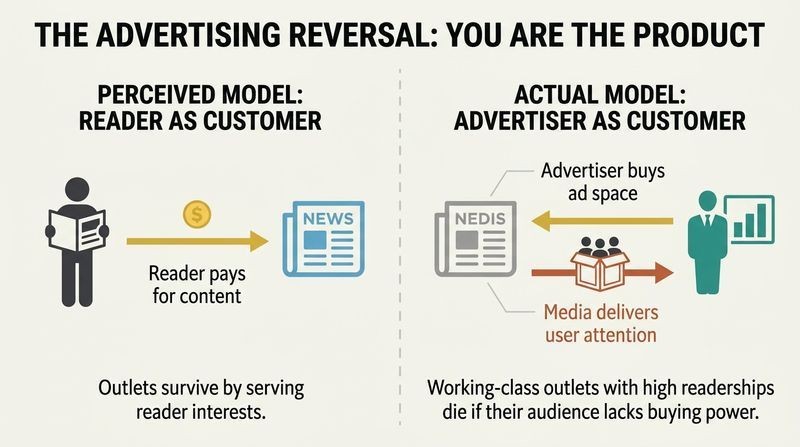
This reframes the entire economics of journalism: outlets compete to deliver affluent audiences to businesses, so 'the drive for large audiences' is really a voting system weighted by income. The insight predates and outshines many later 'attention economy' critiques by locating the bias in who pays rather than merely what engages. It also illuminates the slow death of investigative and public-affairs programming, which is expensive, controversial, and bad for the selling environment. A nuance worth adding: subscription and paywall models (and some public broadcasting) partially escape this filter, which is why the authors champion noncommercial media as a structural remedy, not just a moral one.
Governments and corporations subsidize the news, then discipline it with flak
Media need a cheap, reliable flow of copy, and the powerful provide it. The White House, Pentagon, and State Department are bureaucracies engineered to feed newsrooms: prewritten releases, scheduled press conferences timed to deadlines, and 'photo opportunities.' The U.S. Air Force alone ran a public-information operation dwarfing entire dissenting movements. By one count cited, there are 20,000 more public-relations agents doctoring the news than journalists writing it. Officials are treated as presumptively credible; refugees and dissidents must fight for access.
Flak is organized punishment for deviation. It arrives as letters, lawsuits, advertiser boycotts, and think-tank attacks. Corporate-funded outfits like Accuracy in Media and Freedom House exist largely to browbeat the media toward the establishment line, conditioning outlets to expect costly trouble whenever they challenge power.
Mark Fishman's 'principle of bureaucratic affinity' (only bureaucracies can satisfy the input needs of a news bureaucracy) undergirds this filter, and modern research confirms that a large share of news originates in press releases. The 'experts' point is subtly powerful: by funding think tanks and consultancies, powerful interests manufacture the very authorities the media then quote as independent. The dynamic has intensified since publication, as newsroom cuts increase dependence on subsidized content while the public-relations industry balloons. The one-sided nature of flak matters too: right-wing pressure machines have historically enjoyed resources and access that grassroots critics cannot match, tilting the correction mechanism itself.
A murdered priest in Poland outweighed a hundred murdered in Latin America
The media assign human worth by political utility. Victims of official enemy states are 'worthy' and receive intense, indignant, detailed coverage. Victims of the United States or its client regimes are 'unworthy' and get antiseptic, buried, brief treatment. The evidence is quantitative. Polish priest Jerzy Popieluszko, murdered by communist police in 1984, received more coverage in the New York Times, Time, Newsweek, and CBS than the combined total for 100 religious figures murdered in U.S. client states, some of them American citizens. A worthy victim was valued at roughly 137 to 179 times an unworthy one.
The pattern extends to language. Media apply 'genocide' freely to enemies (Serbs, Saddam's Iraq) and rarely to allies committing comparable or worse abuses (Turkey's Kurds, Indonesia's East Timor).
The worthy/unworthy dichotomy is the book's most testable and most replicated finding, because it isolates comparable atrocities and measures column inches. The genius is the controlled comparison: same crime (a murdered cleric), radically different coverage, with the only variable being who did the killing. The deeper claim is functional: focusing on enemy victims manufactures moral energy for intervention while silence on client-state victims lets allied terror proceed unburdened. A fair challenge is that proximity, source access, and audience familiarity also shape coverage, but the authors preempt this by noting Poland was farther away and less connected to the U.S. than Central America, and that credible refugee testimony on unworthy victims was readily available and ignored.
The same election is 'a step toward democracy' or 'a sham' depending on who holds power
Third-world elections are the propaganda model's cleanest test. Elections in favored client states get legitimized regardless of conditions; elections in disfavored states get discredited regardless of facts. In El Salvador (1982, 1984) and Guatemala (1984-85), voting happened amid ongoing state terror, with roughly 700 civilians murdered monthly, rebels off the ballot by threat of death, no free press, and legally required voting. Media celebrated long lines and turnout as democratic triumphs.
Nicaragua's 1984 election met the opposite fate. Despite superior conditions (no state massacres, secret ballots, no legal duty to vote, a wide spectrum of parties), and despite the Latin American Studies Association calling it 'a model of probity and fairness,' the media echoed Washington's line that it was a farce. Coverage tracked the government's shifting agenda, not electoral reality.
The tables comparing which topics the New York Times raised for each election are damning: fundamental conditions (press freedom, ability of candidates to run, state terror) were 'off the agenda' for client states and suddenly central for Nicaragua, sometimes within the same reporter's work. This exposes how framing, not fabrication, does the ideological labor. Secretary Shultz even articulated the double standard openly, insisting elections require pre-conditions like free assembly, criteria never applied to Salvadoran voting. The episode also reveals the ritual function of official election observers, dispatched to certify fairness on the basis of smiling faces and long lines while ignoring the terror that shaped the outcome in advance.
This is not a conspiracy theory; it is closer to free-market economics
The authors reject the 'conspiracy' label as an evasion. Their model is structural, not clandestine. Most biased choices arise from the preselection of right-thinking people, internalized assumptions, and adaptation to the constraints of ownership, market, and political power. Censorship is largely self-censorship by reporters who adjust to source requirements and by editors chosen because they have already internalized the constraints.
They call it a 'guided market system.' Powerful actors do take initiatives to shape news, and being few in number they can act jointly like sellers in a concentrated market. But mostly, media leaders 'do similar things because they see the world through the same lenses.' Where elites disagree on tactics, vigorous debate appears; where they agree, alternatives simply vanish from view without anyone forbidding them.
Dismissing institutional critique as 'conspiracy theory' remains a standard rhetorical move, which is precisely why this distinction matters. The model is emergent, like a market price: no one dictates it, yet it reliably produces a result serving concentrated interests. This aligns it with sociological accounts of how institutions reproduce themselves through incentives and socialization rather than intent. The framework's honesty about elite disagreement is important and often overlooked by both fans and detractors. When investors or policymakers split, as over Vietnam tactics after 1968, the media open up, but only within bounds that never question the benevolence of ultimate aims. The debate is over means, never over the right to intervene.
The U.S. attacked South Vietnam, a fact no mainstream outlet could name
Apply the standard used for Soviet aggression, and Indochina looks different. The Soviet invasion of Afghanistan was covered from the victims' standpoint and called aggression without hesitation. The U.S. war in Vietnam was covered from Washington's standpoint and framed as a noble if flawed defense of South Vietnam against aggression, even as the United States imposed a client regime it knew lacked popular support and bombed the southern population it claimed to protect.
The authors argue the framing was total. Across vast coverage and commentary, they could find essentially no mainstream report describing the war as U.S. aggression. The most a critic like Anthony Lewis could say was that intervention 'began with blundering efforts to do good.' Debate ranged only from hawks (it can succeed) to doves (too costly), never to the principled ground that aggression is wrong.
This is the model's most uncomfortable application, because it targets not fabrication but the unexamined premise built into every sentence. The comparison method (how would Pravda cover the same event?) is a rigorous device for exposing invisible bias, since one culture's obvious framing looks absurd from outside. The deeper point about intellectual culture is Orwellian: certain conclusions are not refuted but literally unthinkable, absent from the range of expressible opinion. A useful nuance is that this reveals a limit of the model's own reach. Even at peak antiwar sentiment, the principled critique circulated only in marginal outlets, suggesting the doctrinal system operates on educated elites even more tightly than on the general public.
The Tet coverage that supposedly lost the war actually tracked the generals
The claim that a hostile press 'lost' Vietnam collapses on inspection. The influential Freedom House study by Peter Braestrup argued that overly pessimistic, adversarial coverage of the 1968 Tet offensive turned the public and undermined the war. The authors dismantle both halves. Its own polling chapter showed public opinion, if anything, shifted more hawkish during the period of alleged media pessimism, then continued a slow drift dovish it had followed for years.
On accuracy, reporters were less alarmed than officials. Media assessments closely matched, and were often milder than, internal evaluations by the CIA, the Joint Chiefs, and Johnson's own 'Wise Men,' who privately concluded the war was a stalemate. Walter Cronkite plainly reported Tet as a military defeat for the communists. The media never left Washington's framework; the charge of excess independence is the opposite of the truth.
The Tet case is decisive because critics chose it as their strongest example, so refuting it refutes the broader 'adversarial media' thesis on its home ground. The logical trap the authors expose is elegant: if television were powerful enough to lose the war, it also encouraged support through 1967, when coverage was cheerily pro-war. The Freedom House standard turns out to demand that a free press be more upbeat than the nation's own intelligence services, an implicitly totalitarian conception of the media's duty. The episode illustrates the flak filter in action: a well-funded institution manufacturing a durable myth that then disciplines future coverage toward even greater conformity.
An implausible plot to kill the Pope became truth by repetition
When a story is useful, evidence becomes optional. After a Turkish fascist shot Pope John Paul II in 1981, the media, led by Reader's Digest writer Claire Sterling and ex-CIA official Paul Henze, built a 'KGB-Bulgarian plot' narrative. It rested on a confession the gunman produced only after seventeen months in an Italian prison, with access to newspapers, visits from intelligence agents, and clear inducements, and which he repeatedly retracted. No money, car, or witness to the alleged Bulgarian meetings was ever found.
The media accepted it with 'astonishing gullibility.' The same reporters who would demand rigorous proof for any charge against the United States relayed the Bulgarian story uncritically, excluded the obvious alternative (that the gunman was coached), and, when an Italian court dismissed the case for lack of evidence, offered no reassessment or apology.
This case study shows the model's prediction that system-supportive claims face no evidentiary standard while system-challenging claims face impossibly high ones. The 'alternative model' the authors propose (coaching in prison) is not exotic; it is exactly the skepticism U.S. media would reflexively apply to an analogous Moscow show trial implicating American diplomats. The domination of coverage by a tiny set of ideologically reliable 'experts,' amplified by Reader's Digest and think tanks, demonstrates the sourcing filter creating authorities from thin air. The refusal to revisit debunked stories, a pattern the authors note across the Bulgarian plot, Yellow Rain, and MIGs to Nicaragua, suggests the correction mechanism itself is filtered by utility.
The watchdog barks only when the powerful are the ones threatened
Watergate reveals what actually scandalizes the media. The break-in targeted the Democratic Party, an institution of powerful business-backed interests, so it became a defining scandal. Meanwhile, the same era exposed the FBI's decade-long illegal campaign (COINTELPRO) to disrupt the legal Socialist Workers Party and other marginal groups, including complicity in a Black Panther's assassination. Because the victims lacked power, there was no comparable outrage.
Nixon's enemies list, naming powerful people who suffered no real harm, dominated coverage; the government's actual crimes against the powerless did not. The lesson: the press defends elite prerogatives vigorously, but tolerates or ignores illegality when the cost falls on marginal groups or distant foreign victims. The Iran-contra affair repeated the pattern, treating violated congressional prerogatives as the scandal while the 200,000 deaths from U.S.-backed Central American terror passed without inquiry.
This is the sharpest rebuttal to the media's self-image, and it uses the establishment's own proudest example against it. History supplied a near-perfect controlled experiment: two simultaneous sets of government crimes, one against the powerful and one against the powerless, with opposite coverage. The insight generalizes into a diagnostic anyone can apply: measure indignation against the power of the victim, not the severity of the crime. It also explains why Nixon overreached, lulled by a watchdog that had never bitten him for far graver abuses against dissidents and Cambodians. The framework does not deny real journalistic courage; it locates the boundary of that courage precisely at the edge of elite consensus.
Analysis
Manufacturing Consent (1988, with major updates through 2008) is a thesis-driven work of political economy, not media criticism in the conventional sense. Its ambition is structural: to show that a privately owned, competitive, censorship-free press systematically serves concentrated power, and to prove it through paired case studies chosen as hard tests. The difficulty in summarizing it lies in that architecture. The propaganda model is simple; its evidentiary base (Popieluszko versus Latin American clergy, Salvadoran versus Nicaraguan elections, the Bulgarian plot, Indochina, Tet) is dense, comparative, and quantitative. Strip the cases and the model sounds like assertion; keep them and the model becomes hard to dismiss.
The book's enduring contribution is methodological. By insisting on controlled comparisons (same crime, same year, different perpetrator) the authors convert a slippery claim about bias into something measurable. This is why the worthy/unworthy victims finding has replicated so well and why the model outlives its Cold War vocabulary. The fifth filter, anticommunism, reads as dated, but its function (a mobilizing enemy that disciplines dissent) transfers cleanly to the war on terror and to market fundamentalism, as the authors themselves note in updates addressing Iraq and Iran coverage.
The model has real limits. It is strongest on foreign policy and elite consensus, weaker where elites genuinely split or where audiences resist. It underweights journalistic agency, the role of professional norms as partial checks, and the possibility of coverage that is bad for entirely non-ideological reasons (laziness, deadline pressure, sensationalism). Critics reasonably note it can be applied so flexibly as to explain any outcome. Yet the authors' framing as 'guided market' rather than conspiracy insulates it from the easiest rebuttals. In the fragmented digital era, concentration has intensified even as a 'second superpower' of networked dissent emerged, leaving the model contested but far from refuted. Read today, its most transferable gift is a habit of mind: ask who benefits from a given frame, and notice what never becomes a question at all.
Review Summary
Manufacturing Consent received mixed reviews, with many praising its thorough analysis of media bias and propaganda in US foreign policy. Readers found the book eye-opening and relevant, highlighting how media serves powerful interests. Some criticized its dense writing and outdated examples. The propaganda model's five filters were seen as insightful, though some felt the book overlooked other factors influencing media. While considered a classic in media criticism, readers noted its repetitive nature and suggested it could benefit from updated examples to maintain relevance.
People Also Read





FAQ
What's Manufacturing Consent about?
- Media's Role: Manufacturing Consent by Edward S. Herman and Noam Chomsky explores how mass media serves as a tool for powerful interests, shaping public perception and opinion.
- Propaganda Model: The book introduces the "Propaganda Model," which suggests that news is filtered through various biases such as ownership, advertising, and government influence.
- Case Studies: It uses historical events, like the Vietnam War and the coverage of El Salvador, to illustrate how media narratives align with elite interests.
Why should I read Manufacturing Consent?
- Critical Perspective: The book challenges the notion of an independent press, revealing how media serves elite interests.
- Understanding Propaganda: It helps readers understand the mechanisms of propaganda and how public opinion is shaped by media narratives.
- Influential Work: As a seminal text in media studies, it has influenced scholars, journalists, and activists, making it essential for media literacy and political communication.
What are the key takeaways of Manufacturing Consent?
- Propaganda Model: The book introduces a model explaining how media filters information based on ownership, advertising, sourcing, and powerful interests.
- Worthy vs. Unworthy Victims: It highlights the disparity in media coverage between victims aligned with U.S. interests and those harmed by U.S. actions.
- Media's Structural Constraints: The authors argue that media performance is shaped by structural factors, limiting dissent and promoting a narrow range of viewpoints.
What is the "Propaganda Model" defined in Manufacturing Consent?
- Analytical Framework: The "Propaganda Model" explains how media serves powerful societal groups by filtering news through various biases.
- Five Filters: It identifies five filters: ownership, advertising, sourcing, flak, and anticommunism as a control mechanism.
- Impact on News: This model suggests that media choices are influenced by these filters, leading to a systematic bias in favor of elite interests.
How do the authors illustrate the concept of "worthy" and "unworthy" victims in Manufacturing Consent?
- Case Comparisons: Herman and Chomsky compare media coverage of Jerzy Popieluszko, a Polish priest, with that of numerous religious victims in Latin America.
- Quantitative Analysis: They provide data showing Popieluszko received more media attention than the collective coverage of unworthy victims.
- Emotional Framing: Coverage of worthy victims is often filled with emotional language, while unworthy victims receive minimal detail.
How does Manufacturing Consent analyze media coverage of the Vietnam War?
- Selective Reporting: The authors argue that media coverage was biased, often portraying the U.S. as a liberator while downplaying civilian impact.
- Focus on Military Successes: Media highlighted U.S. successes and downplayed atrocities, justifying continued involvement.
- Impact on Public Opinion: This portrayal contributed to a disconnect between public perception and the reality of the conflict.
What role does advertising play in the Propaganda Model in Manufacturing Consent?
- Influence on Content: Advertising is a crucial filter, as media outlets rely on advertising revenue, creating a conflict of interest.
- Censorship by Omission: The need to attract advertisers can lead to self-censorship, downplaying or ignoring important issues.
- Consumer Manipulation: Advertising shapes consumer behavior and public opinion, leading to a passive audience accepting the status quo.
What are some examples of media bias discussed in Manufacturing Consent?
- Popieluszko vs. Romero: The book discusses how Popieluszko's murder received extensive coverage, while Archbishop Oscar Romero's murder was downplayed.
- Guatemalan Victims: It highlights the lack of coverage for religious victims in Guatemala compared to Popieluszko's sensationalized reporting.
- Government Narratives: Media narratives often align with government interests, portraying certain governments as reformist while ignoring their violence.
What criticisms do Herman and Chomsky make about media objectivity in Manufacturing Consent?
- Illusion of Objectivity: The authors argue that objectivity is often a facade, masking biases favoring elite interests.
- Systemic Bias: Ownership and advertising create an environment where objectivity is compromised, narrowing perspectives.
- Call for Accountability: They advocate for greater accountability in media practices to restore the media's democratic role.
How does Manufacturing Consent relate to current media practices?
- Increased Media Consolidation: The book's analysis of media ownership is relevant today, as consolidation leads to fewer voices in mainstream media.
- Digital Age Implications: The internet and social media create new dynamics, but corporate interests still dominate online platforms.
- Ongoing Relevance: Themes of bias and propaganda remain critical in understanding contemporary media landscapes and public discourse.
What are the best quotes from Manufacturing Consent and what do they mean?
- "The mass media serve as a system for communicating messages and symbols to the general populace.": Highlights media's role in shaping public perception beyond information dissemination.
- "The propaganda model describes forces that shape what the media does; it does not imply that any propaganda emanating from the media is always effective.": Clarifies that media may serve propaganda purposes, but effectiveness varies.
- "The public is not sovereign over the media—the owners and managers, seeking ads, decide what is to be offered.": Underscores that media content is driven by commercial interests, not public demand.
How do the authors suggest improving media independence in Manufacturing Consent?
- Grassroots Movements: They advocate for grassroots movements to create and support independent media representing ordinary citizens.
- Democratization of Information: Emphasize the need for democratizing information sources for broader perspectives in public discourse.
- Challenging Media Consolidation: Call for efforts to challenge media ownership centralization, which undermines democratic processes.
Download PDF
Download EPUB
.epub digital book format is ideal for reading ebooks on phones, tablets, and e-readers.








































