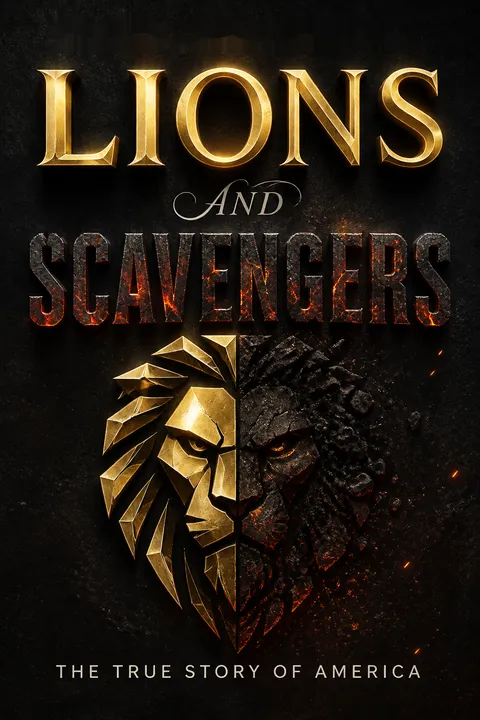

Key Takeaways
1. Western Civilization is a "Pride of Lions" built on core principles.
A tension lies at the core of our being.
Two opposing forces. Within every individual and every civilization, a fundamental tension exists between the spirit of the Lion and the spirit of the Scavenger. The author writes from London, witnessing a "massive river of protesters" supporting Hamas, communists, and transgender activists, all united in a "coalitional hatred of the West," signaling that the Scavengers are gaining ground. This scene, reminiscent of Tolkien's Mordor hordes besieging Minas Tirith, underscores the urgent threat to Western civilization.
The Lion's spirit. The Lion embodies success, responsibility, and duty, understanding that the universe operates by discernible rules and embracing moral obligations. This spirit is the bedrock of civilization, enabling individuals to build, defend, and maintain societal structures. Without the Lion's spirit, civilization inevitably collapses, leaving a vacuum for destructive forces to exploit.
The Scavenger's spirit. Conversely, the Scavenger is animated by envy, frustration, alienation, and vengeance, blaming others for personal failures. They believe in a "Great Conspiracy" against them, justifying any inhumanity against the Lions. This destructive impulse seeks to tear down successful individuals and civilizations from within, ultimately leading to widespread human suffering.
2. The "Way of the Lion" is defined by purpose, choice, and moral duty.
The Creation of Man lies at the root of our civilization.
A master plan. The philosophy of the Lion rests on three central principles, beginning with the belief in a "Logos" or master plan behind the universe, rejecting chaotic paganism. This foundational assumption, though unprovable by science, is the starting point for all scientific inquiry and human endeavor, providing a stable framework upon which Lions can build. It implies a purposeful, understandable world, rather than one governed by arbitrary whims.
Image of God. The second principle asserts that man is made in the image of God, endowed with the capacity for creative action and choice. This means individuals bear personal responsibility for their successes and failures, rather than being mere victims of fate. This concept, deeply embedded in both biblical and Greek thought, empowers individuals to act with deliberation and reason, mastering challenges rather than blaming external forces.
Moral duties. The third principle emphasizes that humans have true and meaningful moral duties, inherited from God, tradition, and reason, not solely from personal feelings. Fulfilling these objective duties brings meaning and purpose to life, while shirking them leads to misery. This framework, exemplified by Edmund Burke's view of society as a partnership across generations, ensures respect for moral tradition and the cultivation of virtue, which does not grow wild but must be actively nurtured.
3. Lions are Hunters, Warriors, and Weavers, each vital to civilization.
Western civilization is filled with people like Arnon Zamora.
The Hunters. These are the creative, audacious innovators who bend the world to their will, forging new paths and crafting solutions. They don't complain about unfairness but seek answers, embracing risk and learning from failure. Modern hunters, like those who transform sand into silicon or oil into energy, create the "cornucopia" of historic plenty, driving economic progress through industriousness and audacious problem-solving.
The Warriors. These Lions are steadfast in defending themselves, their families, and their culture, understanding that strength is the only defense against the Scavenger spirit. The Western warrior tradition, rooted in civic militarism and individualism, emphasizes decisive victory to end hostilities quickly. Figures like General George S. Patton exemplify this ethos, where citizens fight for a common cause, knowing that peace is best guaranteed by the credible threat of overwhelming force.
The Weavers. Often unnoticed, these Lions are prudent, merciful, and strong, dedicated to constructing and maintaining the social fabric. They knit together families and communities, passing on wisdom and upholding institutions. Weavers embody prudence, applying eternal principles to daily life, and mercy, balancing justice with forgiveness. Their quiet risks, like the commitment of marriage and raising children, are the greatest of all, forming the essential sinews of society.
4. The "Rules of the Pride" are Free Minds, Free Markets, Public Virtue, and Rule of Law.
America provides us the freedom to succeed.
Free minds. The Pride protects the innate human capacity to choose, recognizing that innovation and effective defense require freedom of thought. This principle, a bedrock of Americanism, allows for continuous revision of ideas and decentralized authority, fostering creativity in hunters and initiative in warriors. Without freedom of thought, Lions are reduced to Scavengers, losing their will and purpose.
Free markets. Meritocracy thrives on inclusive economic institutions that encourage broad participation, private property, predictable law, and entrepreneurial freedom. Free markets are morally just, recognizing individual rights to labor and property, and efficiently create wealth by incentivizing innovation. They are a "weighing machine" that aggregates human preferences, driving a virtuous cycle of progress that transforms luxuries into necessities and alleviates natural inequalities through comparative advantage.
Public virtue. Beyond individual liberty, a functional Pride requires public virtue, fostering benevolence and mutual obligation. Historically, intermediate institutions like families, churches, and social associations provided safety nets and frameworks for charity, demanding commitment from members. When government replaces these, it fosters a Scavenger mentality, eroding social fabric and paving the way for tyranny.
Rule of law. Lions must be protected by a system of predictable and fair laws, with internal (religious) and external (checks and balances) checks on power. This prevents successful Lions from becoming tyrants and ensures that meritocracy doesn't calcify into corruption. The US Constitution, as the apex of this process, protects individual rights from both mob rule and overreaching government, making the world richer and better.
5. The "Scavenger" is driven by envy, ressentiment, and a "Great Conspiracy Theory."
Envy is pure poison.
The destructive passion. The Scavenger is animated by envy, a "malignant dislike" for the superiority of those who are genuinely entitled to their success. This passion cannot be transmuted into an asset; instead, it acts as a "universal acid," destroying the mechanisms of civilization. Envy stems from the disastrous premise that the world should conform to one's desires, leading to the belief that any denial of these passions is an injustice.
Ressentiment as justification. To justify their envy, Scavengers weave a philosophy of ressentiment, projecting their own inferiority onto others or broader systems. They claim to be victimized Lions, robbed of their birthright by "pseudo-Lions" who masquerade as successful. This "Great Reversal" narrative asserts that existing institutions are lies designed to perpetuate oppression, thus transforming envy into a supposed virtue and justifying the tearing down of civilization.
The Great Conspiracy Theory. This core belief posits that all societal failures and disparities are the result of purposeful oppression by a "cabal of enemies." It begins with "Just Asking Questions" to discredit institutions, then feigns "pseudo-ignorance" to avoid answers, and finally claims that anyone who objects is part of the "active cover-up." This unfalsifiable theory, fueled by emotivism, allows Scavengers to dismiss reality and justify their destructive actions.
6. The "Way of the Scavenger" rejects purpose, responsibility, and objective morality.
If we make our own morality—and if we are free to define ourselves and the world around us—then any exercise of power is self-justifying.
World of power dynamics. Scavengers believe the universe is a cruel, purposeless place, where all morals and civilizations are merely "guises for power." This view, championed by figures like Marx and Foucault, asserts that there is no objective truth, only power, and that reality itself is a reflection of these dynamics. In this framework, any exercise of power becomes self-justifying, as there is no "right" beyond "might."
Failure as victimhood. In the Scavenger worldview, personal failure is not a matter of individual responsibility but evidence of oppression by corrupt power systems. If all humans are born equal in capabilities, then any inequality or disparity in outcomes must be the result of "systemic discrimination." This belief, advanced by thinkers like Robin DiAngelo and Michael Sandel, leads to the dangerous conclusion that meritocracy itself is inherently unfair and must be dismantled to achieve "cosmic justice."
Violence as corrective. The Scavenger philosophy culminates in the belief that violence is the proper and justified response to the "Great Conspiracy" against them. By seizing power, they aim to destroy the perceived Conspiracy and liberate themselves, even if it means mass murder and societal ruin. This principle, exemplified by figures like Lenin and the alleged motivations of Brian Thompson's killer, transforms grievances into a mandate for brutality, where the end justifies any means.
7. Scavengers form a "Pack" of Looters, Lechers, and Barbarians to destroy the West.
The Scavengers have little in common. In fact, it is only their opposition to the West that can explain the odd conglomeration of Scavengers who share a movement.
The Looters. These Scavengers build nothing, instead claiming the innovations of others as their right. Following Marx, they view free markets as exploitative systems designed to immiserate the working class, and private property as a theft of the "commons." Their goal is "revolutionary reconstitution" through looting and destruction of capitalism, church, and family, leading historically to mass murder and economic ruin, as seen in the Soviet Union.
The Lechers. Identifying individual identity with unfettered desires, Lechers seek to shatter all traditional sexual morality, rules, roles, and obligations. They view societal forces that don't celebrate their desires as oppressive "Great Conspiracies" against happiness. This philosophy, exemplified by figures like Nero and the Marquis de Sade, leads to deep unhappiness and aims to obliterate institutions like the family and church, often targeting children for early indoctrination into perversion.
The Barbarians. These Scavengers, exemplified by Frantz Fanon and Edward Said, believe the West is a colonizing power and that non-Western cultures are inherently victimized. They advocate for revolutionary violence and "decolonization" as a purifying act, even if it means "complete disorder" and a descent into barbarism. They blame all failings of non-Western societies on the West, using Western freedoms to advocate for its destruction and recruiting Western children to their cause.
8. The "Rules of the Pack" invert Lion principles: control minds, destroy markets, disintegrate virtue, reject equal law.
In fact, tyranny is the only system that can set you free.
Control free minds. The Pack views free minds as a threat, believing that individuals are indoctrinated by "false consciousness" under capitalist or patriarchal systems. This Marxist-derived concept, deepened by the Frankfurt School, argues that true liberation requires destroying all institutions and norms that shape thought. Historically, this has led to ruthless suppression of intellectual freedom, as seen in Soviet Russia and academic speech codes, where dissent is deemed a product of manipulation.
Destroy free markets. Scavengers undermine free markets by deeming them immoral and degrading. They argue that market success is based on unearned qualities or advantages, making meritocracy inherently unjust. They also claim markets reduce everything to a commodity, stripping life of "deeper meaning." This leads to calls for central economic control, as seen in fascist and socialist ideologies, where "Deeper Moral Values™" are used to justify rigging the scales of economic distribution.
Disintegrate public virtue. The Pack seeks to destroy intermediate institutions like families and churches, which are seen as bulwarks of private property and traditional values. Looters view charity as a capitalist palliative, while Lechers target the family and church to "liberate" individuals from "repressive inauthenticity," often through the sexualization of children. Barbarians dismiss these institutions as tools of colonialist oppression, leading to the predominance of an arbitrary, tyrannical state.
Reject equal rights under law. Scavengers insist on unequal administration of justice, arguing that because the world is rigged against certain victim groups, "antiracist discrimination" or other forms of preferential treatment are mandatory. This logic, exemplified by Ibram X. Kendi and Kamala Harris, posits that guilt attaches to persons or groups, not acts, leading to arbitrary arrests, show trials, and the weaponization of law enforcement against perceived enemies, as seen in Soviet and Nazi regimes.
9. Scavengers exploit the Lion's "guilt" and "mercy" to gain power.
This is precisely why when Scavengers seek to destroy a Lion, they demand an apology—and why the worst thing a Lion can do is apologize to a Scavenger.
The Lion's vulnerability. Lions, believing in sin and guilt, are susceptible to self-criticism and a desire for atonement. This virtue, however, becomes a weapon for Scavengers, who operate from a "shame culture" where guilt is a mark of inferiority. When Lions confess or apologize for perceived sins, Scavengers use this as ammunition to destroy their credibility, demanding further concessions without offering forgiveness.
Bloodguilt narrative. Scavengers accuse successful Lions of bearing unique "bloodguilt" for their prosperity and power, arguing that their success is inherently linked to the oppression of others. This narrative, propagated by figures like Jacques Derrida, forces the West into a position of eternal repentance, forbidding it from judging or combating other systems. This "paternalism of the guilty conscience" leads to self-denigration and a surrender of moral authority.
Exploiting virtues. Scavengers exploit the Lion's mercy by demanding it even when undeserved, often by playing the victim. They transmute their vices into virtues through "membership in a victim group," labeling any discrimination against their behavior as "transphobia" or "Islamophobia." This tactic, exemplified by the grooming-gangs scandal in England, forces Lions to abandon their values out of fear of being labeled bigoted, ultimately leading to the erosion of social cohesion and the triumph of barbarism.
10. The Lion must overcome self-doubt and roar to defend civilization.
For the Lions to win requires no great scheme, no clever machinations. It requires just one thing: courage.
The Lion's dormant strength. Despite being battered and weary, the Lion's strength, courage, and honor remain coiled within. The current moment, marked by the rise of Scavengers, is a call for the Lion to awaken and reclaim its inherent power. This resurgence is not about complex strategies but about a fundamental re-embrace of core principles and a willingness to fight.
Re-embrace core values. The Lion must believe in and actively preach the power of a God-driven, cognizable universe, teaching that individuals are made in God's image with the power to choose and fulfill meaningful moral duties. This means actively rewarding hunters, supporting warriors, and cherishing weavers, ensuring that the next generation is inoculated against the envy and cruelty of the Scavenger.
Courageous action. The Lion must protect free minds, free markets, public virtue, and equal rights under law, brushing away narcissistic guilt and re-embracing self-worth. This requires unsheathing claws, making tough decisions, and understanding that victory sometimes demands actions that are brutal but necessary for self-preservation. The battle against Scavengers is eternal, but they cannot win unless the Lions permit it through their silence and self-doubt.
Review Summary
Lions and Scavengers receives mixed reviews averaging 4.18/5 stars. Supporters praise Shapiro's framework dividing society into Lions (builders, responsible) and Scavengers (destructive, resentful), finding it a timely defense of Western values. Critics argue the metaphor is biologically inaccurate, overly simplistic, and politically one-sided. Several reviewers note repetitiveness and lack of nuance in applying labels to opponents. The book draws heavily on religious foundations and natural law philosophy. Many find it articulate but geared toward those already aligned with conservative viewpoints, with limited persuasive power for others.
People Also Read



Download PDF
Download EPUB
.epub digital book format is ideal for reading ebooks on phones, tablets, and e-readers.








































