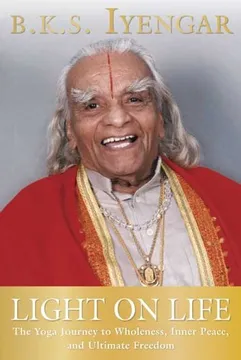
Key Takeaways
1. The Inward Journey integrates the five sheaths of being to reveal the soul
The yogic journey guides us from our periphery, the body, to the center of our being, the soul.
Mapping our existence. Yoga conceptualizes the human being not as a fragmented entity, but as a unified whole composed of five nested layers or sheaths, known as kosas. These sheaths range from the gross physical body to the subtlest layer of divine bliss, functioning like Russian nesting dolls. To achieve true wholeness, we must embark on an Inward Journey to align and harmonize these layers.
The integration process. When these subtle sheaths are in disharmony, we experience alienation, physical disease, and mental despair. True health requires us to establish conscious communication between the outer physical form and the inner spiritual core.
- Annamaya kosa: The anatomical physical body of skin, bones, and muscles.
- Pranamaya kosa: The organic energy body where breath and life force reside.
- Manomaya kosa: The mental body of thoughts, emotions, and obsessions.
- Vijnanamaya kosa: The intellectual body of discernment, intelligence, and wisdom.
- Anandamaya kosa: The blissful divine body where the Universal Soul is glimpsed.
The ultimate goal. By journeying inward through these layers, we move from the changing world of Nature (Prakrti) to the eternal witness of the Soul (Purusa). This path of self-discovery does not reject the physical world but polishes the body until it becomes a clear window for the divine light. Through this integration, we transition from a state of division to ultimate freedom and inner peace.
2. Asana cultivates physical stability, mental awareness, and relaxation in action
Asana is perfect firmness of body, steadiness of intelligence, and benevolence of spirit.
Beyond physical exercise. Postures, or asanas, are often misunderstood as mere physical contortions, but they are actually a laboratory for life and spiritual research. They build a stable foundation of physical health, which is essential because a weak body cannot bear the weight of spiritual aspirations. Through asana, we learn to live fully by cultivating strength, purity, and sensitivity.
Awakening cellular intelligence. During practice, every pore of the skin must become an eye, diffusing awareness and intelligence throughout the entire body. This dynamic extension creates space within the joints and muscles, which brings physical freedom and prevents injury.
- Stretch from the core, extending outward to the periphery.
- Balance active exertion with passive, effortless repose.
- Use the body as a mirror to reflect and correct the mind.
- Align the physical body with the subtle emotional and spiritual layers.
Pain as a teacher. We must learn to distinguish between constructive "right" pain, which signals growth and challenge, and destructive "wrong" pain, which warns of aggression and overstretching. Facing right pain with equanimity builds the mental tolerance needed to handle life's inevitable stresses. By surrendering to the posture, we soften our rigidity and discover the hard, brilliant light of the soul.
3. Pranayama harnesses vital energy to calm the mind and soothe emotions
Breath is the vehicle of consciousness and so, by its slow, measured observation and distribution, we learn to tug our attention away from external desires toward a judicious, intelligent awareness.
Harnessing life force. Pranayama is the expansion, regulation, and prolongation of prana, the vital cosmic energy that animates the universe. It acts as a bridge between the physical body and the mind, calming the nervous system and soothing the brain. By learning to control the breath, we generate a surplus of life energy that can be invested in our spiritual journey.
The four-part breath. Yogic breathing consists of four distinct phases: inhalation, retention after inhalation, exhalation, and retention after exhalation. Each phase represents a sacred cycle of receiving life, uniting with the divine, and surrendering the ego.
- Puraka: Inhalation, which expands and extends the Self.
- Antara kumbhaka: Retention after inhalation, uniting the individual with the divine.
- Recaka: Exhalation, which surrenders the personal self to the universe.
- Bahya kumbhaka: Retention after exhalation, resting in peaceful emptiness.
Calming the brain. Unlike normal breathing, pranayama requires a passive brain and a relaxed throat, eyes, and tongue to prevent stress from locking the nervous system. By soothing the nerves, it dissolves negative stress and prepares the mind for deep concentration. Through this quiet, rhythmic flow, we tame our brain and invite intuitive awareness to guide us.
4. Overcoming the six emotional disturbances requires conscious self-control and breath
We carry around within the recollection of mind our rancor, resentments, hates, greed, and lust, even when the motivating stimulus is absent.
The emotional enemies. Human suffering is compounded by six emotional disturbances: lust, anger, greed, obsession, pride, and hatred. These emotions are natural manifestations of energy that cannot be suppressed, but must be consciously channeled and transformed. When left uncontrolled, they scatter our vital energy and block our spiritual growth.
The role of memory. Unlike animals, humans store emotional reactions in memory, allowing past resentments to poison the present. Yoga teaches us to use the breath, particularly exhalation, to release these toxic emotional blockages and empty the brain of negative imprints.
- Lust: Sublimated into divine love, fidelity, and respect.
- Anger: Transformed into constructive, righteous action and passion.
- Greed: Conquered by minimizing needs and practicing contentment.
- Pride: Softened through humility, self-study, and devotion.
Healing the consciousness. Patanjali offers four healing qualities to purify our interactions: friendliness toward the happy, compassion for the suffering, joy for the virtuous, and neutrality toward the vicious. These attitudes prevent us from leaking vital energy through jealousy or judgment. By cultivating these virtues, we heal our organic body and establish emotional stability.
5. The mind must transition from habitual conditioning to conscious, present-moment action
The real meaning of knowledge is that action and analysis synchronize.
The habitual rut. Our minds are governed by samskaras, subliminal imprints of past experiences that create deeply ingrained habits. These subconscious sandbanks trigger automatic, reactive behaviors that rob us of our freedom and cause us to repeat the same mistakes. We mistake these conditioned reflexes for our true identity, living as prisoners of our past.
Breaking the cycle. To free ourselves, we must replace negative habits with positive ones, and eventually transcend conditioning altogether. This is achieved by bringing the light of conscious awareness to the present moment, using memory as a springboard rather than a cage.
- Identify automatic triggers and subconscious reactions.
- Pause and breathe before responding to external stimuli.
- Cultivate new, positive patterns of behavior through disciplined practice.
- Act without desire for personal reward or attachment to outcomes.
Living in the present. When we act in the present, unconditioned by past regrets or future anxieties, our actions become "colorless" or taint-free. This breaks the karmic wheel of cause and effect, allowing us to experience true spontaneity and freedom. By living each moment thoroughly, we align our actions with the divine flow of life.
6. True intelligence uses discrimination and conscience to transcend the ego
Intelligence is the silent or sleeping partner in consciousness, but when it awakes it is the senior or dominant partner.
Mind versus intellect. Yoga distinguishes between the clever, information-gathering mind (manas) and the discerning, reflective intelligence (buddhi). While the mind is fickle and seeks immediate pleasure, intelligence has the power to freeze-frame thoughts, analyze consequences, and make wise, long-term choices.
The double mirror. Consciousness acts as a double mirror that can reflect either the external world of sensory objects or the internal light of the soul. When we purify our intelligence, we are able to see ourselves objectively, stripping away the illusions of the ego (ahamkara).
- Manas: The sensory, reactive mind that seeks pleasure and avoids pain.
- Ahamkara: The ego or "I-shape" that clings to possessions and identity.
- Buddhi: The discerning, cognitive intellect that initiates change.
- Antahkarana: The moral conscience that aligns us with the soul.
The voice of conscience. Conscience is the aspect of consciousness closest to the soul, guiding us toward unity and wholeness. It often demands the harder path, prompting us to act with integrity, self-control, and compassion. By listening to this inner voice, we transform cleverness into true, intuitive wisdom.
7. Samadhi is the effortless dissolution of the ego into universal oneness
Samadhi is an experience where the existence of 'I' disappears.
The ultimate absorption. Samadhi is the eighth and final petal of yoga, where the individual self merges with the Universal Spirit. It is a state of unutterable bliss, peace, and timelessness, where the knower, the knowledge, and the known become one. In this state, the illusion of separation is dissolved.
Effortless being. In samadhi, the struggle of the ego ends, and the practitioner experiences the soul face to face. It is not a state of sleep or trance, but one of supreme, vibrant awareness where the mind is completely still and transparent.
- Sabija samadhi: Absorption with the seeds of desire and ego remaining.
- Nirbija samadhi: Seedless absorption, completely free from future karma.
- Manolaya: A passive, peaceful state of mind that must be transcended.
- Chidakasha: The vast, luminous space of inner consciousness.
The cosmic breath. At the highest level of meditation, the individual no longer breathes; rather, the cosmos breathes through them. This effortless state of nonbeing reveals our true, immortal nature, freeing us from the fear of death. The yogi returns from this state transformed, acting as a pure instrument of the divine.
8. Ultimate freedom is realized by living ethically in the present moment
The yogi has learned the art of dedication in all his actions to the Lord, and so he reflects the Divinity within him.
Kaivalya in action. Ultimate freedom, or kaivalya, is not a state of isolation but of living in the world with absolute detachment and compassion. The free individual acts in the present moment, entirely disconnected from past habits and future desires, serving as a force for good.
The four aims of life. To live fully, we must balance the four traditional aims of life within the framework of our ethical duties. This ensures that our desires and prosperity do not overflow the banks of righteousness, but flow smoothly toward liberation.
- Dharma: Righteous duty, universal ethics, and moral responsibility.
- Artha: Material prosperity, self-reliance, and earning an honest living.
- Kama: Love, pleasure, and emotional fulfillment.
- Moksa: Spiritual liberation, detachment, and freedom.
Savasana as the key. The corpse pose, Savasana, is the most difficult posture because it requires us to shed all our worldly identities and live in pure being. By practicing the art of dying to the past and future, we learn to live fully in the eternal present. This ethical, present-moment living is the ultimate proof of spiritual realization.








































