
Key Takeaways
1. American Governance: A Paradox of Liberty and Coercion
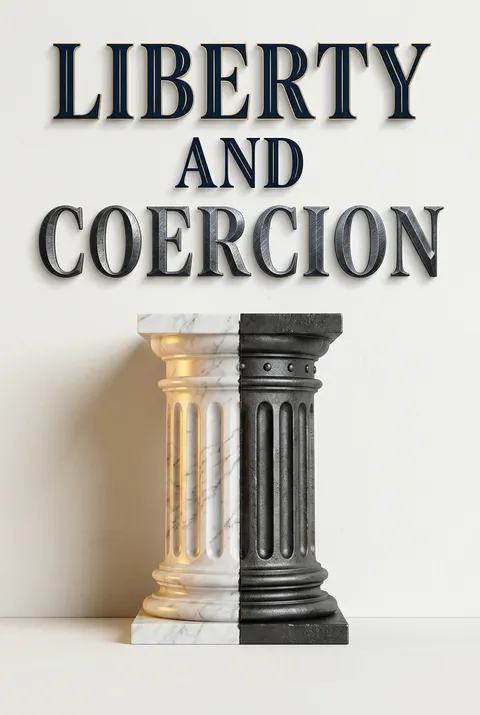
Liberty and coercion were bound together from the earliest days of the republic.
A foundational paradox. American governance has always been shaped by two contradictory principles: a classical liberal emphasis on limiting federal power and protecting individual rights, and a broad, often coercive, state authority. The U.S. Constitution, while enumerating and fragmenting federal powers to prevent tyranny, simultaneously allowed individual states vast scope to regulate public and private life. This inherent tension meant that a polity consecrated to liberty often encased its citizens in systems of coercion.
Dual principles. The federal government was designed with limited, enumerated powers, safeguarded by the Bill of Rights to protect citizens from central state overreach. This reflected a classical liberal belief that government tyranny was the greatest threat to liberty. Conversely, states operated under a "police power" doctrine, rooted in an 18th-century British concept, granting them broad authority to act for the "good and welfare" of their subjects, often prioritizing collective good over individual rights.
Enduring tension. This cohabitation of liberty and coercion runs deep in the American way, manifesting in individuals who simultaneously advocate for federal government restraint while supporting coercive state initiatives. Understanding this paradox requires tracing its roots back to the republic's founding, revealing how these divergent theories of power became institutionalized in law and jurisprudence across centuries.
2. State Police Power: A Broad, Illiberal Authority
This principle called for a polity well regulated by government in which, as the legal historian William Novak has written, “no individual right, written or unwritten, natural or absolute,” could be permitted to eclipse “the people’s safety” or welfare.
Unenumerated state powers. The Tenth Amendment, reserving undelegated powers to the states, effectively granted them "residual powers" that Madison himself noted would "extend to all the objects which, in the ordinary course of affairs, concern the lives, liberties, and properties of the people." This meant states could deeply shape public and private life, often without adhering to the federal Bill of Rights. From the late 18th to mid-20th centuries, states engaged in extensive regulation:
- Economic: Directing internal transportation, controlling capital and labor, chartering corporations.
- Social/Moral: Regulating marriage, forbidding contraception, outlawing "obscene" literature, mandating Sabbath closings ("blue laws").
- Racial: Stripping rights from African Americans (slavery, Jim Crow), denying land ownership to East Asian immigrants.
Royalist roots. This expansive state authority, known as "police power," derived from the 18th-century British "public police" doctrine, which endowed the king with broad authority for his subjects' welfare. American revolutionaries, while rejecting kingship, imported this doctrine into state constitutions, transferring sovereign authority from the monarch to "the people" of each state. This allowed state legislatures, seen as expressing democratic will, to wield power as broad as the British Crown, often with little provision for protecting minority rights from majority will.
Judicial sanction. The Supreme Court, notably in Barron v. Baltimore (1833), affirmed that the federal Bill of Rights did not apply to state governments. This decision reinforced the states' illiberal tendencies, allowing them to sanction policies that violated federal rights in the name of "the people's welfare." This exemption of states from federal rights protections would persist for over a century, institutionalizing a system where state governments could be deeply coercive.
3. Federal Growth: Circumventing Limits through Improvisation
Indeed, this book argues that an emphasis on improvisation rather than transformation provides a better guide to understanding the manner in which the US central state grew as well as the techniques that Congress and the president employed to meet the nation’s governing challenges.
Creative circumvention. Despite constitutional limits, the federal government found ways to expand its reach and power, not through grand transformations, but through ingenious improvisational strategies. These techniques allowed the central state to address complex challenges of industrialization and global power without formally compromising its classical liberal character. Three key strategies emerged:
- Exemption: Freeing certain federal activities from strict constitutional scrutiny.
- Surrogacy: Using enumerated powers to achieve unenumerated policy goals.
- Privatization: Enlisting private groups to perform government work.
Exemption in practice. Areas defined as outside the polity's formal borders—such as war, foreign relations, colonial administration, and immigration—were often exempt from constitutional constraints. This allowed the executive and Congress plenary power, particularly during wartime or in managing territories like Puerto Rico and the Philippines. Immigration policy, for instance, became a plenary power, enabling the federal government to impose racial exclusions (e.g., Chinese Exclusion Act of 1882) without Fourteenth Amendment scrutiny.
Surrogacy and privatization. Surrogacy involved leveraging powers like the commerce, postal, or taxation clauses. The Mann Act (1910) used the commerce clause to regulate prostitution, while the Comstock Act (1873) used postal power to ban "obscene" literature. Privatization saw the federal government relying on private entities for large-scale projects, like the transcontinental railroad, or for social services, such as the Red Cross during World War I. These strategies, while effective in expanding federal influence, often led to a "jerry-built" state, lacking central coordination and susceptible to private interests.
4. Early Republic: A Lean Federal State Amidst Powerful States
What does bear examination is how well America’s central state met its governing challenges given the formal limitations on its power and the long period of time during which it was ruled by a Jeffersonian party ideologically dedicated to keeping that state small.
Limited federal scope. From its founding through the 1860s, the federal government operated within strict constitutional parameters, emphasizing limited, fragmented powers. The Jeffersonian-Jacksonian era, ideologically committed to a small central state, further constrained its growth. Despite these limitations, the federal government faced immense challenges:
- Territorial Expansion: Acquiring and settling vast lands like the Louisiana Territory.
- National Integration: Binding diverse settlers and territories to the new nation.
- Border Defense: Protecting against Indian tribes and European empires.
Surprising federal achievements. The central state achieved significant successes, particularly in territorial management. The Northwest Ordinances (1785, 1787) established a national land market and a uniform surveying system, facilitating rapid settlement. Radical naturalization laws (1790) attracted European immigrants by offering easy citizenship and secure property rights. The postal system, the largest federal "bureaucracy" of its time, fostered a sense of national identity by circulating information widely.
Precarious governance. Despite successes, federal governance remained precarious. The small peacetime army relied heavily on citizen-soldiers (militias and volunteers), whose loyalty was often divided between federal and state interests. This limited federal capacity to enforce treaties with Indian nations or control white settler expansion, often leading to violence and dispossession. The federal government's dependence on private citizens for military muscle, coupled with its aversion to a large professional bureaucracy, meant that its achievements were often due to extraordinary individual commanders like Andrew Jackson and, at times, sheer luck.
5. Industrial Era: Federal Improvisation and State Resurgence
The last chapter demonstrated how the states and their police power resurged after 1877, and how this resurgence gave southern legislatures the authority needed to encode white supremacy into law and political and social life.
Post-Reconstruction counterrevolution. The period following the Civil War (1860s-1920s) saw a complex interplay of federal expansion and state reassertion. While the Civil War initially centralized power, a post-Reconstruction counterrevolution limited federal authority, particularly in areas of social and moral regulation. The Supreme Court, despite championing "laissez-faire constitutionalism" in economic matters, simultaneously reinvigorated the states' "police power" doctrine.
State power in action. States used this restored police power to:
- Economic Regulation: Pass thousands of laws regulating working hours, railroad rates, and public health, often challenging laissez-faire principles.
- Social Control: Enforce racial segregation (Jim Crow laws, upheld by Plessy v. Ferguson in 1896), ban interracial marriage, and regulate morality (alcohol, gambling, prostitution).
- Institutional Expansion: Establish new public institutions like labor bureaus, health boards, and universities, leading to increased state employment and professionalization.
Federal improvisation continued. The federal government continued to grow through its improvisational strategies:
- Exemption: Expanding its control over "unincorporated territories" (e.g., Puerto Rico, Philippines) and asserting plenary power over immigration, leading to racial exclusions.
- Surrogacy: Using the commerce clause (Mann Act against prostitution) and postal power (Comstock Act against obscenity) to regulate morality, areas traditionally reserved for states.
- Privatization: Relying on private corporations for infrastructure (transcontinental railroads) and voluntary organizations for social services (Red Cross, YMCA during WWI), often leading to corruption and uneven outcomes.
This era highlighted the enduring tension between a limited federal state and powerful, often illiberal, state governments, with the federal government's growth often constrained by its own constitutional design and the resurgence of state authority.
6. New Deal: Forging a State of Positive Liberty with Compromises
“We have undertaken a new order of things,” Roosevelt conceded in 1935, but “we progress to it under the framework and in the spirit and intent of the American Constitution.”
Crisis-driven expansion. The Great Depression (1929) shattered the existing economic and political order, creating an unprecedented demand for federal intervention. President Franklin D. Roosevelt, inheriting Progressive government-building traditions, aimed to create a large, expansive central state with regulatory power, supported by professional civil servants. He redefined "liberalism" to include "positive liberty"—the idea that government should actively assist individuals in achieving economic security and opportunity.
Agricultural vanguard. Agriculture became a key area for New Deal experimentation, building on the USDA's existing bureaucratic apparatus and county agent system. The Agricultural Adjustment Act (AAA) of 1933 paid farmers to reduce acreage, aiming to stabilize prices and incomes. This program, while immensely popular and effective in bringing stability to agriculture, disproportionately benefited large landowners and accelerated the dispossession of landless farmers, reflecting compromises with powerful state and local interests.
Labor's breakthrough. In the industrial sector, the National Labor Relations Act (NLRA) of 1935 marked a significant shift. It guaranteed workers the right to unionize and bargain collectively, establishing the National Labor Relations Board (NLRB) with broad enforcement powers. This federal intervention, spurred by widespread labor insurgency and the Supreme Court's eventual validation, fundamentally reconfigured capital-labor relations, leading to unprecedented wage gains and economic security for millions of workers. However, labor's gains were often concentrated in unionized sectors, leaving many agricultural and service workers unprotected, and the movement's reliance on private campaign funding limited its broader political ambitions.
7. Cold War: The Rise of the American Leviathan and New Forms of Power
The central state in consequence grew into an institution of extraordinary size and reach.
Permanent war footing. World War II, immediately followed by the Cold War, transformed the American central state into a permanent "warfare state." Unlike previous conflicts, the Cold War's indefinite nature led to:
- Massive Standing Military: A force of 2.5 million, ten times larger than any previous peacetime military.
- National Security Apparatus: Creation of the Department of Defense, Joint Chiefs of Staff, National Security Council, and CIA (1947).
- Expanded Coercive Powers: Laws like the Smith Act (1940) and executive orders (Truman's 1947 Loyalty Review Board) expanded federal surveillance and repression of dissent, often exempt from constitutional scrutiny.
Fiscal revolution. This expansion was funded by a system of mass and progressive taxation, established during WWII and maintained through the Cold War. Federal revenues soared, shifting fiscal power dramatically from states to the central government. This new financial capacity emboldened federal policymakers to imagine broader interventions, using "national security" as a new form of surrogacy to justify spending on:
- Industrial Policy: Directing defense contracts to the Sunbelt and Far West, fostering new high-tech corridors.
- Infrastructure: Massive investments in dams, hydroelectric power, and the Interstate Highway System (justified as "National System of Interstate and Defense Highways").
- Research & Education: Federal funding for university research (especially military-related) and the GI Bill, driving a major expansion of higher education.
Eisenhower's warning. Even President Eisenhower, a Republican, recognized the profound implications of this growth, warning of a "military-industrial complex" with "grave implications" for the republic. The Cold War fundamentally reshaped American society, creating a powerful, resource-rich federal government, but also one increasingly insulated from democratic oversight and prone to new forms of coercion.
8. Warren Court: Dismantling State Power and Enthroning Individual Rights
In the 1960s, the Warren Court, in making the Bill of Rights and the Fourteenth Amendment the law of the land, put a decisive end to the states’ sovereignty.
Judicial assault on states. The 1960s witnessed a dramatic confrontation between the federal government and states, driven by the civil rights movement and a Supreme Court determined to enforce individual rights. The Warren Court, leveraging the federal government's newfound fiscal power and Cold War legitimacy, spearheaded this assault, deploying two key jurisprudential strategies:
- Incorporation: Using the Fourteenth Amendment to compel states to respect liberties guaranteed by the Bill of Rights.
- Substantive Due Process: Identifying implied constitutional liberties (like privacy) not explicitly enumerated, and enforcing them on states.
Broadening rights. The Court's decisions fundamentally reshaped governance:
- Criminal Justice: Mapp v. Ohio (1961), Gideon v. Wainwright (1963), Miranda v. Arizona (1965) imposed Bill of Rights protections on state criminal proceedings, curbing discriminatory practices.
- Voting Rights: Baker v. Carr (1962) established "one person, one vote," leading to the federal Voting Rights Act of 1965, which dismantled state-level disenfranchisement.
- Marriage & Sexuality: Loving v. Virginia (1967) struck down bans on interracial marriage, and Griswold v. Connecticut (1965) established a "marital right to privacy" for contraception, later extended to abortion in Roe v. Wade (1973).
- Religion in Schools: Engel v. Vitale (1962) prohibited mandated prayer in public schools, incorporating the First Amendment's establishment clause to the states.
A near revolution. These rulings, particularly from 1962 to 1973, constituted a "near revolution" in American governance, fundamentally transforming federal-state relations. The states' long-held autonomy in areas like race, religion, and personal life was decisively broken, and the Bill of Rights was finally enthroned as the law of the entire land, 180 years after its formal ratification. This judicial activism, while controversial, was crucial for advancing civil rights and liberties.
9. Conservative Revolt: Challenging Big Government with Contradictions
“Either we believe in our capacity for self-government,” Reagan declared at the 1964 Republican National Convention, “or we abandon the American revolution and confess that an intellectual elite in a far-distant capitol [Washington, DC] can plan our lives for us better than we can plan them ourselves.”
Backlash against Leviathan. The expansive federal state of the post-1960s, with its deep reach into employment, welfare, and social engineering, triggered a powerful conservative revolt. This movement, led by figures like Ronald Reagan, coalesced around three main grievances:
- Pragmatic: Government's perceived failure to manage the economy and achieve social harmony, especially during the 1970s recessions.
- Racial: White backlash against federal civil rights initiatives, seen as "reverse discrimination" or undue burdens on white communities.
- Libertarian: Opposition to comprehensive federal regulation of capital, labor, and social life, viewed as a threat to individual freedom and free markets.
Reagan's offensive. Reagan's presidency (1981-1989) launched a direct assault on the New Deal legacy:
- Anti-Union Stance: Firing striking air traffic controllers, signaling a tougher stance against organized labor.
- Tax Cuts: Dramatically reducing federal income taxes, especially for high earners, to starve the government of revenue.
- Deregulation: Freezing hiring, curbing new regulations, and appointing anti-government zealots to agencies, leading to crises like the savings and loan collapse.
Ideological warfare. Conservatives, inspired by figures like Lewis Powell and legal scholars like Robert Bork (advocating "originalism"), waged an ideological battle against "big government" and "living constitution" jurisprudence. They established think tanks and media outlets to promote their values, aiming to delegitimize federal regulatory power and the Warren Court's achievements. This campaign, while not fully dismantling the Leviathan, significantly shifted political discourse and constrained federal expansion.
10. Modern Federalism: Congressional Paralysis and State Revival
The recent turn toward the states, then, underscores the constraints imposed on the central state by an eighteenth-century Constitution and the near impossibility of altering the Constitution so as to give government in the United States new tools to address its twenty-first century problems.
Besieged Leviathan. In the 21st century, the federal government, though still a Leviathan, finds itself besieged and often paralyzed. Congressional gridlock, fueled by conservative intransigence and a politics of confrontation, has limited its ability to address pressing domestic challenges like immigration, climate change, and infrastructure. This paralysis has inadvertently created an opening for states to re-enter the policy fray.
State resurgence. States are increasingly acting as "laboratories of democracy," taking the lead on issues ranging from minimum wage and mass transit to same-sex marriage and marijuana legalization. This revival is driven by:
- Congressional Inaction: States stepping in where federal government fails to act.
- Campaign Finance Shifts: Wealthy donors, frustrated by federal paralysis, directing funds to state-level political contests to achieve "one-party states" and influence policy.
- Judicial Rulings: The Roberts Supreme Court, in cases like the Affordable Care Act (2012), has limited the federal government's ability to coerce states into policy initiatives, reaffirming states as "independent sovereigns."
Enduring constraints. While a full return to the states' pre-1960s police power is unlikely, this resurgence highlights the persistent constraints of an 18th-century Constitution on 21st-century governance. The difficulty of amending the Constitution means that new tools for federal action are scarce, forcing improvisation and leaving the nation grappling with its foundational paradox. The ongoing tension between federal power and state autonomy continues to shape American public life, often leading to political paralysis at the national level and diverse, sometimes contradictory, policy landscapes across the states.


Download PDF
Download EPUB
.epub digital book format is ideal for reading ebooks on phones, tablets, and e-readers.








































