
Punti chiave
1. The Artist's Freedom vs. State Control
Next to the right to create, the right to criticize is the richest gift that liberty of thought and speech can offer.
Literature's essence. Literature, a "fiery, fanciful free thing," is inherently incompatible with state control. Nabokov treasures his disgust for systems that corrupt art, viewing it as a defense of Russian literature's spirit. He contrasts the "vicious bully" of Tsarist censorship, which merely hampered authors, with the "sensational and formidable comeback" of Soviet totalitarianism.
Totalitarian suppression. The Soviet regime, unlike its Tsarist predecessor, perfected the "method of making the entire literary corporation write what the state deems fit." This resulted in a "primitive, regional, political, police-controlled, utterly conservative and conventional literature," devoid of individual quest or creative courage. Nabokov highlights the chilling similarity between Lenin's and Nazi Minister Rosenberg's directives: "Every artist has the right to create freely; but we, Communists, must guide him according to plan."
Freedom's value. In a free country, an artist is not forced to produce "guidebooks" or conform to a single ideology. The existence of diverse periodicals and philosophies allows for genuine expression, even if unconventional. This fundamental difference in quality, not just degree, distinguishes a free society from a dictatorship, where authors are compelled to serve the state or the masses, ultimately leading to a "synthesis of a Hegelian triad" that crushes artistic independence.
2. Artistry Over Utilitarianism
In that respect, general ideas are of no importance.
Art's true purpose. Nabokov vehemently argues that literature's primary value lies in its artistic presentation and imaginative creation, not in conveying social messages or serving utilitarian ends. He deplores the "horror of horrors borrowed from the jargon of quack reformers" that demands a "message" from art. For him, the social element in Turgenev is "deplored," Dostoevski's is "ridiculed," and Gorki's works are "savaged" precisely because they prioritize didacticism over artistry.
Rejecting social commentary. He emphasizes that great works, like Madame Bovary or Dead Souls, should not be read as historical documents or social indictments. Instead, they are "specific worlds imagined and created by individual genius." Chekhov, for instance, earns his "highest admiration" for refusing to let social commentary interfere with his "exact observation of people as he saw them," presenting life "artistically" without distortion.
The aesthetic imperative. Nabokov's "principle of artistry combats not merely the prepossessions of the 1950s reader... but also—more important for the writers—the antagonistic and eventually triumphant utilitarian attitude of the contemporary nineteenth-century Russian critics later hardened into the dogma of statecraft by the Soviet Union." He regrets that Tolstoy sometimes prioritized views on agriculture over the "beauty of the curls of dark hair on Anna’s tender neck," underscoring his aristocratic aesthetic.
3. The Ideal Reader's Engagement
The admirable reader identifies himself not with the boy or the girl in the book, but with the mind that conceived and composed that book.
Beyond identification. The "good, the excellent reader" does not seek to identify with characters or "skip descriptions." Instead, they engage with the author's creative mind, savoring "every detail of the text" and enjoying "what the author meant to be enjoyed." This reader is thrilled by the "magic imageries of the master-forger, the fancy-forger, the conjuror, the artist."
Discerning the particular vision. Such a reader understands that the "Russia of Tolstoy or Chekhov is not the average Russia of history but a specific world imagined and created by individual genius." They are not concerned with "general ideas" but with the "particular vision," appreciating the novel not for its social utility but for its intrinsic artistic merit. This approach saves art from "emperors, dictators, priests, puritans, philistines, political moralists, policemen, postmasters, and prigs."
Command of detail. Nabokov's teaching method emphasizes "exact information about details, about such combinations of details as yield the sensual spark without which a book is dead." He illustrates this with diagrams of railway carriages or discussions of 19th-century breakfast habits, arguing that visualizing these specifics is crucial to enjoying the art. The ideal reader, like a "seeker for black pearls," plunges into the "magic chaos" of great writing, appreciating its "cosmic side" beyond mere "comic" elements.
4. Gogol's Absurdist Genius
Great literature skirts the irrational.
Beyond realism. Gogol's genius lies in his "grotesque and grim nightmare," a world where the "absurd" is his muse, not merely the quaint or comic. His works, like Dead Souls and "The Overcoat," are not realistic depictions of Russia but "products of Gogol’s own fancy, his private nightmares peopled with his own incomparable goblins." He creates a "four-dimensional" prose, where parallel lines "wriggle and get most extravagantly entangled," and "two and two make five."
Life from language. Gogol's unique style involves a "combination of two movements: a jerk and a glide," where "a lyrical gust... lets you fall with a bump into the next traphole." He generates "peripheral characters" directly from "subordinate clauses of its various metaphors, comparisons and lyrical outbursts," making "mere forms of speech directly giving rise to live creatures." Examples include:
- A dim landscape breeding a "groggy old soldier"
- Buzzing flies evolving into an "old housekeeper" and "children"
- A dog's bark spawning a "church chorister"
- Sobakevich's head transforming into a "village musician"
The essence of mankind. In Gogol's "nightmarish, irresponsible world," characters like Akaky Akakievich in "The Overcoat" are "absurd because he is pathetic, because he is human and because he has been engendered by those very forces which seem to be in such contrast to him." The "gaps and black holes in the texture of Gogol’s style imply flaws in the texture of life itself," revealing a world of "utter futility" where a new cloak can be the "highest degree that passion, desire, creative urge can attain."
5. Turgenev's Elegant Limitations
He is not a great writer, though a pleasant one.
Descriptive artistry. Turgenev's strength lies in his "plastic musical flowing prose" and "mellow colored little paintings—rather watercolors than the Flemish glory of Gogol’s art gallery—inserted here and there into his prose." He excels at "delicate cameo descriptions" and a "modulated sinuous style," which Nabokov compares to "a lizard sun-charmed on a wall." His ability to capture the effect of broken sunlight or the "dusky black" appearance of a gypsy girl with the sun behind her are examples of his descriptive talent.
Narrative weaknesses. Despite his descriptive gifts, Turgenev's "literary genius falls short on the score of literary imagination," particularly in plot construction. His novels often consist of "conversations in diverse settings charmingly described—good long talks interrupted by delightful short biographies and dainty pictures of the countryside." He is "artificial and even lame" as a storyteller, frequently resorting to:
- "Tedious Eavesdropping Device"
- "Banal handling of plots"
- "Labored epilogues" that "painfully artificial[ly]" resolve character destinies
- "Ponderously explaining what the suggestion was"
The "Turgenev maiden." His most famous contribution is the "Turgenev maiden," a type of heroine embodying "moral strength, gentleness, and... thirst to sacrifice all worldly considerations to what they consider their duty." While admirable, these characters, like Liza or Natalia, are seen as variations of Pushkin's Tatiana, enveloped in a "gentle poetical beauty" that appeals to readers but lacks the raw originality of greater artists.
6. Dostoevski's Sentimental Flaws
In all my courses I approach literature from the only point of view that literature interests me—namely the point of view of enduring art and individual genius. From this point of view Dostoevski is not a great writer, but a rather mediocre one—with flashes of excellent humor, but, alas, with wastelands of literary platitudes in between.
Mediocre artistry. Nabokov's critique of Dostoevski is scathing, labeling him a "mediocre" writer whose work is marred by "literary platitudes" and a "lack of taste." He finds Dostoevski's "gloating pity for people" to be "purely emotional" and his "special lurid brand of the Christian faith" to be "very doubtful." The "moral and artistic stupidity" of scenes like "the murderer and the harlot... reading together the eternal book" in Crime and Punishment exemplifies his disdain for Dostoevski's "shoddy literary trick[s]" and "glorified cliché[s]."
Neurotic characters and muddled motives. Dostoevski's gallery of characters consists "almost exclusively of neurotics and lunatics," whose reactions are often "so freakish that the problem the author set himself remains unsolved." Raskolnikov's motivations for murder are deemed "extremely muddled," a "fast transition from an aspiring benefactor of the world toward an aspiring tyrant for the sake of his own power" that Dostoevski, "in his hurry, can afford to make." Nabokov notes that all Dostoevski's criminal heroes are "not quite sane," undermining any philosophical point.
Playwright, not novelist. Dostoevski "seems to have been chosen by the destiny of Russian letters to become Russia’s greatest playwright, but he took the wrong turning and wrote novels." His novels are seen as "straggling play[s]," a "succession of scenes, of dialogues," with "all the tricks of the theatre." This results in a "mechanical structure" and "verbal overflow" that lacks the "harmony and economy" of a true masterpiece, making his plots, though intricate, lose their "suspense" on re-reading.
7. Tolstoy's Dual Nature: Artist vs. Preacher
What one would like to do, would be to kick the glorified soapbox from under his sandalled feet and then lock him up in a stone house on a desert island with gallons of ink and reams of paper—far away from the things, ethical and pedagogical, that diverted his attention from observing the way the dark hair curled above Anna’s white neck.
Unparalleled artistic genius. Tolstoy is hailed as the "greatest Russian writer of prose fiction," whose art is "powerful, so tiger bright, so original and universal that it easily transcends the sermon." Nabokov particularly admires Tolstoy's unique "time balance," which makes his prose "keep pace with our pulses," giving readers a "sense of average reality." He notes that in his masterpieces, Tolstoy achieves Flaubert's ideal of authorial invisibility, making the novel feel as if it "writes its own self."
The intrusive preacher. Despite his artistic heights, Tolstoy was "torn between his sensual temperament and his supersensitive conscience." In his later years, the "ethical overcame both the esthetical and the personal," leading him to sacrifice his literary career for "rational Christian morality." This "intrusion of the teacher into the artist’s domain" breaks the charm, as "pages and pages follow which are definitely in the margin of the story, telling us what we ought to think."
Functional imagery. Tolstoy's imagery, while vivid, often serves an "ethical purpose" rather than a purely aesthetic one. His "moral metaphors or similes" are "strictly functional, and thus rather stark," often following the formula: "He felt like a person who. . . ." This utilitarian approach to comparison, though effective in conveying moral points, sometimes contrasts with the sheer descriptive beauty found in other passages, such as the "curly birches" or Kitty's "wild rose among nettles."
8. Chekhov's Subtle, Wave-like Art
The story is based on a system of waves, on the shades of this or that mood.
Understated genius. Chekhov is praised for his "quiet and subtle humor" and his ability to create "pathetic characters" with "less emphasis" than any other author. His stories are "sad books for humorous people," where sadness and fun are inextricably linked. He relies on "undercurrents of suggestion to convey a definite meaning," often through seemingly trivial details that, in his hands, become "all-important in giving the real atmosphere."
Naturalistic style. Chekhov's style is characterized by its "natural way" of storytelling, "slowly and yet without a break, in a slightly subdued voice." He achieves "exact and rich characterization by a careful selection and careful distribution of minute but striking features, with perfect contempt for the sustained description, repetition, and strong emphasis of ordinary authors." His "dictionary is poor, his combination of words almost trivial," yet he conveys "artistic beauty far surpassing that of many writers who thought they knew what rich beautiful prose was."
The "ineffectual idealist." Chekhov's heroes are often "charming because they are ineffectual," embodying the "Russian intellectual, the Russian idealist, a queer and pathetic creature." These individuals possess "deepest human decency" but an "almost ridiculous inability to put his ideals and principles into action." They "stumble because he is staring at the stars," dreaming of worlds they cannot build, yet their mere existence is a "promise of better things to come for the world at large—for perhaps the most admirable among the admirable laws of Nature is the survival of the weakest."
9. Gorki's Didactic Mediocrity
As a creative artist, Gorki is of little importance.
Schematic and mechanical. Nabokov dismisses Gorki as a writer of "little importance" artistically, whose work is characterized by "schematic characters and the mechanical structure of the story." He finds Gorki's style "rhetorical and false," particularly in dialogues where characters "talk at length in the rhetorical and false style which Gorki reserved for such occasions." This programmatic approach, driven by "logical demonstration and a passion for reasoning," lacks the "intellectual scope which Gorki completely lacked."
"Powerful" but flat. Gorki's "low level of culture" and "chaos of his ideas" led him to pursue "the striking subject, the contrast, the conflict, the violent and the harsh," which reviewers often mistook for "powerful story" writing. However, stories like "Twenty-Six Men and a Girl" are criticized as "traditional and flat as the worst examples of the old school of sentimental and melodramatic writing," containing "not a single live word" but rather "pink candy with just that amount of soot clinging to it to make it attractive."
Didacticism over vision. Gorki is seen as a "didactic" writer, one of those "naive and nervous Russian intellectuals who thought that a little patience and kindness with the miserable, half savage, unfathomable Russian peasant would do the trick." Unlike Chekhov, who presented "living human being[s] without bothering about political messages," Gorki's characters are often "painted dummies" designed to flaunt "social ideas," ultimately leading directly to "so-called Soviet literature."
10. Philistinism: The Enemy of Art
A philistine is a full-grown person whose interests are of a material and commonplace nature, and whose mentality is formed of the stock ideas and conventional ideals of his or her group and time.
The nature of philistinism. Philistinism is an "international" and pervasive state of mind, found in "all nations and in all classes," from English dukes to Soviet citizens. It is characterized by a focus on "material and commonplace" interests and a mentality shaped by "stock ideas and conventional ideals." This "smug philistine" or "dignified vulgarian" prioritizes conformity and superficiality over genuine artistic or intellectual depth.
Suppression of true art. Philistinism "presupposes a certain advanced state of civilization where throughout the ages certain traditions have accumulated in a heap and have started to stink." It actively stifles creativity and originality, preferring the familiar and the easily digestible. The "mentality of a Lenin or a Stalin or a Hitler in regard to the arts and the sciences was utterly bourgeois," demonstrating how this mindset transcends political ideologies to suppress authentic expression.
Genteel vulgarity. Nabokov distinguishes between simple coarseness and "genteel" vulgarity, the latter being "worse than simple coarseness." For example, "to burp in company may be rude, but to say 'excuse me' after a burp is genteel and thus worse than vulgar." This highlights the insidious nature of philistinism, which often masks its lack of substance with a veneer of refinement or conventional propriety, ultimately hindering the appreciation of true art.
Sintesi delle recensioni
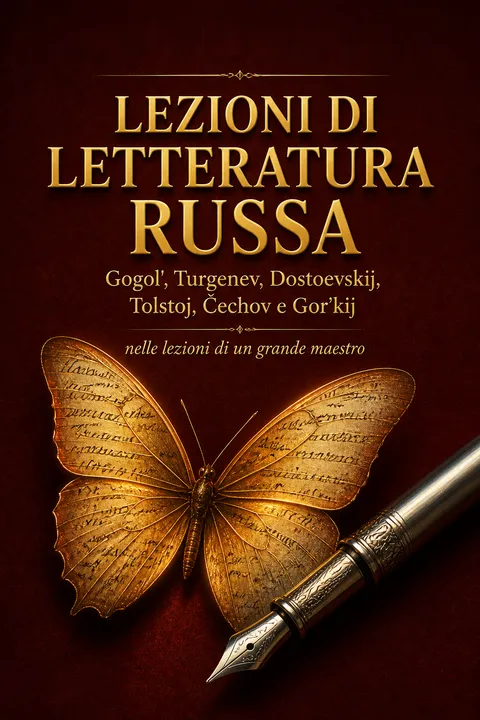
Lezioni sulla letteratura russa di Vladimir Nabokov raccoglie le sue conferenze universitarie dedicate a Gogol, Turgenev, Dostoevskij, Tolstoj, Čechov e Gorkij. I lettori apprezzano la brillante analisi stilistica di Nabokov e il suo coinvolgimento appassionato con la letteratura intesa come arte, in particolare il modo in cui affronta Tolstoj e Čechov. Tuttavia, la sua critica sprezzante e spesso tagliente nei confronti di Dostoevskij — definito mediocre, sensazionalista e popolato da «pazzi» — suscita reazioni forti. Alcuni ritengono che il suo pregiudizio aristocratico e le sue sentenze assolute siano problematici, sostenendo che egli non colga la profondità filosofica di Dostoevskij. Nonostante le controversie, la maggior parte riconosce il valore delle sue osservazioni dettagliate, delle intuizioni sulla traduzione e della guida esperta attraverso la prosa russa.
Altri hanno letto anche


Sull'autore
Altri libri di Vladimir Nabokov


Scarica PDF
Scarica EPUB
.epub digital book format is ideal for reading ebooks on phones, tablets, and e-readers.








































