

Key Takeaways
Everything radiates energy on a spectrum you can learn to read
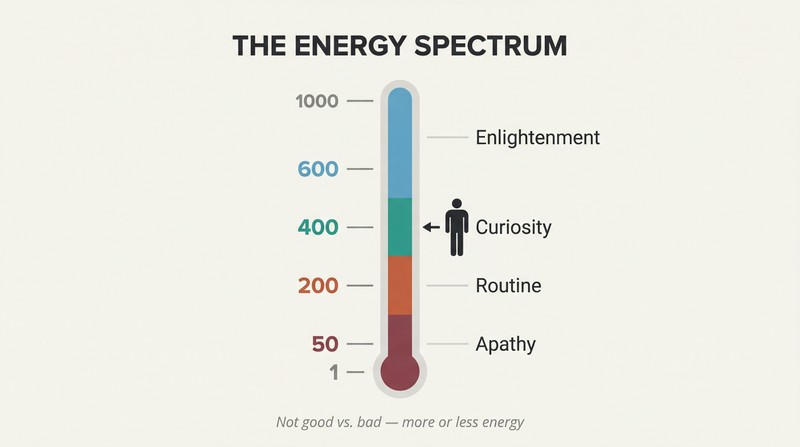
Dodson maps all reality onto a single 1-to-1000 scale. Every emotion, person, place, object, and nation vibrates at a specific frequency. At 50 you find apathy and depression. At 200, functional routine. At 400, intellectual curiosity. At 600, enlightenment. Your position on this spectrum determines what you attract, perceive, and create. The framework replaces binary good/bad thinking with what Dodson calls spectral perception — recognizing dozens of gradients rather than just two options.
Think of a thermometer. "Cold" doesn't actually exist — only less heat. Similarly, "darkness" is just less light. You can't shine darkness into a room. Once internalized, the scale becomes a diagnostic instrument: you can read the energy of a room, a relationship, a restaurant, even a nation — and know what to expect from it.
Level 200 is the tipping point between decay and growth
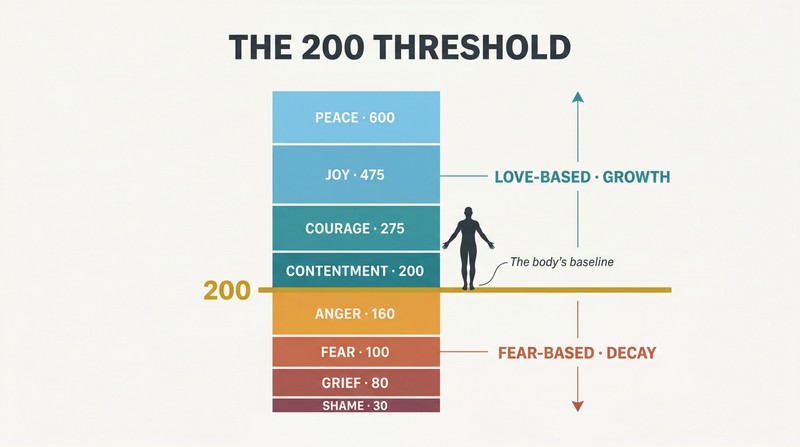
On Dodson's scale, 200 divides two worlds. Below it: shame (30), grief (80), fear (100), anger (160) — all fear-based, draining energy toward decay. Above it: contentment (200), courage (275), joy (475), peace (600) — love-based, pointing toward abundance and life. The human body itself measures at 200, meaning it can go either way.
Below 200, free will is limited and outside help is required to ascend. From 200 to 500, personal willpower drives progress. Above 500, growth becomes a natural pull rather than deliberate effort. Dodson estimates roughly half of humanity still vibrates below this critical threshold. Crossing it brings an inherent sense of integrity and decency — not from moral instruction, but from having enough energy to see clearly.
Stop resisting bad emotions — resistance is what feeds them
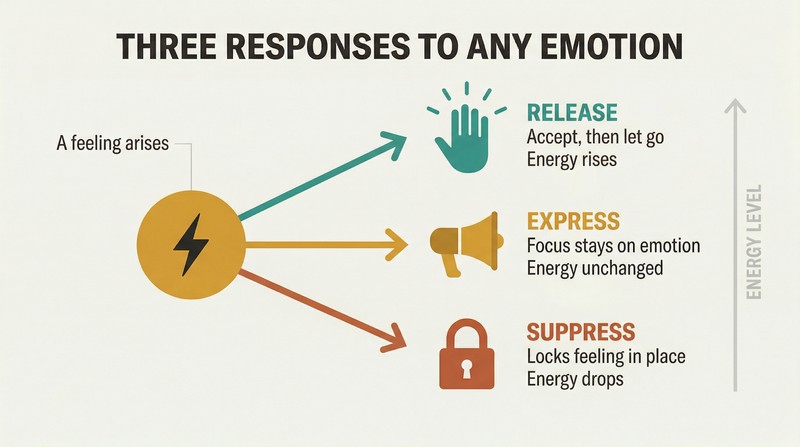
Dodson identifies three options for handling any emotion:
1. Suppress it — locks the feeling in place, eventually dragging your baseline down
2. Express it — keeps you at the same level because focus remains on the emotion
3. Release it — willingly accept it, then let go; this frees the energy and moves you upward
The release technique is disarmingly simple. Breathe the feeling in, acknowledge it without judgment, then release your grip on the out-breath. Relief typically arrives within seconds. Even intense anger, if fully owned — "I am sick of this!" — cannot sustain itself for more than a few minutes and naturally transmutes into something higher. The key insight: emotional phenomena are just energy flowing through consciousness. They only hurt when you resist or cling.
Climb one rung at a time — quantum leaps usually backfire
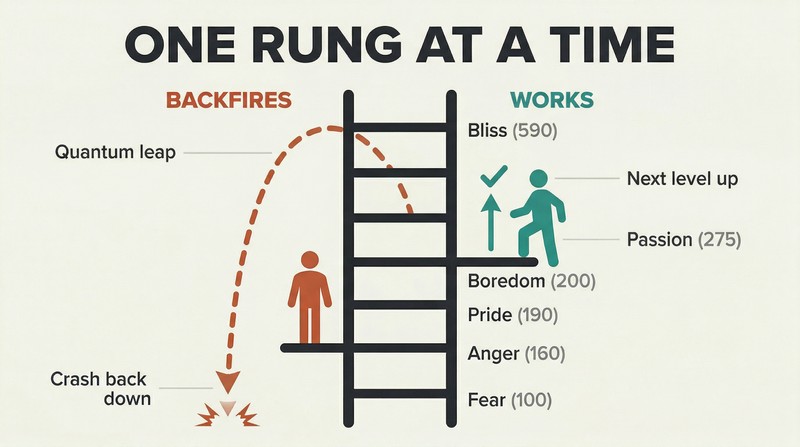
Adjacent states are accessible; distant ones aren't. From pride (190), it's easy to slip into anger (160) but nearly impossible to leap to bliss (590). Dodson compares it to jumping onto a carousel spinning too fast — you'll get bruises, not enlightenment. "Get enlightenment quick" schemes are for the gullible, he writes.
The practical method: identify your current state, then deliberately cultivate the next emotion up. Someone in fear (100) should aim for anger (160) — redirecting from persecuted victim to someone who won't take nonsense. Someone bored (200) should spark a passion (275), not seek unconditional love. Even a movement of just a few points upward can render everything you once held true suddenly meaningless — giving you an entirely new set of eyes.
Make wellbeing your starting point, not your reward for success
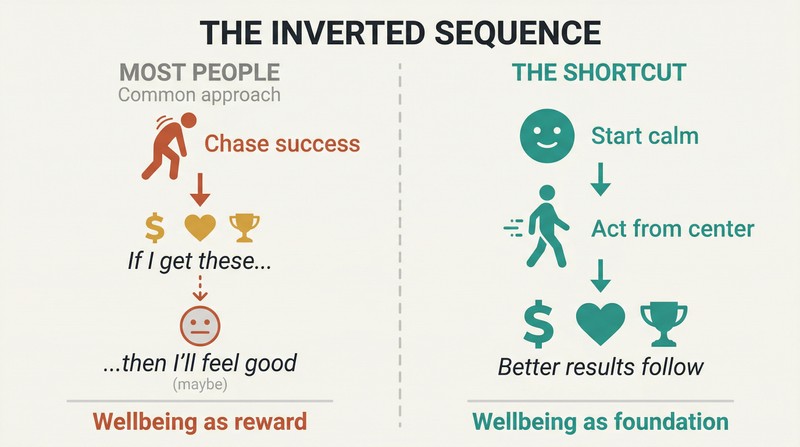
Most people invert the sequence. "When I find a partner, I'll feel better." "When I make more money, I'll be happy." Dodson argues this turns you into a puppet — your ATM balance controlling your mood rather than the reverse. The shortcut: prioritize a general sense of wellbeing before acting, planning, or deciding. When you're calm and centered first, your actions become more fruitful.
This doesn't mean avoiding effort. Dodson advocates inner calm coupled with outer effort — what he calls a wonderful mix. The losing formula is the reverse: tense on the inside, lax on the outside. Eighty percent of self-help products, he claims, merely repackage relaxation as some special method. If you knew how to truly relax body and mind, you'd save enormous time and money.
Your chronic emotional tone — not peak moments — shapes your reality
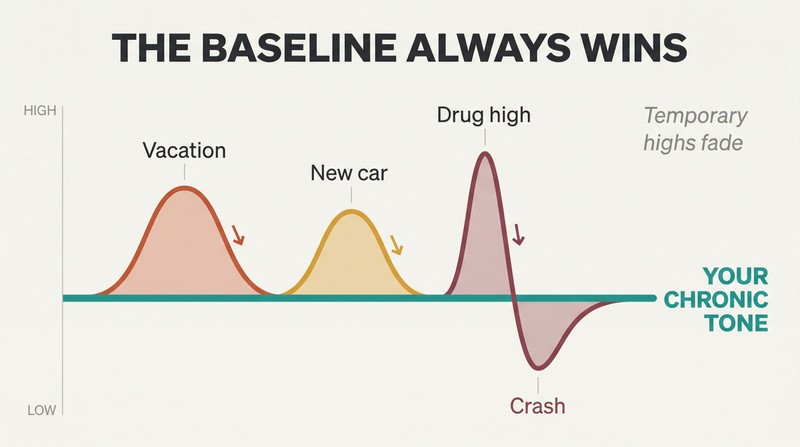
Everyone has a baseline Dodson calls your "basic vibe" — the feeling that remains when all distractions stop. If your chronic state is 195 (discontent), your range likely spans from 80 (sorrow) to 380 (success). You'll rarely touch depression or ecstasy. A temporary high from vacation or a new car fades within days unless the underlying baseline shifts.
Three days at a given level starts aligning external reality with that state. Three weeks grounds it as your new default, making it harder to leave. Drugs create artificial spikes but don't shift the baseline — and the crash between the artificial high and actual state can lower the chronic level further. To find your true baseline, simply stop all distractions and notice what emerges. That residual feeling is your operating frequency.
Replace 'I want it' with 'I'm willing to have it'
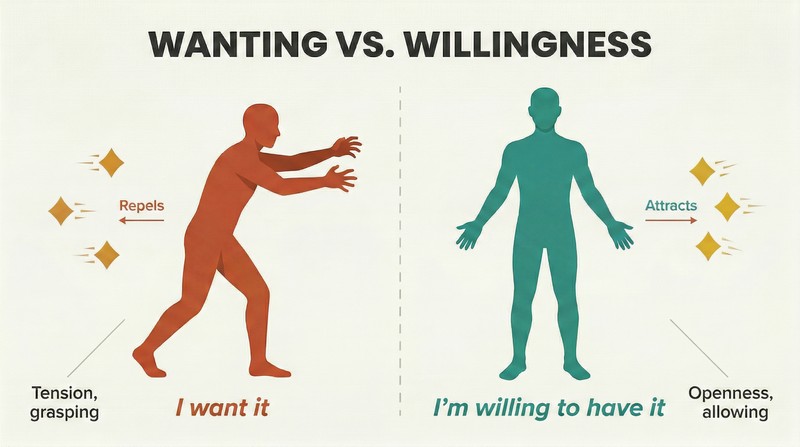
Wanting radiates scarcity. Dodson draws a sharp line between desire (level 125 — craving, neediness) and willingness (level 320 — commitment, openness). "I need money" broadcasts lack and repels money. "I like money" broadcasts appreciation and attracts it. Feel the physical difference between "I want X" (tension) and "I am willing to have X" (openness).
The technique scales to any goal. Instead of "I must have this tonight" (rigid, expectation-loaded), try "wouldn't it be nice one of these days?" (relaxed, allowing). Paradoxically, by the time someone reaches the consciousness level where luxury or adventure comes effortlessly, they're often no longer interested. Dodson's shortcut: visualize the desired reality as already fulfilled — a memory rather than a fantasy — and notice how your state shifts within seconds.
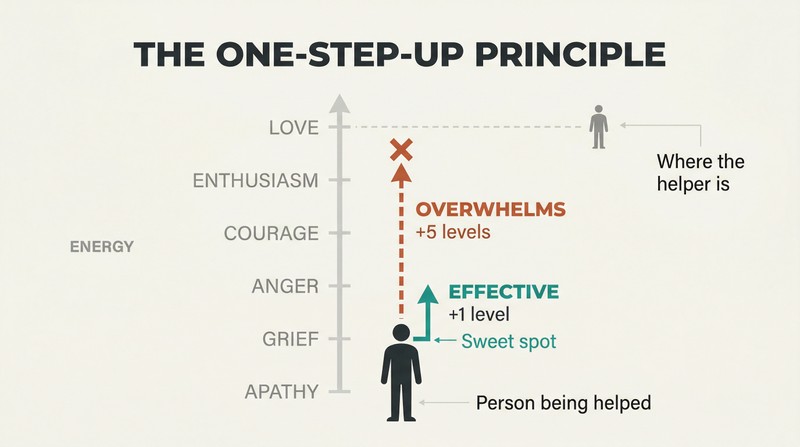
Help people one step above where they are, not where you are
Dodson tested this across 1,000+ seminars. For long-term welfare recipients radiating apathy (level 70-110), he skipped goal-setting entirely — it would fall flat. Instead he worked with bottled-up emotions, physical touch, and letting them vent their anger. For a corporate group (275-310), he focused on goals and action steps. For performers (450), he led meditation on unconditional love. Same teacher, radically different methods.
The principle extends everywhere. Matching someone's pity party helps neither person. Standing three steps higher overwhelms them. The sweet spot: project one level above theirs. Someone in apathy (50) won't respond to enthusiasm (300). But helping them access suppressed sorrow (80) takes them up 20 points — sometimes the difference between life and death.
Sometimes anger is a breakthrough, not a breakdown
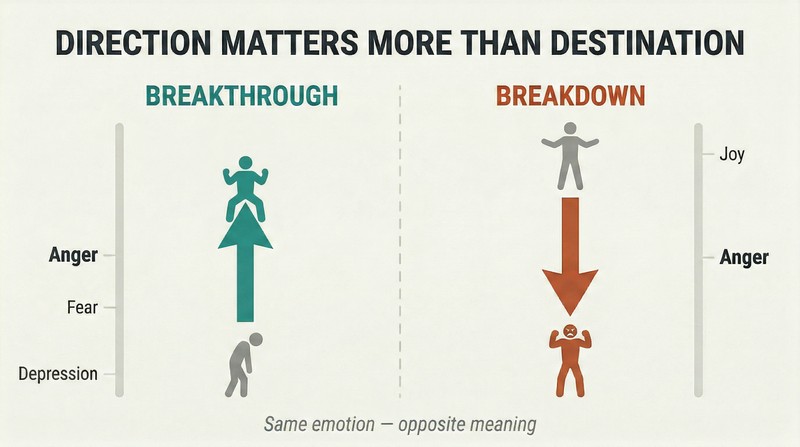
Context determines whether anger signals progress or decline. If someone was depressed (50) or fearful (100) and now explodes with rage (160), that's a significant step upward. Yet conventional wisdom often pushes them back down — a therapist says calm down, a spouse demands silence, and they retreat to depression. This traps people in cycles of rising to anger, getting suppressed, sinking, rising again.
Dodson applies this to nations too. When oppressed populations riot, it can signal an awakening from collective apathy — not a descent. Military force that shoots them back into submission creates a vicious loop. The lesson: evaluate any emotion relative to where the person started. An angry person who was formerly numb is healing. An angry person who was formerly joyful is declining.
Study what attracts your goals instead of forcing your way to them
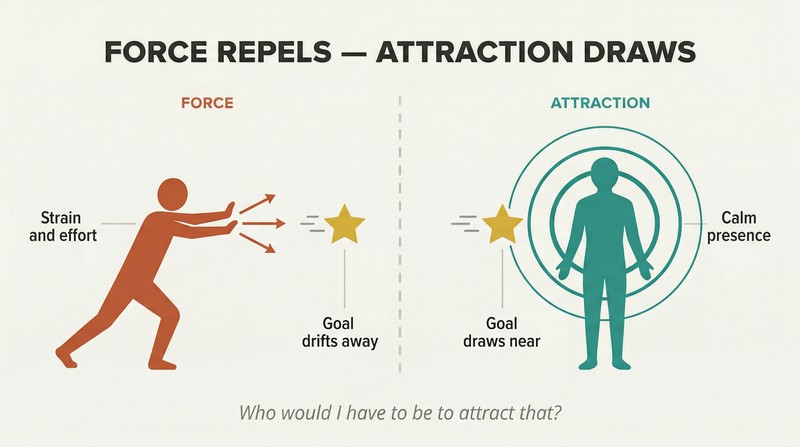
The Swedish cow-herding parable captures Dodson's core principle. Instead of using sticks, threats, and dogs, an attractive woman sings a beautiful song — and the cows come marching. Everything you want is attracted by something specific. If you feel like a level-4 and your ideal partner is a level-7, no force bridges that gap. But occupying level-8 consciousness makes attraction effortless.
Dodson extends this to money, relationships, and beauty. People force cosmetic surgery when inner beauty would radiate outward. They throw money at societal problems when internal willingness is missing — like building a water pipe for a village that won't maintain it. Resorting to force is a sign of weakness. The question that replaces all goal-setting: "Who would I have to be to attract that?"
Analysis
Dodson's Levels of Energy occupies a peculiar niche in consciousness literature — somewhere between David Hawkins' Power vs. Force, Maslow's hierarchy, and the Hindu tamas-rajas-sattva model, yet distinctly its own creation. The book's greatest contribution is making an ancient idea (consciousness exists on a spectrum) viscerally practical. Rather than leaving "raise your vibration" as vague spiritual advice, Dodson assigns specific numbers to emotions, countries, foods, movies, and spiritual teachers, creating a kind of periodic table of consciousness.
The framework's power lies in its diagnostic utility. Once internalized, the scale becomes a mental instrument for reading any situation: Why does this neighborhood feel heavy? Why does this relationship drain me? Why does my therapist's advice backfire? The answers become legible when you understand that a level-400 intellectual approach can't reach a level-80 grief-stricken person, and that suppressing anger in someone climbing out of apathy is catastrophically counterproductive.
The book's weaknesses are inseparable from its strengths. Dodson's willingness to assign numbers to everything — Coca-Cola (255), the U.S. Constitution (590), Pulp Fiction (40) — creates engagement but invites overconfidence. The measurement methodology (intuitive sensing, muscle-testing) lacks peer-reviewed rigor, and Dodson acknowledges a 15% disagreement rate with other scale researchers. Some political and cultural commentary reads as opinion dressed in energetic authority.
More significantly, the framework risks becoming the very dualistic judgment system it warns against. Despite repeated disclaimers that "lower" doesn't mean "worse," the language of levels inevitably creates hierarchy — precisely the misuse that produced India's caste system from similar Vedic principles. Still, the book's core mechanics — releasing over suppressing, gradual over quantum change, wellbeing as prerequisite rather than reward, attraction over force — are psychologically sound and practically transformative. The scale is best used as Dodson intends: a compass for navigation, not a gavel for judgment.
Review Summary
Levels of Energy receives mostly positive reviews, with readers praising its thought-provoking concepts and practical insights. Many find the energy scale helpful for self-reflection and understanding others. Some appreciate the book's unique perspective, while others caution against taking everything literally. Critics note the author's occasional arrogance and subjective opinions. Overall, readers value the book's ability to shift perspectives and provide tools for personal growth, despite some disagreements with specific ideas.
People Also Read




Glossary
World-self
Dodson's term for egoDodson's preferred term for what other authors call 'ego'—the part of the self whose primary drive is 'to get.' The lower one's position on the energy scale, the stronger the world-self's need to acquire, achieve, and strategize. It operates through desire and resistance, creating dependency on external circumstances for wellbeing.
Basic vibe
Your default energy levelAlso called 'habitual emotion,' 'chronic state,' or 'basic energy level.' The emotional frequency a person occupies most of the time—what remains when all distractions are removed. Composed of past experiences, core beliefs, current attention focus, hidden intentions, and habitual behaviors. Takes approximately three weeks at a new level to reset. Determines the range of highs and lows a person normally experiences.
Spectral perception
Seeing gradients, not just oppositesDodson's alternative to conventional binary (dual) perception, which sees only 'good vs. bad.' Spectral perception recognizes dozens or hundreds of gradients on a scale, where whether something is 'hot' or 'cold' depends on where you stand. Analogous to a thermometer that shows many degrees rather than just two states. Allows context-dependent evaluation rather than absolute moral judgment.
Social mask identities
Fake personas for social approvalIdentities people adopt for social occasions to appear more agreeable or to fit in—usually feigning a higher energy state than their actual one, sometimes deliberately lowering it. Maintaining these masks drains energy and eventually becomes unconvincing. Dodson argues that admitting to a low state is more energetically upscale than covering it with artificial positivity.
Scripting technique
Writing movie-scripts of ideal lifeA visualization method Dodson prescribes for people in the 200s energy range. The practitioner writes elaborate movie-scene descriptions of their ideal life—including dialogue, locations, and perspectives—mixing realistic and wishful imagery. Trains imagination, focus, and courage. Most effective when done playfully without expectation of literal manifestation. Useful up to the low 500s.
Astralism
Lower-realm phenomena mistaken for spiritualityDodson's term for metaphysical phenomena originating from astral planes (energy levels 0-499) that are incorrectly labeled 'spiritual.' Includes most psychic readings, channeling, Ouija boards, UFO cults, and occult practices. Distinguished from true spirituality (500+) by its reliance on gimmicks, self-importance, and exaggerated promises. Astral entities lack real power except over those radiating fear or hatred.
Levels of experience
Seven-stage abbreviated consciousness scaleA simplified version of the full energy scale Dodson uses in seminars, progressing through seven stages: Reaction (lowest—responses driven by external stimuli), Memory (living from the past), Thought (rational analysis), Imagination (creating original thoughts), Creation (acting on imagination), Intuition (receiving from higher sources), and Observation (experiencing the world as higher self, fully present and unbiased).
FAQ
What's Levels of Energy by Frederick Dodson about?
- Exploration of Energy Levels: The book introduces a spectrum of consciousness that influences thoughts, emotions, and actions, categorizing energy levels from low (apathy, fear) to high (love, enlightenment).
- Practical Applications: It provides a framework for understanding human behavior and emotional states, helping individuals improve emotional well-being and relationships.
- Connection to Infinity: Dodson discusses the relationship between individuals and Infinity, suggesting that this connection can lead to greater peace and understanding.
Why should I read Levels of Energy by Frederick Dodson?
- Self-Discovery Tool: The book offers a unique tool for self-discovery by helping readers identify their current energy level and its impact on life experiences.
- Practical Guidance: Dodson provides advice on elevating energy levels through meditation, emotional release, and conscious choice-making, improving mental health.
- Holistic Perspective: It integrates concepts from spiritual and psychological traditions, appealing to those interested in personal development and spirituality.
What are the key takeaways of Levels of Energy by Frederick Dodson?
- Energy Scale: The book presents a scale of energy levels from 0 to 1000, each corresponding to specific emotional states and behaviors.
- Importance of Perspective: Dodson emphasizes that one's perspective shapes their reality, encouraging a focus on internal states over external circumstances.
- Paths to Higher Energy: Various methods, including mindfulness and emotional processing, are outlined to help elevate one's energy and life experiences.
How does Frederick Dodson define the energy levels in Levels of Energy?
- Categorization of Emotions: Energy levels range from 0 to 1000, with lower levels representing negative emotions and higher levels representing positive states.
- Measurement of Consciousness: Each level corresponds to a specific state of consciousness, influencing life experiences and interactions.
- Practical Implications: Understanding these levels helps individuals identify their current state and take steps to elevate their energy and consciousness.
What is the Scale of Energy Levels in Levels of Energy by Frederick Dodson?
- Defined Spectrum: The scale categorizes emotional states from low (e.g., apathy at 50) to high (e.g., enlightenment at 600), each with specific thoughts and behaviors.
- Examples of Levels: Level 100 represents fear, while level 550 signifies unconditional love, helping readers identify their emotional state and potential for growth.
- Practical Application: The scale serves as a tool for self-assessment and personal development, encouraging a proactive approach to emotional well-being.
How can I measure my energy level according to Levels of Energy by Frederick Dodson?
- Self-Reflection: Engage in self-reflection to assess your emotional state based on the scale provided in the book.
- Behavioral Indicators: Observe your behaviors and reactions; feelings of apathy indicate lower energy, while joy indicates higher levels.
- Use of the Scale: Utilize the scale to identify your current standing and take steps to elevate your energy through mindfulness and supportive environments.
What are some paths to higher energy mentioned in Levels of Energy by Frederick Dodson?
- Mindfulness Practices: Incorporate meditation, deep breathing, and emotional release techniques to elevate energy levels.
- Positive Relationships: Surround yourself with positive individuals and engage in uplifting activities to rise on the energy scale.
- Creative Expression: Engage in creative activities like art or music, linked to higher energy levels, providing fulfillment and joy.
What is the significance of Infinity in Levels of Energy by Frederick Dodson?
- Absolute Reference Point: Infinity represents the unchanging essence of existence, helping individuals gain perspective on challenges.
- Connection to All: Recognizing one's connection to Infinity can lead to peace and understanding, viewing experiences as part of a larger reality.
- Practical Application: Contemplating Infinity shifts focus from personal issues to a broader understanding, alleviating stress and promoting well-being.
What are the lower energy levels and their characteristics in Levels of Energy by Frederick Dodson?
- Apathy and Despair: Levels below 200, like apathy (50), are marked by hopelessness and emotional numbness, leading to disengagement from life.
- Fear and Anger: Levels 100 and 160 represent fear and anger, with fear causing caution and anger leading to conflict.
- Impact on Life: These levels affect quality of life and relationships, with recognition being the first step toward improvement.
What are the higher energy levels and their characteristics in Levels of Energy by Frederick Dodson?
- Love and Joy: Higher levels, like love (530) and joy (475), are marked by positive emotions and creativity, leading to fulfillment and connection.
- Enlightenment and Bliss: Levels above 600, such as enlightenment (700), represent profound awareness and peace, understanding one's place in the cosmos.
- Path to Growth: Understanding these levels inspires personal growth and transformation, encouraging practices that elevate consciousness.
What is the "Scripting Technique" mentioned in Levels of Energy by Frederick Dodson?
- Visualization Method: The technique involves writing detailed scripts of desired scenarios, helping individuals visualize and embody their goals.
- Encourages Creativity: Engaging in this process taps into imagination and clarifies intentions, aiding in manifesting desires.
- Positive Mindset: It promotes focusing on wants rather than lacks, fostering empowerment and a positive outlook.
How does the concept of "intention" play a role in Levels of Energy by Frederick Dodson?
- Manifestation Power: Intention is central, as Dodson asserts that focus and intention create reality, highlighting clarity in desires.
- Alignment with Higher Energy: Positive intentions align individuals with higher energy frequencies, facilitating growth and development.
- Transformative Practice: Intention-setting encourages responsibility for life choices, empowering individuals to create their desired reality.
About the Author
Other books by Frederick Dodson




Download PDF
Download EPUB
.epub digital book format is ideal for reading ebooks on phones, tablets, and e-readers.








































