

Key Takeaways
A game needs only a player, rules, and a way to win or lose
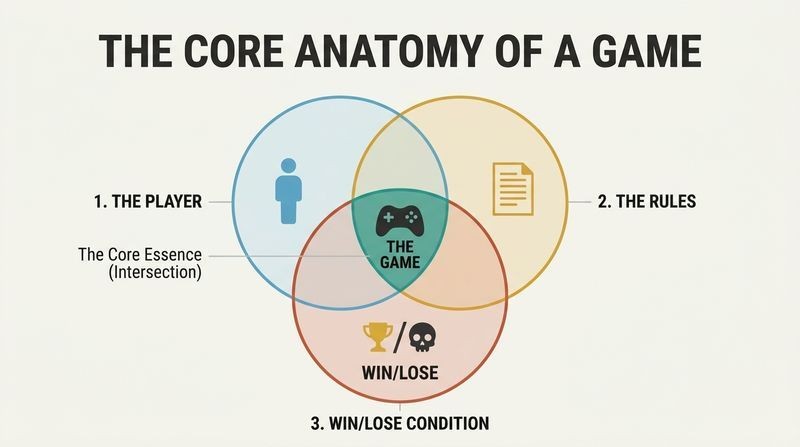
Strip away the jargon. Rogers, a 20-year veteran who designed God of War and the Maximo series, argues that a game is simply an activity with at least one player, rules, and a win and/or lose condition. A video game is that, played on a screen. The objective should be summarizable as fast as an old Milton Bradley box: Battleship says "sink all your opponent's ships." If you cannot state your game's goal that cleanly, you have a design problem.
Everything is gameplay. The book's spine is that there is no single chapter about gameplay because every element (cutscenes, menus, monetization, pause screens) affects how the player feels moment to moment. Even a pause screen is a design decision. Keep objectives simple, keep the player playing.
What's striking is how Rogers resists the academic urge (Bernard Suits, Chris Crawford) to over-define "game." His minimalism echoes design thinking across disciplines: constraints breed clarity. The Milton Bradley test resembles the "elevator pitch" in startup culture and the logline in screenwriting. One tension worth flagging: some celebrated games (open-world sandboxes, walking simulators) deliberately blur or delay their win condition, and emergent-play advocates would push back on "simple objective" as universal law. Still, for the action-focused single-player games Rogers built, clarity of goal correlates strongly with player retention, a principle validated by modern onboarding and tutorial research.
Make form follow function: decide what a thing does before what it looks like
Function first, always. Rogers hammers "Form Follows Function" as the governing law for both playable characters and enemies. Before an artist models a winged skeleton, the designer must define its size, speed, movement, attacks, aggression, and health, because those decisions cascade into how programmers code it, how animators rig it, and how it plays against everything else. Redoing a character repeatedly wrecks team morale and budget.
Personality drives design. Pick three traits (Mario is courageous, bouncy, happy; Kratos is brutal, vicious, selfish) and let them dictate every animation. Maximo was "impatient," so he kicks treasure chests open instead of politely lifting the lid. Use silhouettes so players distinguish characters instantly, a trick Team Fortress 2 uses so you know at a glance who is aiming at you.
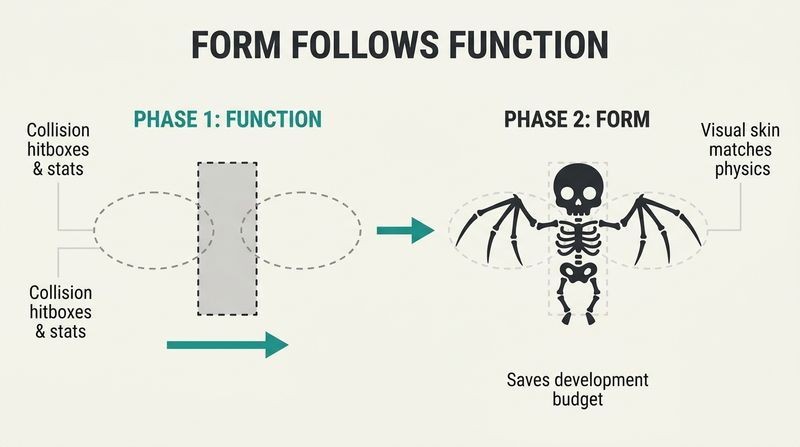
The "three traits" heuristic mirrors character-design practice in animation (Disney's Thomas and Johnston) and even brand archetype work in marketing. Silhouette-first design is well supported by perceptual psychology: the human visual system processes gross shape faster than color or detail, which is why Team Fortress 2's class reads work under combat chaos. Rogers's insistence on locking function early also anticipates lean production philosophy, reducing costly late-stage rework. The subtle risk: rigid "function first" can suppress the happy accidents that emerge when artists play. The best studios iterate between the two rather than treating the sequence as sacred.
Start with a fun idea, then surgically remove everything that isn't fun
The Theory of Un-Fun. Because "fun" is hopelessly subjective (and because developers lose all objectivity after playing a level a thousand times), Rogers offers an inverted method: begin with a genuinely fun concept, then during development hunt down and delete every element that is not fun. What remains is the fun. Un-fun is usually obvious once you look: a floaty camera, laggy controls, an animation so long it wrecks attack timing, puzzles too obscure, enemies too easy.
Don't be too dear. A producer's advice to Rogers: never grow so attached to an idea that you lose objectivity. Kill bad ideas ruthlessly, and toss some good ones too if you have more than you need. Ideas are cheap; execution is everything.
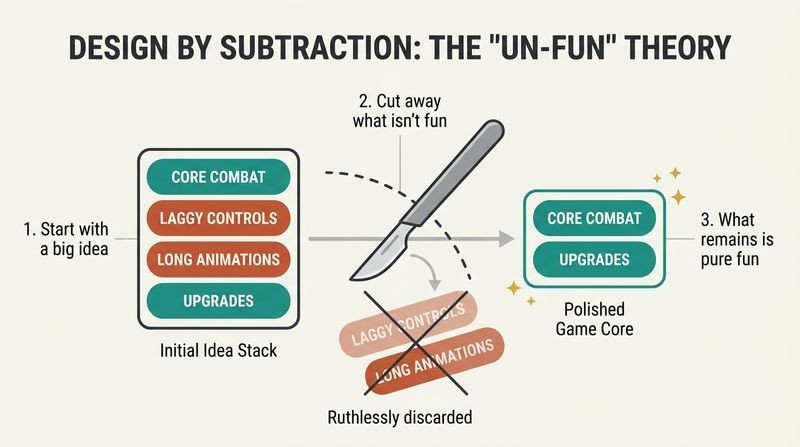
Reframing an unmeasurable positive ("is it fun?") as a measurable negative ("what here is un-fun?") is a genuinely useful cognitive trick, echoing via negativa reasoning found in Nassim Taleb and in medicine's "first, do no harm." It sidesteps the subjectivity trap by making the target concrete and removable. The approach pairs well with modern playtesting analytics: heat maps and drop-off data expose un-fun objectively, countering the "designer blinders" Rogers warns about elsewhere. The limitation: subtraction alone cannot generate delight. You still need a strong initial spark, and over-pruning can sand a game into inoffensive blandness.
Pick only one weird corner: strange characters, world, or activities, never all three
The Triangle of Weirdness. Rogers's storytelling framework warns that a game world can only push one of three corners into the bizarre without alienating players: characters, world, or activities. The Wizard of Oz has weird characters (Tin Man, Scarecrow) in a familiar fairy-tale land with relatable desires. Star Wars has archetypal characters and clear motivations but a weird galaxy of Jawas and Wookiees. Monty Python and the Holy Grail uses stock knights doing weird things (fighting killer rabbits).
Two or more corners loses people. Films like Dune (1984) and games like SkullMonkeys violate the triangle and leave audiences feeling they "didn't get it," and nobody enjoys feeling stupid. Anchor two corners in the familiar so players have something to grip.
This is one of the book's most exportable ideas, applicable far beyond games. It resembles the "one big lie" rule in science fiction writing: readers accept a single implausible premise if everything else follows logically. Cognitive-load theory supports it: novelty taxes working memory, so a design that is strange on every axis overwhelms comprehension. The framework also explains breakout hits: Portal grounds bizarre physics in a mundane test facility with a relatable snarky narrator. A fair challenge is that some cult masterpieces (Katamari Damacy) thrive precisely by breaking the rule, suggesting the triangle predicts mass-market accessibility, not artistic ceiling.
Nobody reads design docs, so draw them and build from a one-page pitch up
No one wants to read your GDD. Rogers discovered this painfully as a new designer, then solved it by drawing his design documents as cartoons. His documentation pipeline escalates in four stages, each feeding the next:
1. One-sheet: a single page covering title, platform, rating, story, unique selling points, and competitive products.
2. Ten-pager: the broad-stroke spine, one topic per page, heavy on visuals.
3. Beat chart: a spreadsheet mapping every level's enemies, mechanics, music, color, and pacing.
4. Game Design Document: the full blueprint programmers turn into a technical spec.
Everything is liquid. Designs are living things that mutate through production, so a GDD should be just long enough to describe the game and no longer. The designer's single most important job is communication.
The insight that documentation must be optimized for its readers, not its author, is chronically ignored across knowledge work, from engineering specs to academic papers. Rogers's cartoon solution is a practical application of dual-coding theory: pairing images with text roughly doubles retention versus text alone. The beat chart is quietly brilliant, functioning like a spreadsheet-based "story bible" that surfaces pacing problems (clumping, sameness, monotone color) before a single asset is built, a cheap way to catch expensive mistakes. The "everything is liquid" caveat is essential honesty: over-documenting a design that will change wastes the very time it was meant to save.
Nail the Three Cs early, because the action must fire the instant a button is pressed
Character, Camera, Control. Rogers calls these the three foundations you must lock before production, because changing one ripples destructively through the whole game. Control is the most universal, since not every game has a character or a movable camera. His cardinal control rule: as the button is pressed, the action should happen. Save beautiful wind-up animations for the finish of a move; a player who must wait for an animation to complete before jumping simply dies.
Respect the human and the camera. Design controls around ergonomics and how hands actually grip a pad. For cameras, beware DIMS (Doom-induced motion sickness) caused by wide fields of view and whipping movement, and never let the character leave the camera's sight. Pick character-relative or camera-relative controls and never switch.
The "button press equals instant action" rule is really a statement about responsiveness and the perception of agency, which HCI research ties to latency thresholds: input delays above roughly 100 milliseconds are consciously felt and degrade the sense of control. Fighting-game communities obsess over this as "input lag" for good reason. DIMS is a real phenomenon rooted in sensory conflict theory, the same vestibular mismatch that causes carsickness, and remains a central VR design problem today. Rogers's framing of the camera as a "person" who needs a spotter is a useful anthropomorphic heuristic, though modern spring-arm and collision-aware camera systems have automated much of what he describes by hand.
Walking is never gameplay: steal Disneyland's tricks to pull players through a level
Disneyland is the best design school. Rogers structures worlds the way Imagineers structure parks: world to level to experience to moment-to-moment play. Key borrowed tools include weenies (visual landmarks like Sleeping Beauty's castle that lure players in a direction), posters that foreshadow attractions, and lands themed so distinctly you always know where you are.
Alleys versus islands. Levels are either alleys (directed, linear, easy to choreograph camera and combat) or islands (open, exploratory, harder to script). Add "fingers," small dead-end detours off the main path, and always reward the end of a finger, even if it is just a trash can. Vary elevation, color, and time of day. If a stretch feels too long or boring, it is, so cut it. Just walking is not play.
The theme-park analogy is more than charming; environmental storytelling and sightline-based guidance are now formalized industry craft (Naughty Dog's "squint test" for lighting the critical path appears here). The weenie concept maps onto wayfinding research in architecture, where legible landmarks reduce cognitive navigation load. "Walking is not gameplay" is a provocative overstatement that the walking-simulator genre (Gone Home, Dear Esther) directly refuted after this book, proving traversal can carry mood and narrative. But Rogers's underlying point holds: traversal must do work, whether that work is combat, discovery, or atmosphere, and empty distance without payload is dead time players resent.
Design combat so the player looks cool and always lands the final blow
People play games to feel awesome. Rogers argues the reason God of War lets button-mashers pull off gorgeous combos, and why Batman: Arkham Asylum choreographs fights through timed prompts, is that players want to feel like experts. Track every move in an attack matrix (name, control, range, speed, direction, damage, special effect) so each attack stays distinct and useful. Combat has four ranges (close, medium, long, area) and four elevations (standing, low, high, aerial).
Let the player deliver the coup de grace. The final killing strike of any fight, especially a boss, must belong to the player, never a cutscene, because feeling that you won is the psychological climax. Close battles are more exciting than lopsided ones. Reward hits with meaty sound, reaction animations, and screen effects so blows feel like they connect.
"Players want to look cool" is a compact theory of intrinsic motivation that aligns with self-determination theory's competence need: games manufacture the feeling of mastery, sometimes before real mastery exists. The Arkham insight (offloading execution difficulty so the fantasy of being Batman survives) is a landmark design move that reshaped the action genre. The coup-de-grace principle is about authorship and agency; taking the last hit into a cutscene is a documented player frustration. A useful counterpoint: some genres (Dark Souls, which postdates this edition's roots) built devoted audiences by refusing to flatter the player, proving "make them feel cool" and "make them earn it brutally" are both viable, audience-dependent philosophies.
Make players hate the villain by having him wreck something they depend on
Hatred is engineered, not assumed. In a game based on Demolition Man, the villain Simon could not be fought until the end, so designers had him run onscreen at each level's start, shake his fist, and flee. Players re-energized every time, muttering "I'm gonna get him." The lesson: make the villain do bad things that also damage gameplay. Kill the blacksmith who forges the hero's sword; kidnap the girlfriend who heals him; burn the village where loot is stored. Now the loss stings mechanically, not just narratively.
Enemies should complement each other. Design foes with contrasting behaviors (a shielded blocker with a shooter behind it, a teleporter paired with a chaser) so combat becomes a threat-analysis puzzle. And enemies are meant to be fought, not avoided, so never design a foe so cheap players just flee.
Tying emotional stakes to mechanical consequences is a sophisticated move that many narrative-heavy games still botch by killing a character in a cutscene before players bond with them. Rogers's version fuses story and system, which is exactly the fusion prestige game writing (The Last of Us, cited here for Ellie) later perfected. The complementary-enemy principle is essentially rock-paper-scissors combat design, and it connects to flow theory: threat analysis keeps the challenge cognitively engaging rather than rote. The Demolition Man anecdote is a small masterclass in intermittent reinforcement, the same variable-ratio conditioning that makes slot machines and social feeds compulsive.
Build challenge, not difficulty: no dropping rocks on heads, no cat mustaches
Challenge rewards skill; difficulty just punishes. Having made Maximo, called one of the hardest PS2 games ever, Rogers learned the distinction firsthand: challenge is an obstacle beatable with skill and knowledge, while difficulty simply inflicts pain and loss. Player death should never be a design yardstick. His two mottos: "no dropping rocks on the player's head" (do not kill players for stopping to get their bearings) and "no cat mustaches" (never build puzzles so cryptic that logic cannot solve them, named after an infamous adventure-game puzzle requiring a mustache disguise for a character who had no mustache).
Love thy player. Use tools like dynamic difficulty balancing (secretly easing enemy health or dropping a health pack when the player is struggling) and rubberbanding to keep players moving. The whole point is to keep them playing.
The challenge-versus-difficulty line anticipates the "accessibility versus difficulty" debate that later engulfed the industry. Csikszentmihalyi's flow model, which Rogers explicitly invokes, gives the framework teeth: engagement lives in the narrow channel between anxiety (too hard) and boredom (too easy). Dynamic difficulty is a quiet application of adaptive systems, though it raises an ethical question the book mostly sidesteps: players who discover the game is secretly helping them can feel their achievements were unearned, which is why studios hide it. "No cat mustaches" is really a plea for solvability through fair inference, the same contract good mystery writers make with readers.
Weaponize player greed with rewards, but refuse coercive monetization
Never underestimate greed. Players will brave deadly platforms for one more coin and grind endlessly for a rare hat. Rogers urges channeling this for good: expose rewards early so players have a to-do list, reward often and with surprise, place treasure using consistent "guidelines" players can learn, and exploit the "me too" factor (seeing another player's robot-chicken mount makes you want one). The best rewards are hard won and double as useful tools.
Then draw an ethical line. Rogers dissects coercive monetization aimed at "whales": currency obfuscation (confusing point-to-dollar rates), bundling, difficulty ramps that force purchases, "fun pain," and reward-removal timers. His ethical alternatives: warn players a game costs money, offer alternative earn paths, give real discounts, and let players back out of a purchase. Treat players how you would want to be treated.
This pairing is the book's moral center on economics, and it aged remarkably well given loot-box regulation debates now underway in several countries. Rogers names the mechanisms of coercion with a candor rare from an industry insider: the difference between designing for greed (giving players goals worth chasing) and exploiting compulsion (engineering regret) is the difference between a well-stocked shop and a rigged casino. Behavioral economics backs him up; variable-ratio schedules and sunk-cost framing are precisely what "whale" monetization exploits. The steelman for aggressive monetization is that it subsidizes free access for the majority, but Rogers's test (would you feel taken advantage of?) remains a clean ethical heuristic.
Reserve cutscenes for kissing and explosions; make players do, not watch
Playing beats watching. Rogers is blunt that most players skip cutscenes to get back to the game, so before writing one, ask whether the moment could be delivered through gameplay instead. Cutscenes are expensive and best saved for two things: intimate moments like a kiss (character collisions look awkward in-engine) and spectacle like explosions (which shine when pre-rendered). Everything else should be interactive.
Tell the story inside the level. Scripted events using in-game assets preserve pacing far better than movies that yank away control. Keep any cutscene short (brevity is the soul of wit), always let players skip them, and never force players to rewatch a scene after every death. Start the game with a bang to hook the audience, and remember it is always better to have players do than watch.
The "do, not watch" doctrine is the interactive medium asserting its own grammar against borrowed cinematic convention, a tension that defined a decade of AAA design. It aligns with active-learning research: people retain and engage more through doing than passive viewing. Rogers's "kissing and explosions" rule is a memorable cost-benefit filter, reserving expensive non-interactive production for exactly the moments interactivity handles poorly. The counterargument, embodied by cinematic-narrative studios, is that authored scenes deliver emotional precision gameplay cannot guarantee. The synthesis most modern games reach is environmental and scripted storytelling that keeps the controller in the player's hands, which is precisely the middle path Rogers advocates.
Analysis
Level Up! is a practitioner's field manual, not a theory text, and that is its defining strength and limitation. Scott Rogers writes from two decades inside the trenches (Pac-Man World, God of War, Maximo, Darksiders) and a stint as a publisher-side creative manager, which gives the book a rare dual perspective: it understands both how games are built and how they are sold. The structure mirrors a production pipeline, marching from idea generation through story, the Three Cs, HUD, levels, combat, enemies, mechanics, rewards, multiplayer, monetization, audio, cutscenes, and pitching. This comprehensiveness is what makes it hard to summarize: it is less a single argument than a densely packed toolbox of hundreds of heuristics.
Yet a coherent philosophy runs underneath, and it can be stated in two commandments: everything is gameplay, and love thy player. Nearly every specific rule (button-press immediacy, coup-de-grace ownership, no cat mustaches, walking is not gameplay, the Theory of Un-Fun) descends from a relentless focus on the player's moment-to-moment felt experience. Rogers is essentially an applied behavioral psychologist who happens to work in games; his tools map cleanly onto flow theory, operant conditioning, cognitive load, and self-determination theory, though he cites almost none of this directly, preferring homespun mottos and cartoons.
The book's weaknesses are honest ones. Its examples skew toward single-player action games of the 2000s, and Rogers admits this bias. Emergent-play, narrative-experimental, and roguelike design philosophies get short shrift, and the walking-simulator and Souls-like movements that followed directly challenge some of his laws. But his framework for ethical monetization was prescient, and his insistence that documentation serve readers, that challenge differs from difficulty, and that agency must never be stolen from the player remains timeless. It is the rare craft book that teaches taste, not just technique.
Review Summary
Level Up! receives mostly positive reviews, with readers praising its comprehensive overview of game design principles. Many find it accessible, humorous, and well-illustrated. It's particularly recommended for beginners and those curious about the industry. Some experienced developers, however, consider it too basic. The book covers various aspects of game creation, from mechanics to documentation, and is appreciated for its practical advice. While some critics find it shallow, most readers value its insights into making games engaging and fun.
FAQ
1. What is Level Up!: The Guide to Great Video Game Design by Scott Rogers about?
- Comprehensive game design manual: The book is a detailed, practical guide covering all aspects of video game design, from basic concepts to advanced topics like character, camera, controls, level design, enemies, music, and monetization.
- Industry experience and anecdotes: Scott Rogers draws on over 20 years in the industry, sharing real-world lessons, personal stories, and examples from well-known games.
- Structured for learning: The book is organized into "levels," each focusing on a specific area of game design, making it accessible for both beginners and experienced designers.
- Focus on actionable advice: Emphasizes practical tips, clear communication, and iterative development, helping readers apply concepts directly to their own projects.
2. Why should I read Level Up!: The Guide to Great Video Game Design by Scott Rogers?
- Learn from a veteran: Scott Rogers has worked on hit games like Pac-Man World and God of War, offering insights grounded in real-world development.
- Balanced theory and practice: The book combines foundational design principles with hands-on advice, making it valuable for students, hobbyists, and professionals.
- Engaging and accessible style: Uses cartoons, humor, and a breezy tone to make complex ideas easy to understand and enjoyable to read.
- Universal truths and clever ideas: Each chapter ends with key takeaways, helping readers internalize best practices and avoid common pitfalls.
3. What are the key takeaways and universal truths from Level Up! by Scott Rogers?
- Gameplay is central: Every element, from story to monetization, should serve and enhance gameplay.
- The Three Cs: Character, Camera, and Control are the pillars of game design; changing any during production can cause major issues.
- Everything is liquid: Game designs evolve constantly, and documentation must be updated to reflect changes.
- Communication is critical: Clear, concise documentation and visual aids are essential for team alignment and successful development.
4. What are the "Three Cs" (Character, Camera, Control) in Level Up! and why are they important?
- Character: Design characters whose appearance, movement, and abilities reflect their gameplay role and personality, using distinct shapes and customization to foster player attachment.
- Camera: Treat the camera as a participant, using cinematic techniques and player-friendly controls to enhance immersion and avoid disorientation.
- Control: Prioritize ergonomic, intuitive control schemes that respond immediately to player input, allowing customization and accessibility.
- Interdependence: Changing one "C" affects the others, so all must be planned and tested together for a cohesive player experience.
5. How does Scott Rogers define and use game design documentation in Level Up!?
- Comprehensive blueprint: The Game Design Document (GDD) details every aspect of the game, from mechanics to story, serving as the team's primary reference.
- Iterative and flexible: Rogers stresses that "everything is liquid," so the GDD must be updated regularly as the design evolves.
- Multiple formats: Use storyboards, diagrams, animatics, and wikis to make documentation engaging and accessible to all team members.
- Effective communication: The goal is to ensure everyone—producers, designers, artists, programmers—understands the vision and details of the game.
6. What methods does Level Up! by Scott Rogers recommend for generating and refining game ideas?
- Diverse inspiration: Draw ideas from a wide range of media and experiences, not just games, to avoid derivative concepts.
- Collaborative brainstorming: Encourage group sessions where all ideas are welcome, recording and exploring each one fully.
- Theory of Un-Fun: Start with a fun core idea, then iteratively remove un-fun elements, even if it means discarding good ideas that don't fit.
- Player focus: Always consider what will be enjoyable and engaging for the player, not just what seems cool on paper.
7. How does Level Up! by Scott Rogers approach story and narrative design in games?
- Flexible story structure: Not all games need a deep story, but every game has some form of narrative, even if it's player-driven.
- Player as hero: Design multiple enjoyable narrative paths and choreograph emotional experiences, letting players create their own stories through gameplay.
- Triangle of Weirdness: Make only one aspect (character, activity, or world) "weird" to avoid alienating players and maintain accessibility.
- Balance depth: Cater to both story-driven and action-focused players by providing optional narrative layers.
8. What are Scott Rogers' principles for character and enemy design in Level Up!?
- Form follows function: Characters and enemies should look and behave in ways that reflect their gameplay roles, using clear silhouettes and visual cues.
- Player attachment: Allow customization and naming to increase emotional investment; design companions and multiple characters to complement each other.
- Enemy design: Enemies should be fun to fight, with telegraphed attacks, vulnerabilities, and varied behaviors to keep combat engaging.
- Boss battles: Bosses need memorable introductions, multiple attack patterns, and clear vulnerable states, emphasizing drama and player agency.
9. How does Level Up! by Scott Rogers address level design and world building?
- Levels vs. worlds: Levels are individual gameplay environments; worlds are collections of levels with a shared theme, organized using maps and beat charts.
- Creative use of clichés: Combine classic themes in unique ways ("Mexican pizza" technique) to keep environments fresh.
- Alley vs. island design: Choose between linear (alley) and open (island) structures based on gameplay goals, providing variety and player choice.
- Reward exploration: Include multiple paths, side areas ("fingers"), and rewards to keep players engaged and motivated.
10. What advice does Level Up! by Scott Rogers give on gameplay mechanics, hazards, and power-ups?
- Mechanics: Design interactive elements like platforms, switches, and puzzles that challenge and engage players, reusing them creatively.
- Hazards: Use predictable dangers (spikes, flames) that punish mistakes but are clearly signaled to avoid frustration.
- Power-ups: Offer temporary or conditional enhancements (health, weapons, speed) that are visually distinct and balanced to empower but not overpower players.
- Anti-power-ups: Use sparingly for surprise, but avoid overuse to prevent player frustration.
11. How does Level Up! by Scott Rogers cover multiplayer, combat, and player health systems?
- Multiplayer modes: Categorizes gameplay into competitive, cooperative, and conjugate, with tailored design for each mode and player count.
- Combat design: Focuses on context, variety, and player empowerment, using attack matrices, lock-ons, and balanced enemy groups.
- Health and death: Communicate damage clearly with HUD, animations, or effects; use checkpoints and quick restarts to keep players engaged.
- Fairness and feedback: Avoid excessive punishment, provide immediate feedback, and design for excitement and satisfaction.
12. What production, pitching, and marketing strategies does Level Up! by Scott Rogers recommend for game designers?
- Pitch preparation: Create concise, visually appealing pitches that highlight gameplay and unique selling points, tailored to the audience.
- Production realities: Plan for people, schedules, and unexpected issues; communicate clearly, iterate, and be ready to revise or cut content.
- Marketing collaboration: Work closely with marketing teams, using clear documentation (one-sheet, ten-pager) to ensure accurate promotion.
- Avoiding pitfalls: Beware of overpromising, designer blinders, and crunch; use vertical slice or horizontal layer production methods for better project management.
Download PDF
Download EPUB
.epub digital book format is ideal for reading ebooks on phones, tablets, and e-readers.








































