


Key Takeaways
Wrap a word in a story, joke, or origin tale and it sticks
Context beats rote memorization. Manish Gupta, a small-town Haryana boy who once looked down on English as a useless "alien tongue," flunked his way through college encounters until he abandoned bare word lists for something stranger: embedding each difficult word inside an anecdote, an embarrassing memory, a pun, or its etymology. His claim is that learning delivered through amusing contexts is absorbed faster and retained far longer.
Consider "teetotaller." Gupta once proudly refused tea at a guest's home, announcing he was a "teatotaller," assuming it meant abstaining from tea, then cheerfully downed a beer. The humiliation (the word actually means total abstinence from alcohol, the "T" emphasizing Total) burned the definition into him permanently. The book is 750-plus words taught this way, from "emancipate" (Roman slaves freed by taking the master's hand off them) to "maverick" (unbranded cattle).
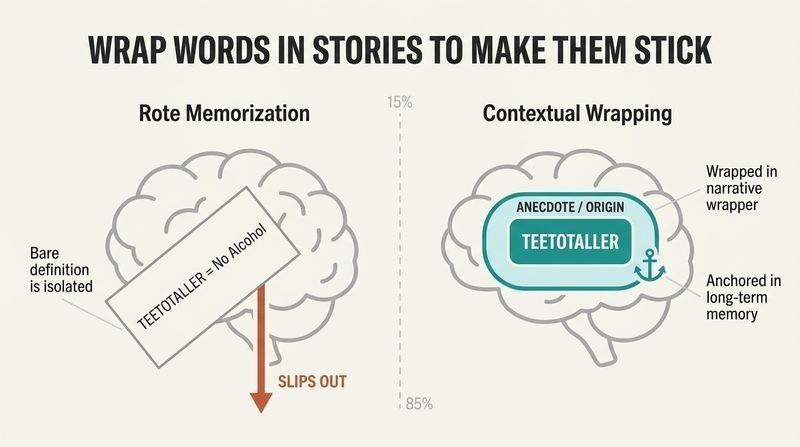
The method aligns closely with cognitive science. Craik and Lockhart's "levels of processing" theory (1972) showed that information encoded with deep, meaningful associations is recalled far better than shallowly rehearsed material. Paivio's dual coding theory adds that pairing a word with a vivid mental image doubles retrieval routes. Gupta intuited this decades before it reached Indian classrooms. The risk is scale: a single joke per word is delightful but slow, and learners chasing exam vocabularies of thousands may find storytelling impractical without pairing it to spaced repetition. Still, for the words that matter most, elaboration reliably outperforms drilling.
Invent your own mnemonics: the crazier and more personal, the stickier
Borrowed memory aids fade fast. Gupta insists a mnemonic (anything that assists memory) works best when you built it yourself. Someone else's clever trick may dazzle on first sight, yet vanish when you need it. The technique: find a comic or logical link between the word and a similar-sounding one, or split the word into chunks and weave a tale.
Examples he offers:
1. "Prosaic" (dull, unimaginative) links to "prose," its actual root.
2. "A turtle cannot hurtle" fixes "hurtle" (to move fast).
3. "Deficit in confidence" unlocks "diffidence" (shyness).
4. "Seek" plus "fan" recalls "sycophant" (a flatterer who fans your ego).
5. "Lamb" plus "blast" builds "lambaste" (to scold harshly).
His own list grew from an engineering-college pact and eventually became his first book.
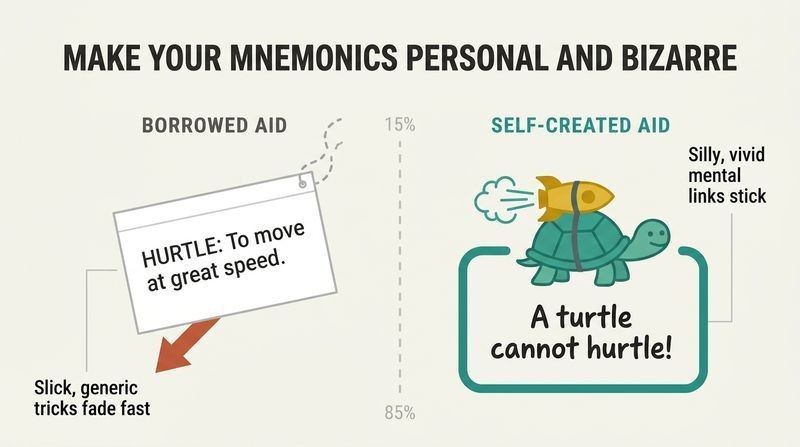
This maps precisely onto the "generation effect," a robust finding (Slamecka and Graf, 1978) that material we produce ourselves is remembered better than identical material we merely read. Atkinson and Raugh's keyword-mnemonic experiments (1975) with Russian vocabulary confirmed that absurd, self-generated image links accelerate acquisition. The reason personal mnemonics win is emotional salience and ownership: the brain tags them as self-relevant. One caution worth naming: mnemonics build recognition and definition recall, not fluent production. Knowing why "sycophant" means flatterer does not guarantee you deploy it smoothly in speech, which is why Gupta pairs the trick with conversation practice.
New words hide in passive memory until repeated use makes them truly yours
Vocabulary lives in two accounts. Gupta distinguishes passive memory banks (words you have met and vaguely recognize) from active memory banks (words you can summon instantly in speech). A newly learned word first lands in the passive account. Only through many encounters, in books, films, news debates, and deliberate attempts to use it aloud, does it migrate to the active account where fluency actually draws from.
His prescription is to run three engines simultaneously: expand vocabulary, fix pronunciation, and practice speaking, rather than treating them as separate stages. He learned this the hard way: knowing a word's meaning was useless if he froze mid-sentence, unsure how to pronounce it. He once abandoned a sentence entirely because he could not pronounce "naiveté" (nah-eev-tey), reworking his confession on the fly to dodge the word.
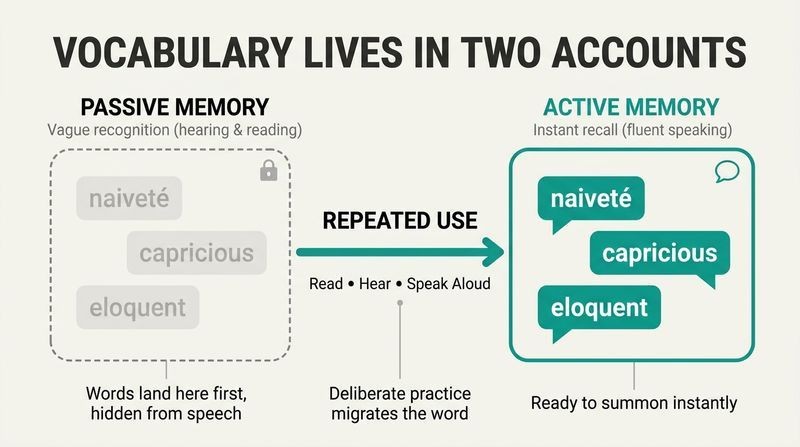
The passive-active distinction is well established in second-language acquisition research, where scholars separate receptive vocabulary (understood when heard or read) from productive vocabulary (used spontaneously). Adults typically recognize far more words than they can produce, and the gap only closes through retrieval practice, the act of pulling a word out of memory rather than re-reading it. Gupta's insistence on speaking the word aloud is the crucial mechanism: testing effect research (Roediger and Karpicke) shows retrieval strengthens memory more than restudy. His pronunciation anxiety point is underrated too; uncertainty about how a word sounds keeps it locked in the passive account indefinitely.
Accent anxiety, not a thin vocabulary, is what actually silences you
The barrier is in the mind. The most quietly radical claim in the book comes from a CEO who stood up at Gupta's talk. Raised poor in Kolkata, taught English only from grade seven, he floundered in engineering college not from ignorance but because he felt inferior the instant before he opened his mouth. His fix was psychological: find a fluent partner whose presence did not make him feel small. He tutored a rich doctor's son in math (playing the confident "guru") while the boy taught him spoken English in return.
Gupta's own trauma echoes this. On a Darjeeling holiday, unable to speak one correct English sentence to a Thai tourist, he watched his convent-educated love interest stride over and effortlessly extract the whole story. The shame, not the grammar gap, drove him.
This reframes language learning as partly an emotional regulation problem, and the evidence backs it. Krashen's "affective filter hypothesis" argues that anxiety, low self-confidence, and stress physically block language intake, no matter how much input arrives. The CEO's trick of engineering a low-threat, high-status role (tutor) is a shrewd piece of self-directed exposure therapy, lowering the filter so acquisition can happen. In postcolonial India the stakes carry extra weight: English fluency functions as a class marker, so the inferiority is socially manufactured, not personal. Naming the anxiety as the true obstacle is more useful than most grammar drills, because learners misdiagnose the problem as knowledge.
Teach the very subject you're worst at to force your own mastery
Weakness becomes the syllabus. Gupta's guiding maxim is blunt: "If you are weak, aim to teach!" As a nineteen-year-old at engineering college, he and two friends each identified their biggest deficiency (his was English, one friend's was general knowledge, the other's was literary expression) and vowed to write a book on that exact weakness before turning twenty-one. Committing to teach a subject you are bad at creates relentless pressure to actually understand it.
The CEO story rhymes with this: he taught math to gain English, adopting the teacher's posture to defeat his shyness. Gupta's confessed weakness in vocabulary, pronunciation, and syntax became the raw material for two published books. The act of having to explain a word to others forced a depth of comprehension that passive study never demanded.
This is the "protégé effect" (also called learning by teaching), documented by researchers like Chase and colleagues: students who prepare to teach, or who tutor others, learn material more deeply than those studying for themselves. The mechanism is metacognitive; explaining forces you to detect gaps in your own understanding, exactly the gaps rote review conceals. There is also a status-repair dimension, as with the shy CEO. The counterpoint worth flagging is the Dunning-Kruger trap: teaching a subject you barely grasp can propagate confident errors. Gupta mitigates this by obsessively fact-checking his etymologies against dictionaries before sharing them, a discipline worth copying.
Etymology links isolated words into a web you cannot forget
Roots turn strangers into cousins. Gupta's favorite trick is showing that seemingly unrelated words share ancestry, so learning one hands you several. A single Proto-Indo-European (PIE) root, the reconstructed common source of most European and North Indian languages, radiates outward across Sanskrit, Latin, Greek, and Hindi.
His showcase examples:
1. Sanskrit "sharkara" (candied sugar) became sugar and German "zucker," so Zuckerberg means "sugar mountain."
2. PIE "pekw-" (to cook) yields English cook, Sanskrit "pakvah," Hindi "pakana," Greek "pepon" (melon), and even Pepsi (via pepsin, from digestion).
3. Latin "caput" (head) fans out into captain, capital, decapitate, and recapitulate.
Rather than memorizing each word alone, you learn the root once and the family comes free, with the shared meaning acting as connective tissue.
Morphological awareness, understanding roots, prefixes, and suffixes, is one of the strongest predictors of vocabulary size in literacy research, and it compounds: a learner who knows Latin "caput" can decode dozens of unfamiliar words on sight. Gupta's cross-linguistic angle is especially powerful for Indian learners, because it dissolves the psychological wall between the "foreign" language and their mother tongue by showing Hindi and English as literal relatives. One scholarly caveat: folk etymology is seductive and often wrong (Gupta himself flags the spurious "corde du roy" origin of corduroy). The web is real, but individual threads need verification, not just a pleasing resemblance.
Fluency is situational: nine escalating settings test your nerve
Rank the rooms that scare you. Gupta proposes that speaking ability is not one skill but a ladder of nine contexts, each harder than the last. Difficulty climbs as the audience grows, becomes less familiar, and matters more emotionally.
His ladder runs roughly:
1. Talking to yourself alone.
2. Talking with a close friend of similar fluency.
3. Chatting in a small group of friends.
4. Addressing that same group.
5. Talking with, then addressing, strangers.
6. Addressing a large unknown crowd.
7. Speaking to a group of attractive women, and finally, face to face with one convent-educated girl.
Gupta placed himself at level three in college and admitted the jump to higher rungs felt impossibly steep before the "most eligible" partners got "booked" in second semester.
The ladder is really a self-made anxiety hierarchy, the same tool clinical psychologists use in graduated exposure therapy for social anxiety: rank feared situations, then practice climbing rung by rung. Its diagnostic value is that it stops learners from conflating a private vocabulary problem with a public performance problem; you can have a huge word bank and still freeze at rung six. The humor of the final rungs (attractive audiences) is more than a joke, since evaluation apprehension genuinely degrades verbal fluency under social-evaluative stress (the Trier Social Stress Test literature confirms this). The actionable move: identify your current rung and deliberately practice one level up.
Study books slowly; the brain absorbs only small bits at a time
Read less, but read deeper. Reversing decades of voracious speed reading, Gupta now reads fewer books and moves slowly, treating them as objects to study, question, and apply rather than consume. Drawing on his second-career reading in neuroscience and cognitive science, he argues the human brain processes only small chunks of information at once, so he advises reading no more than a couple of chapters a day and rereading, since one pass rarely commits anything to memory.
He designed the book around this: difficult words are bolded, footnoted with meanings and usage examples, and capped at roughly one per page so they do not clog the narrative. He even leaves some hard words unexplained deliberately, to build the reader's habit of reaching for a dictionary, betting that humans, though prone to procrastination, are explorers by nature.
The advice runs against the speed-reading industry and lands closer to the evidence. Working memory holds only a handful of items at once (Cowan's estimate is about four chunks), so flooding it defeats encoding. Spacing and rereading exploit the "spacing effect," one of psychology's most replicated findings: distributed practice beats massed cramming for durable memory. Gupta's deliberate omission of some definitions is a clever application of "desirable difficulties" (Bjork), where making retrieval slightly effortful strengthens learning. The tension in his own book is real, though: an anthology this dense with trivia invites exactly the fast, passive skimming he warns against, so the reader must impose the discipline the format alone will not.
Word meanings rot over time, and tracking the decay locks them in
Watch the drift, remember the word. Gupta repeatedly shows that words slide in meaning across centuries, a process linguists call pejoration (the slow worsening of a word's sense). Following the slide is itself a memory aid, because the story of how a word fell explains what it means now.
His cases:
1. "Mistress" began as the female head of a household, then decayed into a kept woman.
2. "Spinster" meant a woman who spun thread, then hardened into an unmarried older woman.
3. "Cavalier" started as a synonym for chivalrous and flipped to mean arrogant and dismissive.
4. "Decimate" once meant killing every tenth Roman soldier, now means large-scale destruction.
5. "Silly" once meant blessed and innocent.
Meanings also shift in the opposite direction (nubile and nymph gained beauty and youth they never originally carried).
Semantic change is a core topic in historical linguistics, and Gupta's pejoration examples reveal something uncomfortable: language encodes the biases of the societies that shaped it. That so many words for women (mistress, spinster, governess, hussy) decayed while male equivalents (bachelor, master) held their dignity is not coincidence, it is a fossil record of gendered social attitudes, a point feminist linguists like Deborah Cameron have pressed. For the learner, the practical payoff is that a word's trajectory is far more memorable than its bare definition, because narrative structure (rise, fall, present state) gives the brain a hook. Knowing decimate meant one in ten prevents the common misuse of it as total annihilation.
Set steep targets inside a competitive but collaborative circle
Rivalry and sharing, together. The engine behind Gupta's transformation was a deliberately engineered environment. He and two engineering-college friends set an audacious target (write and publish a book each before age twenty-one) and built a system that was simultaneously fiercely competitive and intensely collaborative. When one friend found trivia, it went to the friend improving his general knowledge; when they hit tricky English, it went to Gupta.
They pushed each other with reminders of how fast they needed to improve, while pooling every useful scrap of material. The result: they read copiously, learned rapidly, and built a shared reference base, even as the vastness of the task exasperated them. Later, his friend Avinash quizzed him relentlessly on word meanings and pronunciations, a method Gupta credits for far higher retention than solo cramming.
The design here is quietly sophisticated: it fuses goal-setting theory (Locke and Latham showed specific, difficult goals outperform vague "do your best" aims) with the social accountability of a mastermind group. The competitive-collaborative blend resolves a real tension, since pure competition breeds hoarding while pure collaboration breeds free-riding, but combining a shared resource pool with individual scoreboards captures the upside of both. Avinash's quizzing is the testing effect in social form, retrieval practice made unavoidable by a peer. The scalable lesson for any learner is to stop studying alone: manufacture a small group with a hard, dated, public target and a norm of trading useful finds.
Analysis
This is a vocabulary-and-etymology anthology disguised as a memoir, and that hybrid form is exactly what makes it hard to summarize. On the surface it is 750-plus word origin stories strung along Gupta's autobiography, from a Rohtak boy humiliated by his English to a banker-turned-trainer. Beneath the trivia sits a coherent pedagogy: learn through elaboration, own your mnemonics, follow roots, move words from passive to active memory, and dismantle the psychological inferiority that mutes non-native speakers. The trivia is the demonstration; the method is the argument.
Judged against modern learning science, the method holds up remarkably well. Elaborative encoding, dual coding, the generation effect, the testing effect, spacing, and desirable difficulties all independently validate techniques Gupta reached by instinct and struggle. His most original contribution is not any single trick but the insistence that emotional state gates everything, a point that connects him to Krashen's affective filter and to contemporary work on social-evaluative anxiety. In the Indian context this is not incidental; English is a caste and class gatekeeper, so the shame he documents is structurally produced, and naming it is a genuine service.
The weaknesses are worth stating plainly. Etymology is a seductive field where plausible stories outnumber true ones, and while Gupta fact-checks diligently and flags folk etymologies, the sheer density invites the passive skimming he explicitly warns against. The mnemonic-per-word approach also does not obviously scale to the thousands of words a CAT or GRE aspirant needs, and it builds recognition faster than production. Finally, the book's charm, its digressive, association-hopping structure, is also its pedagogical risk: delight can substitute for retention. Yet as a demonstration that curiosity beats drudgery, and that the fastest route into a feared language runs through story, humor, and lowered anxiety rather than grammar tables, it is persuasive and unusually humane.
Glossary
Mnemonic
Self-made memory aid for wordsAnything that assists memory, used by Gupta specifically to lock in difficult English words. It can be an embarrassing memory, an invented comic incident, a joke, a rhyme, an etymology, or a playful splitting of a word into chunks woven into a story. Gupta stresses the mnemonic must be your own creation, because borrowed ones tend to fade when you need them.
Passive and active memory banks
Recognized words versus usable wordsGupta's model of vocabulary storage. Passive memory banks hold words you have encountered and vaguely recognize; active memory banks hold words you can instantly summon in speech. Newly learned words enter the passive bank first and migrate to the active bank only through repeated encounters and deliberate attempts to use them aloud. Fluency draws only from the active bank.
Nine levels of articulation
Escalating ladder of speaking difficultyGupta's ranking of speaking contexts by difficulty, from easiest to hardest: talking to yourself, then to a fluent close friend, then within and to small friend groups, then with and addressing strangers, then large crowds, and finally the most nerve-wracking, addressing attractive strangers or one convent-educated girl. Difficulty rises with audience size, unfamiliarity, and emotional stakes.
PIE base
Reconstructed common ancestral rootProto-Indo-European base, the hypothetical common source of most European and North Indian languages, marked by linguists with an asterisk (for example *pekw-, to cook). Gupta uses PIE roots to show that words across Sanskrit, Latin, Greek, Hindi, and English descend from shared ancestors, turning isolated vocabulary into connected families that are easier to learn together.
Pejoration
Word meaning worsening over timeThe linguistic process by which a word's meaning degrades or becomes less favorable across centuries. Gupta's examples include mistress (once household head, later a kept woman), spinster (once a thread spinner, later an unmarried older woman), and cavalier (once chivalrous, later arrogant). Tracking a word's decline serves as a memory aid because the story explains the current meaning.
Law of Hobson-Jobson
Reshaping foreign words to fitA linguistic principle describing how a borrowed foreign word gets altered to harmonize with the sound patterns of the adopting language. Named after the 1886 Anglo-Indian dictionary title, itself a mangling of the Shia mourning cry Ya Hasan Ya Husain. Examples include khichri becoming kedgeree and Jagannath becoming juggernaut.
Download PDF
Download EPUB
.epub digital book format is ideal for reading ebooks on phones, tablets, and e-readers.








































