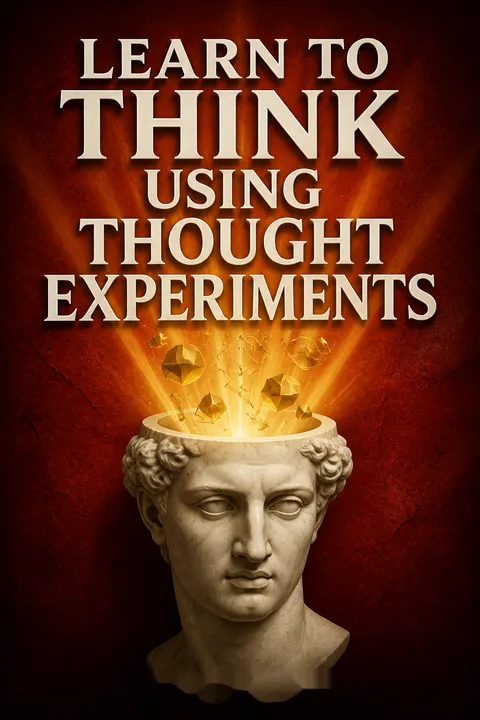

Key Takeaways
1. Thought Experiments: Your Brain's Ultimate Playground
A thought experiment is much more than a “what if” scenario played out to its logical or philosophical end.
Mental tools. Thought experiments are powerful mental tools that allow us to systematically ask questions of the world, explore hypothetical possibilities, and understand complex concepts without real-world constraints. They free us from moral, natural, and practical limitations, enabling us to fully flesh out ideas and their ramifications. This mental arena helps us discover aspects of ourselves and consider future possibilities long before technology can make them real.
Beyond the lab. While traditional experiments involve scientists in labs, thought experiments are conducted purely in the mind. They foster critical thinking, mental agility, and self-awareness, helping us spot biases, question assumptions, and open doors to entirely new ideas. By engaging with these "fictions," we learn to think about thinking itself, a valuable and transferable skill applicable to every walk of life.
Classic examples. Famous thought experiments like the Trolley Problem force us to grapple with moral dilemmas and the value of human life, strengthening different modes of reasoning. Schrodinger's Cat highlights the strange implications of uncertainty, while Einstein's "riding a light beam" challenged fundamental physics, leading to the theory of relativity. These examples demonstrate how abstract mental exercises can profoundly advance our understanding of the universe and ourselves.
2. Embrace Uncertainty: The Foundation of True Knowledge
Learning to thrive in the limbo of uncertainty can greatly benefit your thinking skills because it teaches you to slow down, check your assumptions, put away your ego, and embrace the ultimate version of “I have no idea.”
Questioning knowledge. Early philosophers quickly realized the challenge of distinguishing what we think we know from what we actually know. This branch of philosophy, epistemology, asks fundamental questions about the nature of knowledge, belief, and truth. It encourages us to doubt everything, even seemingly obvious facts, to uncover the true extent of our understanding.
Plato's Cave. Plato's Allegory of the Cave vividly illustrates how our perception can be limited, mistaking shadows for reality. Prisoners, chained to see only shadows, would believe them to be the true objects, unaware of the real world behind them. This allegory highlights our potential ignorance and the importance of mental flexibility and critical thinking to question our default mental models and expand conscious awareness.
The Matrix dilemma. The "brain in a vat" thought experiment, popularized by The Matrix, pushes this further: how do we know our entire reality isn't a sophisticated simulation? Descartes' "I think, therefore I am" offers a starting point, asserting that even if deceived, the act of doubting confirms our existence. This exercise teaches us to strip away every assumption, fostering a "beginner's mindset" to achieve a depth of clarity that enhances all thinking.
3. Perception vs. Reality: Unmasking the Shadows of Our Minds
The first step—perhaps the biggest step—is to really internalize the idea that our perceptions of things and the things themselves are not necessarily identical.
Map is not territory. Our ideas, language, and mental models are like maps we use to navigate reality, but they are not reality itself. These maps are simplified abstractions, inherently incomplete, and can lead to misunderstandings if we forget their limitations. Just as a map doesn't show every detail of the terrain, our perceptions are filtered and interpreted, not direct reflections of objective truth.
Cognitive biases. We often narrow our focus, relying on mental shortcuts and unexamined assumptions to make sense of the world. This can lead us to overlook crucial information or cling to beliefs even when evidence suggests otherwise. Thinking philosophically means habitually asking, "In what ways could I be wrong?" rather than seeking confirmation for what we already believe, pushing us beyond superficial understanding.
Descartes' demon. Descartes' demon problem suggests that an evil entity could be manipulating our reasoning, making us question the reliability of our own thoughts and senses. This extreme doubt underscores that we cannot always trust our internal processes. It compels us to seek firsthand evidence and build knowledge from a foundation of absolute certainty, reminding us that our view of the world might not be as real or accurate as we assume.
4. The Infinite: Stretching the Bounds of Comprehension
In thinking about infinity, we are stretching our minds to the furthest reaches.
Grasping the boundless. Thought experiments provide a unique way to grapple with unfathomable concepts like infinity—the infinitely small, the infinitely big, things without end or beginning. While seemingly abstract, these exercises sharpen our mental tools, extending our conceptual reach and flexibility. They challenge our language, assumptions, and blind spots, inspiring awe and pushing the limits of human knowledge.
Lucretius' Spear. Lucretius' Spear argument challenged the idea of a finite universe: if you threw a javelin past its supposed edge, what would happen? If it continued, there was no edge; if it bounced back, something was beyond the edge. This thought experiment demonstrates the logical inconsistencies of a bounded universe, forcing us to redefine what we consider possible and question the very concept of "boundaries."
Zeno's Paradoxes. Zeno's paradoxes, like the arrow never reaching its target because it must first travel half the distance, then half of the remainder, and so on infinitely, highlight the uncomfortable fit between mathematics and reality. While logically sound in theory, the conclusions are demonstrably false in practice. These paradoxes reveal the limitations of our conceptual tools, showing that what seems intuitively correct can be mathematically or theoretically flawed, and that the "map" of math is not the "territory" of physical reality.
5. Identity: What Truly Makes You, You?
What is a thing or person’s essence, the one aspect that, if changed, would make them no longer what they are?
The Ship of Theseus. This classic thought experiment asks: if Theseus gradually replaces every plank of his ship, is it still the same ship? What if the old planks are reassembled into a new ship? This probes the nature of identity, forcing us to consider whether identity lies in physical components, an abstract idea, or continuity over time. It challenges our unexamined beliefs about what constitutes a fixed identity for objects and, by extension, for ourselves.
The Swamp Man. Donald Davidson's "swamp man" scenario further complicates identity: if lightning strikes a man dead and simultaneously creates an exact molecular replica from swamp molecules, is the replica the same person? Davidson argued no, as the swamp man lacks a "causal history" and genuine memories. This suggests identity is more than just physical manifestation; it encompasses personality, experiences, and patterns of thought, acting as a refinement of the Ship of Theseus.
Transporter dilemmas. The Star Trek "transporter" thought experiment asks if a person disassembled and reassembled at an atomic level is still the same individual. This highlights the role of memory and experience in identity. These experiments collectively push us to define what persists despite change—body, soul, personality, or perhaps the very idea of identity itself is a linguistic construct. Our chosen perspective profoundly impacts how we live, process trauma, and approach personal growth.
6. Understanding: More Than Just Processing Information
For Searle, it didn’t matter how complex the behavior, set of rules or symbols; if there’s no understanding, there’s no actual thought.
The Chinese Room. John Searle's "Chinese room" thought experiment challenges the notion of machine intelligence. An English speaker in a room, following rules to manipulate Chinese symbols, can produce correct responses without understanding Chinese. To an outside observer, they appear fluent, but they lack comprehension. Searle argued that computers, like the person in the room, merely manipulate symbols (syntax) without grasping their meaning (semantics), thus lacking true intelligence or a mind.
Beyond simulation. This experiment prompts us to question what truly distinguishes human thought from mere simulation. It asks where "intention," "consciousness," or "understanding" originate, and why a perfect replica of these behaviors isn't the same as the original. It draws parallels to the "swamp man" and Plato's cave, focusing on the difference between real consciousness and an illusion or image of it, pushing us to define what we mean when we say we "have a mind."
The mind's nature. The Chinese room debate extends to the computational theory of mind, which posits mental states as software on our brain's hardware. Searle's counter-argument suggests that a mind is more than just a program or intelligent conversation; it involves feelings, dreams, sensations, and a deep belief in being alive. This leads to a fundamental inquiry into the accessibility and shared understanding of the "mind" itself, and whether we are truly talking about the same thing.
7. The Private Nature of Experience: Unlocking Empathy
It’s a sobering thought: our deepest experiences and perceptions are fundamentally closed off to others, and permanently private.
The Beetle in the Box. Wittgenstein's "beetle in a box" analogy illustrates the fundamental privacy of individual experience. Everyone has a box with a "beetle" inside, but no one can see into another's box. We use the word "beetle" to refer to what's in our own box, assuming others have something similar, but we can never confirm it. This highlights that our deepest perceptions are inherently inaccessible to others, and language merely provides shared conventions for referring to these private worlds.
Limits of language. This thought experiment reveals the profound difficulty of truly conveying personal experiences—like dreams, intuitions, or deep emotions—through language. Even if we verbalize them, there's no guarantee of accurate interpretation by others. It forces us to acknowledge that while we share linguistic tools, the underlying subjective experience they point to might be fundamentally different and alien, making true understanding a complex challenge.
Cultivating compassion. Recognizing the permanent privacy of others' experiences can foster genuine compassion and humility. We can observe behavior and hear words, but we can never truly know another's pain, love, or internal world. This understanding empowers individuals to own their experiences, defining their reality on their own terms rather than through the lens of others' interpretations. It underscores that, ultimately, our lived experience, within our own minds, is all we truly have.
8. The Power of Questions: Beyond Seeking Simple Answers
Training your brain to confidently engage with these sorts of questions is enriching beyond the quick satisfaction of solving a problem or optimizing what you already know.
The journey, not the destination. Thought experiments are not about finding definitive answers, but about the process of questioning itself. They train our minds to tolerate uncertainty, suspend judgment, and critically examine the architecture of our thoughts, not just their content. This intellectual exercise develops robust cognitive abilities, making us more curious, open-minded, and less concerned with being "right."
Zhuangzi's Fish. Zhuangzi's parable of the happiness of fish beautifully encapsulates the limits of perception and the circularity of knowing others' minds. When Zhuangzi observes the fish's happiness, Huizi challenges him, "You are not a fish, so whence do you know?" Zhuangzi counters, "You are not I, so whence do you know I don't know?" This exchange highlights how our perspectives are inherently unique and how difficult it is to truly understand another's internal state.
Continuous growth. This book concludes by emphasizing that the more we think we know, the less we truly do. Engaging with thought experiments helps us watch for assumptions, question them rigorously, and become comfortable with the unknown. It encourages us to explore the poetic and ineffable aspects of life, recognizing that our mind is an organ through which to experience wonder in this strange and boundless world.
Review Summary
Learn To Think Using Thought Experiments receives mixed reviews (3.84/5) with readers appreciating its accessible introduction to philosophical concepts like Theseus's ship and the trolley problem. Many praise it as thought-provoking and excellent for beginners, noting its short, lucid chapters. However, critics find it repetitive and surface-level, better suited for younger readers or newcomers to philosophy. The content covers classic thought experiments in abbreviated form, with some readers wanting deeper analysis and cultural context. Most agree it's worthwhile for those seeking an introduction to critical thinking.
People Also Read






About the Author
Other books by Patrick King

Download PDF
Download EPUB
.epub digital book format is ideal for reading ebooks on phones, tablets, and e-readers.








































