
Key Takeaways
1. Customer Development: A Hypothesis-Driven Approach
Customer development is a hypothesis-driven approach to understanding: who your customers are, what problems and needs they have, how they are currently behaving, which solutions customers will give you money for (even if the product is not built or completed yet), how to provide solutions in a way that works with how your customers decide, procure, buy, and use.
Understanding Customer Development. Customer development is a structured methodology that parallels product development, focusing on understanding customers, their needs, and their behaviors. It's about testing assumptions, not just building products. This approach helps reduce business risks by validating hypotheses about who your customers are, what problems they face, and how they make purchasing decisions.
Hypothesis-Driven Learning. The core of customer development lies in forming and testing hypotheses. These hypotheses cover various aspects, including customer identity, problem definition, and solution viability. By actively seeking to disprove these hypotheses through customer interactions, you can avoid building products that no one wants.
Benefits of Customer Development. By engaging in customer development, businesses can ensure they are building solutions that meet real needs and are delivered in a way that aligns with customer behavior. This process not only reduces the risk of failure but also saves time and resources by focusing development efforts on validated ideas.
2. Lean Customer Development: Pragmatic and Fast
Every hour spent on customer development has saved 5, 10, or even more hours of writing, coding, and design.
Defining Lean Customer Development. Lean customer development is a pragmatic, approachable, and fast method of understanding customer needs. It emphasizes efficiency and direct engagement with potential customers to validate assumptions quickly. This approach is suitable for both startups and established companies.
Five Steps of Lean Customer Development. Lean customer development involves five key steps:
- Forming a hypothesis
- Finding potential customers to talk to
- Asking the right questions
- Making sense of the answers
- Figuring out what to build to keep learning
Time and Cost Savings. By prioritizing customer interaction and hypothesis validation, lean customer development can significantly reduce wasted time and resources. This approach ensures that development efforts are focused on building products that customers genuinely want and are willing to pay for.
3. Customer Development Is Not Just for Startups
Although Eric Ries uses the word “startup” in the title of his book and Steve Blank wrote specifically about customer development as it pertains to startups, startups are not the only companies that benefit from customer development.
Beyond the Startup World. While often associated with startups, customer development is equally valuable for larger, more established companies. These companies can use customer development to drive internal innovation, explore new markets, and adapt to changing customer needs.
Internal Innovation. Customer development promotes a nimble, iterative approach to innovation and growth within larger organizations. By engaging directly with customers, companies can identify new opportunities and validate ideas before committing significant resources.
Examples of Enterprise Adoption. Companies like Intuit, General Electric, and Toyota have successfully implemented customer development principles to launch new products and improve existing ones. This demonstrates the broad applicability of customer development across various industries and organizational sizes.
4. Customer Development Is Not User Research
Customer development is “advocating for the business.”
Distinguishing Customer Development from User Research. While both customer development and user research involve engaging with customers, they serve different purposes. User research focuses on understanding user experience and advocating for user needs, while customer development focuses on validating business assumptions and building a sustainable business model.
Business-Centric Approach. Customer development is primarily concerned with ensuring that a product or service is viable from a business perspective. It seeks to understand customer behavior, purchasing decisions, and willingness to pay, rather than solely focusing on usability and user satisfaction.
Complementary Processes. Customer development and user research are not mutually exclusive; they are complementary processes that can be used in conjunction to create successful products. Customer development helps identify the right product to build, while user research helps ensure that the product is user-friendly and meets customer needs.
5. Earlyvangelists: The Key to Finding Initial Customers
Earlyvangelists will give you all the details about their problem, their needs, and their environment.
Identifying Earlyvangelists. Earlyvangelists are passionate, enthusiastic potential customers who are highly motivated to solve their problems. They are willing to take a risk on unproven, unfinished products and provide valuable feedback to help shape the product's development.
Characteristics of Earlyvangelists. Earlyvangelists share several key characteristics:
- They have a problem that is a high priority for them.
- They are actively seeking a solution.
- They are willing to work with an imperfect product.
- They are willing to provide feedback and suggestions.
Benefits of Engaging Earlyvangelists. By focusing on earlyvangelists, businesses can gain valuable insights into customer needs, validate product ideas, and build a loyal customer base. These customers are essential for providing early validation and driving initial adoption.
6. Motivating Customers: Help, Expertise, and Purpose
We like to help others, we like to sound smart, we like to fix things.
Understanding Human Motivation. To effectively engage potential customers, it's important to understand the underlying motivations that drive their behavior. People are generally motivated by three key factors:
- A desire to help others
- A desire to demonstrate expertise
- A desire to contribute to a greater purpose
Leveraging Motivation in Customer Development. By framing customer development interactions as opportunities for customers to help, share their knowledge, and contribute to a meaningful cause, businesses can increase participation and gather more valuable insights.
Creating Win-Win Scenarios. Customer development should be a mutually beneficial process. By offering customers a chance to be heard, valued, and influential, businesses can create a positive experience that fosters long-term relationships.
7. Crafting Effective Interview Questions: Focus on Behavior
Customers may not know what they want, but they can’t hide what they need.
The Art of Questioning. Effective customer development interviews require asking the right questions to uncover customer needs and behaviors. The goal is to elicit detailed, specific responses that reveal underlying motivations and pain points.
Focus on Past Behavior. Instead of asking hypothetical questions about future actions, focus on gathering information about past experiences and current behaviors. This provides a more accurate understanding of how customers actually behave.
Example Questions. Some effective customer development questions include:
- "Tell me about how you do _________ today."
- "Do you use any [tools/products/apps/tricks] to help you get ________ done?"
- "Last time you did ___________, what were you doing right before you got started? Once you finished, what did you do afterward?"
8. The Art of Active Listening: Uncovering Customer Needs
You need to guide the conversation and set expectations, but also defer to the customer’s experience.
Beyond Asking Questions. Effective customer development involves more than just asking questions; it requires active listening and thoughtful interpretation of customer responses. The goal is to understand the customer's perspective and uncover hidden needs and motivations.
Identifying Constraints. Pay attention to the constraints that affect customer choices and actions. These constraints may include:
- Lack of awareness of available solutions
- Limited resources (time, money, skills)
- Cultural or social expectations
Uncovering Frustrations and Motivations. Listen for clues about what frustrates customers and what motivates them. Understanding these factors can help you create solutions that are both effective and appealing.
9. Minimum Viable Product (MVP): Maximize Learning, Minimize Waste
The goal of an MVP is to maximize learning while minimizing risk and investment.
Defining the MVP. A Minimum Viable Product (MVP) is a version of a product with just enough features to attract early-adopter customers and validate product ideas early in the product development cycle. The focus is on learning and validation, not on building a perfect product.
Types of MVPs. There are several types of MVPs, including:
- Pre-Order MVP: Validating demand by collecting pre-orders
- Audience Building MVP: Building a customer base before launching a product
- Concierge MVP: Manually providing a service to understand customer needs
- Wizard of Oz MVP: Creating a product that appears to be fully functional but is powered by manual effort
Benefits of Using an MVP. By using an MVP, businesses can:
- Validate product ideas quickly and cheaply
- Gather valuable customer feedback
- Reduce the risk of building a product that no one wants
10. Ongoing Customer Development: Integrating Learning into Daily Processes
You need to stop thinking of customer support as a crew of responsive hole-patchers that deal with problems as they come up, but instead as investigators who have privileged access to the information that holds the key to the future of your business: customer insights.
Embedding Customer Development. Customer development should not be a one-time activity; it should be an ongoing process that is integrated into the daily routines of your organization. This ensures that you are continuously learning and adapting to changing customer needs.
Leveraging Customer-Facing Teams. Empower customer-facing teams (sales, support, account management) to gather customer feedback and insights. Provide them with the training and tools they need to effectively listen and learn from customers.
Closing the Loop. Establish a system for collecting, summarizing, and sharing customer feedback across your organization. This ensures that everyone is aware of customer needs and that product decisions are informed by customer insights.
Review Summary
Lean Customer Development receives mostly positive reviews, with readers praising its practical approach to customer research and product development. Many find it valuable for startups and established companies alike. The book offers actionable advice on conducting customer interviews, validating hypotheses, and developing minimum viable products. Some readers note that the content may be familiar to those well-versed in lean methodologies. Overall, it's considered a useful resource for understanding customer needs and improving product development processes.
People Also Read







FAQ
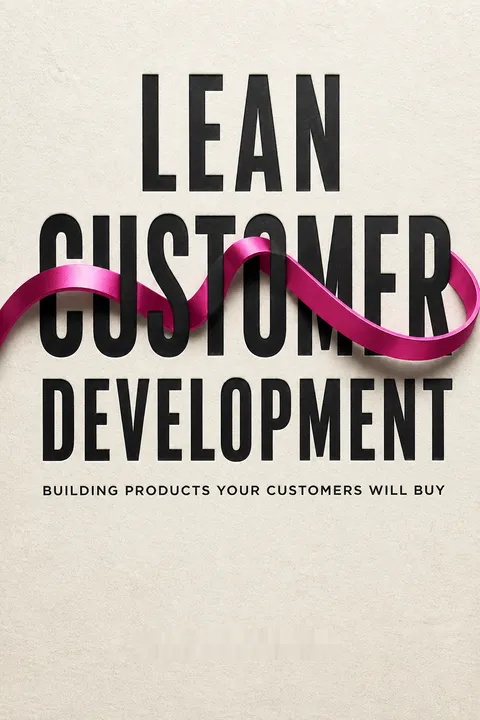
What is Lean Customer Development: Building Products Your Customers Will Buy by Cindy Alvarez about?
- Customer learning focus: The book teaches a hypothesis-driven approach to deeply understanding customers, validating assumptions, and building products people will actually buy.
- Practical, actionable guidance: It provides step-by-step exercises, interview techniques, and social psychology insights for engaging with customers effectively.
- Applicable to all organizations: Alvarez’s method bridges startups and large enterprises, including those in conservative or regulated industries.
- Emphasis on real-world learning: The book stresses learning from actual customer behaviors and needs, not just internal opinions or assumptions.
Why should I read Lean Customer Development by Cindy Alvarez?
- Reduce product failure risk: The book helps you avoid building products nobody wants by validating assumptions early and continuously with customers.
- Actionable techniques for teams: It offers concrete methods for interviewing customers, analyzing feedback, and making informed product decisions.
- Adaptable to any company size: Whether you’re in a startup or a large enterprise, the book shows how to tailor customer development practices to your context.
- Build a customer-centric culture: Alvarez emphasizes sharing learnings across teams and closing the feedback loop to foster continuous learning.
What are the key takeaways from Lean Customer Development by Cindy Alvarez?
- Validate, don’t assume: Always confirm that customers have a real problem, have tried to solve it, and are motivated to buy before investing heavily.
- Customer development saves time: Every hour spent talking to customers can save 5 to 10 hours of wasted design and coding.
- Works for all companies: The approach is essential for startups and large, conservative, or regulated organizations alike.
- Close the feedback loop: Share what you learn internally and externally to build trust, alignment, and better product decisions.
What is customer development according to Cindy Alvarez’s Lean Customer Development?
- Hypothesis-driven learning: Customer development is about forming and testing hypotheses regarding who your customers are, their problems, and what solutions they’ll pay for.
- Parallel to product development: It complements product development by focusing on “Will they buy it?” rather than just “Can we build it?”
- Continuous and iterative: The process involves ongoing conversations and experiments with customers to validate or invalidate assumptions.
- Enables course correction: Early learning allows teams to pivot or refine ideas before heavy investment.
How does Cindy Alvarez define “lean” in Lean Customer Development?
- Pragmatic and efficient: “Lean” means practicing customer development quickly and without unnecessary overhead or bureaucracy.
- Eliminating waste: Inspired by lean manufacturing, the approach focuses on reducing wasted effort by building only what customers truly want.
- Rapid learning cycles: Emphasizes fast, iterative hypothesis testing and learning.
- Adaptable across contexts: The lean approach works for both startups and mature companies.
What are the five steps of the Lean Customer Development method by Cindy Alvarez?
- Forming hypotheses: Explicitly write down assumptions about customers, problems, and solutions to test.
- Finding customers: Identify and reach out to potential customers or “earlyvangelists” who have the problem and are motivated to solve it.
- Asking the right questions: Conduct interviews using open-ended, objective questions to uncover real behaviors and constraints.
- Making sense of answers: Analyze interview data to validate or invalidate hypotheses, looking for emotion, surprises, and contradictions.
- Figuring out what to build: Use validated learning to design minimum viable products (MVPs) that address real customer needs efficiently.
How do you identify and write hypotheses in Lean Customer Development by Cindy Alvarez?
- List assumptions explicitly: Use prompts like “Customers have ___ problem” or “Customers are willing to invest ___ to solve this problem” to surface hidden beliefs.
- Write a problem hypothesis: Format it as “I believe [type of people] experience [type of problem] when doing [type of task],” focusing on specific, testable claims.
- Narrow your focus: Start with a specific customer segment and problem to accelerate learning and avoid vague, broad hypotheses.
- Test and refine: Use interviews and MVPs to validate or invalidate these hypotheses quickly.
Who are “earlyvangelists” in Lean Customer Development and why are they important?
- Passionate problem solvers: Earlyvangelists are customers who have a severe problem and are motivated to find a solution, willing to take risks on unfinished products.
- Rich feedback sources: They provide detailed feedback, try beta versions, and help refine the product through their enthusiasm and engagement.
- Critical for validation: Earlyvangelists are essential for validating hypotheses because their urgent needs drive honest, actionable insights.
- Different from early adopters: Unlike early adopters who try new tech for novelty, earlyvangelists are driven by real pain points.
What are the best practices for conducting customer development interviews in Lean Customer Development by Cindy Alvarez?
- Prepare and practice: Do a dry run with a colleague to refine your questions and interview style before talking to real customers.
- Set clear expectations: Thank the interviewee, emphasize that you want to hear their personal experiences, and position them as the expert.
- Use silence and open-ended questions: Wait after asking questions to encourage detailed responses, avoid leading questions, and gently guide tangents.
- Take detailed notes: Capture verbatim quotes, emotions, and surprises; consider pair interviewing for better note quality.
How many customer interviews do you need according to Lean Customer Development by Cindy Alvarez?
- 15–20 interviews typical: Usually, 15 to 20 interviews provide enough insight to stop hearing surprises and see clear patterns.
- Milestones in learning: After 2 interviews, assess if you’re learning; after 5, you should meet an excited customer; after 10, patterns should emerge.
- Invalidation is valuable: If after 5 interviews no one is excited, your hypothesis is likely invalid and should be refined or pivoted.
- Quality over quantity: The goal is to learn and validate, not just to hit a number.
What are the components of a validated hypothesis in Lean Customer Development by Cindy Alvarez?
- Real problem acknowledgment: The customer clearly recognizes a definite pain point or problem that affects them.
- Belief in solvability: The customer believes the problem can and should be resolved, showing motivation to seek a solution.
- Active investment: The customer has already tried to solve the problem through effort, time, money, or learning.
- No external blockers: There are no regulatory or social constraints preventing the customer from trying to fix the problem.
What types of Minimum Viable Products (MVPs) does Cindy Alvarez describe in Lean Customer Development?
- Pre-Order MVP: Validates customer commitment by collecting pre-orders or financial pledges before building the product.
- Audience Building MVP: Builds a community or audience before product launch to validate demand and ease distribution.
- Concierge and Wizard of Oz MVPs: Deliver the product manually or with hidden human effort to test customer interest without full automation.
- Single Use Case MVP: Focuses on solving one specific problem or feature well to validate value before expanding.
- Other People’s Product MVP: Leverages existing products or competitors’ infrastructure to test ideas quickly and cheaply.
Download PDF
Download EPUB
.epub digital book format is ideal for reading ebooks on phones, tablets, and e-readers.








































