


Key Takeaways
Most couples' biggest bedroom problem isn't technique — it's silence
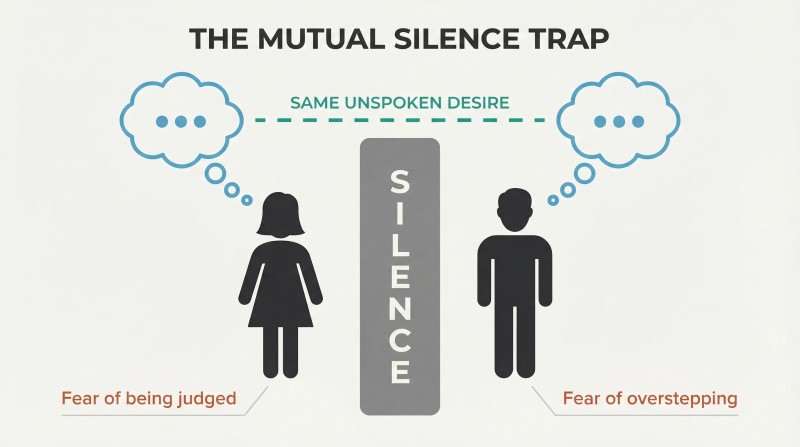
The book was born from a breakup. A friend's girlfriend left him, complaining he never understood her sexual needs — she wanted to be "bent over and fucked hard" sometimes, and he never sensed it. When the author surveyed friends of both genders, the pattern was everywhere: women frustrated that men couldn't read their desire for rougher sex, and men perplexed about what their partners actually wanted.
The culprit isn't desire — it's a mutual communication failure. Women fear being labeled freaks for wanting assertive sex. Men fear crossing the line after a lifetime of being taught to be gentle and respectful. Both stay silent, and both lose. On the kink spectrum, wanting more dominance barely registers — yet it remains one of the most unspoken desires in committed relationships.
Women who fight for control all day crave surrendering it at night
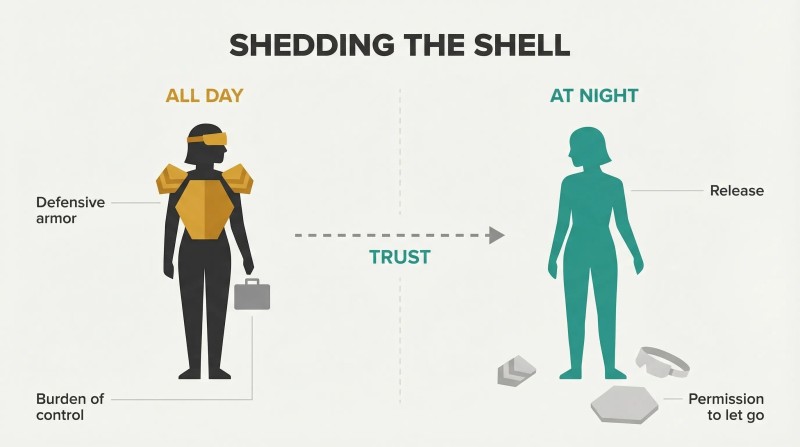
The feminist paradox fuels the desire. The same cultural forces that empower women professionally create a surprising bedroom longing. After days spent maneuvering through workplace politics and proving competence, many women crave release — letting someone else take charge, but only with someone they trust completely. The author compares it to Ed Norton in Fight Club: someone so beaten down by expectations that they find purity in losing control.
"Be a good girl" programming amplifies it. Women are conditioned from childhood to be modest and not "too" sexual, creating guilt around pursuing pleasure. By surrendering to a partner who controls the sexual agenda, women feel liberated from that guilt. It's not their "fault" they're aroused — he's the one in charge. The dominance acts as a psychological permission slip for pleasure.
Bedroom assertiveness is confidence and control, not disrespect
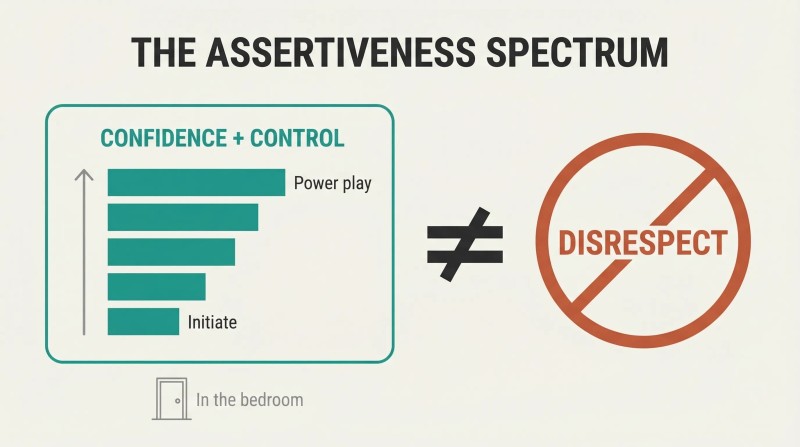
Alpha male is a vibe, not a body type. Think Don Draper, not Peter Campbell. The book defines the bedroom alpha male not as a gym-bro or frat boy, but as someone who radiates take-control energy — a man who makes a woman feel both desired and safe. He doesn't need the biggest muscles. He needs presence.
Sexual assertiveness exists on a spectrum:
1. Simply being the one who initiates sex
2. Telling your partner exactly what you want
3. Pinning her hands down or pulling hair
4. Spanking, dirty talk, and spontaneous encounters
5. More advanced power play with agreed-upon rules
None of this involves abuse or any assertion that she's less than equal. The bedroom door is a hard boundary — alpha behavior belongs inside it, never outside.
Introduce dominance by showing in the heat of the moment
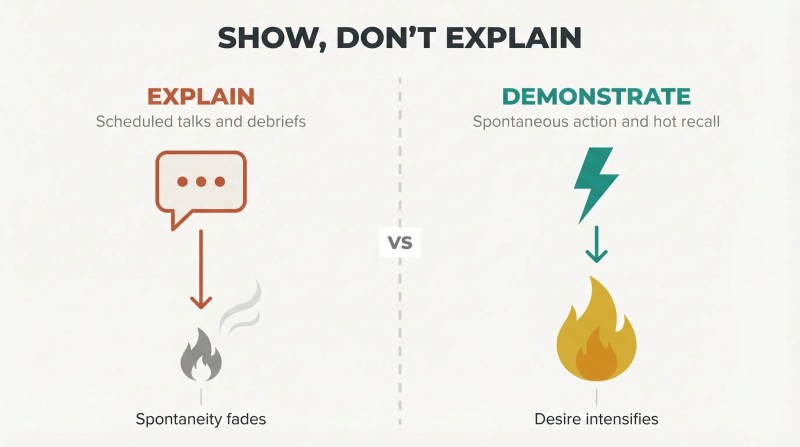
Lead with action, not a scheduled conversation. Rather than launching into an awkward discussion, the book recommends women introduce the idea physically during normal lovemaking: grab him and pin him against a wall for a deep kiss, start light dirty talk, tell him to spank you, or pull his hair and whisper "do that to me." Another move: get him extremely aroused through teasing, then lie back and say "have your way with me."
Follow up with hot reinforcement, not analysis. Post-coital pillow talk works better than a sit-down debrief. Recall specific things he did and tell him how much they turned you on. Random texts like "Still thinking about that spanking" keep energy alive without over-explaining. If he keeps asking questions, drag him to the bedroom and demonstrate instead.
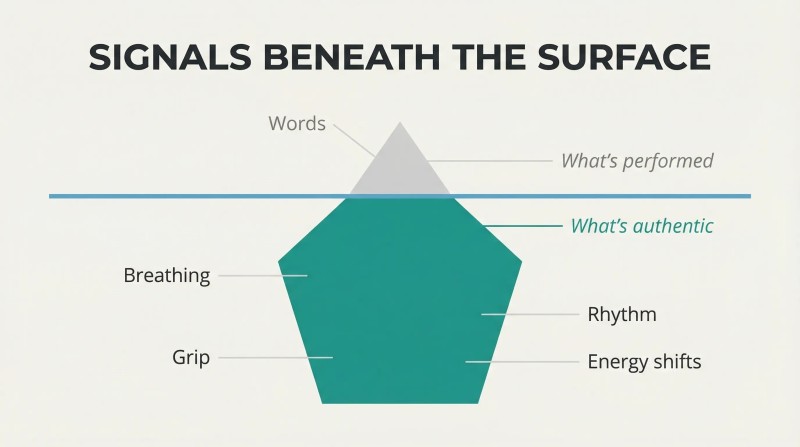
Her breathing, grip, and rhythm reveal more than her words
Pay attention to her reactions, not your assumptions. When she scratches your back and breathes hard, that's not the moment for gentle face-cradling. When she's nuzzling softly, don't pull her hair. The book urges men to track changes in breathing, physical intensity, vocalizations, and general energy.
Learn to spot the fakes. The author offers four blunt signs she's not actually climaxing:
1. "Porn noises" — sounds clearly performed rather than involuntary
2. Suddenly pulling out all the stops to make him finish — she's ready for it to end
3. "Silent orgasms" where she goes still and claims she came
4. Theatrically loud orgasms followed by immediately hopping out of bed
The antidote is reading her real signals and adjusting in the moment, not interrogating her afterward.
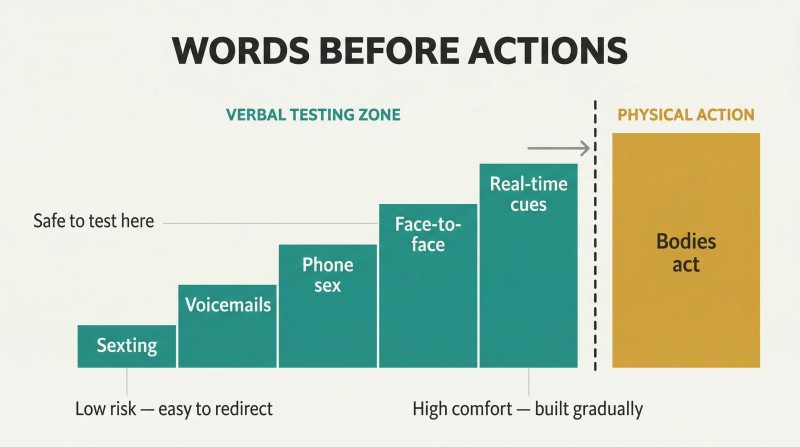
Dirty talk is the safest way to test limits before bodies do
Words before actions protect everyone. Dirty talk lets you propose an aggressive move verbally and gauge the reaction before physically committing. If he mentions slapping during phone sex, she can redirect with a breathy "be gentle with me, baby" — no harm done. If he'd tried it physically, the mood might shatter.
Start in writing if speaking feels awkward. The book suggests a progression:
1. Sexting and provocative emails
2. Dirty voicemails left during the workday
3. Long-distance phone sex for assertiveness practice
4. Face-to-face dirty talk referencing previous conversations
5. Real-time verbal cues during sex to guide, praise, or redirect
Dirty talk also doubles as a steering wheel — women can escalate ("Show me what a man you are") or slow things down ("Not so rough, Sugar") without breaking the mood.
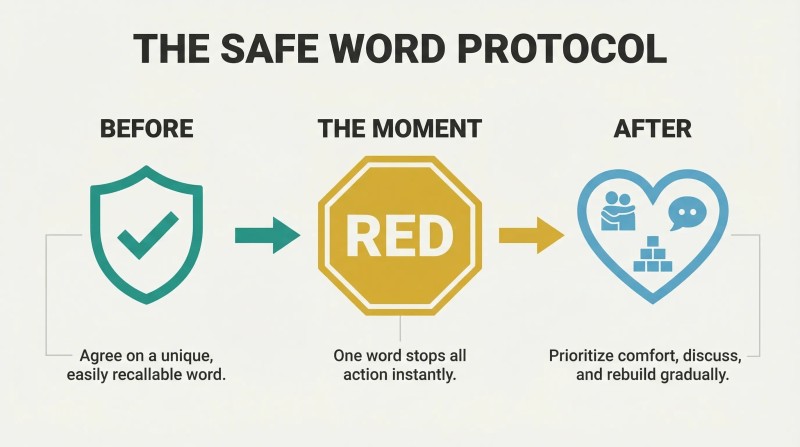
Agree on a safe word before any power play begins
One word stops everything instantly. A safe word is a pre-agreed term — typically unrelated to sex, like a color or city name — that either partner can say to immediately halt all activity. It's essential because in dominant scenarios, "no" and "stop" might be part of the roleplay. Choose a single, easy-to-remember word, and make it identical for both partners.
What happens after matters enormously. When a safe word is spoken, don't break apart or get dressed. Hug, cuddle, lie together, and be gentle. No blame, no argument, no stony silence. Let the moment pass, then talk calmly about what happened and how to adjust next time. The next sexual encounter should be tender and traditional — work back up to experimentation gradually from there.
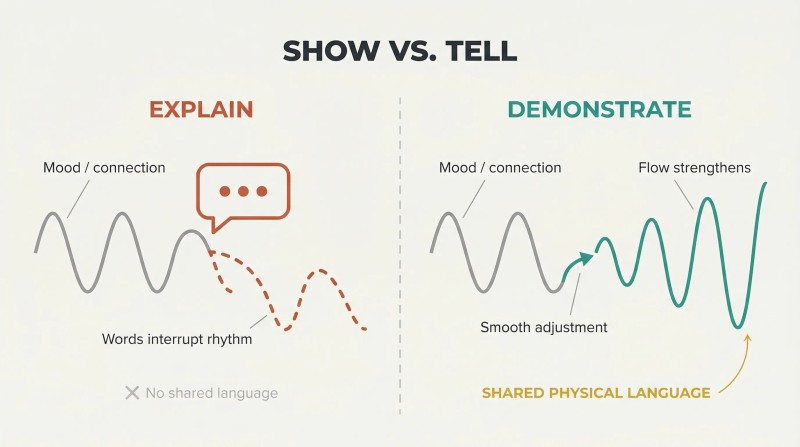
Demonstrate the move you want — never stop to explain it
Real-time demonstrating preserves the mood. The book's term for showing rather than telling during sex. Instead of explaining how you want oral sex performed, say "like this" and go down on her to show the rhythm. If hair-pulling gets an involuntary "ouch," don't panic or apologize — switch to running fingers through her hair, then gradually rebuild to a gentler pull. A calm "OK, Baby" suffices.
Post-sex debriefs should stay hot, not clinical. Rather than "I hope I wasn't too rough," try: "How about when I did that — was that too much? Damn, that was hot." This signals the roughness is mutual pleasure, not something requiring an apology, while still opening the door for honest feedback. The goal: develop a shared physical language that makes words unnecessary.
Overcome bedroom shyness with escalating non-sexual touch first
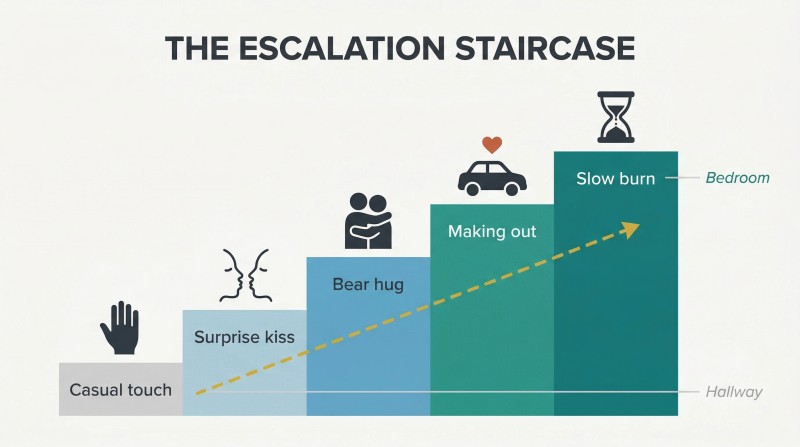
Don't start in bed — start in the hallway. The book prescribes a gradual physical escalation:
1. Hand on her back as she passes, casual touches in the kitchen
2. Spin her around for a kiss — tell her it's because she's beautiful
3. Bear hugs from behind at the sink or while she's reading
4. Making out where sex isn't possible — car before a restaurant, bar hallway
5. Extended foreplay where you refuse to let it progress: "I'm not done with you yet"
Confidence is contagious — and so is discomfort. If you force yourself through moves that feel unnatural, she'll sense the hesitation and shut down. Only do what genuinely excites you. A woman begging you to take it further because your foreplay drove her wild is the ultimate confidence booster — and an on-ramp to alpha territory.
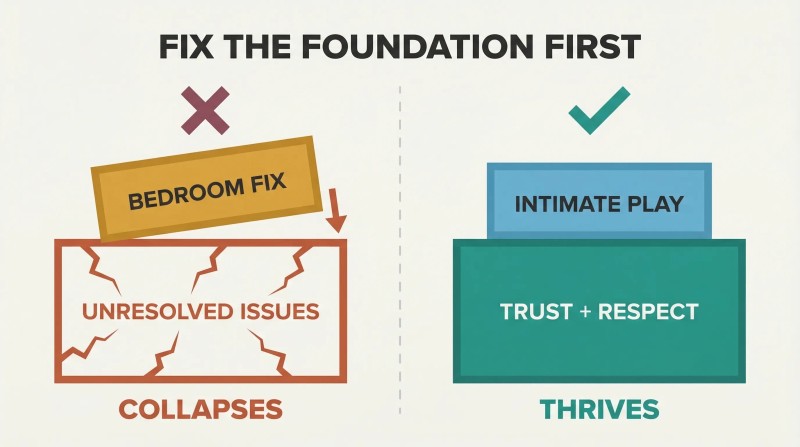
Never try to fix a broken relationship through the bedroom
This experiment requires a healthy foundation. The book repeatedly stresses that assertive sex play is exclusively for couples with solid relationships, mutual trust, and genuine respect. If your mind keeps drifting to day-to-day relationship problems while reading, stop and fix those first. Better sex will follow naturally.
Common traps to avoid: Don't pick fights hoping for intense make-up sex — angry sex driven by real conflict hurts both partners long-term. Don't mistake wanting a bedroom alpha for wanting a different life partner. And never let bedroom dynamics bleed into daily interactions — if he starts treating her roughly outside the bedroom, or she emasculates him with comments like "I guess you're not an alpha male after all" when he can't fix the DVD player, the experiment has gone wrong.
Analysis
Kingsley's book addresses what may be the most common unspoken tension in long-term heterosexual relationships: the chasm between culturally conditioned sexual politeness and the primal desire many women have for assertive, even rough, intimacy. What elevates it beyond a standard sex manual is its psychological framework — particularly the argument that feminist empowerment and sexual submission aren't contradictory but complementary. Women who spend days proving competence in male-dominated spaces don't want less agency; they want a private arena where the performance of strength can be safely set down.
The 'good girl' programming thesis is the book's sharpest insight. Kingsley argues that women internalize sexual shame so deeply that they need a psychological alibi for their own pleasure — and a dominant partner provides that alibi. This isn't pathology; it's a rational adaptation to decades of cultural messaging that equates female sexual appetite with moral failure. The framing anticipates academic work on sexual communal strength and responsive desire that gained traction years later.
Structurally, the book mirrors its own thesis. By giving men and women separate sections before uniting them, Kingsley replicates the communication bridge she's asking couples to build. Her emphasis on safe words, aftercare, and graduated consent was notably progressive for 2008, predating mainstream conversations about enthusiastic consent by nearly a decade.
The limitations deserve acknowledgment. The heteronormative framing excludes same-sex couples entirely. The pop culture references anchor it in a specific moment. And while the psychological insights about female desire are genuinely compelling, men's reluctance is attributed almost entirely to socialization, with little exploration of men who may genuinely not want dominant roles — or who might have their own complex relationship with aggression worth unpacking.
Still, the core contribution endures: the most dangerous thing in any couple's bedroom isn't a rough grip or a bold position — it's silence. The book's real subject isn't domination; it's permission — to want, to ask, and to explore without shame.
Review Summary
Just Fuck Me! receives mixed reviews, with an average rating of 3.35/5. Some readers find it helpful for couples wanting to spice up their sex life, particularly in exploring more aggressive bedroom dynamics. Others criticize its simplistic approach and lack of research-based information. The book is seen as potentially useful for beginners but less valuable for experienced readers. Some appreciate its straightforward style, while others find the content too basic or potentially misleading. Overall, opinions vary on its effectiveness in addressing the topic of male dominance in the bedroom.
Glossary
Alpha male (bedroom context)
Confident, take-charge sexual partnerAs used in this book, a bedroom alpha male is not a muscular bully or disrespectful partner but someone who exudes confident, take-control energy during sex — initiating, directing, and calling the shots. The term spans a spectrum from simply being the one who starts sex to physically assertive moves like hair-pulling, spanking, or pinning. It has nothing to do with how the man behaves outside the bedroom and does not require a particular body type.
Safe word
Emergency stop signal during sexA pre-agreed word — typically unrelated to sex, like a color or city name — that either partner can say to immediately halt all sexual activity. Borrowed from BDSM practice, the book recommends safe words for any couple experimenting with power dynamics because normal words like 'no' or 'stop' may be part of the roleplay. After a safe word is spoken, both partners should cuddle gently, recover without blame, and discuss calmly before resuming experimentation.
Real-time demonstrating
Showing moves instead of explainingA communication technique during sex where, instead of verbally explaining what you want your partner to do, you demonstrate it physically on them first. For example, rather than describing a preferred oral sex rhythm, you perform it on your partner and say 'like this.' The book presents this as the primary way to give feedback and redirect during lovemaking without killing the mood through clinical conversation.
June Cleaver aspect
Retro-domestic role-play for dominanceThe author's term for a role-playing scenario where the woman adopts a 1950s housewife persona — dressing up for his arrival home, preparing his favorite meal, having his equivalent of 'slippers, pipe and newspaper' waiting — to help the man ease into an alpha male mentality by evoking traditional male-authority dynamics. The evening culminates in him 'rewarding' her with dominant sex. Named after the iconic homemaker character from the TV show Leave It to Beaver.
FAQ
1. What is "Just F*ck Me!" by Eve Kingsley about?
- Focus on sexual assertiveness: The book explores the desire many women have for their male partners to be more sexually assertive and dominant in the bedroom.
- Guide for couples: It serves as a practical guide for both men and women to communicate and experiment with male-dominant sexual dynamics in a healthy, consensual relationship.
- Not about BDSM: While it touches on rough sex and power dynamics, the book clarifies that it is not a manual for BDSM but rather for mainstream couples wanting to spice up their sex lives.
- Emphasis on communication: The author stresses the importance of open, honest communication and mutual consent when exploring new sexual territory.
2. Why should I read "Just F*ck Me!" by Eve Kingsley?
- Improve sexual communication: The book helps couples break down barriers and talk openly about their sexual desires and boundaries.
- Enhance intimacy: By addressing unspoken fantasies, couples can deepen their connection and satisfaction in the bedroom.
- Practical, real-world advice: Kingsley offers actionable tips, scenarios, and scripts for initiating and navigating assertive sex play.
- Normalize common fantasies: The book reassures readers that wanting more assertiveness or roughness in sex is normal and not a sign of relationship problems.
3. What are the key takeaways from "Just F*ck Me!" by Eve Kingsley?
- Assertiveness is attractive: Many women crave sexual dominance from their partners, and it can be a healthy part of a loving relationship.
- Communication is crucial: Discussing desires, boundaries, and safe words is essential for safe and satisfying experimentation.
- Mutual satisfaction matters: Both partners’ comfort and pleasure are prioritized, and no one should feel pressured or unsafe.
- It’s not about abuse: Assertive sex is distinct from disrespect or harm; it’s about consensual play and trust.
4. How does Eve Kingsley define "alpha male" in "Just F*ck Me!"?
- Masculinity with respect: An alpha male is described as confident, assertive, and in control, but not disrespectful or abusive.
- Not a stereotype: The book distinguishes between genuine alpha qualities and negative traits like arrogance or insensitivity.
- Emotional strength: True alpha males provide safety, reassurance, and leadership, both in and out of the bedroom.
- Sexual leadership: In the context of sex, being an alpha male means initiating, taking charge, and reading a partner’s cues.
5. What are the main reasons women want more sexual assertiveness, according to "Just F*ck Me!"?
- Relief from daily pressures: Many women want to let go of control and responsibility, especially after managing stress and expectations in daily life.
- Feminine empowerment: Paradoxically, being dominated can make women feel more feminine and powerful in their sexuality.
- Desire for objectification (in context): Some women enjoy feeling like a sexual object in a safe, loving environment, as a form of liberation from societal expectations.
- Escaping "good girl" conditioning: The book discusses how cultural messages about being "good" can inhibit women’s sexual expression, and assertive sex can help break those barriers.
6. How does "Just F*ck Me!" by Eve Kingsley recommend couples communicate about sexual assertiveness?
- Start with non-verbal cues: Women can initiate rougher elements during sex to signal interest before having a formal conversation.
- Use post-sex pillow talk: Discuss what felt good or what could be improved in a relaxed, non-judgmental way after intimacy.
- Gradual introduction: Begin with small changes and positive reinforcement, rather than overwhelming a partner with demands.
- Establish safe words: Agree on a word that immediately stops all activity if anyone feels uncomfortable, ensuring safety and trust.
7. What practical advice does "Just F*ck Me!" give men for becoming more assertive in the bedroom?
- Read her cues: Pay attention to changes in her breathing, movements, and vocalizations to gauge her interest in rougher play.
- Initiate at the right time: Choose moments when you’re both connected and in sync, avoiding times of stress or conflict.
- Experiment with confidence: Try assertive moves like passionate kissing, hair pulling, or spanking, but always watch her reactions and adjust accordingly.
- Communicate and debrief: After trying something new, check in with your partner to ensure she felt safe and satisfied.
8. What guidance does "Just F*ck Me!" offer women for expressing their desires for more assertiveness?
- Define your desires: Reflect on what kind of assertiveness excites you—whether it’s being given orders, rough sex, or feeling objectified.
- Show and tell: Use both actions (like initiating rougher play) and words (dirty talk, direct requests) to guide your partner.
- Reinforce positively: Praise your partner when he does something you like, and gently redirect if something feels off.
- Set boundaries: Clearly communicate what is and isn’t okay, and use safe words or phrases to adjust intensity as needed.
9. What are some specific techniques and scenarios for assertive sex described in "Just F*ck Me!"?
- Assertive positions: Missionary with legs over shoulders, doggie-style, pinning hands, and spontaneous sex in unconventional places.
- Physical techniques: Spanking, hair pulling (from the roots), grabbing, pinching, and throwing onto the bed—all done with care and consent.
- Assertive oral sex: Men can take control during oral, dictate rhythm, or use dirty talk to heighten dominance.
- Use of toys and games: Incorporate vibrators, dildos, blindfolds, and light bondage (scarves, ties) to enhance the power dynamic.
10. How does "Just F*ck Me!" address boundaries, safety, and consent in assertive sex play?
- Safe words are essential: Both partners should agree on a non-sexual word that stops all activity immediately if needed.
- Ongoing check-ins: Partners should regularly communicate before, during, and after sex to ensure comfort and mutual enjoyment.
- No means no: Even in role-play or rough scenarios, real discomfort or withdrawal of consent must be respected instantly.
- Aftercare matters: Following intense play, couples should spend time being gentle and reassuring to reinforce trust and emotional safety.
11. What role do dirty talk, role-playing, and games play in "Just F*ck Me!" by Eve Kingsley?
- Dirty talk as communication: Talking dirty helps set boundaries, express desires, and maintain the mood without clinical discussions.
- Role-playing for comfort: Adopting characters (e.g., boss/secretary, handyman/housewife) can make assertive scenarios less awkward and more exciting.
- Games and toys: Stripping games, treasure hunts, and playful challenges can ease couples into new dynamics and keep things fun.
- Gradual escalation: These tools allow couples to experiment with assertiveness at their own pace, building confidence and trust.
12. What are the best quotes from "Just F*ck Me!" by Eve Kingsley and what do they mean?
- “Being able to take a risk and ask for what you want might be one of the hardest things you’ll ever do, but it can also lead you to the most rewarding and sexually satisfying experiences of your life.”
- Encourages vulnerability and open communication as the path to deeper intimacy.
- “Male domination in the bedroom is a perfectly normal fantasy shared by millions of couples in healthy, long-term, loving relationships.”
- Normalizes the desire for assertive sex and removes stigma from these fantasies.
- “This is not a relationship advice book. This is a guide to pleasing your woman in bed.”
- Clarifies the book’s focus on sexual dynamics rather than general relationship counseling.
- “It is normal for a woman to want her partner to be more forceful in the bedroom. There is nothing bad, wrong or even extreme about this type of desire or fantasy, nor does it mean that there is something wrong with the male partner.”
- Reassures both partners that these desires are healthy and not a sign of dysfunction.
Download PDF
Download EPUB
.epub digital book format is ideal for reading ebooks on phones, tablets, and e-readers.








































