
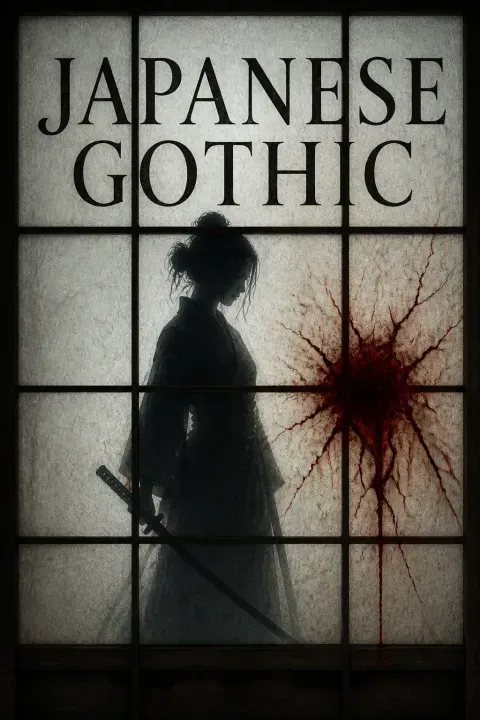


Plot Summary
A Stain Tastes of Blood
Lee Turner1 presses his thumb to a dark, narrow stain on the kitchen wall of his father's3 newly acquired samurai house in Chiran, Kagoshima, and licks it. It is blood, old but unmistakable, in a place it should not exist.
Lee1 has fled New York after killing his roommate James, though the details of the crime remain a blank spot his sedatives cannot fill. He remembers only cleaning the stairwell and boarding a plane. Now he must play the role of a son taking a stress leave, keeping his violent secret from his father James3 and his father's girlfriend Hina.5
The house itself feels wrong: dimensions that don't match, a window that appears and vanishes, and an open doorway that reminds him of the night his mother6 disappeared from a Cambodian hotel. He clings to the fog of Ativan, hoping Japan will swallow his guilt.
Lee’s arrival establishes him as an unreliable narrator whose own mind is a crime scene he cannot enter. The bloodstain becomes a stand-in for the truth he simultaneously seeks and flees: he literally tastes it yet cannot name its significance. His compulsive need to measure anomalies is a desperate attempt to impose order on a psyche fractured by trauma and substances. The house’s impossible architecture mirrors his internal state, a space where past and present bleed together, foreshadowing the temporal collapse to come.
The Last Samurai's Daughter
Iwasaki Sen2 has known only the blade. At eighteen, she trains relentlessly under her father, Itaro,4 the last samurai of Satsuma, who came back from the failed rebellion a hollowed-out man. He punishes her slightest failure, forces her to slaughter hares, and once buried her alive to teach her to accept death.
Sen2 endures because she believes she is forging herself into a weapon her father4 can respect. But something has changed in this house hidden by sword ferns: no animals sing, the food has no taste, and she glimpsed a foreign man's face1 in her window, an omen of hostile Western powers.
When her father4 cuts a stray lock of hair for an unseemly appearance, she bows. Inside, she sees an uncanny stain on the kitchen wall and feels her world shrinking to a point of dishonor and dread.
Sen’s introduction reveals a character defined by toxic devotion to a father whose approval is existential oxygen. Her warrior identity is a cage built from Hagakure quotations and filial piety, yet she harbors an acute perceptiveness, noticing the house’s unnatural silence and the wrongness in her father’s eyes. The buried-alive memory is crucial: it shows how she internalized the lesson that love means surviving abandonment. Her glimpse of Lee plants the first seed of an alternative reality, a future where the samurai are ghosts.
The Closet Door Opens
Late one night, light glows behind Sen's2 closet, a door she knows leads only to cement. When she slides it open with her blade ready, she finds not a demon but a pale young man with green eyes1 kneeling in a mirror image of her own room.
He bows and speaks broken Japanese, claiming the year is 2026 and that she is the ghost, not him. Lee Turner1 proves his impossible claim with a prediction: tomorrow, a fire will consume the mayor's house in Chiran. Sen2 is skeptical but agrees to listen.
Before closing the door, Lee1 asks the question that will anchor their pact: Do you want to know how you die? He offers to research her fate if she gives her name, but Sen,2 trained to mistrust spirits, refuses to offer more than Sen of Shimazu. His words burrow into her mind as she blocks the door with her dresser.
This first meeting sets the terms of their exchange: Lee trades concrete future knowledge for access to the dead, while Sen seeks survival but will ultimately trade it for self-determination. Lee’s clinical approach, his quick deduction of the Meiji era from her clothing and charcoal, marks him as a detective of the impossible. Sen’s resistance to giving her true name, Iwasaki, shows that even in the face of wonder, her identity is guarded, a final loyalty to her father’s legacy.
Ashes and a Broken Guard
The next day, smoke rises from Chiran, and Sen2 tastes charred flesh. That night she returns to the door, furious, but Lee1 shows her a broken sword guard he found in his time under the floorboards of the same room, inscribed with her family's motto.
Sen2 recognizes it as the one she hid that very morning, now tarnished and cracked by over a century of earth. Faced with irrefutable evidence that she haunts this house, Sen's2 fury collapses into terror: she is dead, or soon will be, and her entire life's training will end in failure.
Lee,1 sensing her despair, offers a deal: he will help her discover her fate if she helps him find a way to contact the dead, specifically his missing mother.6 Sen2 agrees, though she still withholds her true surname, knowing that names hold power.
The sword guard functions as the story’s first temporal anchor, a physical object that materially proves the inescapable continuity of time and decay. For Sen, the moment is not just a shock but a profound destabilization of her warrior philosophy: if her death is fixed, what is the purpose of her discipline? The motto The way of the samurai is found in death now reads as bitter irony. Lee’s eagerness to use her as a bridge to the dead reveals his utilitarian view of her, though his own pain is beginning to surface.
The Sea That Swallows Time
Lee1 takes Sen2 to the town hall to search her family's koseki. Along the way, Sen2 stumbles, and when Lee1 grabs her arm, the world dissolves into a grey expanse of ash and a black ocean roaring toward them. They release each other and reality snaps back, but the shared vision has marked them.
At the archive, Sen2 uses her wooden passport and a performance of tears to convince the clerk to show the record. There, she reads the death dates of her entire family: October 27, 1877, just three days away.
She flees the building, overwhelmed. Lee1 later looks up the Iwasaki deaths online and discovers the gruesome truth: a murder-suicide by the father.4 He chooses to withhold this from Sen,2 believing ignorance is kinder, but his secrecy will soon become its own betrayal.
The ashen world is a liminal space where their timelines intersect and deteriorate, a visual metaphor for the entropic force that erodes both memory and life. The event also establishes the physical consequence of their connection: merging worlds is dangerous. Sen’s theatrical deception at the archive, deploying the very weakness her father despises (female tears) to obtain the truth, marks her growing pragmatism and willingness to violate samurai norms for survival. Lee’s decision to hide the full truth mirrors his own self-deception, setting up a parallel arc of misguided protection.
The Execution on the Porch
That night, Lee1 flees a ghostly samurai in his room and stumbles through the door into Sen's2 forest. She hides him under the porch just as her father4 drags out a captured spy and demands Sen2 test her blade on him. While Lee1 lies inches below the floorboards, Sen2 beheads the man with a single strike. Blood pours through the slats, drenching Lee,1 baptizing him in violence he did not commit but cannot wash away.
Afterward, Sen2 leads Lee1 to the river to clean off. Under the stars, Lee1 admits he has killed someone too, though he cannot remember why. Sen2 does not recoil. Instead, she tells him that reasons are for people who want to forgive themselves, and that she does not. In that moment, two murderers find an impossible kinship.
This scene cements the bond between Lee and Sen not through romance but through shared transgression and mutual non-judgment. Sen’s forced violence, performed under her father’s gaze, echoes Lee’s own fugue-state violence; both are actors in scripts written by monstrous fathers. The porch becomes a threshold of complicity: Lee’s presence underneath, drenched in blood, implicates him in Sen’s world just as she is implicated in his search for truth. Their conversation by the river introduces the theme that understanding is more valuable than absolution.
The Suitcase Tracks
While Sen2 is absent, Lee1 picks the lock on his father's3 office. Inside, he finds newspaper clippings about a human trafficking ring dissolved in Tokyo and victims found with organs missing, all marked by a turtle tattoo. His father James3 is not just a professor but a man obsessively tracking the network that supposedly took his wife.6
Lee1 remembers the open hotel door in Cambodia, the two parallel lines in the sand that were suitcase tracks, and his recurring dream of his mother6 folded inside, calling to him. The articles suggest his mother6 may have been cut apart and sold, but Lee's1 mind begins to fracture around an older, darker memory he cannot yet access: the sound of that suitcase dragging across the porch while he lay half asleep.
The turtle tattoo linking the trafficking victims to the recurring turtle imagery (Sen’s sword guard, the Urashima legend, Hina’s sea glass gifts) begins to weave the mythological and the horrific together. Lee’s discovery positions his father as a man chasing ghosts, but the repressed memory of the suitcase’s sound hints that the predator was much closer to home. This turning point deepens the mystery while tightening the psychological screws: Lee is not just running from his own crime but racing toward a truth that will shatter his already fractured identity.
The Sharpening of Knives
Sen2 stays for dinner at Lee's1 insistence, but Hina5 is cold, making barbed comments about Sen's2 appetite. When Lee's father3 steps out, Hina5 lunges across the table with a freshly sharpened kitchen knife, aiming for Sen.2 Sen2 disarms her, and Lee1 orders Hina5 to leave.
Hina's5 eyes are wet with desperate tears as she insists she only wanted to protect Lee1 from Sen.2 After Hina5 storms out, Lee1 finds her car still in the driveway, but no sign of her. That evening, Lee1 and Sen2 try to reach his mother6 again by touching, but the door between worlds remains stubbornly ordinary.
Frustrated and afraid, Sen2 writes Lee1 a letter to be opened after her death, then returns to her own time. Lee1 sits alone, abandoned by the woman who once felt like the only person who saw him.
Hina’s attack externalizes the story’s core conflict between protective love and destructive control. Her claim to be protecting Lee reveals that she knows something about Sen’s nature, but her methods mirror the very violence the fathers embody. The knife, sharpened to an exquisite edge, becomes a symbol of the precision required to sever toxic bonds. Sen’s letter, written in the shadow of her imminent death, introduces the theme of writing as a bulwark against erasure: she wants to be remembered, to have existed in someone’s eyes.
The Truth Beneath the Stain
Lee's1 withdrawal from sedatives reaches a tipping point when his father3 tells him the police found his roommate's8 body in the well. The absurdity of the claim triggers a cascade of recovered memory: the Cambodia hotel, his mother's6 screams, his father's3 silhouette dragging a suitcase across the sand.
Lee1 finally understands that he did not kill his roommate;8 he assaulted him in a psychotic break and fled, but the real murderer was always his father James,3 who killed Lee's mother6 to prevent her from leaving with Lee.1 In the kitchen, Lee1 confronts his father.3
The older man grabs a knife and plunges it into Lee's1 stomach. Lee,1 running on adrenaline, wrestles the knife away and stabs his father3 repeatedly in the chest, then drags the body to the well and dumps it in, just as his father3 once disposed of his mother.6
This is the novel’s psychological climax, where the repressed returns with literal, visceral force. The revelation that Lee’s murder was a substitution for his father’s crime reframes his entire narrative: his self-loathing, his addiction, his identification with monsters were all misdirections to protect the only parent he had left. The act of killing his father is both traumatic release and tragic inheritance; he becomes the murderer he feared he was, closing a cycle of violence. The well, earlier a site of ghost stories and dead raccoons, now holds the physical proof of the truth.
The Fall of the Iwasaki House
On the morning of October 27, Sen2 returns home to a dreadful silence. She finds the servants dead and her mother7 and brothers lying in her futon, their throats cut. Her father Itaro4 sits in the corner, waiting. He confesses he lost his honor at the rebellion and can no longer bear the shame.
He begs Sen2 to act as his kaishakunin, the second who beheads a samurai during seppuku to grant a swift death. Sen2 refuses at first, horrified, but when her father4 drives the tanto across his own belly and writhes in agony, she cannot bear his suffering.
She raises her katana and strikes, but her hands tremble, and she decapitates him completely, a disgrace to his ritual. Then, surrounded by the corpses of her family, she turns the blade on herself and slices open her abdomen, choosing her own end over a life alone.
Sen’s final act is the culmination of her arc: she rejects her father’s demand through her imperfect strike (a failure that is also a rebellion), then reclaims agency by choosing her own death. The complete decapitation signifies that she will no longer be his tool; she severs the bond literally and symbolically. Her suicide is not weakness but the ultimate exercise of will in a world that has taken everything else. The scene mirrors the bloodbath at Lee’s kitchen: two children destroying their fathers, though Sen’s violence is framed by ritual rather than frenzy.
Hands Across the Abyss
As Sen2 slumps against the closet door, it slides open, and through the gap she sees Lee,1 collapsed on his own floor, a knife wound in his stomach. Covered in his father's3 blood, he has crawled to the threshold one last time. Neither can speak, but Sen2 reaches out and takes his hand.
Their touch bridges the centuries for a final, fleeting moment. Outside the house, the tide retreats, the flowers wilt, and the temporal walls collapse.
In the palace beneath the sea, the goddess5 who built this sanctuary watches both her children die again, powerless to stop the endings she tried so hard to prevent. The loop resets, and somewhere in another iteration, Lee Turner1 arrives once more at the house behind the sword ferns, thumb pressed to a stain he does not yet understand.
The final handhold is the story’s emotional core: two people who were never fully seen by their families find mutual recognition at the moment of death. Their touch, which earlier triggered the destructive ashen world, now offers comfort rather than chaos. The cycle reset reinforces the tragic nature of the loop: Otohime’s love cannot save them from themselves, only offer infinite chances to fail. The novel thus becomes a meditation on whether connection, even temporary and doomed, can redeem suffering.
Epilogue
Otohime,5 princess of the Dragon God's undersea palace, has spent centuries alone after a fisherman named Urashima Taro abandoned her. She once saved a human girl named Sen,2 offered to the sea by her mother,7 and later disguised herself as the maid Youna11 to watch over her.
She also owed a life debt to Lee's mother,6 who rescued a turtle (Otohime5 in disguise) on a Cambodian beach. To protect both children, Otohime5 built the house behind the sword ferns as a pocket of frozen time, luring their families with whispered dreams. She became Hina5 to love Lee,1 and Youna11 to serve Sen.2
But the children found each other across her carefully maintained walls, and their union shattered the illusion, releasing the accumulated years like the smoke from Urashima's opened box. In a final letter, Sen2 bequeaths the house and her memory to Lee,1 writing that she hopes they will meet again when time circles back.
Otohime’s perspective reframes the entire narrative as a failed rescue mission by a divine being who cannot comprehend the human preference for painful truth over blissful ignorance. Her tragedy parallels the fathers’: love expressed as control, freedom withheld for safety. Sen’s letter offers a counterpoint: the hope that endings are not permanent, that the loop is not a prison but a promise of reunion. The novel leaves open the possibility that in some future cycle, the children might choose differently, might finally walk away from the house and their fathers’ legacies.
Analysis
Japanese Gothic operates as a nested series of traps: the house is a trap for Lee1 and Sen,2 their upbringings are traps of paternal expectation, and the narrative itself traps the reader in a loop that reveals meaning only in retrospect. The novel interrogates the cost of truth by asking whether it is better to live numbed within a protective lie or to suffer the violence of clarity. Lee's1 addiction to sedatives and Sen's2 addiction to her father's4 approval are presented as parallel self-erasure strategies, both requiring a kind of death to escape. The gothic elements (the impossible house, the bleeding walls, the ghostly encounters) serve not as supernatural spectacle but as externalizations of psychological fragmentation. The dual timeline structure, converging at the moment of mutual suicide, suggests that human connection across any distance, even centuries, is the only force capable of making suffering meaningful. Otohime's5 tragic inability to let her beloveds choose their own endings critiques a love that cannot permit autonomy; she learns nothing, and so the cycle repeats. The novel's final gesture, Sen's2 letter bequeathing the house to a man not yet born, argues that memory and story are the true ghost, the persistence of the self beyond death that makes the loop worth enduring.
Review Summary
Japanese Gothic is a dual-timeline gothic horror novel receiving largely enthusiastic reviews, with most readers praising its haunting atmosphere, rich Japanese mythology, and emotionally layered characters. Reviewers highlight the immersive prose, creepy house setting, and clever intertwining of two timelines set in 1877 and 2026. The audiobook narration by Natalie Naudus earns consistent praise. Some readers found the pacing slow or the ending confusing, while a minority felt the characters underdeveloped. Overall, it's considered a standout horror release of 2026 and a strong follow-up to Baker's debut adult horror novel, Bat Eater.
Characters
Lee Turner
Unreliable truth-seeker fleeing a crimeA college student with an eidetic sensitivity to lies and patterns, Lee dulls his overwhelming mind with sedatives after his mother's6 disappearance eight years ago. He has just fled New York, believing he killed his roommate8, though the memory is a blank. Driven by a compulsive need for truth, he is both detached and desperately seeking connection, using his intellect to dissect anomalies while remaining blind to the most devastating facts about his own family3. His arc moves from numbness to devastating clarity.
Iwasaki Sen
Female samurai bound by honorTrained since childhood to be her disgraced father's4 sword, Sen is disciplined, fierce, and hungry for approval in a world that saw her as a replacement for a son. She clings to the samurai code even as her father's4 behavior becomes increasingly monstrous, because without that identity she is nothing. Her encounter with Lee1 awakens a desire to be seen as more than a weapon. She has internalized her father's4 violence as love, and her growth lies in learning that obedience is not loyalty.
James Turner
Lee’s father and secret killerA handsome, charismatic professor of East Asian studies who projects warmth but is chillingly controlling. He murdered Lee's mother6 to prevent her from leaving, then spent years pretending to search for her. He views Lee1 as a defective extension of himself, demanding normalcy while offering conditional affection. His broken watch, stuck at 11:44, symbolizes his arrested moral development and the moment his life truly stopped.
Iwasaki Itaro
Sen’s father, a disgraced samuraiThe sole survivor of the Satsuma Rebellion, Itaro returned home a hollow shell of the honorable warrior Sen2 revered. He brutalizes Sen2 under the guise of training, uses the Hagakure to justify cruelty, and ultimately reveals that his return was not love but cowardice. His shadow seems to swallow rooms, a physical manifestation of his consuming shame. He represents the toxic inheritance of tradition.
Hina / Otohime
Sea goddess disguised as caretakerAn immortal princess of the undersea Dragon Palace, Otohime has a history of becoming dangerously attached to humans. She takes the form of Hina, Lee's father's3 girlfriend, to watch over Lee1, and the form of Youna11, a maid, to watch over Sen2. Her love is possessive and smothering, bending time itself to keep her charges safe. She tells ghost stories and gives sea glass, but her kindness is a gilded cage.
Lee’s Mother
Lost woman with mental illnessLee's1 vibrant, troubled mother who struggled with mental health and tried to flee her controlling husband3. She was murdered by James Turner3 on a family trip to Cambodia. She appears in Lee's1 dreams and visions, calling to him from inside a suitcase, a voice urging him to unbury the truth.
Sen’s Mother
Complicit and distant parentA woman who offered Sen2 to the sea as a child to save her infant son, and has never truly loved Sen2 since. She favors her sons and silently endures her husband's4 abuse, her passivity enabling the family's destruction. She represents how maternal love can be withdrawn and conditional.
Matt Baldridge
Lee’s roommate and triggerA well-meaning college student whose stained shirt accidentally triggers Lee's1 repressed memory of his mother's6 blood, leading to Lee's1 breakdown. Lee1 conflates him with his father3, calling him James3. His survival and concerned texts ground the reality that Lee's1 murder was a delusion.
Seijiro
Sen’s resentful younger brotherSen's2 resentful younger brother, frequently punished and openly critical of their father4. He represents the normal childhood Sen2 was denied.
Kotaro
Sen’s baby brotherThe youngest Iwasaki child, doted on by their mother7. Sen2 feeds him honey when he is hungry and calls it his name for her.
Youna
Loyal maid (Otohime in disguise)The servant who washes blood from Sen's2 hands and braids her hair. Her gentle care masks her true identity as the sea goddess5.
Plot Devices
The Closet Door
Portal between 1877 and 2026A sliding door in the house that connects Sen's2 room in 1877 to Lee's1 room in 2026, but only activates at low tide when the sea's influence wanes. It is the mechanism through which the two timelines intersect, and its sporadic opening governs their ability to meet and touch. The door represents the thin membrane between life and death, past and present, and the characters' mutual desire to breach it.
The House Behind the Sword Ferns
Liminal time-loop sanctuaryA property built by Otohime5 between the earth and the sea, where all four seasons bloom simultaneously and the interior is larger than the exterior. It traps its inhabitants in a repeating three-day cycle, shielding them from the outside world's progression and from their original fates. The house is both refuge and prison, its magic contingent on the sea's proximity, and it ultimately collapses when Lee1 and Sen2 find each other.
The Turtle Motif
Symbol of Otohime and immortalityTurtles appear throughout: on Sen's2 sword guard, as the trafficking ring's tattoo, in the well, in the legend of Urashima Taro, and as the form Otohime5 takes when saved by Lee's mother6. They symbolize longevity, the sea goddess's5 protection, and the borrowed time the characters live on. The motif threads the mythological layer into the horror plot, connecting the immortal and human realms.
The Sedatives
Lens of self-deceptionLee's1 Ativan, Benadryl, and other medications blunt his hyper-awareness and suppress his traumatic memories of his mother's6 murder. His withdrawal over the course of the novel sharpens his perceptions and allows the truth to surface, but also makes him dangerously unstable. The pills are a crutch he uses to maintain the lie of normalcy and to survive his father's3 presence.
The Legend of Urashima Taro
Folktale mirroring the main plotInterspersed in three parts, the story of a fisherman who spends three days in an undersea palace only to return and find three centuries have passed, and who is given a box he must never open. When he opens it, time rushes over him and he turns to dust. The tale parallels the time bubble of the house and the revelation that discovering the truth (opening the box) has a catastrophic cost that the characters are willing to pay.
Download PDF
Download EPUB
.epub digital book format is ideal for reading ebooks on phones, tablets, and e-readers.








































