


Key Takeaways
Vague wishing gets you nothing; deciding exactly what you want gets you everything
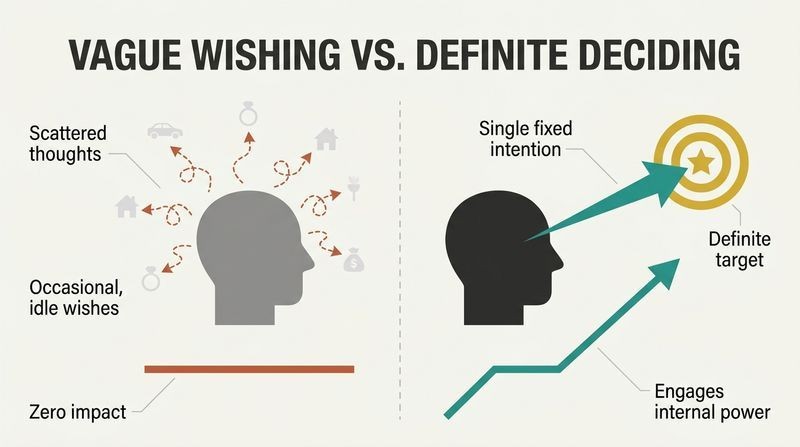
The core claim of this 1926 pamphlet is startling in its simplicity: if you truly know what you want, you can have it. The problem is that almost nobody does the knowing. The author sketches a parade of ordinary people, Jimmy the office boy who gasps at a red roadster, Florence eyeing a ring, Jones the bookkeeper resigned to renting forever, who spend their days emitting idle wishes without ever forming a fixed intention.
A wish is just noise. "If wishes were horses, beggars would ride" captures the default human posture. These people, the author argues, are getting exactly what they expect, which is nothing, because occasional or half-hearted wanting never engages the deeper power inside them. Earnest, definite desire is the switch that turns everything on.
What's striking is how cleanly this anticipates modern goal-setting research decades early. Edwin Locke and Gary Latham's goal-setting theory (1968 onward) found that specific, difficult goals reliably outperform vague "do your best" intentions, precisely because clarity directs attention and effort. Strip the metaphysics away and the pamphlet is describing what psychologists now call implementation intention: the mind cannot pursue a target it has not named. The weakness is the causal claim. Naming a goal focuses behavior; it does not summon results by cosmic decree. Still, the diagnostic that most people never decide what they actually want remains uncomfortably accurate a century later.
Write your wants on paper, ranked by importance, and revise the list daily
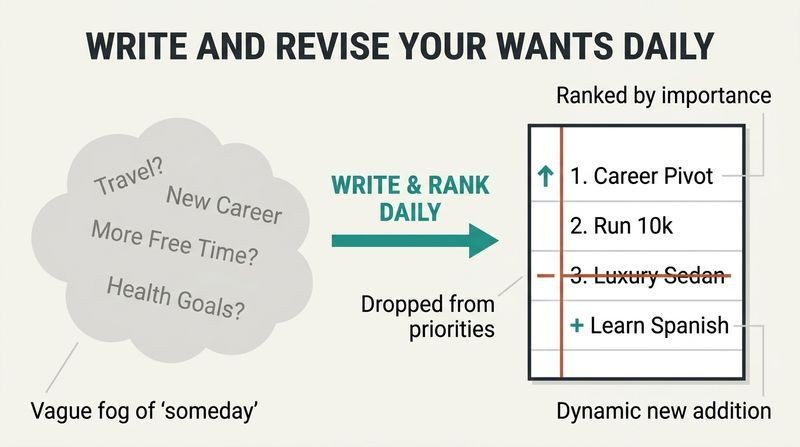
The Plan is deliberately concrete. Put pen to paper and list everything you want, ordered by how much it matters to you. The author insists you not hold back: go the limit, want too much, include things that seem impossible from any practical standpoint. The list is not fixed. You revise it daily, adding, subtracting, and reordering until it feels right.
Changes are the point, not a problem. When a brand-new desire muscles its way toward the top, that is a signal of progress. When something you once craved quietly drops off the list, that is progress too. The written, evolving document externalizes your intention and forces the vague fog of "someday" into ranked, legible priorities you can actually act on.
The insistence on writing by hand and revising daily aligns with what cognitive scientists call the generation and testing effect: physically producing and repeatedly re-engaging material encodes it far more durably than passive reading. The ranking demand is subtly sophisticated. Forcing priorities into a strict order surfaces trade-offs that a bullet list of hopes conceals. Modern productivity systems from Warren Buffett's apocryphal "25-5" list to Marie Kondo's discard test echo the same logic: clarity comes from subtraction. The daily revision also functions as a values audit, revealing that what we thought we wanted often evaporates once we see it written down beside what we want more.
Read your list three times daily, dwell on it constantly, and tell no one
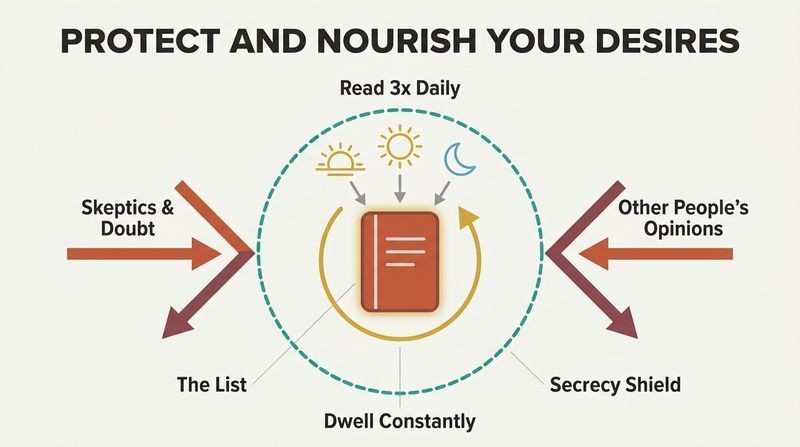
Three Positive Rules of Accomplishment form the daily discipline:
1. Read your list three times a day, morning, noon, and night.
2. Think about what you want as often as you possibly can.
3. Speak of your plan to no one except the power within you.
Secrecy is not superstition here; it is protection. The author argues your everyday mind (the objective mind) is dangerously suggestible. Surround it with skeptics, or even just chatter, and progress stalls. So you keep the plan sealed. You may associate with people who already possess what you want, but you never disclose your method to them. The repetition keeps the desire hot and constant; the silence keeps it uncontaminated by other people's doubt.
The secrecy rule is the most debated instruction, and modern psychology cuts both ways. Peter Gollwitzer's studies suggest that announcing an identity-goal can create a premature "sense of completeness," reducing the drive to actually do the work, which supports staying quiet. Yet accountability research shows public commitment often boosts follow-through. The reconciliation may be intention versus action: keep the wish private, but make behaviors public. The thrice-daily repetition, meanwhile, is spaced rehearsal, a well-validated memory technique, and functions much like a modern affirmation or visualization practice. Choosing to orbit people who already have what you want also foreshadows social-contagion findings: we absorb the norms and expectations of our reference group.
Specify the color, price, and deadline; a fuzzy target proves you aren't serious
Definiteness is the test of sincerity. Do not merely write "money" or "a car." If you want an automobile, name the make, style, price, color, and the date you want it in your driveway. If you want a home, design the structure, the grounds, the furnishings, the location, and the cost. If you want to break a sales record, write the exact total, the deadline, the number of units required, and list your prospects with the sum expected beside each name.
Vagueness reveals a lack of earnestness. The author is blunt: if you cannot decide these specifics, you are not truly in earnest, and you will never realize the desire. It may feel foolish to itemize a fantasy in such detail, but precision is what converts a daydream into a directive.
This is arguably the pamphlet's most practically useful demand, and it survives translation into any secular framework. Specificity does three measurable things: it makes progress trackable, it makes the goal feel real enough to trigger planning, and it exposes whether the desire is genuine or performative. The sales example, breaking a target into prospects and expected sums, is essentially a modern pipeline forecast. Contemporary frameworks like SMART goals (specific, measurable, achievable, relevant, time-bound) are the direct descendants of this instruction. The sharpest insight is psychological rather than mystical: the inability to specify what you want is itself diagnostic information, usually meaning you want the status of the thing more than the thing.
You don't need faith or a theory of how it works to start
Belief is not a prerequisite. The author concedes you cannot manufacture faith on day one, and that some items on your list will look flatly impossible. Write them down anyway, in their proper rank. Faith arrives after the first taste of results, not before.
Do not try to reverse-engineer the mechanism. The book offers a farming analogy: you do not demand an explanation for why a single kernel of corn, dropped into fertile soil, sends up a stalk and produces an ear packed with hundreds of new kernels. It simply does. In the same way, the method of accomplishment will unfold on its own, often faster than expected, without your needing to understand or supervise the process. Your job is to plant the desire clearly and tend it daily.
Releasing the demand to understand the mechanism is quietly wise, even for skeptics. Modern behavior change often stalls in analysis paralysis, where people research the perfect system instead of acting. The corn metaphor reframes action as planting: you control the input and the conditions, not the biochemistry. There is a real psychological analogue here in self-efficacy theory, where confidence grows from mastery experiences rather than preceding them. The honest admission that faith comes after results, not before, is more sophisticated than most manifestation literature, which typically demands unwavering belief upfront. The risk, of course, is that "don't analyze it" can also shield the claim from scrutiny it deserves.
Expect a voice called Discredit to dismiss your wins as luck, and refuse it
The ancient enemy shows up right after your first success. The author names it Discredit: the whispered thoughts that say "that was just a coincidence," "it couldn't possibly have been the plan," "what a remarkable fluke." This voice arrives precisely when you begin to accomplish things, and its job is to sever the connection between your effort and your result.
The counter-move is to claim credit and give thanks. Instead of shrugging off a win as chance, the author instructs you to consciously attribute it to the power you engaged, which builds assurance and invites more accomplishment. Doubt, distrust, and questioning are treated as natural but corrosive. When they surface, the remedy is mechanical: pull out the list, reread it, and talk to yourself about your desires until the doubt dissolves.
Discredit is a shrewd bit of folk psychology. Attribution theory in modern psychology studies exactly this: whether people credit outcomes to internal, controllable causes or external, random ones. Those with an internal locus of control persist longer and achieve more, while chronically attributing success to luck erodes motivation and repeatability. The pamphlet's instinct to consciously "claim" a win is essentially reinforcement learning applied to the self: label the causal link so the behavior repeats. The obvious hazard is the opposite error. Refusing to ever attribute results to chance can curdle into superstition or overconfidence. Healthy practice claims agency over effort while staying honest about the role of circumstance.
Close every accomplishment with genuine, joyful gratitude, not polite thanks
Gratitude is treated as an active ingredient, not a courtesy. When something on your list arrives, the author insists you give thanks with your whole soul, letting it show on your face. The logic is a small emotional chain reaction: sincere thanks is impossible without gratitude, and gratitude is impossible without happiness. So the act of thanking your own inner power for what it delivered manufactures the very state of mind that keeps the process running.
Thankfulness strengthens faith and compounds results. Rather than analyzing the gift, you accept it with happiness and reinforced belief. Gratitude here works less like a spiritual reward and more like a feedback loop: it converts each success into fuel, deepening conviction and priming you for the next desire on the list.
This may be the most empirically vindicated instruction in the book. Robert Emmons and Michael McCullough's gratitude research found that people who kept weekly gratitude journals reported higher wellbeing, more optimism, and even better sleep than control groups. Barbara Fredrickson's "broaden-and-build" theory explains the mechanism: positive emotions expand attention and build psychological resources over time, exactly the compounding effect the author describes. The pamphlet's chain from thanks to gratitude to happiness maps neatly onto this. Where it overreaches is treating gratitude as causally producing external possessions rather than the internal state that sustains persistent, motivated action. As mood regulation and motivation maintenance, though, the practice is remarkably sound.
You get what you ask for, including its hidden costs, so want wisely
Be careful what you wish for is here a literal warning. The author cautions that the same method can deliver things that make you miserable, wreck others' happiness, or bring sickness. If you obtain something, you must also take everything that comes attached to it. So when you plan your wants, you are urged to choose desires you are confident will serve both your own greatest good and your fellow man's.
Sequence your ambitions from easy to hard. Start your first list with familiar, concrete targets, a specific sum of money or a material possession, because these come faster and more reliably than breaking entrenched habits or healing bodily and mental ills. Master the small wins first. As you progress, the higher and truly important aims, including the desire to help others as you were helped, naturally rise up the list.
The ethical caveat elevates this above pure acquisitiveness and echoes a durable moral intuition: desire is not self-justifying. Behavioral economists would recognize the "hidden costs" warning as a plea to account for externalities and second-order consequences, the collateral damage our narrow goals ignore. The staged difficulty, mastering easy material goals before attempting habits or health, is genuinely astute developmental psychology. Bandura showed that early mastery experiences build the self-efficacy needed to attempt harder challenges. Starting with a winnable target is how confidence is bootstrapped. The closing move, where helping others organically climbs the priority list, hints that the author sees material success as a training ground rather than a destination.
Give the idea away freely, because the law of life is you get by giving
The book ends on reciprocity, not accumulation. In a closing letter, the anonymous author frames the greatest goods of life, sight, hearing, love, life itself, as gifts mysteriously bestowed rather than earned. Powerful ideas, he argues, belong in the same category, and the most profitable thing you can do with a valuable idea is give it away.
Generosity is presented as self-interest correctly understood. By passing the method to people who are stuck, worried, or discouraged, you align yourself with what the author calls the law of life: "You get by giving." The reward is not public thanks, which you should not expect, but a private increase in power and a larger life. Even the book's origin fits this ethos: the author omitted his own name, believing the greatest good comes from helping without seeking praise.
The anonymity is a genuinely elegant proof-of-concept: an author preaching selfless giving who refuses the credit. The reciprocity principle has robust support. Adam Grant's research in "Give and Take" found that "givers" often rise to the top of success distributions, not just the bottom, because generosity builds trust, networks, and reputation over time. Anthropologist Marcel Mauss showed gift economies bind communities through obligation and return. That said, "you get by giving" also served an obvious commercial function here, encouraging readers to buy and distribute more copies. The insight survives the self-interest, though: giving with no expectation of return tends, paradoxically and reliably, to return more than transactional exchange.
Analysis
"It Works" is a 1926 artifact of the American New Thought movement, the same intellectual current that produced Wallace Wattles, Napoleon Hill, and eventually Rhonda Byrne's "The Secret." Its power lies in radical compression: under 3,000 words, one plan, three rules. That brevity is both its genius and its limitation. The book strips manifestation down to a testable behavioral protocol, decide precisely, write it down, review thrice daily, stay silent, give thanks, but it wraps that protocol in an untestable metaphysical claim, that an omnipotent inner power the author calls Emmanuel physically delivers your wants. The interesting move for a modern reader is to separate the mechanism from the metaphysics. Nearly every instruction has an empirical analogue: goal specificity (Locke and Latham), spaced repetition, gratitude interventions (Emmons), internal locus of control, self-efficacy staging (Bandura), and reciprocity (Grant, Mauss). Read as a psychology of attention and motivation, the pamphlet is shockingly durable. Read as literal cosmic causation, it commits the classic error of survivorship and confirmation bias, the testimonials from realtors and equity firms select for successes and ignore the silent majority for whom lists changed nothing. The author's own caveats are telling. He admits faith comes after results, warns that desires carry hidden costs, and insists on ethical screening, all hedges that a pure magical-thinking text would not bother with. What endures is the behavioral core: most people never convert diffuse longing into ranked, specific, revisited intention, and that failure alone explains much drift. The book's insistence that inability to specify what you want is itself diagnostic remains its sharpest, most modern insight. Its shadow is the flip side of "you can have anything," the implication that those who lack simply did not want correctly, a victim-blaming logic that runs through the entire genre it helped seed.
Review Summary
It Works is widely praised for its simplicity and effectiveness in teaching the law of attraction. Many readers report success in manifesting their desires by following its straightforward method: writing down goals, reading them daily, and keeping them private. The book's brevity is seen as a strength, allowing readers to quickly grasp and apply its principles. While some find it overly simplistic, most appreciate its directness and motivational impact. Readers often compare it favorably to other self-help books and recommend it as a starting point for manifesting goals.
People Also Read





Glossary
Emmanuel
The omnipotent power withinThe author's chosen name (meaning "God in us") for the inner power he believes can fulfill any earnest desire. He borrows the underlying concept from Thomson Jay Hudson's "subjective mind" but treats the label as secondary; whatever it is called, this power is described as capable and willing to bring about whatever you sincerely and definitely want.
Objective mind
Your everyday conscious mindThe waking, decision-making mind you use daily. The author considers it vacillating and highly suggestible, prone to mere wishing rather than earnest desire. Its job is to decide precisely what you want; its weakness is that it is easily derailed by doubt and by the skepticism of the people around you, which is why the plan must be kept private.
The Three Positive Rules of Accomplishment
Daily discipline for manifesting desiresThe book's core practice: (1) read your written list of wants three times daily, at morning, noon, and night; (2) think about what you want as often as possible; and (3) tell no one about your plan except the inner power itself. Together they keep desire constant, vivid, and protected from external doubt.
Discredit
Inner voice dismissing wins as luckThe author's name for the recurring skeptical thought that arrives after early successes, insisting the result was mere coincidence rather than the plan working. He treats it as a natural but dangerous enemy and prescribes consciously claiming credit and giving thanks as the antidote to preserve momentum and faith.
FAQ
What's "It Works: The Famous Little Red Book That Makes Your Dreams Come True!" about?
- Concise and Practical Guide: The book offers a concise, definite, and result-oriented plan to improve one's life conditions.
- Focus on Desires: It emphasizes the importance of knowing what you truly want in order to achieve it.
- Power of the Mind: The author discusses the power within each person, referred to as "Emmanuel" or the subjective mind, which can help fulfill desires.
- Simple Rules: It provides simple rules and a plan to help readers achieve their goals and desires.
Why should I read "It Works: The Famous Little Red Book That Makes Your Dreams Come True!"?
- Proven Success: The book has been used successfully by many individuals and organizations to improve motivation and performance.
- Easy to Understand: It is deliberately kept short and straightforward to make it easy to read and apply.
- Empowering Message: It empowers readers by teaching them how to harness their inner power to achieve their desires.
- Practical Application: The book offers practical steps and rules that can be applied to various aspects of life.
What are the key takeaways of "It Works: The Famous Little Red Book That Makes Your Dreams Come True!"?
- Know What You Want: Clearly define your desires and write them down in order of importance.
- Consistent Focus: Regularly read and think about your desires to maintain focus and connection with your inner power.
- Inner Power: Trust in the omnipotent power within you to help achieve your desires without needing to understand how it works.
- Gratitude and Faith: Express gratitude for accomplishments and maintain faith in the process to ensure continued success.
What is the method proposed by the author in "It Works: The Famous Little Red Book That Makes Your Dreams Come True!"?
- Write Down Desires: List your desires on paper, adjusting them as needed until they are clear and prioritized.
- Three Positive Rules: Read your list three times daily, think about your desires often, and discuss them only with your inner power.
- Be Specific: Be detailed about what you want, including specifics like type, style, and timing.
- Progress and Adjustments: Regularly update your list as you achieve goals and develop new desires.
How does the author of "It Works" suggest dealing with skepticism and doubt?
- Revisit Your List: When doubts arise, review your list of desires to reinforce your commitment and focus.
- Surround Yourself Wisely: Choose to associate with people who have achieved what you desire, but avoid discussing your methods with skeptics.
- Trust the Process: Accept that the power within you works without needing to understand the mechanics, similar to natural phenomena.
- Express Gratitude: Counter skepticism by giving thanks for accomplishments, reinforcing belief in the process.
What are the "Three Positive Rules of Accomplishment" in "It Works"?
- Read Your List: Read your list of desires three times a day—morning, noon, and night.
- Think Often: Regularly think about your desires to keep them at the forefront of your mind.
- Keep It Private: Only discuss your desires with your inner power, not with others, to maintain focus and avoid skepticism.
What role does the "subjective mind" play in "It Works"?
- Inner Power Source: The subjective mind is described as a powerful force within each person, capable of fulfilling desires.
- Omnipotent Nature: It is considered omnipotent, meaning it can achieve anything you earnestly desire.
- Connection to Desires: Establishing a strong connection with this power is essential for achieving your goals.
- Faith and Sincerity: The subjective mind responds to sincere and earnest desires, not half-hearted wishes.
How does "It Works" suggest you should define your desires?
- Be Detailed: Clearly specify what you want, including all relevant details like type, style, and timing.
- Prioritize Desires: List desires in order of importance to ensure focus on what truly matters.
- Adjust as Needed: Regularly update your list to reflect new desires and remove those no longer relevant.
- Be Realistic Yet Ambitious: While some desires may seem unattainable, include them if they are important to you.
What caution does the author of "It Works" provide about desires?
- Consider Consequences: Be aware that obtaining certain desires may lead to negative outcomes for yourself or others.
- Plan for Good: Ensure your desires contribute positively to your life and the lives of others.
- Avoid Harmful Desires: Be cautious of desires that could lead to misery, harm, or negative consequences.
- Focus on Positive Impact: Aim for desires that bring the greatest good and pave the way for future hope.
What are some testimonials about "It Works"?
- Training Success: Organizations like Shawmut-Bridges Equities and Pan-Desert Realtors Association report increased motivation and performance.
- Long-term Use: Many companies have used the book for years as part of their training programs with positive results.
- Personal Endorsements: Individuals in various fields have found the book effective in achieving personal and professional goals.
- Continued Demand: The book remains in demand for its practical and effective approach to achieving desires.
What are the best quotes from "It Works" and what do they mean?
- "If you KNOW what you WANT you can HAVE IT": Emphasizes the power of clarity and focus in achieving desires.
- "You get by giving": Highlights the importance of generosity and helping others as a path to personal gain.
- "The Power and what it does is beyond understanding": Encourages trust in the process without needing to understand the mechanics.
- "Sincere and earnest thanks cannot be given without gratitude": Stresses the role of gratitude in reinforcing faith and achieving success.
How does "It Works" suggest you should handle accomplishments?
- Acknowledge Success: Recognize and give credit to your inner power for achievements.
- Express Gratitude: Be thankful for accomplishments, which reinforces faith and encourages further success.
- Avoid Discredit: Counter thoughts of coincidence by affirming the role of your inner power in your achievements.
- Celebrate Progress: Use accomplishments as motivation to pursue higher and more meaningful goals.
Download PDF
Download EPUB
.epub digital book format is ideal for reading ebooks on phones, tablets, and e-readers.








































