


Key Takeaways
Setting goals is effortless; your ancient brain sabotages the achieving
The gap is neurological, not moral. Assaraf argues our brains are goal-desiring machines, but they evolved under two overriding priorities: safety and energy efficiency. Any big change (leaving a job, losing weight, starting a business) registers as a survival threat, so the brain fights to drag you back to its comfort zone like a thermostat restoring room temperature.
The statistics illustrate the trap. He cites that roughly 80% of startups fail within 36 months, 95%+ of dieters regain lost weight, and 70% of lottery winners go broke within a few years. These are not failures of willpower or intelligence. They are the predictable output of a Stone Age operating system running in a high-tech world where change is misread as danger.
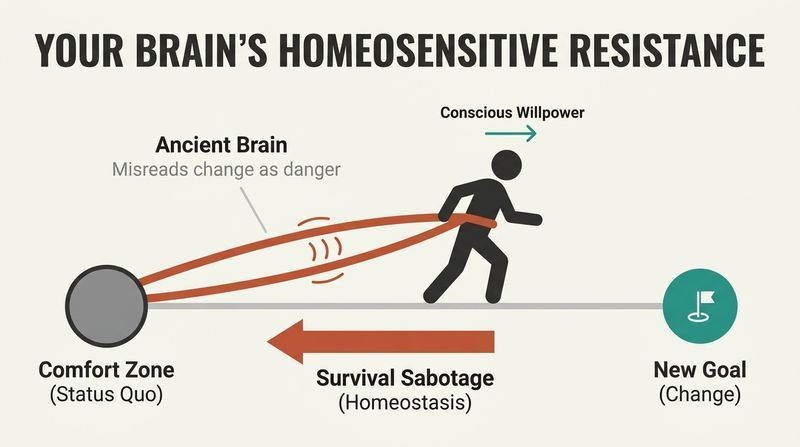
The framing is compassionate and largely accurate: evolutionary psychology does show a strong status quo bias. It resonates with Daniel Kahneman's loss aversion and with homeostatic set-point theory in obesity research. One caution: attributing nearly all failure to an evolutionary comfort zone can veer into unfalsifiable territory, where any setback confirms the theory. Structural factors (capital, health, discrimination) also drive those startup and poverty statistics. Still, reframing stuckness as a design feature rather than a character flaw is genuinely useful, lowering shame enough that a person can actually experiment with change rather than spiral into self-blame.
Your subconscious runs 95% of your life on autopilot
Meet the 800-pound gorilla. Assaraf splits the mind into two: a slow, deliberate conscious brain and a lightning-fast, habitual subconscious brain he nicknames the gorilla. Neuroscientists estimate only 3 to 5% of brain activity is conscious; the other 95 to 97% runs beneath awareness. The subconscious reacts to threats before the conscious mind even registers them.
The gorilla craves coherence. He compares the brain to an orchestra: when habits, beliefs, and emotions align, you get harmony (coherence). Try to change one instrument and you introduce dissonance, which is metabolically expensive, so the brain restores the old tune. This is why willpower, goal-setting, and clever plans fail against ingrained patterns. You cannot out-muscle millions of years of wiring. You must retrain the subconscious to agree with the conscious.
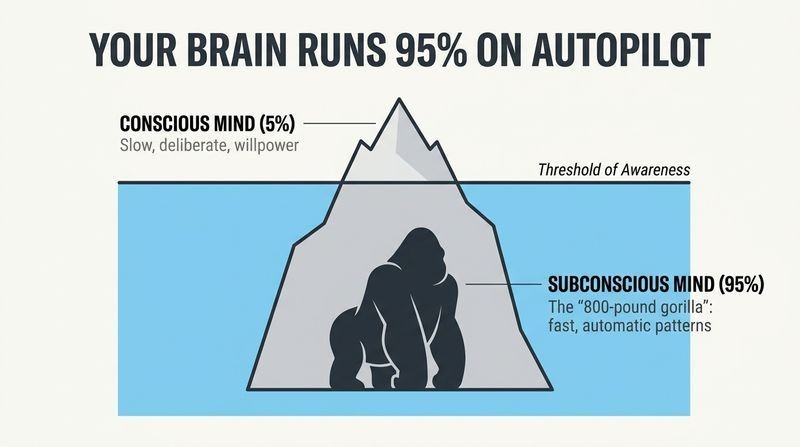
The dual-process model echoes Kahneman's System 1 and System 2, though the precise 95% figure is more rhetorical than measured; no clean instrument quantifies conscious versus nonconscious processing. The deeper insight holds: automatic processes dominate behavior, a point supported by decades of implicit cognition research. The orchestra-and-coherence metaphor cleverly translates cognitive dissonance into something visceral. What's worth questioning is the strict conscious-versus-subconscious dichotomy; modern neuroscience sees these as deeply interwoven networks, not two separate agents. Assaraf acknowledges there are no literal two brains, which keeps the metaphor honest and useful rather than misleading.
You can rewire your brain at any age through neuroplasticity
The brain is renovatable, not fixed. For decades science claimed the adult brain was hardwired. Neuroplasticity overturned that: neurons that fire together wire together (Hebb's rule), so repeated thoughts and actions carve deeper neural pathways while unused ones decay. Assaraf describes three mechanisms: neurogenesis (growing new neurons), stronger connections (Hebb's rule), and better connections via myelin, the fatty sheath that speeds signals.
Flip the plasticity switch. Six accelerators keep the brain changeable:
1. Novelty and curiosity (triggers dopamine)
2. Pleasure and pain (encodes fast)
3. Purpose and a clear why
4. Focused attention
5. Physical exercise (feeds the brain oxygen)
6. Stepping outside your comfort zone
Even imagining an action changes the brain: mentally rehearsing piano notes activates the same regions as playing them.
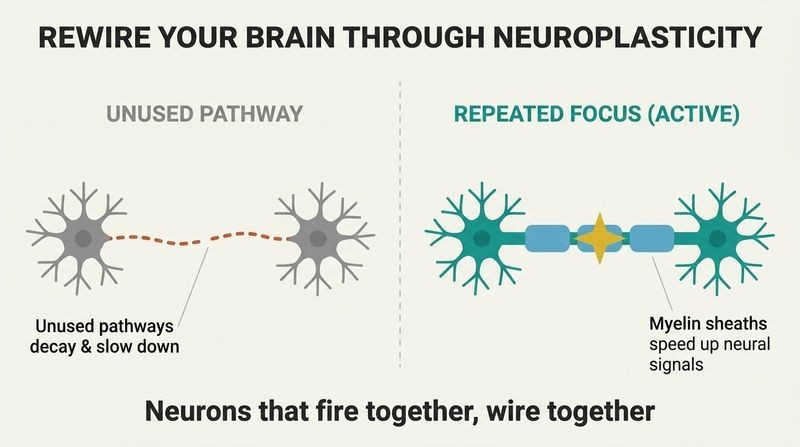
Neuroplasticity is real and well-documented, but popular treatments often overstate how easily adults can rewire. Structural change requires substantial, sustained, effortful practice; casual affirmations rarely reshape cortex. The mental-rehearsal claim rests on genuine studies (Pascual-Leone's finger-exercise work), yet imagined practice produces smaller gains than physical practice. Assaraf's six accelerators map neatly onto established findings: aerobic exercise boosts BDNF and hippocampal volume, novelty drives dopaminergic learning, and focused attention underlies expertise (the London taxi-driver hippocampus studies). The honest takeaway is that plasticity is a real lever, not a magic wand, and it rewards consistency over intensity.
Train three neuro-muscles: Awareness, Intention, and Action
AiA is the core practice. Assaraf treats mental capacities like muscles you strengthen through reps. Three are foundational:
1. Awareness: observing your thoughts, emotions, and body without judgment, which lets you catch the gorilla mid-act
2. Intention: consciously deciding how you want to think, feel, and act
3. Action: taking one small step, which builds the brain through learning regardless of outcome
Awareness is the master key. He calls it the one wish to grant if a genie appeared, because without noticing a pattern you cannot change it. The practical drill pairs a 60-second breathing exercise (six slow breaths to deactivate the stress response) with AiA: notice your state, choose an intention, take a step. This converts a reactive, automatic moment into a deliberate, chosen one.
The Awareness-Intention-Action sequence is essentially applied mindfulness fused with implementation intentions, both of which have strong evidence bases. Metacognitive awareness (noticing your own mental states) is the active ingredient in cognitive behavioral therapy and mindfulness-based stress reduction. Naming an emotion demonstrably reduces amygdala activation, a finding from Matthew Lieberman's affect-labeling research, which validates the pause-and-observe step. The muscle metaphor is motivating but imperfect: unlike biceps, attention fatigues and does not always grow linearly with use. Still, framing self-regulation as trainable rather than fixed is empowering, and the emphasis on tiny action steps over grand resolutions aligns with behavior-change science.
Change habits by hijacking the trigger, not fighting the reward
Every habit is a three-part loop. A trigger fires, a behavior follows, a reward locks it in. Since the reward comes too late to interrupt and resisting the behavior burns finite willpower, the leverage point is the trigger. Assaraf illustrates with his own sugar addiction before a Las Vegas trip with a legendary dessert buffet. He used mental rehearsal: dozens of times he vividly imagined the trigger (the buffet) then imagined turning and walking away. By the real trip, his brain had already rehearsed walking away 40 times.
Make new habits stick with three principles.
1. Make the change too small to fail (floss one tooth, read one page)
2. Stack the new habit onto an existing one
3. Be consistent; consistency beats intensity, averaging about 100 days to cement
The trigger-behavior-reward loop draws directly on Charles Duhigg and Ann Graybiel's basal-ganglia research, and the tiny-habits and habit-stacking principles come from BJ Fogg and James Clear. Assaraf synthesizes these well. His mental-rehearsal twist is the distinctive contribution: rehearsing the interruption rather than just the goal. This fits research on implementation intentions (if-then planning), which reliably outperform motivation alone; the exercise-study he cites showed planning tripled adherence. One nuance worth flagging: identifying triggers works better for cue-driven habits than for habits fused with emotional regulation, where the underlying need must also be addressed, not merely the cue.
Treat irrational fear as a signpost pointing toward growth
Fear is a fast, ancient alarm. Sensory input reaches the amygdala, the brain's smoke detector, nearly twice as fast as it reaches the conscious frontal lobes, triggering fight, flight, freeze, or faint. The system evolved for real predators but now fires false alarms at public speaking, sales calls, and credit-card bills. A humiliating high-school speech can make the subconscious classify all public speaking as mortal danger 25 years later.
Move toward the fear, not away. Assaraf recounts conquering claustrophobia after a panic-inducing MRI by practicing in a flotation tank, stacking a breathing exercise with a calming visualization, then deliberately imagining being buried alive until he could switch panic on and off. The reframe: irrational, non-life-threatening fear signals something that matters and marks the path to your potential.
The exposure approach Assaraf stumbled into is the gold standard for anxiety treatment, systematic desensitization and exposure therapy, validated across thousands of clinical trials. Repeatedly facing a feared stimulus while staying calm allows the amygdala's fear response to extinguish. His flotation-tank self-experiment is essentially DIY graded exposure. The distinction between rational and irrational fear is clinically important, though harder to draw in practice than the book suggests; some avoidance is wise. The claim that fear signals what matters is a useful reframe borrowed from acceptance and commitment therapy, where anxiety often points toward personally valued directions worth pursuing despite discomfort.
Hidden implicit beliefs override the conscious goals you declare
Two belief systems compete. Explicit beliefs are conscious and stated (I will become a millionaire). Implicit beliefs are buried in the subconscious (I'm not smart enough). When they clash, the implicit almost always wins, dragging you back to a financial or weight set point like a thermostat. Assaraf's own early real estate career stalled not from lack of skill but from a hidden belief, seeded by his father, that skipping college meant he lacked the brains.
Beliefs are changeable habits of thought. He cites the placebo effect (averaging around 33% improvement) and research that believing housework is exercise produces real weight loss. To rewrite beliefs: daydream to inhibit limiting thoughts, take baby steps, visualize and act, and use the Open Window phrase (In the past I believed X; now I'm discovering Y).
The explicit-implicit distinction mirrors decades of dual-attitude research and the Implicit Association Test tradition in social psychology. The placebo evidence is robust and genuinely shows beliefs shape physiology. Some cited studies, however, come from Ellen Langer's lab, whose dramatic mind-set effects (the housework-as-exercise study, the counterclockwise aging study) have faced replication scrutiny and small sample sizes, so they should be held loosely. The core practical insight stands on firmer ground: self-limiting narratives operate below awareness and quietly veto conscious ambition. The Open Window reframe is a clever linguistic hack, converting a fixed identity statement into a growth-oriented, in-progress one, echoing Carol Dweck's mindset research.
Stress harms only when you frame it as a threat
Same wave, two responses. Assaraf borrows a surfing metaphor: identical stress can produce a threat response (fight, flight, freeze, narrowed focus, constricted blood vessels) or a challenge response (relaxed body, steady breath, broadened focus, creativity). The stressor is constant; the interpretation determines the outcome. Research shows people who view stress as harmful suffer its worst effects, while those who see it as energizing perform better.
Tame the monkey mind. Chronic worry keeps the Default Mode Network (the brain's idle chatter system) overactive. Meditation and mindfulness quiet it, and even modest practice increases gray matter. He recommends scheduling three to five short reset breaks daily and reframing stress as a sign that something matters. The CDC notes stress factors into five of the six leading causes of death.
The threat-versus-challenge distinction rests on solid ground: Alia Crum and Shawn Achor's work showed that a stress-is-enhancing mindset improved health and performance, and Jeremy Jamieson's research found reappraising arousal as helpful improved test outcomes. Kelly McGonigal popularized the finding that stress harms mainly those who believe it harms them. That said, the reframe has limits; chronic, uncontrollable stress (poverty, trauma, caregiving) damages health regardless of framing, and telling someone to simply reappraise can shade into victim-blaming. The Default Mode Network science is legitimate, though meditation's gray-matter effects, while real, are modest and accumulate slowly, not overnight.
Feed your inner Einstein by starving your inner Frankenstein
Negativity bias is the default setting. The brain is Velcro for bad experiences and Teflon for good ones (Rick Hanson's phrase). Roughly two-thirds of amygdala neurons scan for threats, and we recall angry faces and losses faster than pleasures. Assaraf personifies the two halves of the prefrontal cortex: the left is your inner Einstein (solutions, optimism, possibility), the right leans toward your inner Frankenstein (barriers, pessimism, why-you-can't).
Activating one dims the other. Because the brain has limited resources, engaging the Einstein side reduces Frankenstein activity. His four-step drill: reset with breathing, become aware of the negativity, kill the ANTs (Automatic Negative Thoughts, from Daniel Amen) by questioning and replacing them, then practice flip-flopping between the two states on command like changing a TV channel.
Negativity bias is one of the most replicated findings in psychology; Baumeister's paper Bad Is Stronger Than Good catalogs it exhaustively, and it makes evolutionary sense since missing a threat was costlier than missing a reward. The Einstein-Frankenstein lateralization, however, oversimplifies. The strict left-equals-positive, right-equals-negative mapping derives from Richard Davidson's approach-withdrawal research but is far messier than pop treatments imply; emotion is not neatly lateralized. The practical drill is sound regardless of the neuroanatomy: questioning automatic negative thoughts is the backbone of cognitive therapy, and cognitive reappraisal reliably shifts mood. Treat the brain-hemisphere story as a useful metaphor, not literal wiring.
Write vivid, emotional, right-sized goals to recruit your whole brain
Goals must hit a neurological sweet spot. A goal too big triggers the hypothalamus and amygdala into stress mode; too small fails to release motivating dopamine. Assaraf tells of Caroline, a near-bankrupt Scottish hairstylist who wrote in a dream book I will become Scottish Hairdresser of the Year, pasting magazine photos with her own face on the winner, then won the award in front of 2,000 stylists and became a millionaire.
Four goal-setting mistakes to avoid.
1. Lack of clarity (be precise, vivid, and written; written goals succeed 50% more often per Gail Matthews)
2. Lack of emotional value (tie it to a deep why)
3. Wrong size (find the challenging-but-possible zone)
4. Fantasizing without action (daydreamers applied for fewer jobs and got lower offers)
The research scaffolding is a mix of solid and shaky. Gail Matthews's written-goals study is frequently cited but was a small, unpublished-at-the-time conference finding. The stronger evidence comes from Gabriele Oettingen, whose decades of work show that positive fantasy alone drains energy and predicts worse outcomes, while mental contrasting (vividly imagining the goal, then confronting real obstacles) genuinely boosts achievement. Assaraf incorporates this correctly. The dopamine-and-sweet-spot framing aligns with the Yerkes-Dodson arousal curve and with Locke and Latham's goal-setting theory, which found specific, difficult goals outperform vague or easy ones. Caroline's story is inspiring but is a single anecdote, not evidence.
Planning beats motivation: it nearly tripled exercise adherence
The bridge from goal to result is a plan. In a study Assaraf cites, people who only tracked exercise or added motivational information hit their weekly workout about 35 to 38% of the time. Those who also wrote one specific if-then plan (day, time, place) hit it 98% of the time. Motivation without a plan actually lowered adherence.
Why and how live in different brain regions. You cannot fully occupy both at once, so a powerful why supplies dopamine but a concrete how supplies direction. Assaraf's STT process breaks goals into Strategies (broad approaches), Tactics (single doable actions), and Timelines (specific dates and times). Each small completed step delivers a dopamine hit, chaining into a virtuous cycle. As Doctorow said of writing, headlights that show only the next stretch still get you the whole way.
This is the strongest empirical claim in the book, and it holds up. The dramatic adherence jump comes from Sheeran and Milne's implementation-intentions research, and Peter Gollwitzer's meta-analyses across hundreds of studies confirm that if-then planning produces medium-to-large effect sizes on goal attainment. Specifying when, where, and how offloads the decision to an environmental cue, bypassing the willpower bottleneck. The neuroscience that why and how recruit distinct networks draws on Lieberman's work and is directionally right. The practical implication is underappreciated: most people over-invest in pumping up motivation and under-invest in the humble logistics of scheduling, which is where results actually come from.
Results lag effort: nurture the roots before judging the shoots
Change obeys a law of gestation. Assaraf invokes roots and shoots: when you start Innercising or a new habit, the visible results (shoots) trail the invisible neural rewiring (roots) by weeks or months. Habits take 65 to 365 days to cement. The vulnerable gap is when you're doing the work but seeing nothing, which is exactly when most people quit. Staying power beats willpower.
Your current life is just a scorecard. Your bank balance, weight, and relationships reflect past thoughts and behaviors, not your fixed worth. Change the roots and the scorecard changes. Alan Deutschman's book Change or Die found heart patients faced a 90% failure rate at changing even under threat of death, yet concluded people can change; they just use the wrong strategies. Build a daily ritual: morning gratitude, visualization, planning, and tiny consistent actions.
The delayed-payoff problem is real and underrated; behavior-change dropout clusters precisely in the early period before intrinsic rewards kick in, which is why James Clear calls it the plateau of latent potential. The habit-formation range Assaraf cites comes from Phillippa Lally's University College London study, which found a 66-day median with wide variation, so his 65-to-365 window is accurate. The you-are-not-the-scorecard reframe is psychologically shrewd: separating self-worth from current outcomes reduces the shame spiral that derails change. One caveat: the roots metaphor can rationalize staying on an ineffective path too long. Persistence is valuable, but so is knowing when a strategy genuinely is not working.
Analysis
Innercise sits in a crowded genre (brain-based self-help) but distinguishes itself by grounding familiar advice in a coherent evolutionary-neuroscience narrative and, crucially, in a repeatable practice format. John Assaraf, an entrepreneur turned NeuroGym founder, frames the entire book around one governing metaphor: the brain evolved for safety and efficiency, so it treats meaningful change as a threat and drags you back to a comfort-zone set point. Everything else (fear, limiting beliefs, stress, negativity, habits) becomes a specific manifestation of that single mechanism, which gives the book unusual structural unity.
The intellectual backbone is borrowed rather than original. The dual-process model echoes Kahneman; habit loops come from Duhigg and Fogg; implementation intentions from Gollwitzer and Sheeran; mental contrasting from Oettingen; growth mindset from Dweck; negativity bias from Baumeister and Hanson. Assaraf's contribution is synthesis and packaging: rebranding mental techniques as Innercises (mental workouts) and offering short, scriptable exercises like the six-breath reset and the AiA sequence. This is the book's genuine value; it converts abstract findings into daily reps.
The weaknesses are typical of the category. Neuroscience is deployed as rhetorical garnish more than mechanism; dopamine, the amygdala, and prefrontal lateralization are invoked with more confidence than the literature supports. The Einstein-Frankenstein hemisphere story and the crisp 95% subconscious figure are metaphors dressed as facts. Evidence leans heavily on single anecdotes (Caroline, Katrama, the many customer testimonials that double as marketing for NeuroGym's paid programs), and some cited studies (Langer, Matthews) are fragile.
Yet the core prescriptions are among the best-supported in behavior science: specific written if-then plans, exposure to conquer fear, tiny consistent habits, cognitive reappraisal of stress and negative thoughts, and separating self-worth from current results. A discerning reader who treats the neuro-explanations as motivating metaphor and the practices as tested tools will extract real, durable benefit.
Review Summary
INNERCISE receives mixed reviews, with an average rating of 4.07/5. Readers appreciate the neuroscience insights and practical exercises for self-improvement. Many find the content valuable for personal growth and goal achievement. However, frequent criticism targets the book's perceived advertising for the author's programs. Some readers feel it lacks depth or originality compared to similar works. Despite these drawbacks, many still recommend it as a useful guide for understanding brain function and implementing positive changes in one's life.
Glossary
Innercise
Mental workout to rewire brainAssaraf's coined term for science-based mental and emotional exercises done in repeated sets and stacks, like physical workouts, to strengthen mindset and retrain the subconscious. Examples include breathing resets, visualization, mental rehearsal, and affirmations, all aimed at aligning conscious goals with subconscious patterns to make change easier.
The Gorilla
The powerful subconscious brainAssaraf's nickname for the fast, habitual, emotional subconscious brain that governs an estimated 95% of activity and constantly works to keep you safe within your comfort zone. Because it is faster and more powerful than the conscious mind, willpower alone cannot override it; it must be retrained to cooperate.
Neuro-Muscles
Trainable mental capacitiesMental and emotional capacities (awareness, intention, action, focus, willpower, beliefs, confidence, and more) that Assaraf argues can be strengthened through repetition like physical muscles. The three core neuro-muscles are Awareness, Intention, and Action.
AiA
Awareness, Intention, Action drillA foundational Innercise pronounced eye-ya, standing for Awareness (notice your mental, emotional, and physical state without judgment), Intention (consciously choose how you want to respond), and Action (take one small step). It converts an automatic reactive moment into a deliberate, chosen one.
Coherence vs. Dissonance
Brain harmony versus internal conflictCoherence is the brain's preferred state where habits, beliefs, and emotions align, producing calm and flow. Dissonance is the metabolically costly conflict that arises when you try to think or act against ingrained patterns. The brain works to restore coherence, which is why change feels exhausting and tends to revert.
Explicit vs. Implicit Beliefs
Stated versus hidden beliefsExplicit beliefs are conscious convictions you can articulate (I can earn more). Implicit beliefs are buried in the subconscious (I'm not smart enough). When the two conflict, the implicit belief usually wins, producing self-sabotage that returns you to a set point until the hidden belief is rewritten.
Inner Einstein and Inner Frankenstein
Optimistic versus pessimistic mental modesAssaraf's personifications of the left prefrontal cortex (Einstein: solutions, optimism, possibility) and the right-leaning tendency (Frankenstein: barriers, pessimism, why you can't). Because brain resources are limited, activating the Einstein mode dims the Frankenstein mode, so deliberate positive focus reduces negativity.
STT Process
Strategies, Tactics, Timelines planningAssaraf's planning Innercise that bridges goals and achievement. Strategies are broad approaches to a goal, Tactics are single doable actions, and Timelines assign each tactic a specific date and time. Small completed steps release dopamine, chaining into sustained motivation.
Roots and Shoots
Invisible change precedes visible resultsAssaraf's metaphor for the law of gestation in behavior change. The roots (subconscious neural rewiring) grow invisibly before the shoots (visible results) appear. The gap between effort and payoff is when most people quit, so faith and consistency during that period are essential.
Take 6: Calm the Circuits
Six-breath stress resetA 60-second foundational Innercise: take six slow rhythmic breaths in through the nose and out through the mouth while silently affirming breathing in calmness and breathing out stress. It deactivates the stress response and restores access to the brain's executive functions before other techniques.
FAQ
1. What is "INNERCISE: The New Science to Unlock Your Brain’s Hidden Power" by John Assaraf about?
- Science-Based Brain Training: The book introduces "Innercise," a set of evidence-based mental and emotional exercises designed to strengthen your mindset and unlock your brain’s hidden power.
- Overcoming Mental Barriers: It explains how subconscious patterns, limiting beliefs, and emotional blocks—not lack of knowledge—are the real obstacles to achieving your goals.
- Practical Tools for Change: Assaraf provides actionable techniques rooted in neuroscience and psychology to help readers rewire their brains for success in health, wealth, relationships, and more.
- Real-Life Success Stories: The book features testimonials and case studies from people who have transformed their lives using Innercise methods.
- Empowerment and Neuroplasticity: It emphasizes the power of neuroplasticity, showing that anyone can change their brain and life by consistently applying the right mental exercises.
2. Why should I read "INNERCISE" by John Assaraf?
- Unlock Hidden Potential: The book offers practical strategies to break free from self-sabotaging habits and unlock your fullest potential.
- Science-Backed Methods: All techniques are grounded in the latest neuroscience, making them more reliable than generic self-help advice.
- Achieve Lasting Change: Innercise focuses on creating sustainable, long-term change by addressing both conscious and subconscious patterns.
- Applicable to All Goals: Whether your aim is better health, more wealth, improved relationships, or personal growth, the methods are adaptable to any area of life.
- Inspirational and Actionable: The book combines motivational stories with step-by-step exercises, making it both inspiring and easy to implement.
3. What are the key takeaways from "INNERCISE" by John Assaraf?
- Mindset Over Knowledge: Success is less about what you know and more about your mindset, emotional blocks, and ingrained habits.
- Two Brains Concept: You have a conscious (logical) and a subconscious (emotional/habitual) brain, and aligning them is crucial for change.
- Neuroplasticity Is Key: Your brain can be rewired at any age through deliberate practice, novelty, and focused attention.
- Innercise Techniques: Regular mental exercises—like "Take 6: Calm the Circuits" and "AiA (Awareness, Intention, Action)"—can help you manage stress, fear, and negative habits.
- Commitment vs. Interest: True transformation requires commitment, not just interest; being committed means taking action despite discomfort or fear.
4. How does John Assaraf define "Innercise" in "INNERCISE: The New Science to Unlock Your Brain’s Hidden Power"?
- Mental Fitness Training: Innercise is a set of science-based mental and emotional exercises designed to strengthen your "neuro-muscles" (beliefs, habits, focus, etc.).
- Daily Practice: Just as physical exercise builds muscle, daily Innercise builds mental resilience, emotional control, and positive habits.
- Variety of Techniques: Innercises include breathing exercises, visualization, mindfulness, cognitive priming, and guided meditations.
- Evidence-Based: All Innercises are grounded in neuroscience and proven psychological methods, not just motivational theory.
- Goal-Oriented: The purpose of Innercise is to help you overcome subconscious resistance and achieve your most important goals.
5. What is the "Two Brains" concept in "INNERCISE" and why is it important?
- Conscious vs. Subconscious: Assaraf explains that you have a conscious (rational, slow, deliberate) brain and a subconscious (emotional, fast, habitual) brain.
- Subconscious Dominance: The subconscious brain controls 95–97% of your thoughts, feelings, and behaviors, often overriding conscious intentions.
- The "Gorilla" Metaphor: The subconscious is likened to an 800-pound gorilla—powerful and resistant to change, always seeking safety and efficiency.
- Alignment Is Essential: Real change happens only when your conscious goals align with your subconscious beliefs and habits.
- Innercise as a Solution: The book’s techniques are designed to retrain the subconscious so it supports, rather than sabotages, your conscious goals.
6. How does "INNERCISE" by John Assaraf explain and use the concept of neuroplasticity?
- Brain’s Ability to Change: Neuroplasticity is the brain’s capacity to form new neural connections and rewire itself throughout life.
- Three Mechanisms: The book highlights neurogenesis (creating new neurons), Hebb’s Rule (neurons that fire together wire together), and myelination (improving connection efficiency).
- Activating Neuroplasticity: Innercise techniques—like novelty, curiosity, focus, and stepping out of your comfort zone—stimulate neuroplasticity.
- Lifelong Learning: Neuroplasticity means you’re never too old to change your habits, beliefs, or skills.
- Practical Application: By consistently practicing Innercises, you can deliberately reshape your brain to support your goals and well-being.
7. What are the "Three Core Neuro-Muscles" in "INNERCISE" and how do they work?
- Awareness: The ability to observe your thoughts, emotions, and behaviors without judgment, allowing you to catch and interrupt negative patterns.
- Intention: Deciding how you want to think, feel, and act, and setting clear, purposeful goals for your behavior.
- Action: Taking consistent, constructive steps toward your intentions, reinforcing new neural pathways through repetition.
- Synergy: These three work together—awareness gives you choice, intention gives you direction, and action creates change.
- Foundational Innercise: The "AiA" (Awareness, Intention, Action) exercise is a daily practice to strengthen all three neuro-muscles.
8. How does "INNERCISE" address and help overcome fear, limiting beliefs, and negative habits?
- Fear as Fuel: The book teaches you to recognize and reframe fear, using it as a motivator rather than a barrier.
- Identifying Limiting Beliefs: Innercises help you uncover subconscious beliefs and stories that hold you back, then replace them with empowering ones.
- Habit Loop Disruption: By identifying triggers and using mental rehearsal, you can break disempowering habits and form new, positive ones.
- Emotional Mastery: Techniques like "Take 6: Calm the Circuits" and "I Release" help you manage stress, anxiety, and emotional overwhelm.
- Step-by-Step Exercises: Each chapter provides practical Innercises to address specific obstacles like fear, stress, and negative self-talk.
9. What are some of the most important Innercise techniques and exercises described in "INNERCISE"?
- Take 6: Calm the Circuits: A breathing exercise to deactivate the stress response and restore calm and focus.
- AiA (Awareness, Intention, Action): A process to pause, set a clear intention, and take a small, positive action.
- Mental Rehearsal: Visualizing yourself successfully performing a desired behavior to strengthen new neural pathways.
- Kill the ANTS: Identifying and challenging Automatic Negative Thoughts, replacing them with empowering affirmations.
- Flip-Flop: Practicing switching between negative and positive emotional states to build emotional agility and resilience.
10. How does "INNERCISE" by John Assaraf recommend setting and achieving goals using brain-friendly methods?
- Vivid, Written Goals: Set specific, vivid, and written goals to give your brain a clear target.
- Emotional Value: Tie your goals to a strong "why"—an emotional reason that fuels motivation and persistence.
- Right-Sized Goals: Choose goals that are challenging but achievable to avoid triggering subconscious resistance.
- Planning and Mini-Steps: Break goals into small, actionable steps (using the STT—Strategies, Tactics, Timelines—process) to create momentum and regular dopamine rewards.
- Visualization and Anchoring: Use visualization, sensory cues, and emotional anchoring to prime your brain for success.
11. What is the daily Innercise ritual recommended in "INNERCISE" and why is it important?
- Consistent Practice: Establish a daily ritual of Innercise at a set time and place to build strong mental habits.
- Variety of Techniques: Include gratitude exercises, visualization, affirmations, meditation, and reviewing your goals and progress.
- Track Progress: Record and review your changes to stay motivated and recognize subtle improvements over time.
- Patience and Persistence: Understand that change takes time—roots (subconscious changes) grow before shoots (visible results) appear.
- Customization: Adapt the ritual to your needs, but ensure it includes both mental and emotional exercises for holistic growth.
12. What are the best quotes from "INNERCISE" by John Assaraf and what do they mean?
- “Whatever the mind can conceive and believe, it can achieve.” —Napoleon Hill (featured in the book): Emphasizes the power of belief and imagination in achieving success.
- “Are you interested or are you committed?” —Alan Brown (Assaraf’s mentor): Highlights the difference between passive interest and the active commitment required for real change.
- “You have two ‘brains,’ not one.” —John Assaraf: Stresses the importance of aligning conscious and subconscious processes for lasting transformation.
- “Change is hard because, as far as your brain is concerned, radical change is a potential threat.” —John Assaraf: Explains why resistance to change is natural and how to work with your brain, not against it.
- “Awareness gives you choice and choice is what gives you freedom.” —John Assaraf: Underscores the foundational role of self-awareness in creating the freedom to change your life.
About the Author


Download PDF
Download EPUB
.epub digital book format is ideal for reading ebooks on phones, tablets, and e-readers.








































