
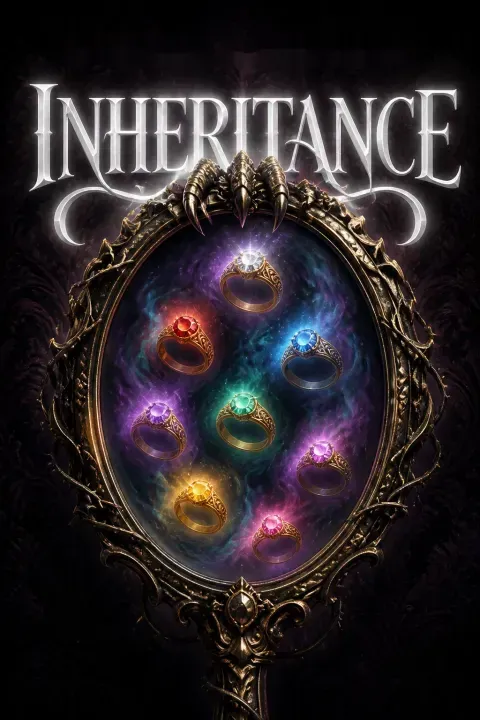


Plot Summary
Prologue
In 1806, Astrid Grandville marries Collin Poole at his family's cliffside manor in Maine. After the celebration, she retreats to her new bedchamber to admire her reflection as a bride. A woman enters whom Astrid does not recognize. Before she can speak, the stranger rushes forward and stabs her repeatedly.
The killer licks Astrid's blood from her finger, takes the wedding ring from her hand, and curses her: Collin will come to her, or bride after bride will die in this house. Astrid, bleeding through her white dress, drags herself downstairs to find Collin. She dies in his arms, promising with her last breath that she will never leave him. The portrait of Astrid will hang in the foyer for two centuries, and her promise holds true.
This prologue establishes the origin wound of the entire narrative: a curse born from obsessive, unrequited love and ritual murder. Hester Dobbs does not simply kill; she performs a dark binding. The licking of blood, the theft of the wedding ring, and the invocation of future brides constitute a working of malevolent magic. Astrid's final vow to never leave becomes both romantic promise and literal truth: her spirit remains tethered to the manor. The prologue introduces the central symbolic object (the ring) and the pattern (a bride dies, a ring is stolen) that will repeat across generations. The portrait in the foyer ensures no one enters without seeing the first victim.
The Red Stiletto
Sonya MacTavish,1 a 28-year-old graphic designer in Boston, is weeks from marrying Brandon Wise11 when she cancels a florist appointment and comes home early. A red stiletto lies in the foyer.
A white dress and men's clothes mark a trail to the bedroom, where music plays and she finds Brandon11 naked with her cousin Tracie, who was helping plan the bridal shower. Sonya1 throws the shoe, striking him. She kicks them both out of her house, takes back his key, and calls her best friend Cleo Fabares,3 who arrives with wine and fury.
Her mother Winter4 soon follows, having learned of the betrayal from Tracie's mother. The three women pack Brandon's11 belongings into trash bags. Winter4 delivers them to his friend's house. Sonya1 blocks his number when he texts begging to talk.
Sonya's reaction reveals a woman whose engagement was built on self-deception. The absence of grief, only rage and disgust, suggests she had been erasing herself to fit Brandon's vision: the formal wedding she did not want, the sleek houses he preferred. The shoe she throws becomes a projectile of reclaimed agency. Her neighbor later confirms Tracie visited at least twice before, transforming what Brandon called a singular mistake into a pattern of deception. Sonya's speed in mobilizing her support network shows an instinct to face crisis through action and community rather than solitude.
Sabotage and Exit
At By Design, Sonya1 discovers Brandon11 has already called their bosses, Matthew and Laine, painting her as stressed and unhinged. She corrects the record calmly.
Over six weeks, Brandon11 wages a campaign of retaliation: rumors spread that she cheated on him and was a bridezilla, her car is keyed, and ultimately a completed project is wiped from her computer with the backup corrupted. She works until midnight reconstructing it, then finds all four tires flat. Unable to prove his guilt, Sonya1 resigns.
Laine and Matt, sympathetic, give her the Baby Mine account as a gift and two weeks of paid vacation. She drives to her mother's4 house and realizes she feels relieved rather than defeated. Freelancing, she decides, is what she was supposed to do all along.
Brandon's escalation from social sabotage to professional destruction to physical intimidation reveals a narcissist who cannot tolerate rejection. Sonya's choice to leave rather than fight a war of attrition she cannot win embodies mature self-preservation. The gift of the Baby Mine account from her bosses signals that her talent and character were valued; it was the environment Brandon poisoned, not her work. Her pivot to freelancing transforms a forced exit into an intentional new beginning, one that will prove essential when the inheritance arrives.
A Stranger at the Door
In January, Oliver Doyle II5 appears at Sonya's1 duplex. He explains that her father Andrew, adopted as an infant, had a twin brother named Collin Poole,9 raised by an aunt while Andrew was placed for private adoption. The birth mother, Lilian Crest, died giving birth.
The birth father, Charles Poole, killed himself shortly after. Collin,9 a reclusive painter, recently died falling down the stairs of his cliffside manor in Maine. He left Sonya1 everything: the house, its contents, a maintenance trust, and a percentage of the family shipping business.
The condition: she must live there at least three years. Sonya1 takes Cleo3 to her mother's4 house. Winter4 reveals Andrew had recurring dreams of a house by the sea and a mirror with a face not quite his own. They find his sketchbooks filled with drawings of both.
This revelation fractures Sonya's understanding of her own history. The father she knew as an only child shared a womb and apparently a psychic connection with a brother he never met. Winter's revelation about Andrew's dreams adds metaphysical weight to the inheritance: the manor was calling to the separated twin, and now to his daughter. The sketchbooks provide tangible evidence of a connection that transcended physical separation. The condition requiring residence suggests Collin understood the manor was not merely property but a legacy demanding presence and commitment.
Lost Bride Manor
After a lawyer negotiates a three-month trial period, Sonya1 packs her car and drives to Poole's Bay. When she rounds the final curve, the manor rises on cliffs above the churning Atlantic: twin turrets, cobbled brown stone, deep blue cladding, the skeletal weeper tree.
It matches her father's drawings exactly. Trey Doyle,2 the lawyer's son, greets her and tours her through the labyrinth of parlors, the solarium, the formal dining room, and finally the two-story library in one turret, which she claims as her studio.
Her bedroom occupies the opposite turret. In Collin's9 office, she discovers a painting of the manor by her father, signed with his distinctive mark. The portrait of Astrid, the first lost bride, watches from the foyer. Sonya1 falls completely, irrevocably in love with the house.
The manor functions as a character with its own gravitational pull. Sonya's instantaneous attachment is less a real estate decision than a homecoming; she recognizes a place her father dreamed of, a place that has waited in her bloodline. The discovery of her father's painting inside Collin's private office creates the first material proof of the twin connection, as if the brothers exchanged messages across their separation. Trey's role as guide establishes him as gatekeeper to both the house's practical operations and its accumulated stories.
The Invisible Household
Strange events begin immediately. Sonya's1 tablet plays songs that answer her mood or comment on her actions. Each morning, her bed is made, the fireplace cleaned and reset with fresh logs. Items on her dresser rearrange into new configurations.
Cabinet doors stand open when she enters a room. At first she blames autopilot and forgetfulness, but the evidence compounds. Trey2 mentions casually that the manor is haunted. During her first solo walk, the front door sticks and refuses to open until an audible thunk releases it.
Sonya1 starts a log of incidents. When Cleo3 visits and immediately senses the spirits, Sonya1 stops rationalizing. She decides that an invisible housekeeper who handles dishes and fireplace maintenance is more help than threat, and she is not leaving.
Sonya's progression from denial to acceptance establishes her psychological arc. The multiplicity of phenomena (music, moved objects, household chores) suggests not a single ghost but a community of presences with different agendas. Her instinct to document is quintessentially her: a graphic designer imposing order through record-keeping. The stuck door that releases on its own hints at a protective presence countering a malevolent one. The manor reveals itself as a contested space where different spirits exercise different degrees of power.
Seven Rings, Seven Brides
Trey2 and Sonya's1 cousin Owen Poole6 arrive to move furniture. In a closet, Sonya1 finds a wedding portrait of Johanna, Collin's9 wife. Trey2 says the closet was empty when he inventoried the house.
Owen6 explains the history: in 1806, Hester Dobbs8 murdered Astrid Poole on her wedding day and stole her ring, cursing the manor so that a bride would die each generation. Seven Poole brides have perished. Johanna fell down the stairs on her wedding day, the seventh. At 3 a.m., Sonya1 and Cleo3 both hear piano music drifting from downstairs.
They find the music room empty but candles still warm. Cleo3 identifies the tune as the folk ballad "Barbara Allen," a song of love, rejection, and death. The number seven appears in steam on Sonya's1 bathroom mirror.
The curse narrative transforms the manor from picturesque inheritance into dangerous legacy. Seven functions as both structure and mystery: seven brides, seven rings, seven deaths across two centuries. That the painting of Johanna manifested where it had not been before suggests the house itself supplies evidence when the heir is ready to receive it. The 3 a.m. hour aligns with traditional supernatural lore while the choice of 'Barbara Allen' as a ghostly performance demonstrates intelligence and thematic precision behind the haunting.
Through the Predator Mirror
Sonya1 dreams she stands before a full-length mirror framed with carved predators: wolves, hawks, serpents. Through the glass she sees not her reflection but a bedroom from another century. She passes through and witnesses Marianne Poole in labor, attended by midwives.
A son is born. But a second twin's birth brings hemorrhaging. As Marianne weakens, she looks directly at Sonya1 and speaks: her children are Owen6 and Jane, and Sonya1 descends from them. Hester Dobbs8 enters, unseen by the grieving husband, and pulls the wedding ring from Marianne's finger.
Hester8 sees Sonya1 and taunts her: 'You're the ghost here.' Sonya1 sketches every face from the vision the next morning, capturing the midwife, the dying mother, the husband's grief, and the witch's8 cruel triumph.
This vision establishes the mirror's rules: Sonya is both witness and participant, invisible to most but seen by the dying and by Hester. The inversion of 'you're the ghost here' repositions power. In the past, Sonya is the insubstantial one, yet her ability to observe and record grants her a form of agency. The birth scene links creation of life (the twins who continue the line) with death, while Hester's opportunistic theft during the husband's grief demonstrates her parasitic nature: she feeds on maximum vulnerability.
The Gold Room Bleeds
Exploring the third floor, Sonya1 and Trey2 approach the Gold Room. The air turns frigid. Yoda12 growls. When Trey2 opens the door, the door slams shut with him inside and Sonya1 locked out. Inside, the temperature plummets further. The draped bed hammers against the floor.
Drawers fly open and slam. The pale gold wallpaper splits like wounds and blood runs down. Trey,2 unshaken, calls Hester8 a half-assed witch. As soon as he touches the doorknob, the violence stops and the walls heal. That night, Sonya1 wakes to pounding at the front door and a blizzard raging outside her window.
She nearly steps out but remembers the stuck door from before. When she opens it, the night is clear and calm. The blizzard was an illusion designed to lure her into the cold, just as Catherine Poole was lured to her death.
The Gold Room confrontation establishes Hester as a presence of genuine menace whose power, while theatrical, has limits. The bleeding walls evoke bodily violation, a physical echo of the violence enacted on Astrid. Trey's calm in the face of supernatural assault reveals a man who refuses to grant the witch power over him. The blizzard illusion recycles Hester's original method (Catherine's death by exposure), suggesting her repertoire is finite. The detail that the illusion breaks when the door opens hints that her power weakens at thresholds.
Clover's Playlist
After the Gold Room, Trey2 takes Sonya1 to dinner at the Lobster Cage, where she meets Bree, the head chef and Trey's2 high school ex. The meal is easy and warm, cementing their transition from friends to something more.
Trey2 shares his own ghost stories: at twelve, a beautiful young woman appeared in the music room while he practiced guitar, complimented his playing, and told him to learn 'Satisfaction.' Years later, he recognized her photo as Lilian Crest, called Clover,7 Sonya's1 biological grandmother.
They realize Clover7 is the musical spirit on Sonya's1 tablet. Sonya1 tells Trey2 the full story of Brandon's11 betrayal and sabotage. Later, Clover7 appears to Trey2 directly at 3 a.m., telling him to help Sonya1 recover the seven rings. Her speech is warm and peppered with 1960s slang.
The romance develops as counterweight to the horror, with Trey's steadiness offering a foundation for Sonya's increasingly strange life. Identifying Clover transforms an eerie phenomenon into something familial: a grandmother who never got to raise her sons now communicates with her granddaughter through the music she loved. Clover's appearance as a ghost frozen at nineteen, using the language of her brief lifetime, creates a poignant portrait of interrupted youth. Her direct appeal to Trey makes explicit that he has been drawn into the family's supernatural obligation.
The Clock Strikes Three
Every night, the grandfather clock in the second parlor chimes at 3 a.m., though its pendulum is still and it has not been wound. The hands always point to three. Trey2 moves them as an experiment; they always return. Clover7 tells him the clock belongs to Hester.8 At the same hour, the piano in the music room plays 'Barbara Allen,' and somewhere in the house a woman weeps.
Sonya1 begins sleepwalking at 3 a.m., drawn toward something. Cleo3 follows her one night as she walks blindly through the halls. The clock has become a marker of Hester's8 presence, a nightly reminder that the witch8 remains active. Yet the piano music suggests Astrid is also present, countering Hester's8 malice with her own sorrowful witness.
The 3 a.m. chime functions as Hester's signature, a mockery of sacred time inverted into the witching hour. The frozen clock that nonetheless sounds suggests a moment of death preserved and repeated. The dual phenomena (clock chimes and piano music) represent the competing forces within the house: Hester's aggression versus Astrid's mournful testimony. Sonya's sleepwalking, which takes her on a journey through the house's history before reaching the mirror, suggests the spirits are guiding her toward the knowledge she needs, using her unconscious mind as a vehicle.
The Bride in the Closet
Cleo3 arrives a day early to move into the manor permanently. The door opens for her and Clover's7 music welcomes her. While exploring the servants' passages alone, Hester8 attacks with slamming doors and a blaring horror movie, but Cleo3 escapes.
Later, in the turret studio closet, Sonya1 and Cleo3 find a portrait of Clover7 as a bride, visibly pregnant, painted by Sonya's1 father. Sonya1 is overwhelmed by emotion. They hang it in the music room beside Johanna's portrait. Cleo3 names the housekeeping spirit Molly, after Clover7 plays 'Good Golly Miss Molly.'
Molly continues to clean, organize, and prepare rooms. Cleo3 takes over the turret as her painting studio and begins work on a mermaid book. She and Sonya1 establish new rhythms, sharing meals and movie nights, their friendship anchoring the house's living energy.
Cleo's arrival transforms the manor's emotional ecology. Where Sonya approached the haunting with wariness, Cleo embraces it with delight, naming the spirits and accepting their presence. The portrait of Clover, painted by a man who never saw his birth mother but dreamed her, reinforces the twin connection as something mystical. Hanging the two lost brides together (Johanna and Clover) creates a visual genealogy of the curse's victims. Molly's continued domestic service suggests a spirit who finds purpose in caring for the living inhabitants, while Cleo's artistic productivity in the turret demonstrates that creative energy can coexist with supernatural disturbance.
Pot Roast and a Heartbeat
Sonya1 nervously prepares her first major dinner party for the entire Doyle family. The pot roast succeeds beyond her hopes. Corrine, Trey's2 reserved mother, declares it better than her own and trades her pound cake recipe for Winter's.4
During dessert in the music room, Paula plays piano while Ace sings. Anna10 suddenly presses a hand to her belly and announces she has felt the baby move for the first time. The family shares the moment with tears and laughter.
After the Doyles leave, Sonya1 finds the kitchen spotless: Molly has handled the cleanup. She receives a text from Trey,2 and her tablet plays 'Stay.' The evening transforms the manor from a haunted inheritance into a home capable of hosting joy, new life, and the warmth of chosen family.
The dinner party functions as Sonya's full integration into the Doyle family, who were Collin's chosen kin and now extend that circle to her. Corrine's approval, the recipe exchange, and especially the moment of Anna feeling her baby move all represent continuity and new generations, a direct counterpoint to the curse's legacy of bridal death. Molly's invisible cleanup feels like approval from the house itself. The party also demonstrates that the manor, for all its darkness, can still hold celebration, music, and the announcement of a coming child.
Leave or Die
Hester's8 aggression intensifies. She traps Cleo3 in the bathroom, turning the hot water on full until steam fills the room. The message 'leave or die' appears on the fogged mirror. The doorknob burns to the touch. Yoda12 scratches at the door, and when Cleo3 reaches for it, it opens.
She grabs him and runs. Another day, while Sonya1 works in the library alone, Hester8 blows a gale through the room that lifts Sonya's1 chair off the ground, topples her mood boards, and sends sketchbooks flying. The chandelier sways.
Sonya1 clutches the desk and Yoda,12 shouting that this is her house and Hester8 is just a pest who needs exterminating. The attack stops. Later, they discover a ghost boy playing fetch with Yoda,12 later identified as nine-year-old Jack Poole, who died of scarlet fever in the early 1900s.
Hester's escalation correlates directly with Sonya's growing determination. The 'leave or die' message echoes the original threat to Astrid, revealing Hester's limited repertoire. Yet her power has boundaries: she cannot harm Yoda, cannot prevent Cleo from escaping, cannot sustain the library assault indefinitely. Jack's appearance as a playful child spirit adds another dimension, suggesting the manor holds many who are not malevolent, only young and lost. Sonya's defiant shout marks a psychological turning point: she has stopped being afraid of the witch and started being angry.
Four Rings on Her Hand
Sonya1 witnesses two additional bridal deaths through the mirror. Agatha Poole, a haughty society bride in 1892, dies at her wedding reception after eating a poisoned petit four laced with something that causes rapid anaphylactic shock. She convulses on the ballroom floor while Hester8 takes her Cartier ring.
Lisbeth Poole, a sweet-natured eighteen-year-old in 1916, collapses during her wedding celebration after multiple black widow spider bites delivered through her wedding dress. Each time, Hester8 appears to claim the ring, now wearing four on her fingers.
Sonya1 has now seen the first four brides die. The pattern is clear and gruesome: poison, exposure, childbirth complications, allergic reaction, venom. Hester8 improvises methods but always arrives for the ring. Sonya1 understands these visions are being given to her deliberately by the other spirits as evidence.
The completed vision cycle establishes the curse's methodology: Hester adapts her means to available opportunities but never varies her objective. The rings function as trophies and anchors, physical tokens binding her power. That Sonya receives these visions from the benevolent spirits (likely Astrid) suggests an alliance of the dead against their murderer. Each vision adds to Sonya's store of knowledge, transforming her from frightened resident into investigator. The question shifts from 'what happened' to 'how can it be undone.' The specificity of each death scene also humanizes the victims, who would otherwise remain names in a family tree.
Into the Glass
At 3 a.m., Sonya1 sleepwalks again. Cleo3 follows, texting Trey,2 who arrives with Owen.6 Sonya1 visits the nursery where a long-dead infant's mother eternally grieves, then the servants' quarters where young Molly O'Brian died of fever. Finally she enters the ballroom.
Amid the shrouded furniture, the mirror stands revealed, its carved predators snarling. Only Sonya1 and Owen,6 both of Poole blood, can see through the glass to a party in the past: dancers, flowers, chandeliers ablaze. Cleo3 and Trey2 see only their own reflections.
Sonya,1 now fully awake, links her hand with Owen's.6 He steps through first. She follows. The mirror swallows them, leaving Trey2 and Cleo3 waiting with the dogs, staring at empty glass. The heartbeat from the Gold Room stops. Silence falls over Lost Bride Manor.
The cliffhanger represents Sonya's transformation from passive heir to active participant in the manor's mystery. She no longer sleepwalks into the visions; she steps through awake, by choice, with family beside her. Owen's ability to see through the mirror confirms the hereditary nature of the supernatural access. Only Pooles can enter. The silence that descends after they disappear implies a threshold has been crossed, the first volume ending where the quest truly begins. The carved predators on the frame, frozen mid-hunt, suggest the danger waiting on the other side. Trey and Cleo's vigil on this side of the glass establishes the two-world structure that will define the trilogy.
Analysis
Inheritance operates on multiple levels suggested by its title. Sonya1 inherits property and wealth, certainly, but more significantly she inherits a severed family history, a supernatural obligation, and a house that is not merely haunted but actively contested. The novel's central tension is not between living and dead but between competing claims of belonging. Hester Dobbs8 insists the manor and its Pooles belong to her because she desired Collin first. Sonya1 insists the manor belongs to her because it was given, because her father dreamed it, because she loves it. The question the trilogy poses is: what confers legitimate ownership of a place? Blood? Love? Residence? Legal title? Or something closer to mutual recognition?
The novel also explores the architecture of female rage. Hester's8 fury at being unchosen curdles into a two-century campaign of murder. Sonya's1 fury at Brandon's11 betrayal fuels her escape from a life that was slowly erasing her. Clover's7 spirit channels her lost motherhood into protective DJ-ing. Astrid's murder becomes the founding trauma that traps her in witness. Each woman's response to being wronged shapes her afterlife or her future.
The manor itself functions as a body: it has a heart (the Gold Room, where Hester's8 pulse beats), a voice (the piano, the tablet music), and memory (the mirror that replays the past). The seven rings are both wound and suture, objects that must be retrieved if the house is ever to heal. That the first volume ends with Sonya1 stepping into the mirror rather than destroying it suggests the story recognizes that healing requires entering the wound, not sealing it from the outside.
Review Summary
Inheritance by Nora Roberts, the first in The Lost Bride Trilogy, receives mixed reviews averaging 4.28/5 stars. Readers praise the atmospheric haunted mansion setting, engaging characters, and addictive storytelling. Many appreciate the gothic romance blend and strong female friendships. Common criticisms include rushed romance with little chemistry, excessive mundane details about the protagonist's daily life, repetitive scenes, and a jarring cliffhanger ending. Some found the pacing slow with too much exposition, while others were completely captivated. The audiobook narration by Brittany Pressley is universally praised.
People Also Read


Characters
Sonya MacTavish
Graphic designer and unexpected heiressA 28-year-old graphic designer from Boston, pragmatic and self-reliant. Sonya was raised by her widowed mother4 after her artist father died when she was twelve. She nearly married a man who was wrong for her in every way (Brandon Wise11), and discovering his betrayal freed rather than devastated her. She is observant, organized, and processes shock through documentation (she keeps a log of paranormal incidents). Her love for the manor is instantaneous and fierce, awakening a stubborn protectiveness she did not know she possessed. She has her father's green eyes (the Poole inheritance) and his artistic sensibility, though her talent expresses digitally rather than on canvas. Her journey traces an arc from self-erasure to defiant ownership of her space, her history, and her power.
Trey Doyle
Steady small-town lawyer and allyOliver Doyle III, called Trey, is the third generation of a family law firm in Poole's Bay. He grew up in the manor as Collin's9 honorary nephew, absorbing its history and its ghosts without fear. Calm to the point of unflappability, he responds to slamming doors and bleeding walls with dry humor. He is observant, patient, and quietly fierce in his loyalties. His romantic interest in Sonya1 develops with deliberation rather than rush, matching her need for steadiness after betrayal. He has played guitar since boyhood, once took lessons from the ghost of Clover7 without realizing it, and uses his calm as both professional tool and personal armor. His anger, when it surfaces (at Brandon11, at Hester8), is all the more potent for its rarity.
Cleo Fabares
Best friend and fearless roommateSonya's1 college roommate turned lifelong best friend, an illustrator with a Creole grandmother who practices folk magic. Where Sonya1 is practical, Cleo is intuitive; where Sonya1 resisted the supernatural, Cleo embraced it from the first moment she walked into the manor. She speaks to ghosts, names them, and treats them as eccentric housemates. Her move into the manor transforms it, adding warmth, laughter, and the energy of someone who finds hauntings delightful rather than threatening. She bakes, cooks, paints mermaids, and negotiates a trade with Owen6: a painting for a sailboat. Her loyalty to Sonya1 is absolute, her courage genuine (she follows her sleepwalking friend through a dark house full of spirits), and her emotional intelligence makes her the heart of the household.
Winter MacTavish
Sonya's widowed motherWinter raised Sonya1 alone after her husband Andrew died in a scaffolding accident when Sonya1 was twelve. She works as an administrative assistant at a Boston law firm and has a practical, supportive nature. She still senses Andrew's presence occasionally, a belief that prepares her to accept the manor's hauntings when Sonya1 reveals them. Her reaction to Sonya1 inheriting the manor is protective but not controlling; she trusts her daughter's judgment. She taught Sonya1 the pot roast recipe that wins over the Doyles, and her weekend visit confirms that Sonya1 has found where she belongs.
Oliver Deuce Doyle II
Family lawyer and genealogistCollin Poole's9 lifelong best friend and attorney, Deuce is a meticulous professional with a passion for genealogy. He created the Poole family history book that documents the family tree, including the deaths of the seven brides. He handled Collin's9 estate with care and negotiated the trial period for Sonya1 with genuine warmth. He is married to Corrine, father to Trey2 and Anna10, and son to Ace. His quiet competence and decency make him a reassuring presence, and his knowledge of family history proves essential to Sonya's1 understanding of the curse.
Owen Poole
Shipbuilder cousin and reluctant allyOne of Sonya's1 newly discovered Poole cousins, Owen runs the hands-on side of the family shipbuilding business. He is blunt, practical, and skilled with his hands: he builds boats, restores furniture, and constructs elaborate doghouses. His initial wariness toward Sonya1 (she inherited what might have been his) gives way to grudging respect and eventual loyalty. He sees through the mirror because he shares the Poole bloodline. His dog Jones, a scrappy one-eyed rescue, is his constant companion. He develops a barter relationship with Cleo3, trading a custom sailboat for her mermaid painting, hinting at a deeper connection forming.
Clover (Lilian Crest)
Ghost DJ and biological grandmotherLilian Crest, who called herself Clover, died at nineteen giving birth to twin sons: Collin9 and Andrew. Her spirit remains in the manor, communicating through music played on Sonya's1 tablet. She favors rock and pop spanning decades, choosing songs that comment on conversations or moods. She appears as a beautiful young woman in 1960s fashion, beaded necklaces and low-slung jeans, radiating warmth. She never got to raise her babies, and her presence in the house is protective rather than sorrowful. She speaks to Trey2 directly, asking him to help Sonya1 break the curse. Her portrait, painted by Sonya's1 father from his dreams, hangs in the music room.
Hester Dobbs
Murderous witch and curse-casterThe antagonist who murdered Astrid Poole in 1806 and cursed the manor so that a Poole bride would die each generation. In life, she was obsessively in love with Collin Poole and could not tolerate his marriage to another. She used dark magic, blood rituals, and poison to kill or cause the deaths of seven brides across two centuries, stealing each wedding ring as a trophy. As a spirit, she occupies the Gold Room on the third floor, the source of the manor's malevolent cold. She can create illusions (blizzards, giant birds), manipulate objects violently, and mark flesh with ice burns. Her power is strongest at 3 a.m., signaled by the grandfather clock. She is possessive, theatrical, and limited: she cannot leave the house or sustain attacks indefinitely.
Collin Poole
Sonya's deceased uncle, Andrew's twinAndrew MacTavish's identical twin, separated at birth and raised by an aunt who was told he was illegitimate. Collin grew up in his grandmother Patricia's house, never knowing he had a brother until Deuce's5 genealogical research uncovered the truth shortly before Andrew's death. He was a painter of considerable talent whose style closely resembled his twin's. He loved the manor and restored it meticulously. His wife Johanna died falling down the stairs on their wedding day, and he became a recluse afterward, rarely leaving the house. He died the same way, falling down the same stairs decades later. He left the manor and his entire estate to Sonya1, his brother's only child.
Anna Doyle
Potter sister and first local clientTrey's2 younger sister, pregnant with her first child. She is a talented potter whose business, rebranded by Sonya1 as Practical Art, thrives after the website redesign. She visits Sonya1 early with coffee cake and becomes both client and friend. Her pottery pieces are displayed throughout the manor. During Sonya's1 dinner party, she feels her baby move for the first time, a moment of new life that counters the manor's history of death. She is married to Seth, whose family owns the Bayside Hotel.
Brandon Wise
Cheating ex-fianceSonya's1 former fiance, a talented but manipulative graphic designer at By Design. He insisted on a lavish, formal wedding that was everything Sonya1 did not want, and he pressured her toward sleek modern houses when she craved character and history. Sonya1 caught him in bed with her cousin Tracie. He then waged a campaign of workplace sabotage, including destroying her work and flattening her tires, forcing her to resign. His narcissism cannot tolerate rejection; he must make himself the victim and Sonya1 the villain.
Yoda
Rescue dog and spirit detectorA small brindle mix (Boston terrier and dachshund) adopted by Sonya1 from a local rescue. He is housebroken, affectionate, and unerringly senses supernatural presences. He growls at Hester's8 manifestations but plays happily with the ghost boy Jack, who taught him to walk on his hind legs. He sleeps in Sonya's1 room and provides both companionship and an early warning system for paranormal activity.
Plot Devices
The Predator Mirror
Portal to witness the pastA full-length cheval glass framed with carved predators (wolves, hawks, bears, serpents, a two-headed dragon). It appears and disappears throughout the manor, seen first in Andrew's dreams, then in Sonya's1 visions, and finally manifesting physically in the ballroom. Only those of Poole blood can see through its glass to scenes from the past. It functions as a portal Sonya1 walks through to witness the murders of the seven brides. The carvings seem alive at times, snarling and snapping. The mirror is the mechanism by which the benevolent spirits (likely Astrid) show Sonya1 the evidence she needs to understand and eventually break the curse. It connects the manor across time.
The Seven Wedding Rings
Tokens of the curse's powerHester Dobbs8 stole each bride's wedding ring as she died, from Astrid's simple gold band in 1806 to Johanna's platinum-and-diamond ring in the late twentieth century. The rings are both trophies and anchors; Hester8 wears them on her fingers in the mirror visions, and their number grows with each death Sonya1 witnesses. Astrid's first words to Sonya1 through the mirror were 'Find the seven rings. Break the curse.' The rings represent the marriages that were severed, the lives cut short, and the power Hester8 accumulated. Recovering them is the stated objective that will occupy the remainder of the trilogy.
The Grandfather Clock
Nightly signal of Hester's presenceLocated in the second parlor, this antique grandfather clock has not been wound in years. Its pendulum hangs motionless. Yet every night at 3 a.m., it chimes three deep, funereal bongs. The hands always point to three. Collin9 kept the clock but never wound it, finding the chime annoying. Clover7 told Trey2 the clock belongs to Hester8. Moving the hands changes nothing; they reset. The clock functions as a warning system and a marker of Hester's8 territory within the house. Its consistency (only at 3 a.m.) suggests the hour holds ritual significance for the witch8, perhaps the time of Astrid's death or the casting of the curse.
The Poole Family History Book
Record of lineage and deathsCompiled by Deuce Doyle5 as a gift for Collin9, this leather-bound coffee table book contains a meticulously researched family tree from the 1600s to the present. It documents births, marriages, and deaths, including the seven brides who died at the manor. The book is Sonya's1 primary source for names, dates, and causes of death. It reveals the pattern she needs to recognize: one bride dies each generation, and the deaths are never natural. The book also documents twins running through the family line, a genetic thread that proves significant when only Sonya1 and Owen6 can see through the mirror.
Lost Bride Manor
Haunted container of the curseBuilt in 1794 by Arthur Poole on cliffs above the Atlantic in Maine, the manor has been expanded across two centuries into a Victorian Gothic labyrinth of turrets, secret passages, and dozens of rooms. It is simultaneously a character, a prison, and a legacy. The house holds a community of spirits: malevolent (Hester8 in the Gold Room), protective (Clover7 with her music, Astrid at the piano), helpful (Molly the housekeeper), playful (Jack the boy), and grieving (the mother in the nursery). The curse is bound to the house; brides who marry elsewhere in the Poole line do not die. The manor responds to its living inhabitants, opening doors for those it welcomes and resisting those it does not. It is the stage on which the entire drama unfolds.
The Lost Bride Trilogy Series
About the Author
Other books by Nora Roberts






Download PDF
Download EPUB
.epub digital book format is ideal for reading ebooks on phones, tablets, and e-readers.








































